Archive for the Category ◊ Jigs and Fixtures ◊

Author:
• Friday, July 31st, 2015

dowel former

The otherwise excellent square hole punches from Lee Valley have a practical problem that I detailed on this blog more than two years ago, along with a suggested solution.

In brief, the punches work beautifully to square the upper section of a round hole in applications such as a pegged mortise and tenon joint. The punches are sized from 3/16″ to 1/2″ in 1/16″ increments. Each requires boring a round hole 3/64″ less than the width of the punch and thus the use of unusually sized dowel pegs.
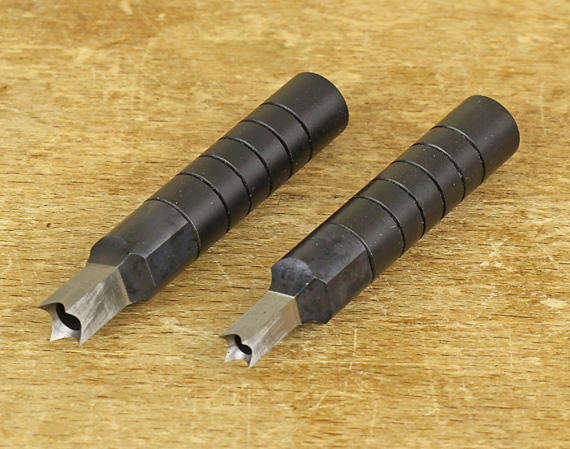
Lee Valley square hole punches

For example, a 13/64″ hole is used with the 1/4″ punch. After forming the square portion, the round hole could reasonably be enlarged to 7/32″ but anything further would risk damaging the edges of the square. So, here’s the problem: how to obtain round pegs in diameters such as 13/64″, 7/32″, and so forth. Even Lee Valley, despite my suggestion, does not supply the equipment to make such dowels.

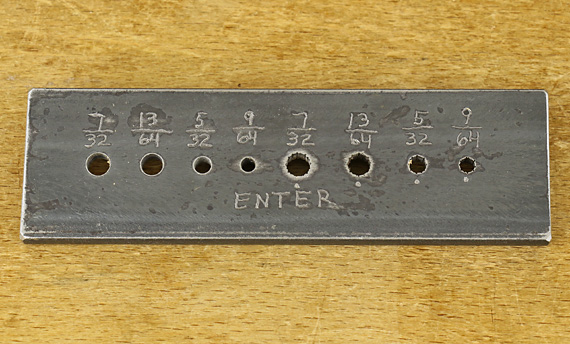
There are methods demonstrated on the internet for making dowels using a portable power drill and clever shop-made cutters, but I prefer a simple dowel-former plate to make these short pegs. This is easily made from a piece of unhardened weldable steel, 1/4″ x 1 1/2″ x 5″, from the local hardware store. Rough-shaped stock is pounded through the holes to form the dowels.

Construction

Use a drill press to bore two holes for each diameter, one for rough cutting and the other for finish cutting. The roughing holes are on the right side of the plate in the photo at top. Relieve the diameter of all holes by reaming from the exit end using a General #130 6° tapered reamer, going to full depth for the roughing holes and about 1/2 depth for the finishing holes.

Deeply score the sidewalls of the roughing holes with a 2/0 blade in a fret saw and a 4″ double extra slim saw file. Use a small sharpening stone to cleanly remove the burr and create a sharp edge on the entry side of the holes. Use a countersink bit to lightly chamfer only the exit side of all holes.

Use

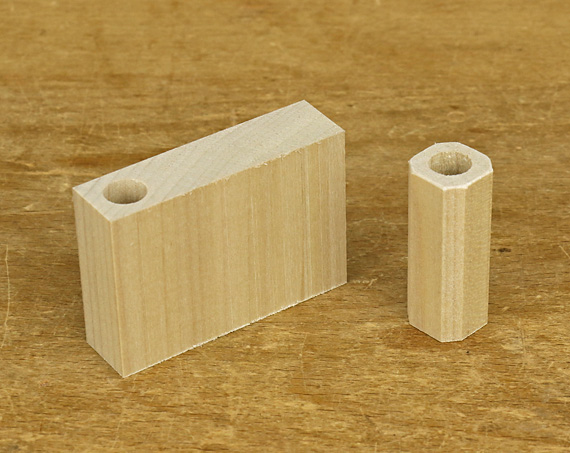
Start by making stock from straight-grained wood, ideally riven, to a width slightly more than 1/64″ larger than the hole diameter. Trim the corners to make an approximately octagonal cross section. I prefer to use a small handplane for this step.

Directions for using this type of plate usually recommend whittling an approximate taper on the blank to ease its entry into the hole. However, I’ve found the forming cutting goes much smoother and more balanced with a nicely centered blunt entry point formed on the blank with a pencil sharpener or dowel pointer.

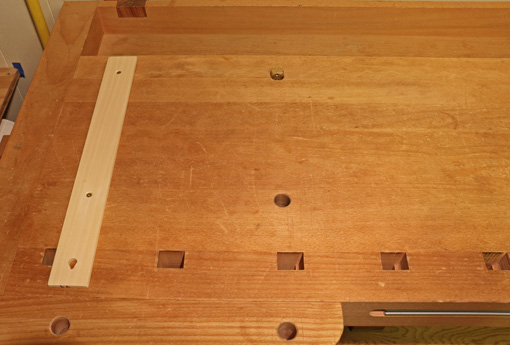
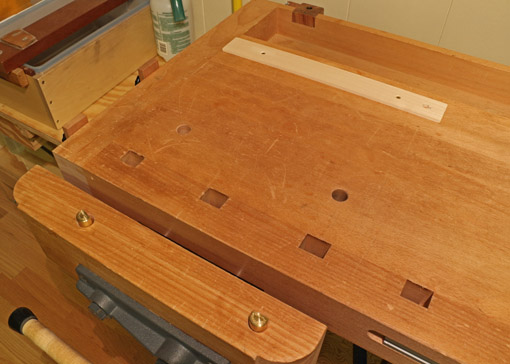
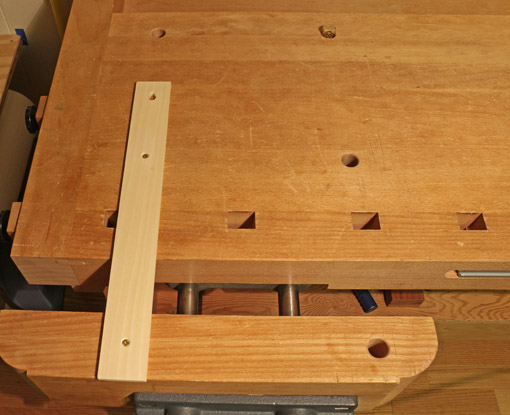
Place the former hole over a dog hole in the workbench top. Use the roughing hole first, followed by the finishing hole. Pound the wood blank with a mallet, taking care to keep the blank perpendicular. Proceed until the blank is nearly flush with the plate, then use a narrower peg to tap it the rest of the way though. A piece of blue tape under the dog hole will catch the dowel, saving the frustration of looking for it on the floor.
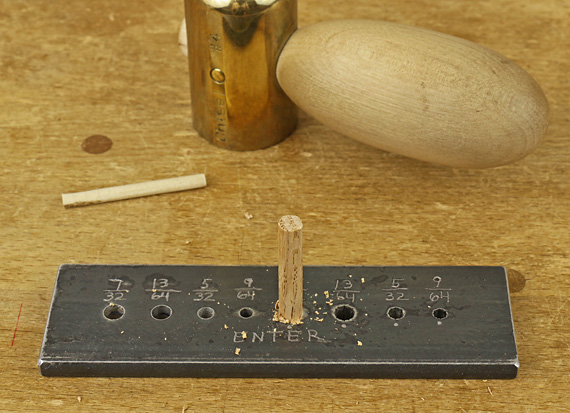
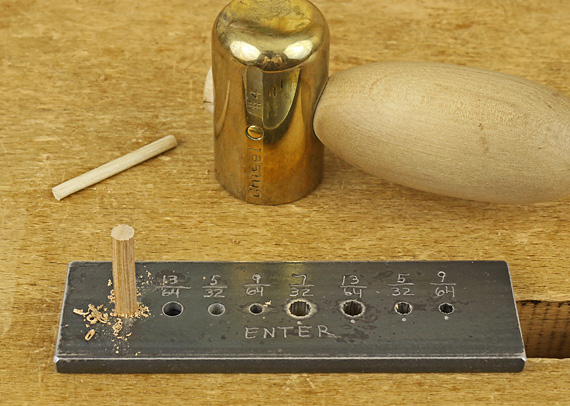
shop-made dowel former

shop-made dowel former

I have found that the two-stage process produces smoother cutting and better dowels. The photo below shows, from left to right, a piece of shaped stock, rough dowels formed by the first step, and straight, smooth finished dowels in cherry, bubinga, and red oak.
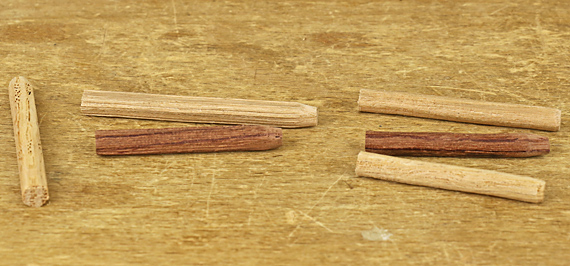
shop-made dowel pegs

Ideally, this tool would be made of hardened tool steel like a genuine Veritas or Lie-Nielsen but that is beyond what I can accomplish in my shop. However, the shop-made version is inexpensive, easy to make, has any hole size you want, solves the problem with the square chisels, and works surprisingly well.
Category: Jigs and Fixtures  | Comments off
Author:
• Tuesday, April 21st, 2015

drill stops

Maybe.

Of course, the best drill stop is on a drill press but the topic here is drill stops for hand drilling, which for most of us means with a portable electric drill, corded or cordless. So, let’s look at the candidates.

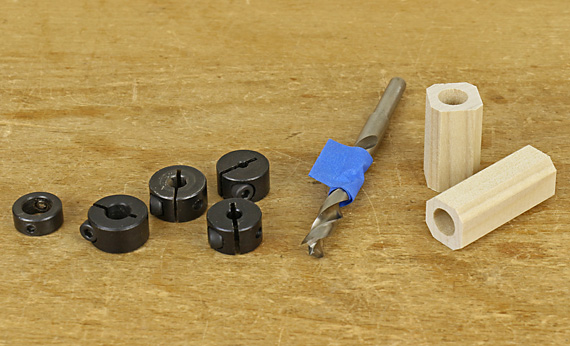
The most common store bought drill stop is a round metal collar with a single setscrew that tightens against the drill bit. These are cheap and not bad, but I’d stop short of calling them good. Most of them tend to tilt as the screw is tightened and all of them can damage the flutes of the bit. If you jiggle or turn the collar to direct the point of the setscrew toward the bottom of a flute and then tighten the screw carefully and firmly, they can stay put and perform decently. Fuller makes a version of these that is longer than the others.

Another type of stop uses a setscrew to close the metal collar’s diameter to bind it by friction against the drill bit. I’ve found that the metal is too stiff to reliably close down snugly against the bit, or on the other hand, that the inside diameter is too close to that of the drill bit so the collar is too hard to get on or off the bit. They’re borderline acceptable; I wouldn’t call them good.

Some of the stops used in conjunction with a countersink are pretty good and some of the Forstner bit stops seem good but those are other matters.

An utter failure is the red plastic stop that twists on and supposedly tightens against the drill bit. I have found them totally unreliable – they easily slip. Sorry, I wouldn’t use them in a hundred years on any project of importance.

Now let’s look at what I think most of us use: masking tape. Wrap some blue tape tightly around the drill bit and squish it in against the flutes. Then fold over the last bit of length so it forms a little flag that sweeps away the drilling dust on the work piece to signal that you are at full depth, and later to make the tape easier to remove.

In any careful work, I put a mark on the drill bit at the bottom of the tape with a Sharpie. Then, as I’m drilling successive holes, I check repeatedly to see if there is a gap between the mark and the tape, which would indicate that the tape has slipped. Alternatively, I keep checking with a ruler.

What about for very careful work, especially drilling many holes, such as in carcase dowelling? For this, remove all doubt and make a dedicated wooden collar drill stop as James Krenov recommended.

drill stop

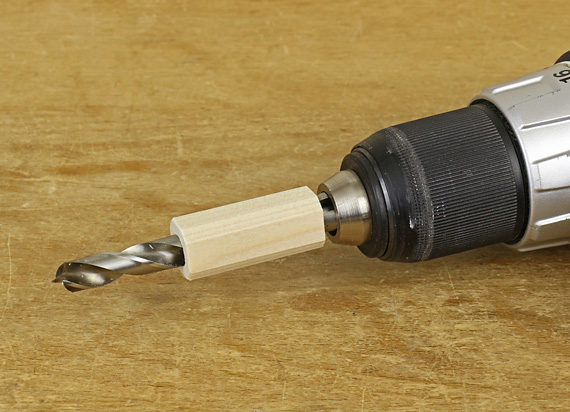
Work out the required length according to the desired depth of the hole and the length of the drill bit. Use a drill press to bore into the end grain of an over-wide squared block then saw off the stop itself. Chamfer the long corners for safety so they won’t hack at your fingers. If you cut the cross section of the stop to size before drilling, it will register less accurately against the drill press table and the drilling is likely to be dangerous.

making a drill stop

The cutting depth can be fine tuned by adjusting the amount of the drill shank inside the chuck – assuming it is a good chuck. This type of drill stop has never let me down. It’s worth the extra effort. By the way, dentists understand this.

So, yes, there is a good drill stop, but you have to make it.

Author:
• Sunday, May 11th, 2014

shooting glove

Shooting is a gateway technique that produces reliable accuracy and control unattainable with machines. Here are three simple tips to improve your results with shooting.

1- Put a grippy glove on your left (non-dominant) hand

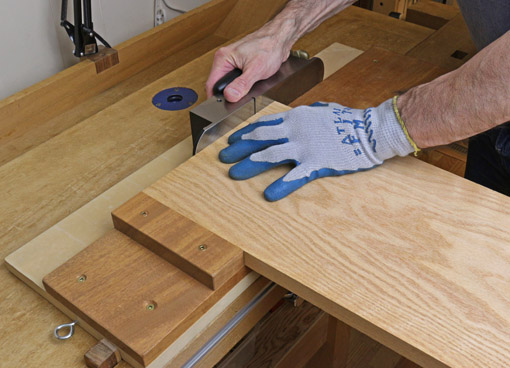
An inexpensive, widely available glove with a rubbery grippy palm adds remarkable strength to your hand. The work piece must be controlled with the left hand in two respects. First, it must not slide or pivot during the cutting stroke of the plane. The torque can be considerable with a wide work piece of dense wood. The glove gives you control with much less effort than a bare hand.

Second, in preparation for the cut when shooting end grain, the work must be advanced a tiny amount along the fence toward the plane. Without this, the blade edge will simply clear the work piece because it has already cut away the previously projecting thickness.

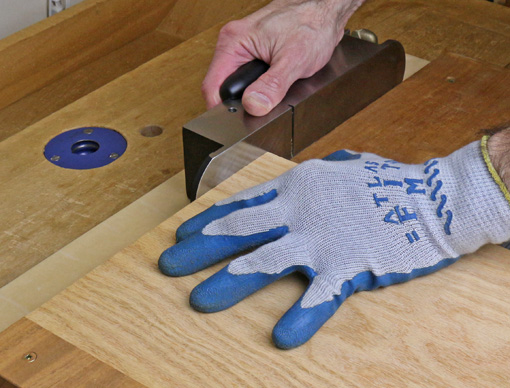
Practically, the work piece is advanced just to meet the toe of the plane sole, as in the photo below. This is done almost without thinking but it is a precise move made more controllable by the gloved hand.

registering the board

2- Simple microadjustability

Everything is not square in woodworking, even when we intend it to be so. For example, when fitting a drawer front to its opening, the sides of the front piece should be made to match the opening, even if it is a bit out of perfectly square.

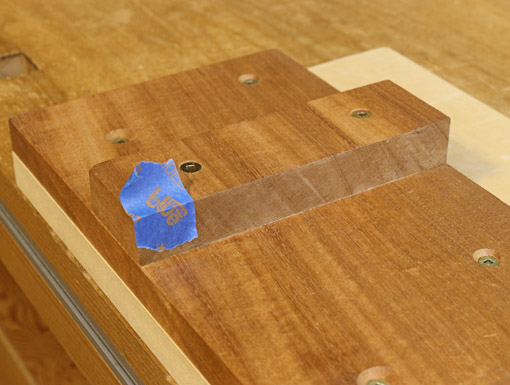
To minutely adjust the shooting angle away from 90°, just place a piece of blue tape at the appropriate end of the shooting board fence. Realize too, that the angle can be adjusted with phenomenal precision by slightly altering the position of the tape.

microadjustability

Of course, this is done empirically, but for some mathematical fun, note that a .003″ thick tape placed at the end of a 7″ fence will change the angle .025° from 90°, and moving it to the 6″ position will adjust that new angle, in turn, by .004°. Using a .001″ plane shaving would create an initial adjustment of .008° from 90°. Shims are magic!

3- Hold the plane like you mean it

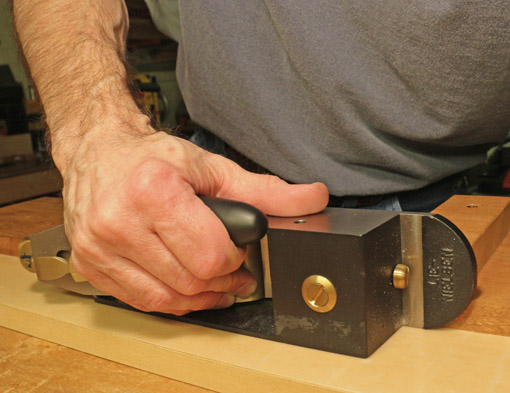
Whether you have a dedicated shooting plane like the #9 I use, or use a nice heavy bevel-up bench plane, or, yes, a bevel-down bench plane, grip that righteous beast over the blade. Get the big muscles at the base of your thumb firmly down on the sidewall of the plane, wrap your fingers around into the throat of the plane, and plant the ends of the fingers on the lower part of the lever cap. That way, you can control the ride of the plane on the horizontal track while keeping the sole tight sideways against the vertical runner.

grip the plane for shooting

Furthermore, you get a good tactile sense of the blade’s cutting action. In concert, all of this promotes accuracy by preventing the plane from tipping in any direction as it takes a firm, uninterrupted stroke.

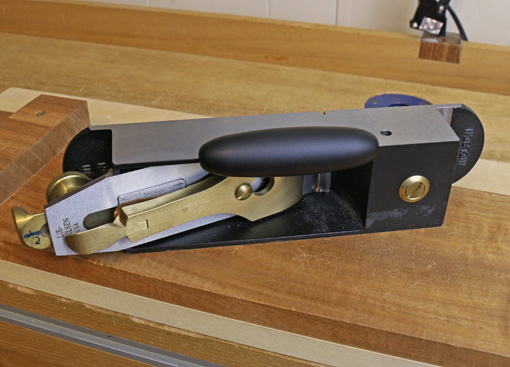
I like the “hot dog” attachment from Lie-Nielsen on the #9. This is something I imagine could also be readily made by the user.

hot dog attachment

Category: Jigs and Fixtures, Techniques  | Tags:  | 5 Comments
Author:
• Wednesday, April 02nd, 2014

IMG_1194_edited-2

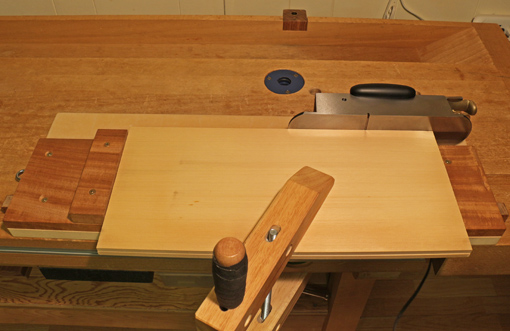
This is so easy. Shooting is a fast and accurate method for making a straight and square long grain edge on small boards, generally less than about two feet in length. This is far easier, especially for thin stock, than planing the edge while the board is held vertically in a vise.

Though shooting is mostly associated with truing end grain, I really don’t know why long grain shooting is not commonly discussed in instructional materials. True, it’s not absent but I think it should be included among routine methods.

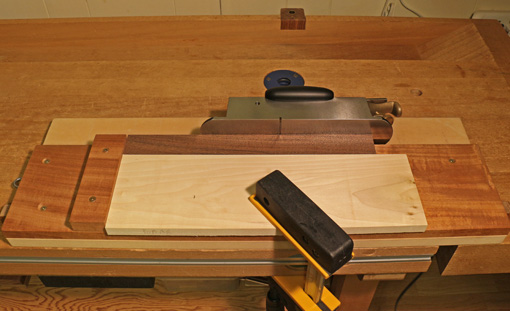
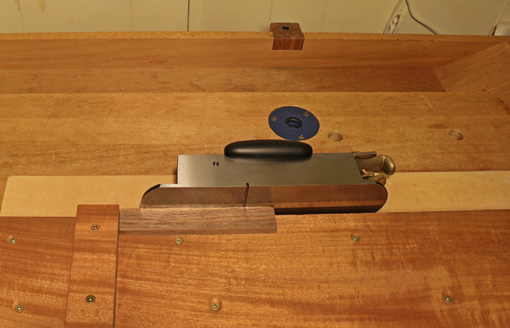
A long shooting board is helpful for this work. The long grain edge of the work piece should overhang the edge of the platform by a half-inch or so (see below), while the end is butted against the fence. For narrow pieces, especially a series of them such as drawer parts, I clamp an auxiliary bracing piece of plywood or MDF onto the shooting board platform, as in the top photo, to help my left hand steady the work piece.

The plane does not contact the vertical running edge of the shooting board platform that is used for end grain shooting. You simply control the plane to produce a straight edge much as you would when planing with the sole down – initially emphasize pressure on the toe of the plane, transition to balanced pressure, and finish with pressure on the rear portion of the plane.

IMG_0189_edited-3

I like my Lie-Nielsen #9 for most of this work, but really any bench plane, bevel-up or bevel-down, with a length appropriate for the work, will do. The “hot dog” handle on the #9 is very helpful to control the plane in all directions. Placing my fingers on the lever cap gives a good feel of the blade’s cutting action. When using a regular bench plane, I like to grip the arch in the sidewall of the plane and place my fingers over the lever cap. The contour of the Veritas bevel-up jack plane makes it especially effective to place the heel of the hand on the rear of the sidewall arch.

Medium to larger work is more easily and accurately managed by clamping it to the work surface. This prevents the work piece from yawing as you push the plane, which would make it difficult to produce a straight edge.

It is also possible to accurately set the auxiliary bracing piece, referred to above, to produce a parallel-sided work piece. This can also be accomplished by planing to a gauged line. No table saw is needed here.

A nice way to combine machine and hand work to make small to medium pieces with accurate and smooth edges, such as drawer parts, is to refine and smooth the machine-jointed edge by shooting. Then rip to width on the table saw with the planed edge against the fence. The ripped edge can be smoothed with one or two passes of a hand plane, usually later in the building process.

You can even eliminate the shooting board and still do this work. Just take a piece of 3/4″ MDF, clamp the work piece on top with its edge overhanging the MDF, and run the plane on the workbench top. If you don’t trust the trueness of your workbench, temporarily cover it with another piece of 3/4″ MDF.

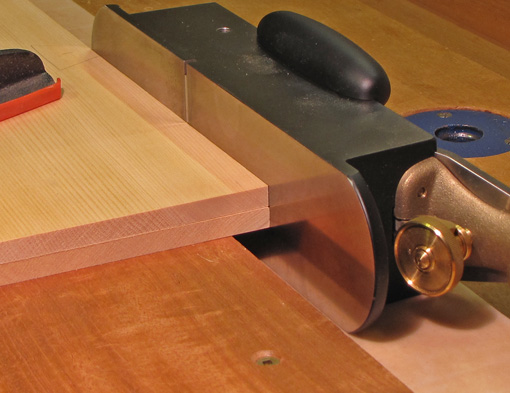
This is also an easy, effective method to edge joint a pair of thin or small boards, such as drawer bottom stock (see below). Decide on the mating edges, “close the book” on the joint, clamp the pieces to the platform, and shoot both edges at once. It’s hard to miss.

IMG_1196_edited-2

Shooting is also a sensible way to work with very small pieces (see below).

IMG_1199_edited-2

These are effective methods that require minimal infrastructure and can be used regularly on a wide range of projects.

Category: Jigs and Fixtures, Techniques  | Tags:  | One Comment
Author:
• Saturday, February 01st, 2014

IMG_1176_edited-2

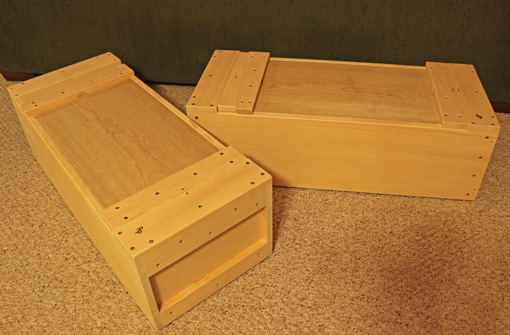
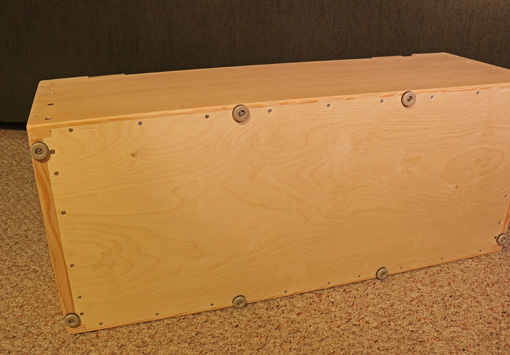
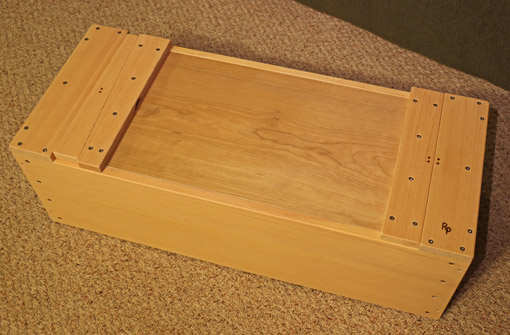
These practical Japanese toolboxes with characteristically clean design and clever functioning are based mostly on Toshio Odate’s article in the October 1995 issue of American Woodworker magazine, pages 58-59, available online.

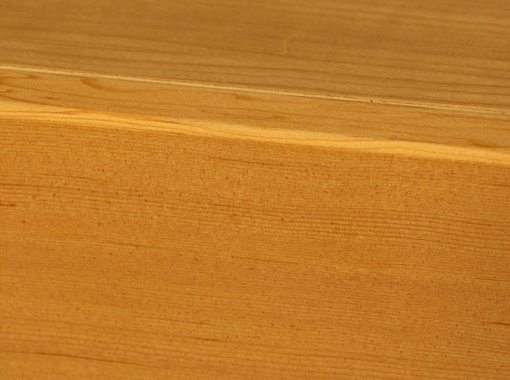
Overall dimensions of my version are 32 1/2″ long, 13 1/2″ wide, and 10 3/8″ high. The primary wood is quartersawn Douglas fir, obtained as dimensional 1-by stock. The tight grain reminds me of the raked sand in a Japanese zen garden.

IMG_1179_edited-2

The sides and ends are assembled much like Odate’s but using deep thread screws instead of nails. The lower edge of the end “handle” is undercut with a 15° bevel to help the four fingers grab it reliably for lifting the box while the thumb comes over the top end piece. I added a like-sized piece below it onto the main end piece for extra rigidity.

The bottom is 3/8 Baltic birch plywood fit into a rabbet, glued, screwed, and nailed. I preferred the plywood to avoid seasonal dimensional conflict posed by a solid wood bottom fixed cross grain to the end pieces. True, nails allow some give but the modern material avoids the risk of splits and is strong. Eight hard plastic feet will minimize abrasion wear on the bottom as the boxes are inevitably slid on hard floors.

IMG_1181_edited-2

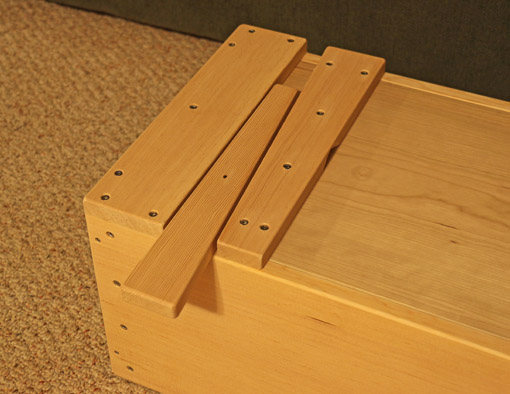
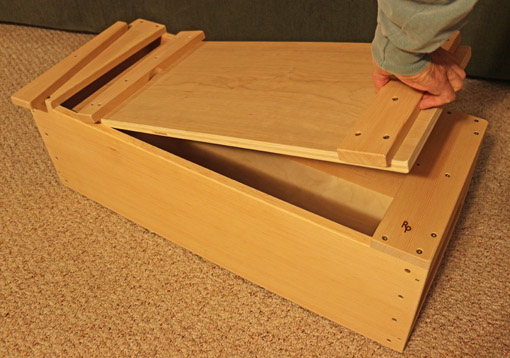
For the top, I similarly went modern with cherry veneered 3/4″ plywood. I found it by chance on sale but I like its looks with the Doug fir. The plywood allows a tighter tolerance between the top and the sides than would be possible to maintain with solid wood. The sliding-lock top is based on the traditional version as described by Odate, but with a very clever wedge lock described by George Snyder in an article on the Woodcraft blog. (Thanks to Wilbur Pan for the link.)

IMG_1183_edited-2

IMG_1177_edited-2

I added contoured undercuts on both edges of both top battens to make the top easier to handle for insertion and removal.

IMG_1178_edited-2

I’ve had the Odate article bookmarked on my web browser for years, so I’m glad I finally got around to building these boxes. The decision to use plywood for the top and bottom, and the wedge lock for the top resolved my reservations with the traditional design as presented by Odate. Then, finding the beautiful Doug fir got me building.

These toolboxes will no doubt see plenty of rugged use but with their bombproof construction they should be up to the job. They were fun to build.

Author:
• Tuesday, January 28th, 2014

IMG_1163_edited-2

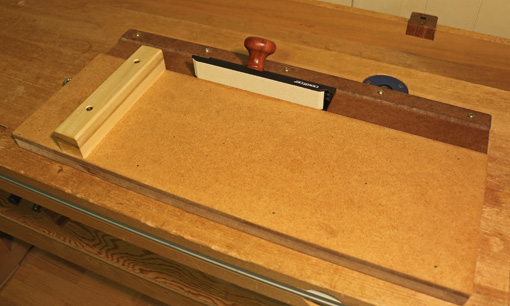
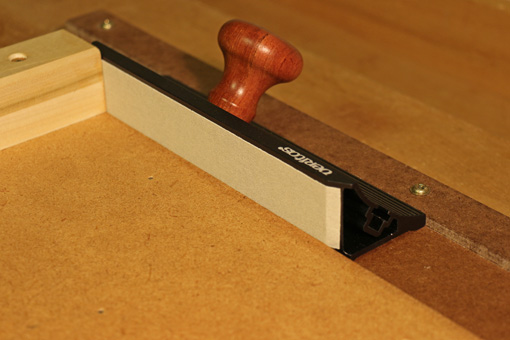
The Veritas Shooting Sander uses the principle of shooting – a guided vertical cutter is pushed to engage a work piece that is stably oriented by a surface and a fence – but uses sandpaper instead of a plane blade as the cutter. It’s simple and useful.

Though it certainly is not intended to replace shooting with a plane and a good shooting board, I’ve been so far finding it handy for odd-shaped parts that cannot be fully backed by a conventional shooting board fence, and for small parts.

As we would expect from Veritas, the tool is well made and thought out. The accurately made anodized aluminum extrusion body and the nifty adjustable wooden handle are good reasons to forego a shop-made attempt at this low-cost tool.

The shooting board I made for it is straightforward but there are a few fine points. The base is 3/4″ MDF, 23″ long. The work surface is 7 3/4″ wide with a nice straight edge against which the sander runs. The track for the sander is 2 1/8″ wide with a 1″-wide outer guide rail.

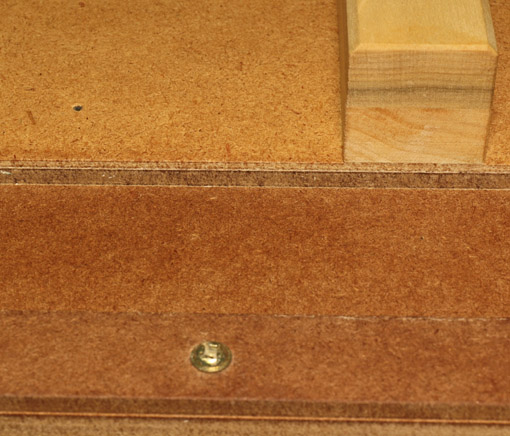
The work surface must be elevated at least 9/32″ above the track surface for the sandpaper to meet the lowest part of the work piece. I made the work surface from two pieces of MDF (just what was handy) for a total thickness of 11/32″, which gives a little margin for error when applying the sandpaper to the tool. That is, the bottom edge of the work piece is sure to be within the width of the sandpaper, even if I don’t apply the PSA paper to the tool perfectly accurately.

IMG_1164_edited-2

The fence is about 1 3/8″ high, screwed down 3 1/2″ from the end of the board with slightly oversized clearance holes that allow fine tuning for squareness.

Break in the shooting board just as you would for a plane shooting board by running the sander along the edge of the work surface so that a tiny width of sandpaper, say 1/16″, cuts a miniscule rabbet along the edge of the work surface. Then screw down the 1″-wide guide rail on the outside of the track so it is snug against the sander for the full length of the track.

IMG_1166_edited-2

A generous amount of oil-varnish finish toughens the MDF surfaces. Finally, I waxed the track. It all works well.
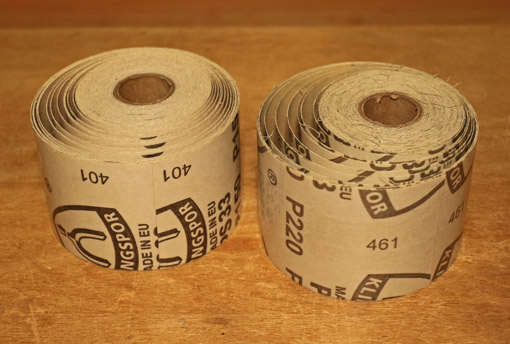
1 1/4″ wide adhesive-backed sandpaper strips are used for this tool. These are most economically made by slicing 2 1/2″ Klingspor PSA abrasive roll paper down the middle of its width. The paper strips that Lee Valley supplies are Klingspor’s.

IMG_1165_edited-2

After removing the first piece of sandpaper from the tool, I cleaned the residual adhesive off the tool with a citrus-based remover, but did not then clean off the slightly greasy residue of the remover. I found that subsequent sandpaper stuck plenty well enough and left hardly any residual adhesive when removed.

The tool is very easy to use but there are a few caveats. The sandpaper leaves grooves that are surprisingly deep for a given grit. That is simply because the tiny grits on the sandpaper are running in the same tracks over and over, unlike with regular hand sanding where the slight variations in movement erase most of the tiny grooves.

The work goes slower than shooting with a plane, especially since sandpaper seems to cut slowy on endgrain. Also, the thickness (height) of the work piece is limited to just under 1 1/4″.

The tool can be used ad lib to sand odd angles without using the fence by holding the work piece very firmly and offering its edge at the desired angle (such as indicated by a scribed line) to the sander running in the track.

All in all, this so far has been a worthwhile addition to the shop. My sense is that it will increasingly become a valuable quick “problem solver” tool that I’m very glad to have.

Category: Jigs and Fixtures, Tools and Shop  | Tags:  | Comments off
Author:
• Tuesday, December 10th, 2013

IMG_1094_edited-2

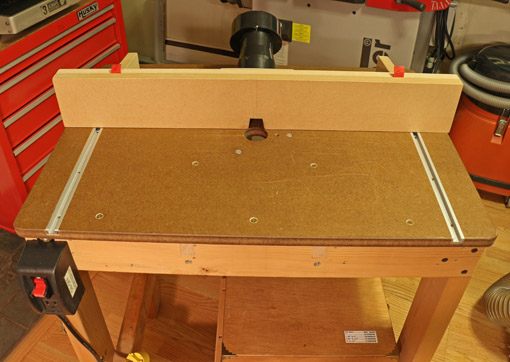
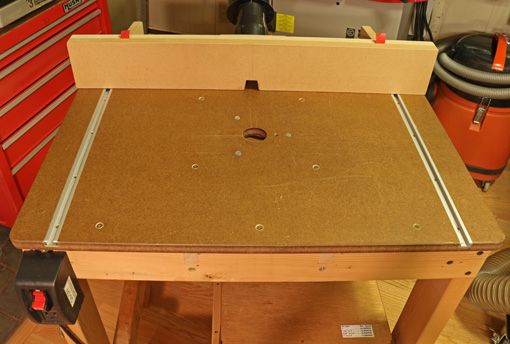
The review of router tables and lifts in the Fine Woodworking Tools and Shops issue (#237, Winter 2014) prompted me to again think about the subject. I have to admit, after reading about all the nifty gadgets, I was tempted to complicate matters and foul up my happily working simple system, which is described here, here, and here.

Naaah.

I recently added a T-track system instead of F-clamps to lock the fence in place, and a while ago upgraded to heavy-duty locking casters, but otherwise the setup is the same. There is no removable plate, no router lift, no above-table height adjuster, no fence microadjuster, no miter gauge track, no above-table bit removal, and no insert rings. No shoes, no shirt, no problems.

So, how does this home grown model “Easy 2” stack up against the models reviewed in FW? Let’s look:

Price: At a total cost of about $180, which includes the extra Bosch base, the Easy 2 is $470 less than the “Best Value” and $920 less than the “Best Overall” system in the review.

Flatness: The E2 has an intended crown of .003″ over the full length of the table, and, owing to the lack of an insert ring, a deviation of less than .001″ in the critical area around the bit opening. This beats all the models tested with the possible exception of the Festool, which has a .002″ dip. I agree with the author that a slight crown is preferable to a dip. I disagree, however, that a dip as high as .030″ is acceptable for quality work.

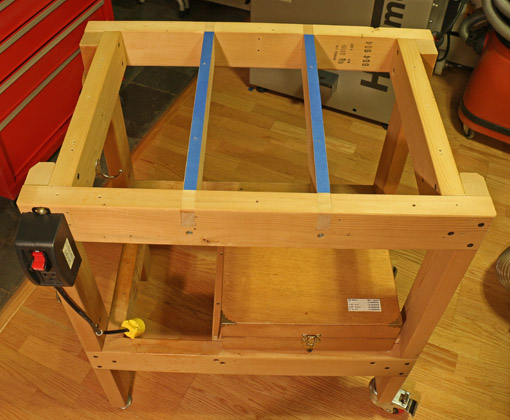
The Big Easy achieves this fine accuracy by employing the wonderful flatness tolerance of stock MDF plus shims. Here is the undercarriage of the table with supports across the width of the table near the router base, along with blue tape shims, aka “microadjustments.”

IMG_1092_edited-2

Fence: The E2’s continuous fence is flat and square within .001″. A split-fence attachment is easily installed and removed with finger knobs.

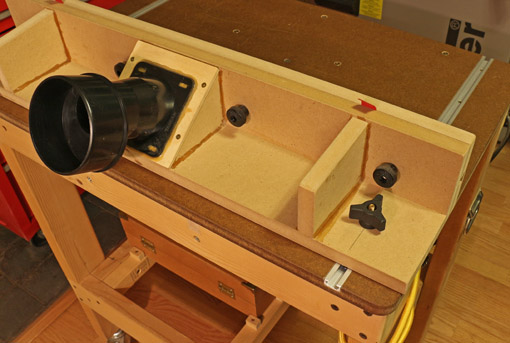
Here is a rear view of the fence locking system:

IMG_1096_edited-2

Dust collection: With simple fittings available from Rockler, the E2 is probably as efficient as all of the tested models except the two with enclosures.

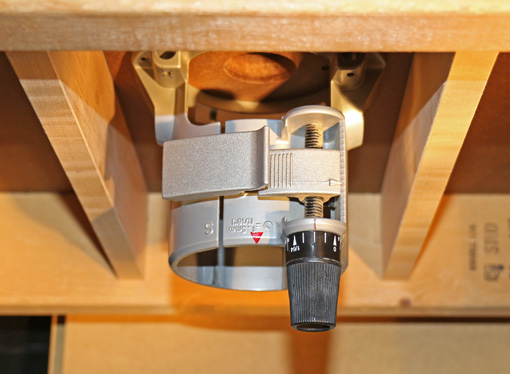
Bit height adjustment: The Bosch microadjustment dial easily allows at least .004″ adjustments with no discernible backlash using a dial that can be zeroed out at any time. Each of the easily visible increments on the black dial is equal to the thickness of a typical sheet of paper.

IMG_1097_edited-2

I do not have a device to measure vertical alignment as described in the article, but this is not likely to be a significant issue because the router base, which has been flattened on a granite surface plate using sandpaper, attaches directly to the MDF that is manufactured to excellent tolerances of flatness and thickness.

It is necessary to squat to reach under the table to attach the router motor and to make height adjustments. I do not mind a bit, but for those who prefer to avoid the latter, Bosch makes the router base usable with a simple hex key to allow height adjustments from above.

My intent is not to disparage the fine products reviewed in the article, but rather to demonstrate that there is a different, simpler way for those who might prefer. This router table system works – it allows me to build what I want.

IMG_1095_edited-2

[By the way, I disavow the detail in the plan drawing of the shop on page 58-59 of the same issue, which shows the woodworker’s router table with an insert plate and an insert ring. He also doesn’t own a two-wheel grinder and he wouldn’t lay a plane on its side. Nice shop though.]

Author:
• Tuesday, August 13th, 2013

IMG_0787_edited-2

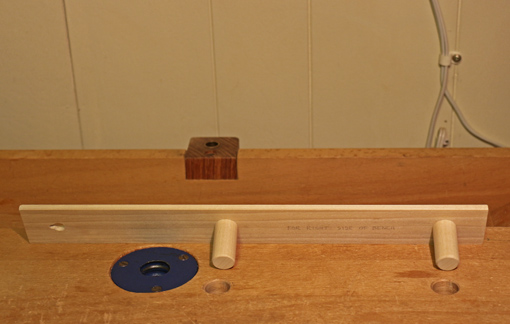
It pays to have a wide repertoire of options to hold wood in place while working on it. Here is a very simple, albeit unoriginal, device that can be used in conjunction with many of the other methods discussed elsewhere on this blog.

The idea for these planing stops came to me from a version made by Veritas. The adjustable feature of the Veritas is nifty, but I have an inhibition about forcefully pushing my planes toward large pieces of metal, even aluminum. The shop-made version is super-simple, super-cheap, and wooden.

IMG_0796_edited-2

These are made from 15″ x 1 3/4″ x 7/32″ poplar with 1 /1/2″-long pieces of 3/4″ dowel attached with brass screws, deeply countersunk. I spaced the dowels to accommodate the holes in my workbench. If I had great forethought several years ago when boring those holes, each pair in both directions would be separated by a constant distance. As it is, I had to make three planing stops, each with a different dowel spacing, to make full use of the hole patterns. This is not a problem because I want to have a few stops in any case.

The low profile of these stops allows their use with thin workpieces but is still sufficient to secure thicker boards.

For planing along the length of a board, two dogs usually suffice to secure the wood. However, vigorous planing with the scrub or jack, working diagonally or directly across the board, tends to dislodge it. A third stop is very helpful in these cases. Similar situations often arise in random orbit sanding, routing, and carving. Workpieces that have curved edges, live-edge boards, finished drawers, and wide panels also can thwart the simple two-dog work holding system.

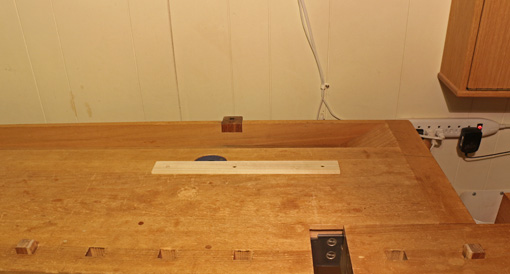
The photos above are at the right side of the bench with the tail vise and wooden bench dogs. (The blue Record holdfast hole is not involved in this system.)

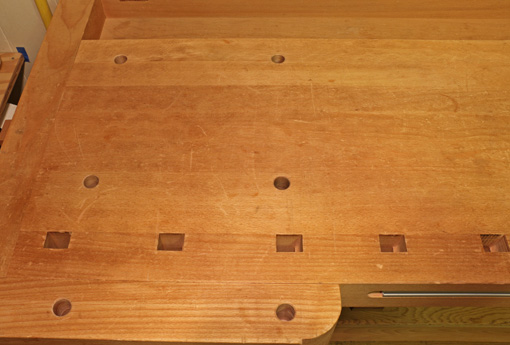
Below is the hole pattern on the left side of the bench. Following are some of many possible configurations of planing stops, Veritas Bench Pups, and bench end stops.

IMG_0790_edited-2

Here the planing stop is set up as a simple end stop, assisted by a single Pup:

IMG_0789_edited-2

Here, Pups in the front vise and the two stops at the end of the bench work with the planing stop:

IMG_0794_edited-2

Yet another variation, to put work further outward:

IMG_0791_edited-2

With all of this gear, something can probably be worked out to manage just about any work piece on the bench top:

IMG_0792_edited-2

Addendum:

Before settling on this version, I experimented building an adjustable version using different types of screws with the heads projecting from the tops of the dowels. The heads would then run in a T-slot in the stop piece. This would make the dowel positions adjustable like the Veritas version.

It became too finicky for my taste, especially since I wanted to keep the stops less than 1/4″ thick so they could be used for panels and other thin work pieces. The adjustable design can be done using a thicker stop piece. Readers may want to give it a try, but I like the thin and simple version.