Founded in 2008, Heartwood is among the longest-running active woodworking blogs on the internet. It contains 266,000 words of original content in 600 posts, all written by me alone. (That is not including comments.) And there are 1400 original photographs.
Here you will find plenty of serious woodworking instruction, information on tools, shop setup, and wood, along with musings about the craft. All for you to enjoy for free. No adds, no selling, no nonsense.
Very conservatively, there has been 6 million visits and 20 million page views (actual human visits, not bots, crawlers, etc.).
I am always delighted to hear from fellow enthusiasts and anyone exploring fine woodworking.
No respectable woodworker can venture to the local Home Depot for that next-on-the-list home fixit thingy and resist a stroll through the tool corral because, you know, there might be something there that you absolutely need without having realized it. So, in this lucid state, I acquired a few of these little DeWalt trigger clamps.
DeWalt calls them “medium” but I rate them: small enough but strong enough. They are an excellent alternative to spring clamps, which I have never really liked.
The 2 5/16″ (actual) throat depth is at least that of most spring clamps except for some awkwardly large steel and ratcheting models. The 6″ clamping length of the model I use is longer than nearly all spring clamps. There is remarkably little bowing of the I-beam bar even with the maximum force applied, which is nominally 100 pounds.
The fixed jaw can be reversed for spreading. The jaw pads have horizontal and vertical V-grooves for use on corners and small round pieces.
A trigger clamp is not quite as easy to use one-handed as a spring clamp. However, they are still convenient to apply with one hand if you preset the jaw opening, then carefully set the first jaw flat on the workpiece, and finally squeeze the handle to plant and tighten the second jaw.
DeWalt’s trigger clamp series also includes “small,” which is too tiny for much use in my shop, and “large,” which I skip in favor of the “extra large,” which generates 600 pounds of force. I wrote about those in another post.
Shooting is a gateway skill to precise hand tool woodworking. So get started by shooting with the planes you have.
The basic requirements are:
Mass. You want substantial momentum to firmly and steadily carry the blade through the cut after you get it started, especially for end grain shooting.
The side of the plane should be square to the sole. If you only have a not-so-great plane, use tape to shim the side. I did this with my old Record jack plane when it was the only one I had. [Please see in the Comments section reader Michael’s germane point and my lengthy reply for more details on the squareness issue.]
It helps a lot to have a comfortable, secure grip to consistently apply pressure where it is needed. Dedicated shooting planes have this feature.
The blade must be sharp. Sharp! A dull blade is not only harder to push through the cut, but accuracy will suffer as the plane and the blade itself deviate from a true path.
For end grain shooting:
Best: a dedicated shooting plane.
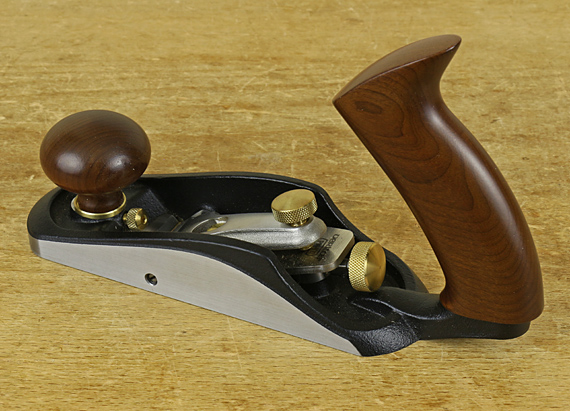
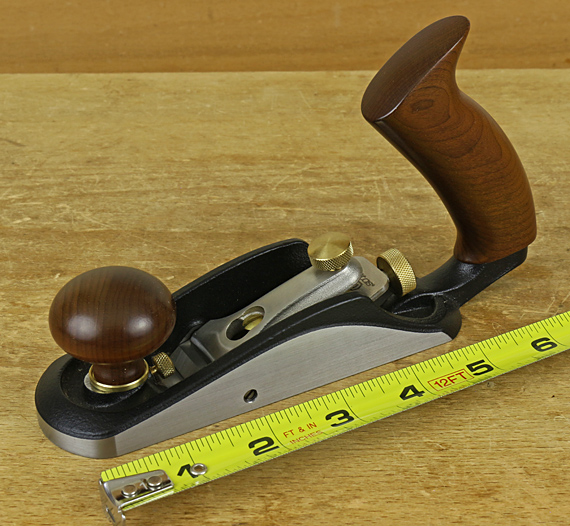
I use the Veritas shooting plane, and love it. Comfortable and accurate to use, it meets all the requirements above. The adjustable-angle handle properly and comfortably directs pressure, and the 20° skew really eases the blade through the cut. The bevel-up design is easy to set up and adjust, and provides excellent support to the blade close to its edge.
Is it worth spending about $350 dollars on a plane just for shooting? In view of all the other expenses involved in woodworking, yes, it is. (See the first sentence of this post.)
Lie-Nielsen also makes a great shooting plane, which I have had a chance to use briefly. This massive tool uses a bevel-down design and a skewed, Bedrock-style adjustable frog. Personally, I like the Veritas design and features, but both merit consideration.
I use a straight edge blade for end grain shooting – no camber.
Good: a bevel-up bench plane.
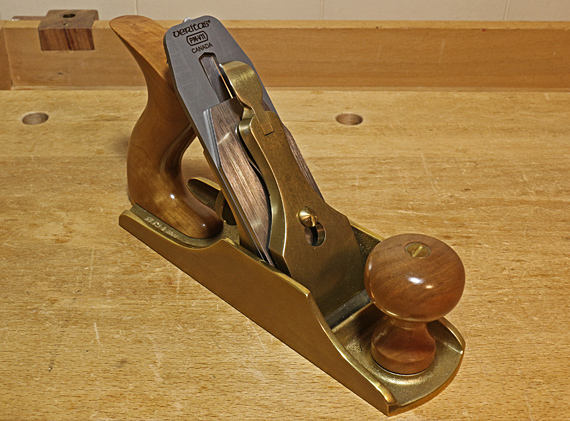
The Veritas BU jack plane is perhaps the most versatile plane of all, and a good shooter. The BU design gives good blade support, and makes it easy to swap dedicated blades for its varied uses. You can get a decent grip on this plane for shooting.
Adequate: a bevel-down bench plane.
I used a BD jack and jointer for shooting for years. I do not consider these ideal but they can get the job done. Don’t let anyone tell you that you “can’t” cut end grain with a bevel-down plane. Use a sharp blade, and set the chipbreaker close to the edge to reduce deflection.
Gripping a bevel-down bench plane for shooting may be a bit awkward for some. With the jack, I squish the base of my thumb behind the side hump and plant four fingers on the lever cap. A grippy glove can help. (So then you’ll have one on both hands.)
For long grain shooting:
Compared to using a plane with the blade on the bottom (the “regular” way) this is just a matter of different manual mechanics. The plane is not running in a track as in end grain shooting.
So, a BU or BD bench plane is fine, as long as it has decent mass and stability, the side is square to the sole, and you can get a decent grip. And . . . the blade is sharp.
I like my Lie-Nielsen #9 “iron miter plane,” which I’ve dedicated to long grain shooting, because its beefy, boxy design makes it stable through the stroke, and it handles exceptionally well with the “hot dog” grip. This is a bevel-up design with a 20° bed. (Hmm . . . ) Unfortunately, I don’t see it on their website any more. Veritas sells a somewhat similar plane.
I keep the #9 set up with a straight edge blade, mostly because it is easier to maintain and works well for the thin stock that I’m usually using when long grain shooting. A mild camber, such as for a jointer plane, is also a good option, especially if you will be long grain shooting thicker stock, or if you are also using the same plane and blade for general tasks.
Have you given much consideration to your footwear in the shop?
The power input and the control of your tools originate from your stance. If it’s not well placed and reliable, your performance will suffer. You will also fatigue sooner.
Dependable footing is also essential to safety, especially with machine work. There, you cannot afford to compromise.
Our shop floors are usually littered with sawdust and shavings even with a good dust collection system gathering most of the waste from machine work. No matter what type of floor is in your shop, these make it potentially slippery.
That said, sure, I’ve been known to get a few things done in my jammies and slippers in my home shop. But for serious work, I like low-cut hikers or at least trail-running shoes. Lately, my favorites are these sturdy Red Head Blue Ridge Low Hiking shoes from Bass Pro Shops. They have good support, wonderful grip, and a beefy toe cover. And the camo accents look kinda cool, don’t ya think?
For a long time, I have not liked the leather honing wheel on the Tormek. I never used it for general sharpening because I prefer stones, but even for knives, gouges, and an occasional touch up of other edges, I find it fragments easily and does not hold the honing compound as well as I would like.
I finally got around to setting up the wheel with felt. It was easy to remove the leather and scrape clean the plastic base of the wheel.
I got the felt from McMaster. I first tried PSA-backed felt just for the convenience of applying it to the wheel. The hardest available in this style was “Firm” F1. A 3/16″-thick strip proved to be still too soft.
The harder “Hard” felt is available only in sheets without the PSA backing. I cut the 1/8″-thick, 12″ x 12″ sheets into strips and applied them with 3M General Purpose 45 spray adhesive using simple butt joints to make a continuous layer around the wheel. The S2-20 (durometer 50A) works best. The S2-32 (durometer 80A) is nominally about half as compressible as the S2-20 but the difference does not seem to matter for this purpose. I prefer the texture of the S2-20 as it seems to grab the honing compound better.
Because I use the wheel for fine finishing, I charged it with 0.5 micron diamond. Mineral oil-based paste and water-based spray will both work but I think the paste is better. They cut fast but can get expensive over time. An economical alternative is a stick of Formax “green micro fine honing compound,” which I surmise is also about 0.5 micron, available from Woodcraft. Of course, it cannot cut as fast as diamond but with patience it can still produce an excellent edge.
My preference is mineral oil-based synthetic diamond paste from Beta Diamond Products. It cuts fast and consistently, and a little bit goes a long way. I find the jar easier to deal with than the syringe.
Bottom line: the felt replacement works very nicely; I like it a lot better than the leather wheel. It is especially helpful for knives, gouges, and is even handy for quick touch ups of plane blades and chisels. I keep these touch ups very light because I don’t want to round the edge too much, which would interfere the next time I work the edge on stones.
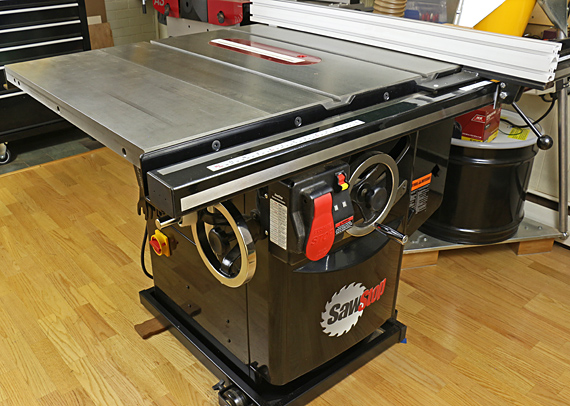
Oops, I had a SawStop “event.” But it was not my flesh that met the blade. Rather, I foolishly forgot to reset the miter gauge fence when setting up an angled crosscut, and ran the aluminum fence into the blade, and . . . boomp! So, I had to send out the damaged blade for repair along with my spare blade that was damaged 14 years ago when I was setting up the new saw. This, plus buying a new SawStop brake, made for an expensive goof up. All told I’ve lost use of the tablesaw for four weeks.
But, I’m doing just fine, thank you. In fact, the episode has reinforced my longstanding conviction and advice that the tablesaw is not the key machine in the furniture maker’s shop. In my view, that distinction belongs to the bandsaw, especially when it teams up with a good thickness planer, or better yet, a wide jointer-planer combination machine.
Far from being a hand tool purist, I was happy ripping on the bandsaw with surprisingly little clean up required with a handplane. I also cleaned up lots of 15/16″-thick, 3″/3 1/2″-wide pieces by standing them on edge going through the DW735 planer with the Shelix cutterhead. I made sure the rollers and bed stayed clean, and it went well.
“What about crosscutting,” you say, “that’s not likely to go well on the bandsaw.” Well, using the little miter gauge that came with my bandsaw, the crosscuts are pretty accurate and not too rough even with my all-purpose 3-tpi blade.
Which brings me to another longstanding conviction and advice. And that is the importance of shooting. It was a pleasure to clean up the bandsawn crosscuts cleaner and more accurately than even the tablesaw could do. Shooting is so critical to accurate furniture making that I suggest sparing no effort and tools to set up good systems for end grain and long grain shooting. (I’ll describe my current long grain setup and have some tips in an upcoming post.)
I won’t be selling my tablesaw – it does a lot of tasks efficiently and well. However, I do want to reinforce this advice regarding machines, especially for woodworkers setting up or upgrading their shops:
The first machine to buy is a good portable thickness planer. The DW735 has no peer.
As soon as you can, buy the best bandsaw you can. Steel frame style, at least 12″ resaw height, preferably something close to 2.5 HP or more.
Get a 12″ jointer if you can.
And sometime, yes, you’ll probably want a tablesaw.
Most important, no matter what tools you have, build things.
1. If you had a BU jack plane with a 20° bed, could you still use it on end grain? Sure. My Lie-Nielsen #9 “iron miter plane” has a bed of 20° and it works wonderfully on end grain, and so does my L-N shoulder plane with a bed of 18°. Perhaps this is so because resistance is indeed determined solely by the attack angle and not by the sharpening angle per se.
2. This is not about block planes, which, of course, also happen to be bevel-up. It is about BU smoothing planes and, to a lesser extent BU jack planes. Incidentally, I suspect one reason for the popularity of 12°-bed block planes over 20°-bed models is that the former are more compact and thus easier to manipulate with one hand.
3. This is not just a theoretical discussion. BU planes with 20-22° beds have been designed and are available from distinguished planemakers. Take a look at Karl Holtey’s #98 Smoother. Philip Marcou offers bevel-up smoothing and jack planes with 15° and 20° bed angles. [Drool, drool . . .] Though not it’s intended to be used as a smoothing plane, I’ve experimented with setting up my L-N #9 (20° bed) as a high-attack smoother. It works.
So, what’s the point of these four posts? It is simply this: a good addition to the Lee Valley and Lie-Nielsen product lines would be, at the least, the option of a bevel-up smoothing plane with a 20-22° bed. (22° would suit me just fine.)
To create higher attack angles, such as 55°, to reduce tearout with a bevel-up smoothing plane, here are more advantages to a 20-22° bed angle versus the commonly produced 12° bed angle.
1. A higher bed angle requires less camber in the edge to achieve a given “functional camber.” Please see my post that defines the terms I am using and explains the simple math, and this post that shows the effect of bed angle. A blade placed in a 12° bed requires about 75% more “observed camber” to achieve the same functional camber as when placed in a 22° bed. For example: you must grind .014″ camber to achieve .003″ functional camber in a 12° bed, but only have to grind .008″ to achieve the same .003″ functional camber in a 22° bed.
Putting camber in the blade edge takes time and it’s easier to do if there’s less of it.
2. As the wear bevel develops on the lower (flat) side of the blade, an adequate clearance angle is maintained longer when the bed angle is greater. Again, I reference Terry Gordon’s article in Furniture and Cabinetmaking magazine (November 2018, Issue 276, pp. 48-50) and Brent Beach’s website.
Here are two more possible advantages to a 20-22° bed versus a 12° bed, but these are speculative.
1. For a given attack angle, the narrower sharpening angle (as would be used with the higher bed angle) may produce less resistance in the cut. I’m not sure. Maybe resistance is instead determined only by the attack angle, as has been suggested to me by a planemaker. I do not have a way in my shop of making an apples-to-apples comparison. I’d need two planes, identical except for bed angle, then make the same attack angle in each – for example, one with a 22° bed and a 33° blade (=55°) and the other with a 12° bed and a 43° blade (=55°).
2. Perhaps the steeper 20-22° bed is an advantage in design and manufacturing in that it is sturdier and less likely than a 12° bed to deflect downward. I don’t make planes, so I don’t know.
In the previous post, I discussed how a 20-22° bed in a bevel-up smoothing plane can produce a wider range of useful attack angles without resorting to excessively high sharpening angles. The use of narrower sharpening angles has, in turn, several advantages:
1. Sharpening is easier. It is simply more difficult to get a good, sharp edge at, for example, 43° than 33°. It is also awkward to work at the higher angles, and the feedback from the surface of the stone is not as good. I think this is readily evident but some may disagree.
2. Based on my experience, and I think most woodworkers would agree, a blade with a very steep secondary bevel dulls faster than one with a more usual, narrower bevel, all else being equal.
—————————–
Sidebar: how an edge dulls
The profile of the sharp edge of the blade ideally starts out as two straight surfaces meeting at a clean, sharp point. As the edge wears, steel is abraded away from the surfaces near the edge, and the original point becomes rounded over. The worn surfaces of the blade that approach the blunted edge can be thought of as “wear bevels.” Thanks to Brent Beach and Steve Elliot for their development and detailed study of these concepts.
For both bevel-up and bevel-down planes, the wear bevel on the top side of the blade (the side facing away from the wood) is wider than that on the bottom side, because it is the top (front) of the blade that bears the brunt of the collision with the wood. The bottom-side wear bevel, which is on the flat side of the blade in a BU plane, is nonetheless important.
Brent Beach explains the value of removing the lower wear bevel when sharpening to regain a truly sharp edge, to maintain proper clearance of the blade edge from the wood, and to avoid the need to apply undue pressure when planing. David Charlesworth’s Ruler Trick is thus particularly helpful for bevel-up plane blades.
——————————-
3. A functionally sharp edge is preserved longer when the blade is sharpened at a narrower angle. This is consistent with point #2. Australian planemaker Terry Gordon explains this nicely in a recent article in Furniture and Cabinetmaking magazine (November 2018, Issue 276, pp. 48-50). It is best understood diagrammatically but the gist is that a skinnier edge retains useful sharpness longer by remaining narrow longer.
In summary, there are important advantages in sharpening and edge endurance when using the narrower sharpening angles permitted by a higher bed angle in bevel-up smoothing planes.
For example, if you want a 55° attack in your BU smoother, you’re better off being able to sharpen at 33° with a 22° bed (=55°) than having to sharpen at 43° with the 12° bed (=55°) in currently offered stock planes.
Coming up: still more issues. Can you tell that I’m building a case that I think L-N and L-V should hear?