Archive for the Category ◊ Tools and Shop ◊

Author:
• Friday, January 14th, 2022
Veritas Bevel-Up #1

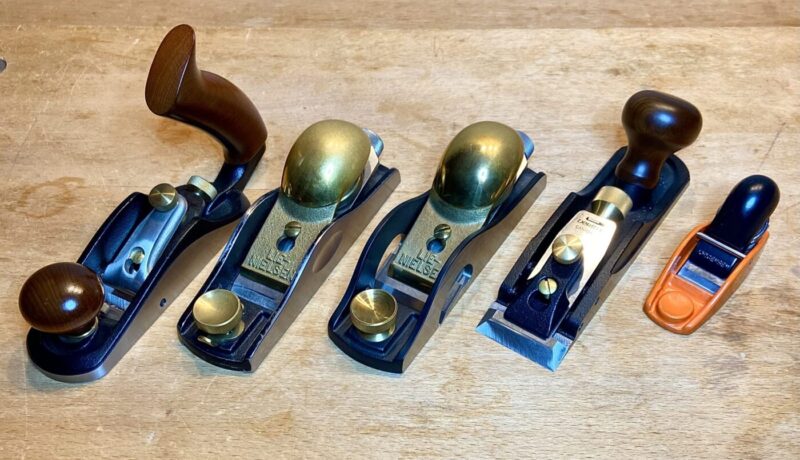
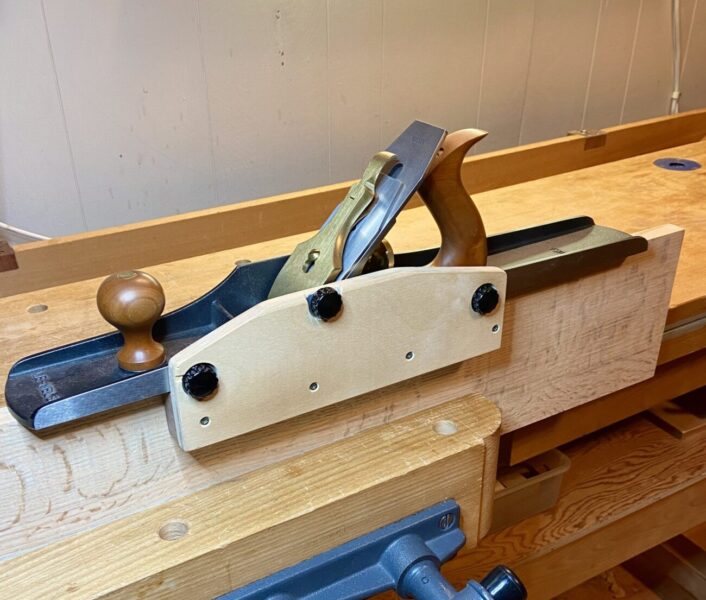
This is the Veritas Bevel-Up #1 plane, which I have been using for a year now. With a 1 7/32″-wide blade, it is indeed small but it works legitimately as a seriously useful plane. An ancillary tool, not a necessity, still I reach for it a lot more than I expected, so I want to share its merits with readers.  

This plane excels for small or concentrated work where its maneuverability and the vision of the work that it affords are significant advantages. In fact, even large projects involve plenty of detail work, such as a leveling touch-up at the shoulder of an assembled mortise and tenon, and fitting small components, especially those involving angles and round-overs. 

What makes this plane worthwhile for me is the feel. While there is some crossover in function with a block plane, this plane is different. Getting both hands in non-cramped positions on the handles of the BU#1 away from the sole affords feedback and control that I really appreciate. I can readily feel the tilt, and I like the excellent visual clearance. I also find that it handles significantly better than the Stanley style (bevel-down) #1.

I keep the BU#1 tuned about like a smoother with the blades mildly cambered. Because there is little momentum behind this small plane, it is particularly important to keep the blades sharp, especially if using a high attack angle. 

Veritas Bevel-Up #1

This plane has a 15° bed so you can sharpen with a secondary bevel of 30° for a good all-round attack angle of 45°. It is also useful to keep a second blade sharpened to 40° or 45° for a 55° or 60° attack, respectively, to use as a touch up plane on difficult grain. The short sole helps in this function. By the way, I would prefer a 20° bed but I’ve covered that issue at length elsewhere

Other features that I like are Veritas’ Norris-style combination adjuster with set screws near the front of the blade to make responsive lateral adjustments, and the adjustable front sole plate with a retainer set screw to easily regulate the width of the mouth. The sole of the BU#1 that I first received was slightly but significantly concave along its length but Lee Valley, being the great company that they are, exchanged it without bother. I slightly touched up the sole of the replacement, just because I’m picky. 

The BU#1 does not suffer from the unfortunate handle design that plagues most other Veritas planes. (They can be replacedtalk to Bill Rittner.) It has only a mild curve but this works well for this plane; it feels right and comfortable to me. 

My usual disclaimer: This review is unsolicited and uncompensated. My goal is only to point out good tools so you can make great stuff.

Author:
• Friday, February 05th, 2021
table saw

A reader who recently sold his table saw asked about managing without it.

If you have been reading this blog over the years, you probably know my opinion. Of the five major small shop machines – table saw, bandsaw, jointer, planer, and router table/shaper – the most dispensable is the table saw.

Don’t get me wrong, the table saw is certainly helpful and I don’t want to give up my Saw Stop. It is great for clean, accurate ripping and crosscutting among other tasks. But you can still build everything you want without that cast iron landing pad with an emergent blade, just not as fast or conveniently.

I suggest the following tools as keys to working efficiently without a table saw. The links give lots more information. 

1.  Bandsaw! This takes up much less shop space than a table saw, though you still need infeed and outfeed space. 

You can rip quite accurately on a well-tuned bandsaw. Decent crosscutting can be achieved with or even without the miter gauge though you will need outboard support. And, of course, the bandsaw is much more versatile than the table saw. 

No bandsaw either? I could still do just about everything by hand (but I really, really don’t want to) with my Disston ripsaw, wide and narrow-blade bowsaws, an inexpensive crosscut breakdown saw, large and medium ryoba saws, a Gyokucho “05” crosscut kataba, the wonderful Bad Axe hybrid backsaw, and a few more. 

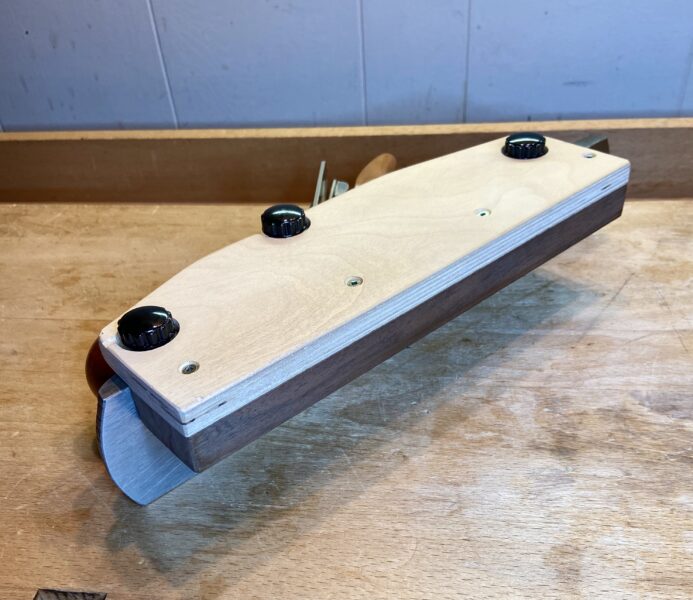
2. Cross-grain shooting board with an appropriate, ideally dedicated, plane. Here’s how I made my current one. This will clean up your crosscuts like no other tool on earth, hand or power.

3. Long-grain shooting board. This underutilized technique is great for accurately and conveniently cleaning up short to medium length rip cuts. My current board accommodates work up to about three feet. This is very easy to make and does not really require a dedicated plane, though I prefer my Lie-Nielsen #9. 

4. A jack plane, or better yet, a jack and a jointer, round out the essentials for the shop without a table saw. 

This is all in addition to the usual complement of hand tools and machines that you would want to have with or without a table saw.

By the way, my longstanding recommendations for machinery remain: for your first machine, get a thickness planer. Then get a bandsaw. Then get a jointer, 12” or wider, if you can. Build a router table. And, yea, get a table saw too, if you can. 

Category: Tools and Shop  | 10 Comments
Author:
• Saturday, October 31st, 2020
PM-V11 plane blade

Disclaimer: Or what they do tell you but you might not notice.

Tools exist for making things. The same goes for your shop.

You need good tools to do good woodworking but there are plenty of forces pushing you, a woodworker, to exert undue attention on tools. First, woodworking tools are fascinating and cool. Then there is the constant pressure of tool marketing, often disguised as just “informational.” You know you are on the wrong track if you find yourself frittering away your valuable woodworking time fussing with tools to avoid the stress and uncertainty of actually making something.

I understand; I’ve been there.

It is fine to be a tool collector/restorer in addition to, or instead of, being a woodworker. But you might as well be clear about it. 

The key to choosing tools is to understand that for each tool, there is a threshold of quality below which it cannot properly do its job. Do not buy below that threshold because you will be burdened with tool-like objects that have no purpose in this world. A chisel with cheesy steel will always be a cheesy chisel begging you to upgrade.

Above that threshold, tool quality fairly reliably improves with increased price. However, the gains in performance soon become smaller and smaller as the price rises. 

So, recognize that threshold and find your comfort point above it. 

One more thing: The best time and place to decide to buy a new tool is usually when you are working in the shop, where things are real. Tool stores and shows can be dangerous. That said, sometimes they do open your eyes to a new type of tool or a greatly improved version. 

Bottom line: Keep your focus on making things and let your tools serve that purpose. 

Author:
• Wednesday, September 16th, 2020
1:4 French curves

These useful tools from Veritas are paired sets of French curves. The small and large members of each pair have the same curve pattern in a 1:4 ratio.

This allows you to draft on paper at the commonly used scale of 3 inches = 1 foot using the small curve of the pair and then transfer the drawn curve to the workpiece using the full size curve of the pair. Similarly, you can layout full size mock ups with the large curves, decide which one looks good, then use the corresponding small curve to incorporate the curved element into your design on paper.

Veritas French curves

The curves are made from 3mm-thick 3-ply birch. The largest one is 36″ long. The edges are not as smooth as plastic curves, so you might want to do some light touch up with sandpaper using a block to avoid rounding over. 

There are tiny holes at corresponding locations in each pair of curves that can be used as reference points to transfer a layout from one curve to the other in the pair. Numbering the holes, as shown here, helps keep track of the paired locations. 

1:4 French curves marked up

I often use long, very gradual curves in my designs, so I wish Veritas would also produce paired sets like these with very mild curves. I imagine this could be readily done with a CAD-CNC process. 

The key to using French curves is to mark the end points of a curve, then “fill in” the curve using at least one (usually two or more) additional reference point(s) to guide the placement of the template. Shift the reference points and use various segments of the French curve until the drawn curve looks the way you want. 

Consider using this wonderful rasp for truing curves in templates and workpieces. [If I made a buck from it, I might have called this a shameless plug.] 

By the way, why “French” curves? Beats me, but with a little online research, I learned that French curves are based on segments of the Euler spiral, named for the great eighteenth-century Swiss mathematician. The Veritas curves approximate a common Burmester set, named for German physicist-mathematician Ludwig Bermester (1840–1927). So, why aren’t these types of curves called “German curves?”

Category: Product reviews, Tools and Shop  | Tags:  | 2 Comments
Author:
• Monday, August 31st, 2020
DIY tools

I do not like to use my high-end edge tools for rough and tumble DIY projects where a sharp edge has a good chance of meeting up with a nail. Similarly, precision hand tools such as a Starrett square have no business sliding about in mystery debris.  

So, even though my classy hand tools are fully capable of handling rough jobs, I prefer to use my set of utility tools for most repair work on the Magic House. (“Magic,” you know, because it makes my time and money disappear.)

There are a couple of ways for a serious woodworker to accumulate these DIY tools.

You might buy them specifically for such work. Good examples are above. The little Rali block plane has replaceable blades. It does not seem to be available any more but most any cheap pocket/block plane will do. That cheapo square is actually decently made and pretty accurate. The DeWalt tape is also the one that comes with me on wood buying trips.  

Sometimes, especially early on in learning woodworking, we try to save a few bucks by buying a tool that seems good enough, but later proves to be a poor call for fine work. That is how this old Stanley chisel has survived all these years. It easily sharpens to a decent edge that I don’t mind abusing for DIY work. I replaced the round rasp with a hand-cut version but the cheap one is just fine for enlarging a rough hole in plywood. The screwdriver makes a great paint mixer and general hacking/prying tool. 

more DIY tools

Maybe you did not recognize the value of quality tools, or maybe you just did not know how deeply you were going into woodworking. Either way, an upgrade does not always mean waste. 

The take home point: Do not buy tools for their own sake. A tool has a purpose. Match the tool to the job – the one at hand or even the one to which you aspire.

Category: Tools and Shop  | 4 Comments
Author:
• Wednesday, July 08th, 2020
router table miter slot

Devoted readers (thank you!) know that I like to keep my router table simple but very capable

The router table is truly a key tool in the small shop but there is a wide range of complexity and cost involved. I admit to being intermittently tempted by router lifts, tracks and slots in the table and fence, bit changes and height adjustments from above the table, and micro adjustability of almost everything.

Yet, my simple set up continues to do everything required. It consists of an MDF top and fence on a 2×4 base, dust collection, and the Bosch 1617EVS held in a dedicated base attached underneath the table. Moreover, the flatness accuracy of the top equals the best tables reviewed in Fine Woodworking magazine #237, and it substantially exceeds most of them. Some of those rigs cost more than ten Bens. 

But what about routing a rabbet or profile on the end of a narrow stick, or, more challenging, a dado in the middle of, say, a 4″-wide rail? I again admit to being tempted by an impressive cast iron tabletop with a miter gauge slot. 

router end grain on router table

For routing on the end of the stick, the workpiece alone gives too little registration against the fence. Therefore, I have usually used a squared piece of plywood or MDF, about 10″ x 12″, to register the workpiece against the fence and prevent tearout at the trailing edge. (See photo just above.)

However, sometimes it is handy to use a miter gauge, especially for a short dado. This also allows me to register the left end of the workpiece against the miter gauge stop for a repeatable task.

Well, there just is not enough depth in a 3/4″ MDF top for a metal-lined track for a miter gauge. (Unlike for a T-track, which is more shallow.) Thicker MDF is an another option but that would mean a new table top that would require a recess to mount the router base. A bare slot in the 3/4″ MDF is also problematic in that it would wear quickly. I could line the slot with UHMW tape but it would be hard to get the width just right to avoid having to adjust my miter gauge bar every time I brought it over from the table saw. 

So, as usual, I turn to the late Pat Warner’s writings for a solution. On page 99 of his The Router Book, there is a simple way of making a temporary “slot” in your MDF router table top. My version uses nominal 1/2″ MDF with adhesive UHMW tape on inside edges. (See the photo at the top.) The outer board is screwed down in the near right corner to give more clearance for the miter gauge head, and elsewhere the boards are clamped.

This allows me to use my table saw miter gauge – the wonderful Incra 1000HD and its adjustable end stop. Note that I do not need to adjust the width of the bar. Instead, I retain the setting that works for the table saw, and then for the router table, simply set the two MDF boards snugly against the bar for a wobble-free fit. A backer board prevents tearout at the trailing end of the workpiece. The router table fence is not functional for the cut itself but is close by for dust collection if possible.

It looks like I just saved several hundred dollars yet again. 

Mmmm, that walnut looks nice.

Author:
• Sunday, June 28th, 2020
DeWalt cordless sander

The DeWalt DCW210 is a cordless 5″ random orbit sander that is powered by the company’s 20-volt lithium-ion battery system.

Smitten with DeWalt’s 20V Max series of tools, it is a bit like dealing with Apple stuff. I know I’m being played but the products are just darned good. 

Handling is excellent. Weight, vibration level, and control are comfortable. With a top grip, the only option, the sander tends to meet the work squarely with no tendency to tip or gouge. At least with a smallish 2.0 amp-hour battery, balance is excellent. The rubberized area enhances the feel, and the on-off switch is easily accessible from the grip position. 

This is a finishing sander, not a stock removal hog. In that context, it has plenty of power. It is similar to my Bosch ROS20VS, if not more aggressive. The DCW210 has a standard 8-hole base with hook-and-loop disc attachment, and runs with a 3/32″ diameter orbit. The brushless motor is very efficient, so I read. It has a variable speed dial, also accessible from the grip position, but I rarely use that option on a sander. 

You’re going to love this as I do: the motor brake stops the motion immediately when you hit the power switch. Hallelujah!

Dust collection with the onboard bag is surprisingly good but of course, no match for sanding with a vacuum hose. (I vacuumed up the tool nice for the photo.) The bag’s good-sized plastic collar and locking system makes it easy to use one hand to detach and attach with a nice positive click. A spring that lines the bag can be compressed and popped to “shake out” stubborn dust. I find it is more useful for allowing a vacuum hose to thoroughly clean out the bag without it being sucked into the hose. 

The outlet diameter will not fit standard shop vac hoses but this does not matter to me because using a cordless sander with a hose would pretty much negate the advantages of having no power cord. So I will use this sander without tails of any sort.

I cannot offer data on how long the battery charge will last. After a while of sanding, I check the charge-level indicator on the battery and replace it if it is low. With just two extra lightweight 2.0 Ah batteries on hand and using the DCB113 charger, I could keep working indefinitely. You can also buy higher capacity batteries but I guess at some point the weight would get uncomfortable. Anyway, this is a finish sander suited for relatively light work. Note that DeWalt charger models vary considerably in their charge time.

I will still use my bigger Bosch 3725DVS (3/16″ diameter orbit) with its cord and a vac hose for heavier work but the DeWalt DCW210 is now my go-to tool for finish sanding. 

This review is unsolicited and uncompensated. I just want to help you choose good tools. 

Category: Product reviews, Tools and Shop  | Comments off
Author:
• Thursday, May 07th, 2020
workbench height

In a 2011 post, I argued for an empirical approach to determining your best workbench height instead of relying on any formula. The many variables in body characteristics, woodworking styles, and tools necessitate practical testing.

Consider the tasks you do at the bench, such as planing, sawing, and chiseling, and the portion of time and effort you are likely to devote to each category. Then find a workbench, Workmate, or a sturdy table to try the work at different heights created by clamping layers of boards or plywood to the table. Find what feels best all-around. 

Maybe your ideal bench height will change over time as mine has. Recently, after assessing how I was working, and then testing just as I recommend to others, I raised my bench almost two inches to 37″. I feel more comfortable overall, particularly being able to stay closer to a neutral head posture. I can reduce the bend in my neck, which reduces stress on the lower cervical vertebral joints. 

On the other hand, I can feel that the higher bench height transfers more of the work of certain tasks such as heavy planing to my upper back and arms. Fortunately, I’ve maintained good upper body strength, especially in the upper back and shoulders, so I don’t seem to miss the reduced drive from the ground. In fact, firming my upper back as I work actually further removes stress from my neck.

I used long #14 screws to attach a glued stack of Baltic Birch plywood to the base of the bench, replacing the previous riser blocks. 3M Safety-Walk slip resistant tape applied to the bottom along with filler blocks between the bench and the back wall do a great job of keeping the bench stable in all directions.

Assess your stress” and work habits to make your shop time more efficient and pleasant.

Category: Tools and Shop  | 9 Comments