Author:
• Friday, April 23rd, 2010

So far we have been mostly considering what we would like to do for a project. Somewhere along the way we must consider if it can be done and how to do it. Certainly, those two issues are in the undercurrent of thought all along the way, aided by experience. Now the construction details, functional specifics, and the available skills and tools have to be dealt with for sure.

The discussion of these issues has been intentionally placed here in the sequence, not at the beginning, to encourage free creativity in developing ideas. If we were to start with directions for how tables have always been made, for example, this might inhibit new ideas, especially for one-of-a-kind work. However, the price for this freedom in producing ideas and concepts is that some will, upon research, prove impractical or impossible. Thus, in reality, the creative stages overlap and change order; there is no single correct path.

For research into construction methods and functional features of furniture, there are countless sources. Some of my favorites:

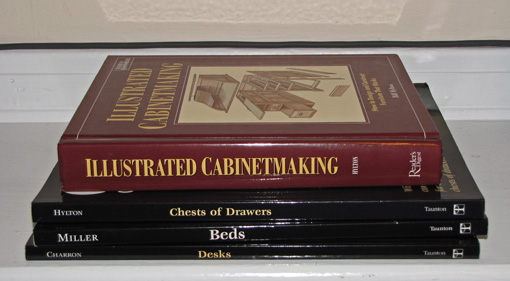
Bill Hylton’s Illustrated Cabinetmaking is a great place to start. Thinking of making a dining table? The chapter on that starts with measurements for leg room, elbow room, and so forth. Then he presents drawings and construction details for 14 ways of making a dining table, including leg and apron, trestle, pedestal, etc.

I also like Taunton’s project book series which includes Chests of Drawers, Beds, Desks, etc. Fine Woodworking and Popular Woodworking magazines’ back issues (both available on disc) are excellent sources. Will Neptune’s articles in FW are worth their weight in gold. Though I do not do reproduction furniture, I’ve spent many hours in years past studying Franklin Gottshall’s books.

Since I design all of my own work, I’m not following the plans in these publications, but I do try to understand as much as possible about how things were successfully done by others. If a woodworker is going to break from traditional construction, it behooves him to comprehend why it was done that way in the past, and carefully think through, and possibly trial run, any novel approaches.

For the wall mirror, the example piece for this series, I researched mirror glass – quality, thickness, beveling, etc. I also checked into how the mirror was secured into the frame in a few different published plans.

Do you have the skills to make the piece you want? I think it is important to not overreach, get stuck in a project that you cannot handle, and create a disappointment. (Yea, been there, done that.) On the other hand, this is a key stage where you can improve as a woodworker by researching and practicing new skills in preparation for a project. Perhaps you want to learn bent lamination technique, a padded shellac finish, or maybe just a new way to hold work on the bench. Let the requirements of the piece that you envision spur you to be a better woodworker. Here’s how.

Finally, you may have to, ahem, buy some new tools. This is the best situation in which to buy them – the need to use them to actually make something.

Next in the series: Mock-ups
Author:
• Wednesday, April 21st, 2010

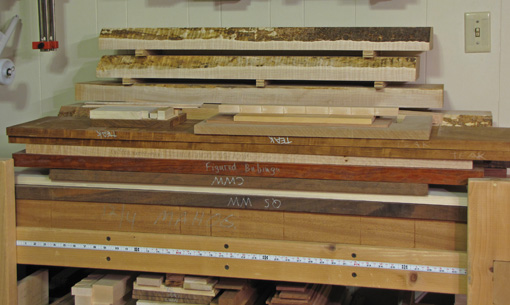
A design on paper or a monitor can never move us like the presence of the real object. It isn’t a work in wood without the wood. Sometimes a special piece of wood is the genesis of a project, sometimes it follows the design, but either way, the choice of wood is never an afterthought. It goes hand in hand with the design.

I never get past the first idea or sketch without considering what woods might bring them to life. Sensitivity to the wood is essential to creating compelling, personal woodwork. I believe that one reason that a lot of the furniture that comes from non-woodworker design “experts” looks lifeless is that the wood is just “filled in,” like a color of paint.

Unlike stone, clay, glass, or metal, wood carries the exciting variety of biology for us to behold and use! Practically, this requires that we understand and account for its properties, quirks, and even its mysteries. The differences in choosing, for example, butternut versus bubinga will affect almost every aspect of a piece.

Research as to the characteristics, limitations and potential problems of the wood may be necessary, especially if using an unfamiliar species. Here are a few helpful sources: 

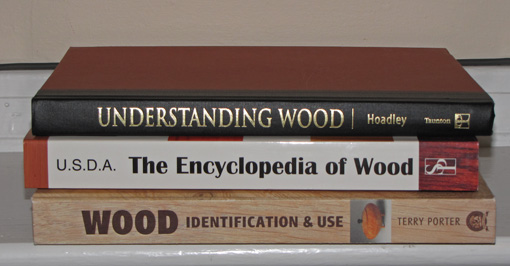
Understanding Wood by Bruce Hoadley. If there is any one “must have” book for woodworkers, this is it.

Wood Handbook/Encyclopedia of Wood from the Forest Products Laboratory. All 486 pages are available as a free pdf here. Click on “View” under “Wood handbook – All Chapters” for the 13.90 MB download. Also available from Lee Valley in printed form.

Wood by Terry Porter. A beautiful compendium of pictures and descriptions of woods to whet your appetite.

FPL Tech sheets Look on the right side of the page for “Wood Properties (Techsheets).” Very helpful data such as wood movement values for many species . 

Paul Hinds’ unbelievable website with a gazillion pictures of a zillion species of wood. 

Purdue Cooperative Extension site Select “Hardwood Lumber and Veneer Species” from the drop down list. Practical monographs on domestic species with helpful pictures showing the range of quality and figure within each species.

Most important, you’ve got to get your hands on the particular wood you are planning to use, see how it works, moves, finishes, and watch and live with it a little while before using it in the project.

For the mirror, the example piece for this series of posts, I wanted a densely figured wood that would look good in narrow widths. I held up some pieces next to the bathroom mirror: maple, other light woods, and walnut, just didn’t give the look I wanted. The reddish color and swirly figure of waterfall bubinga were hits. I had false started with some figured makore only to find that I seemed to be sensitive to the dust and I wasn’t as fond of the figure as I first thought. I also had to junk one of the pieces of bubinga that had some stresses in it. That’s wood for you. I love this stuff.

Next in the series: Researching the design and techniques.

Author:
• Tuesday, April 13th, 2010

“I change many things, discard, and try again until I am satisfied. Then, however, there begins in my head the development in every direction, and, inasmuch as I know exactly what I want, the fundamental idea never deserts me, – it arises before me, grows. . .”Beethoven

As you play with various ideas, one (maybe a few) seems particularly attractive. It grabs you and demands further exploration. After some development, it becomes a clear, strong, and compelling vision of your project. This is what I am calling the “concept.”

The concept is important because it will be a guiding, unifying vision throughout the rest of the design and building processes. It defines a piece: its look, mood, style, and aesthetic. It sustains you when doubts arise deep into making a project. The concept is a bit like a person you understand, trust, and love.

For most of us, highly skilled and exact drawings are not necessary to represent a concept. What matters is to have enough sketches, graphite or electrons, and a mental sense, to make the concept clear to you. Every detail need not be worked out at this point. Rather, the clarity of the concept is a reference that promotes consistency when deciding later which nuances fit or fight the look of the piece.

Like a song, there will usually be a “hook” – an aspect that draws keen interest within the unity of the piece. The concept need not be grand; a modest, simple theme sharply conveyed with conviction can be quite powerful. There must be a good sense of the size and overall proportions of the piece.

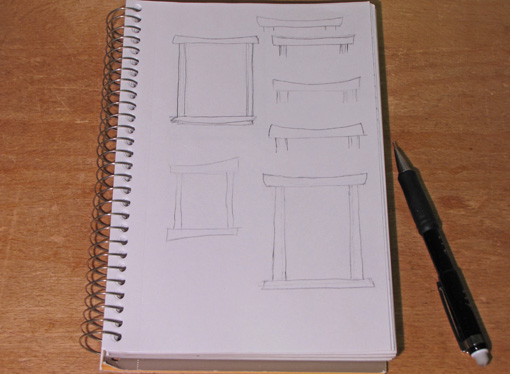
For the wall mirror, the example piece in this series, I wanted a Japanese motif, most significantly with curves contrasting with straight lines and angles. No mitered corners. The top of the frame was the hook for me. The straight line, trapezoidal sides lead the eye up to it. As I experimented with different shapes at the ends of the top piece, it was easy to pick the winner. The straight lines and angles of the bottom piece form a visually solid base. I later reworked the end angles. Later I experimented with adding a little shelf.

I envisioned the surfaces of the top and bottom pieces to be convex in the horizontal and vertical dimensions but I could not draw that. No problem – I worked it out later with a mock-up. I experimented with size and proportions using a medicine cabinet at home and some masking tape. I was not sure of every detail and dimension at this point, nor was everything on paper, but I was sure about the essential look of the piece.

I emphasize the need to have a concept! Some woodworking projects reflect the lack of a unifying, clear vision on the part of the maker. Features foreign to each other may be conglomerated or there may be no focus of interest, no reason for the viewer to care. Sure, we’re woodworkers and we all make pure utilitarian stuff too – I sure do – but if you want to make fine woodwork that excites and fulfills, develop a good concept to get you going.

This is fun!

Next: Wood

Author:
• Sunday, April 04th, 2010

An idea is a notion, an inkling. It is not a developed concept of a piece; that comes later. It is what you start with. Many ideas come to mind, some making a quick exit, some lingering, and some shining brightly. Some may gather light slowly, some may later fade, and maybe some will be true love at first sight.

There are two important matters in this. First, get a sketchbook and use it. It is a place to save ideas and to play with them. I like a small (6″ x 9″) book for convenient portability, though larger books offer the advantage of juxtaposing more sketches on one page. Maybe an iPad will do. Second, you must recognize a good idea – one that demands further exploration. Ultimately, that is a personal feeling that you’ve got to trust.

Ideas are found anywhere and everywhere. You may start with a specific functional need, such as a dining table to seat six people, or have some great wood that “tells you” what it can become, or just want to make any kind of fulfilling piece. In any case, look at lots of furniture, old and new, as well as architecture, nature, and more. Visual inspiration may come from sources that are seemingly distant from woodworking – pottery, roof tile, shoes, a doorknob, a turtle, or the dark recesses of your mind.

Go to Google Images and search Mayan art, coffee table, Greek temples, or whatever. Don’t be shy. Einstein said, “The secret to creativity is knowing how to hide your sources.” True, I suppose, but there should be no guilt involved. If you are designing a dining table, for example, look at more than just dining tables. Maybe a plant stand or a Japanese shrine will generate an idea for the table legs.

Doodle in your sketch book. Drawing ability is handy but not essential. Get something on paper that has meaning for you. I find it more productive to remember what I thought I saw and work with that, knowing that the image or motif has surely been churned in the machinations of my mind before it even becomes a sketch. Fine, I think. Maybe someone out there will make something truly 100% original, but probably not. I would bet all “original” designs are derivative to some extent. Those notions that “pop into your head” almost surely have some external basis.

On the other hand, unless you are doing reproduction work or working from plans, I feel there is no point in trying to copy or “be like” someone else’s style. It will probably be a poor copy because you are not that other person. Besides, why would you want to?

As you redraw your sketches, they become further modified and more your own. The new sketches can modify an overall look or refine only parts or details. Stay with it, explore, reject and develop as you wish. While there is still much work to be done in the design process, you are on your way to producing a clear concept of what you want to build.

I posted this little sign below the handle of my drawing cabinet:

Next: the Concept

Author:
• Sunday, March 28th, 2010

This is the introduction to a series of posts that will explore the process of turning an idea into a finished piece. The context will primarily be original work, as distinct from making something from plans or reproduction work.

For woodworkers, understanding the stages of the creative process can help us refine and better utilize it. This is the guts of creative work. For many of those who appreciate fine woodwork, there is a fascination in the development of a piece from something in the mind, to lines on paper or screen, to wood. How does something get to be there?

The outline of the series is as follows:

1. Introduction

2. Ideas

3. Concept

4. Wood

5. Research

6. Mock-up

7. Drawing

8. Building

It should not be inferred from this outline that the process is quite so linear. The stages can overlap, switch order, repeat, and sometimes be skipped. Furthermore, the very nature of creativity can generate endless exceptions to everything involved with it. Nonetheless, there is a generally applicable map that leads a woodworker’s journey from a thought to the existence of a creation that stands on its own. The finished piece reflects the soul of the craftsman/artist as well as the integrity of the process from which it arose.

For me, making things is fun and exciting. Please join me in the exploration! I will reference, as an example, a fairly simple, small piece – a wall mirror. This will avoid unnecessary complexity that might distract from the essential concepts, and it will keep the photography easy. Note that the posts in this series will not necessarily be contiguous because along the way I may get the urge to post on other topics.

Author:
• Sunday, March 14th, 2010

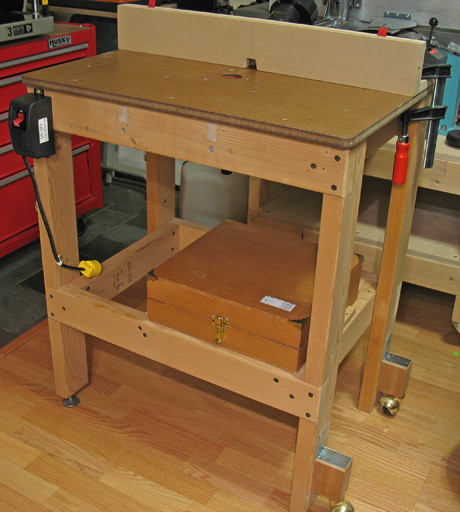
In previous posts, I described my router table and fence. They use a simple approach without router lifts, drop-in fitted plates, table slots, miter gauges, or proprietary tables and fences.

Yet upon noticing a handy-looking router table fence micro adjuster in a catalog, I was tempted. It looked straightforward enough. I studied the item in the store and figured, 24 tpi on the lead screw, well, let’s see, that’s 1/24″ per turn, 1/64″ = 3/8 turn, .004″ = about 1/10 turn. No gradation markings. . . forget it. It would not be easy to move the fence a discrete tiny numerical increment, and why else would I want a micro adjuster?

So how do I accurately adjust my router table fence? The answer is: as directly as possible, preferring consistency over absolute measurements, and using one-sided tolerance woodworking techniques which are easily compensated. For example, if I want grooves for a drawer bottom to be 3/8″ from the edge, I set the fence to a reasonably close 3/8″ and plan the work to cut all the parts with that setting. As an example of one-sided tolerance, to cut a rabbet, use the part that will fit in the rabbet to adjust the fence, adding just a hair of depth. The slight excess of lip is easily trimmed after assembly, whereas too little depth would require lots of corrective planing.

There are rare circumstances, however, when it is helpful to move the fence a tiny, specific numerical distance. If I make a cut with the router table and, for some reason, I do not want to alter the mating part to fit, I use .001″ resolution calipers to measure the difference between the cut part and the mating part and thus the amount I need to move the fence to accurately finish the cut.

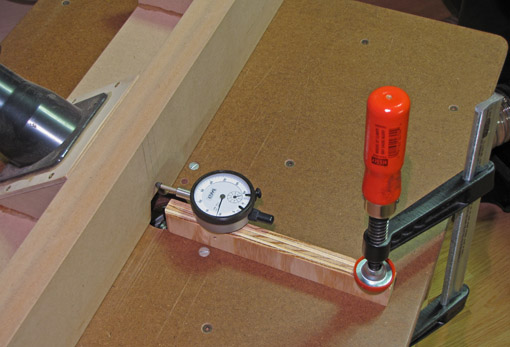
I use one screw to attach an inexpensive dial indicator to a stick which gets clamped on the table with the tip of the indicator against the fence. The fence is then moved according to the direct readout on the indicator. It would be possible permanently rig a dial indicator to the fence and table but that would be too fussy for rare use.

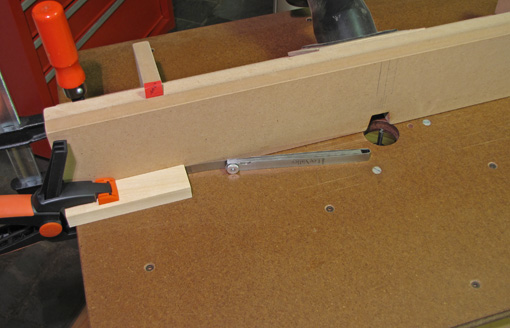
Alternatively, without a dial indicator, to retract the fence, clamp a block to the table near the end of the fence to register the initial fence position, loosen that end of the fence, interpose a feeler gauge, snug the fence up to it, and retighten the fence. To advance the fence, set the feeler gauge against the fence, snug up and clamp the block against it, loosen the fence, remove the feeler gauge, bring the fence against the block, and retighten the fence. The increment at the bit is half the measured amount at the end of the fence. These procedures are far easier and more intuitive to do than to read or write them!

For bit height, I also like to work directly, but if a measured movement is needed, the very fine adjuster with marked gradations on the Bosch 1617 router works well.

In summary, I adjust the router table fence with direct, low-tech methods the vast majority of the time, and very occasionally employ simple methods using basic multipurpose tools (that I already own) to produce specific measured adjustments.

And I saved myself from another mind-cluttering, special-purpose gadget.

Author:
• Saturday, March 06th, 2010


I will be exhibiting my work at the Paradise City Arts Festival at the Royal Plaza Trade Center, Marlborough, MA, March 19, 20, 21, 2010 (Friday, Saturday, Sunday), booth #233. Come on over if you have the chance.

This is a highly selective juried show with beautiful work in many media including ceramics, furniture, glass, jewelry, fiber, painting, photography, and sculpture. Many of the 175 artists from 22 states, Canada, and Japan are represented in major collections, museums, and publications around the world. Among its many accolades, Paradise City was named the #1 Art Fair in the US in 2008 by American Style magazine and is a perennial Top Ten pick. It is a tremendously inspiring place to be for anyone who makes or appreciates fine craft.

Heartwood readers, if the greater Boston area is reasonably accessible for you, I can tell you this is a worthwhile visit. Of course, I invite you to please stop by my booth and say hi!

Details are at the Paradise City website (that’s my cabinet on their home page). There’s also a little feature on my work in their print and online Spring Guide, page 8, and in their online slide show, “New Faces” (though I am returning from last Fall’s show).

For collectors and anyone who enjoys beautiful craft and art, including furniture/woodwork, seeing the work “live” is the best way to appreciate it and explore your ideas to acquire fine work. It is really the sophisticated and appreciative visitors to Paradise City that make the show!

Category: Resources  | 4 Comments
Author:
• Tuesday, February 23rd, 2010

Remember the old joke about the lost tourist in New York City who asks a local, “How do I get to Carnegie Hall?” The reply: “practice, practice . . .”

I am sometimes asked by novice woodworkers how best to acquire and practice skills. Well, aside from exploiting the myriad sources in media and in person, one must get into the shop, practice, and make sawdust. The inquiry truly applies to woodworkers at all general skill levels who are broadening or deepening their involvement in the craft. Woodworking is a vast field and no one is an expert at all phases, so skill acquisition is an ongoing issue for all of us. 

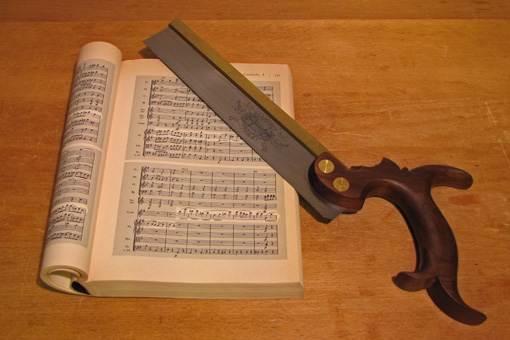
Here is my suggested approach. Let’s say one wants to learn hand cut dovetailing. I would start with isolating the process. Prepare some short pieces of easy-going poplar and cut joints. Ponder and practice layout, sawing to lines, chopping, and so forth. Think about what went wrong, tune your tools, test the limits of accuracy, and experiment. This is like practicing scales in learning a musical instrument. I would not start with a drawer, or even a box, because that creates too many distractions from the core technique.

However, I would soon, very soon, make something with dovetails. It should be a simple, manageable project that might generate some discomfort but not beyond what you feel you can reasonably handle. I would not await perfection in “practicing scales” because there is no such thing, it will be boring, and sooner or later, you have to integrate that core skill into making a bit of music. The music makes the skill meaningful.

So make a little etude piece of woodwork. Simple can be interesting. It will not end up on the back cover of Fine Woodworking. So what. It will contain some mistakes and you won’t be able to correct all of them. So what. It will, however, be yours and will bring you some quiet joy.

Forging ahead, try a small drawer. Now your dovetail “scales” and “etude” experiences will be used to make another box, but this time it will have to fit neatly into a case, which itself will have to be properly constructed if there is to be any chance at all of a good fit. You are integrating skills and they are thus becoming more meaningful.

You will be subtly adapting your dovetail skills to suit a more complex construction. Your designs, aesthetic desires, and the functional requirements of the piece beckon for further refinement of the core skill. Thus you are developing beyond a technician to a craftsman. The music’s beauty is the ultimate impetus to the dance of the fingers on the strings. This is fine woodworking that embraces technique but with a purpose beyond technique: to create a fulfilling piece of personal woodwork.

I think I am a good self-teacher, but at various times I’ve made mistakes at all of these stages. I’ve dwelled too long on isolated technique, overreached in attempting projects I wasn’t ready for, and inhibited my design ideas from fear of breaking new technical ground. That’s the other thing about practicing and getting good at woodworking, you will never stop making mistakes. You will, however, understand them and know what to do despite them.

Happy woodworking indeed!

Category: Ideas  | 9 Comments