Archive for the Category ◊ Tools and Shop ◊

Author:
• Monday, March 07th, 2011


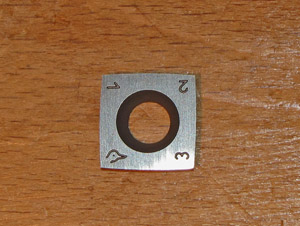
I have had my eye on carbide segmented cutterheads for a while. After studying the options and particularly after reading Glen Huey’s excellent article in the February 2011 Popular Woodworking, I decided to get the Byrd Shelix cutterhead for my DeWalt DW735 planer.

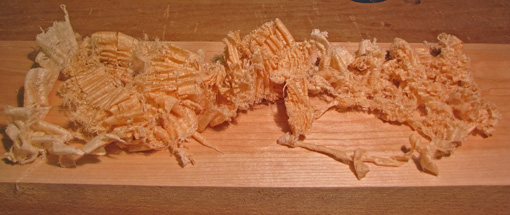
Most of my pieces use highly figured woods. I had been having trouble getting good surfaces from the planer on some of these difficult gems of nature, despite using appropriate technique. I don’t expect a machine planer to yield a finished surface, of course, but tearout surprises can require corrective handwork sufficient to change dimensions and relationships. Parts meant to match and reference surfaces were disturbed; there was too much backtracking and unpredictability. This affected my work flow and was frustrating.

In considering a segmented cutterhead, I first had to decide if the DeWalt DW735 was a good enough machine in which to invest. After years of use, its design, quality, and reliability are proven. So, primarily for the joy of using my beloved figured woods, I took the plunge: $447 for a Byrd Tool Shelix – “she” for shear, and “helix”. (Sounds like a part to soup up a motorcycle or something.)

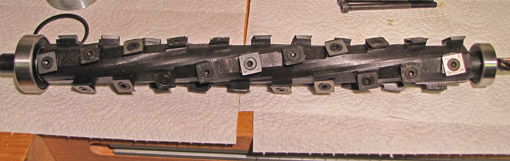
Below is the Shelix in all its medieval-looking glory. Thankfully, it comes with the bearings attached

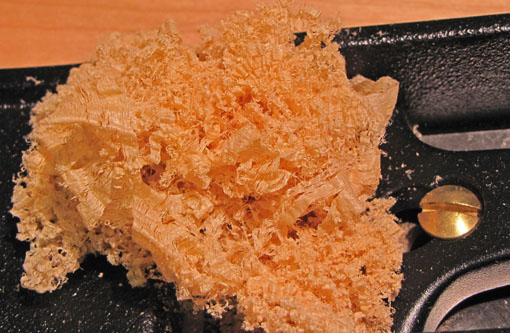
In future posts, I will discuss the basic design and performance of the Shelix, and how this tool is integrated into the work flow of a project. The latter issue is the most important one and required the most thought to make this a sensible investment.

The post immediately following this one lists tips for installing the cutterhead.

Author:
• Sunday, February 27th, 2011

The utility of a tape measure is mostly early in the building process, later steadily diminishing as most parts are cut in relationship to other parts or structures that are already in the project rather than to absolute dimensions. In general, we only measure when we have to. It is usually safer and more accurate to relate one part directly to another. This allows the effect of small absolute inaccuracies to cancel.

Nonetheless, when you are choosing boards at the wood dealer, breaking down stock to approximate sizes, and dimensioning a project’s primary structural parts, such as the length of a table leg, the tape measure is on duty. So let’s take a look at this humble tool.

In choosing a typical cupped-blade tape, I think for most furniture makers, an 8 or 10-foot tape with a ½” wide blade is too short and too floppy. It certainly will not do the job when sorting boards at the wood yard. On the other hand, a 25-foot tape with a 1″ wide blade is fine for that but seems too big in the shop where the deeply cupped blade and heavy case are cumbersome for marking out. A 12-foot tape with a 3/4″ blade is a good compromise. It has enough overall length, adequate stand-out stiffness, and is fairly convenient to mark from – the blade can be rocked so the edge meets the wood to eliminate parallax when marking. Look for a tape with neat, fine increment lines. I’m happy with my Ace Hardware model, pictured above.

Most tapes read left to right – hook it at your left, pull out the tape toward your right and the numbers are facing correctly toward you. Tapes that read right to left are marketed to be more convenient for right-handers, like me. The idea is that you pull the tape toward your left with your left hand, the numbers are facing you correctly, and your right hand makes the mark. I find the standard left-to-right tape is just fine since the tape is used in many different ways and it does not bother me to read it upside down sometimes.

The zero point accuracy of the hook varies from tape to tape so check it against a quality steel rule. Assuming the incrementation is accurate (a dubious proposition), if the tape is reading short, the hook can be shimmed with a bit of tape on its inside face. If it is reading long, you can try to file the inside face but that’s difficult. The more practical way to manage layout is to simply use one tape for all the related parts of a project. The tiny absolute errors almost never matter and the consistency will make all be fine.

When the marking reference is on a surface, meaning that the tape is not hooked over the end of a board nor is the end butted against something, you’ve got to start the measurement somewhere on the tape and the using the end is awkward at best. Let’s say you want to measure and mark 32 ½” starting from a line on the wood. Do NOT place the 1″ mark at the reference line thinking that, sure, you’ll remember to mark at 33 ½”, because you will NOT. Well, at least I will not. Instead, I use the 10″ mark on the tape for zero and mark at 42 ½”. True, I could make a mistake and be 10″ off, but that really does not happen because that error would be visually obvious. Give it a try; it works reliably for me.

Also consider the flat tapes from Fast Cap. While this is not a tape for the wood yard because it has no stand out stiffness at all, it has advantages in the shop because it lays flat on the work and effortlessly eliminates parallax. I have the 16-foot “Standard Story Pole Flatback” model, pictured above, which has a clear zone on the bottom of the tape which is easy to mark with a pencil and is erasable. In addition, this is an overall well-made tool with other convenient features. Again, though, don’t mix tapes for related parts of a project; choose one and stay with it.

Category: Tools and Shop  | 7 Comments
Author:
• Tuesday, January 18th, 2011

This is really a matter of opinion and personal work habits, but I would like to make a case for the humble workbench tool well. The bench that I have used for more than 25 years has one and I would feel awkward working without it. Here’s why.

The tool well is a place for tools, small parts, and other sundry items not in immediate use while working at the bench. When placed there, the items are protected from bumps and dings because they lie below the level of the work surface. Think about vigorously jack planing a board, pushing the plane in various directions, and the possibility of the toe of the plane crashing a square, gauge, or straightedge. Ouch. Working a curve with a rasp, sawing joints, and paring with a chisel are other examples.

Of course, the tool in hand may also be damaged from such collisions.

Without a tool well, it will actually take up more space to place the unused tools on the work surface at a safe distance to create sufficient clearance from the work at hand to avoid feeling inhibited. Thus, the tool well saves, not wastes, space.

The work on the bench surface is likewise protected from the items in the well, such as chisels. Wood parts are rotated, pushed, and otherwise manipulated on the work surface and you want to avoid unintended meetings with tools.

The outer edge of a tool well at the end of the width of a bench should be flush with the work surface. Thus, for most purposes, the bench width effectively includes the width of the tool well. The same is true of a well in the middle of the bench width. The inside of the well on my bench is 5 1/4″ wide and 2 3/8″ deep.

Of course there are some disadvantages to the tool well. Tool wells at the end of the bench width prevent most clamping in that area. Also, there is less continuous flat area on the bench. (Though Bob Lang has a clever solution to this in a bench he designed and is detailed in Popular Woodworking.)

The disadvantage that seems to be stated most often, that the tool well collects dust and debris, is not a disadvantage at all. Yes this does happen, but I would rather the debris, such as chips from chopping joints that didn’t get swept to the floor, be out of the way in the well than sit on the work surface. Anyway, it’s no big deal to sweep out the well since there is a handy ramp at one or both ends.

So, for woodworkers who are buying, building, or upgrading their workbench, these are some considerations to keep in mind and which I hope will be helpful. There are many bench designs and many excellent sources to study. Decisions are ultimately personal, so go with what seems right for you and enjoy every minute at the bench.

Category: Tools and Shop  | 11 Comments
Author:
• Monday, December 27th, 2010

Here are more second thoughts regarding previous posts. The updates are based on additional experience, news, modifications, and ideas relating to these tools.

The Domino Effect, June 12, 2009. It takes time for woodworkers to develop faith in new forms of joinery, as in new glues and finishes. We would like to have a crystal ball to see how they perform a few generations into the life of a piece. To ease my lingering doubts, I assembled a few test joints with the Domino and annihilated them with a 3-pound drill hammer. The wood failed before the joints. A very light sanding of the surface of the domino tenons to improve wetting seems like good insurance.

I’ve used Domino joints in high-end pieces but still don’t think they will ever replace traditional mortise and tenon joinery. It would be helpful if the system could make the mortises at least 1/4 inch deeper than the current maximum of 28 mm (nominal; actual is 29 mm) and use accordingly longer tenons. The machine can also be used as a handy small mortiser even without using dominos.

It would be interesting to hear of readers’ experiences with Domino joints.

Lie-Nielsen Convex Sole Plane, September 11, 2010. Finger grips filed into the sides of the plane have proven helpful. In general, I almost feel that a tool isn’t really part of my repertoire until I’ve done something to personalize it.

8 Simple Shop Tips and Conveniences, February 15, 2010. The Ni-MH batteries in the Panasonic drill-light set have finally died after a long, productive life. I replaced the set with the Makita LCT 300W 18-volt drill-impact driver-light set which uses Li-ion batteries. Wow – lots lighter, faster and longer-lasting charge, and what a buy. The impact driver is more for DIY than furniture making but it’s a serious bad boy with 1280 inch-pounds of torque.

Minimax E-16 Bandsaw, May 18, 2009. It appears from the Minimax website that this model is no longer available from them. The E-16 remains a good fit for my shop because it covers just about all my needs while being lighter and more maneuverable than the more popular MM-16. Nevertheless, I feel as strongly as ever that a quality bandsaw will expand most woodworkers’ range of work as few other tools can and more than any other machine. Bandsaws do not take up much space and can be made mobile. I suggest a steel frame saw with at least 12 inches of resaw height.

How Much Camber Should Be in Plane Irons?, May 21, 2009. Having received a few questions on this, nope, I still won’t say how much. IT DEPENDS. And don’t bother measuring it. In addition to the plane’s function (smoothing, jack, etc.) and the bevel up or down factors, other issues include: is the plane skewed in use (which makes the camber’s “sag” have a shorter span), how sharp is the blade, how hard is the wood, and how is the cap iron adjusted? Also, the amount of downward deflection of the blade’s edge will be altered by most of these factors which will, in turn, affect the functional effect of the camber.

The key is to monitor the feedback from the blade’s performance and make adjustments at the next sharpening session. Usually, camber is overdone. Fortunately, this is easy to correct, since most of the dullness is at the crown of the camber where it is readily honed away.

An Inexpensive Saw that Does Its Job Well, May 30, 2010. This has been a great workhorse in the shop. I wonder if it could be manufactured with a taper-ground plate for a little higher price. That, and a little better handle geometry would make it even better.

There’s always more to learn!

Category: Tools and Shop  | 4 Comments
Author:
• Tuesday, November 30th, 2010

Here are some updates to previous posts, mostly regarding tools.

Since the original posts appeared, I’ve had the time to accumulate experience with additional tools, incorporate modifications to tools, or have additional ideas about their function.

Rust Busters, January 15, 2009, discussed helpful rust prevention products. Shortly thereafter, I installed Zerust drawer liners in my tool cabinet drawers. These look and feel like non-slip router mats but contain corrosion inhibitors which work invisibly and odorlessly. The gripping effect of the mat prevents tools from sliding, bumping, and rattling when the drawer is opened and closed. A 1 x 6-foot sheet costs $8.95 and protects up to 5 years according to the package label, 2 years according to the website. A definite winner.

Dovetail Chisels, September 28, 2008. Opinions vary because there is more than one good way to do almost everything in woodworking, but I still find it helpful to have a set of narrow chisels with side relief to clear the waste between tails. My Japanese chisels for this purpose are more than 20 years old. Bob Zajicek of Czeck Edge Tools has addressed this issue by producing a chisel design with side bevels that directly meet the back at a 70̊ angle, and have a one degree taper along the length to further reduce binding. I have not tried these but it looks like an excellent design and they are doubtless as meticulously crafted as the other products by Bob that I have tried.

Other options to consider are the Ashley Isles round back dovetail chisels sold by Tools for Working Wood.

More Workbench Upgrades – Pups, Anchors, and Stops, December 2 and 6, 2009. The longer I used these helpful additions to my workbench, the more it became apparent that the Veritas Wonder Pups would provide even greater versatility to the wood-holding repertoire. I put thin PSA cork on the clamping faces. They are now part of the team and are clear winners. 

Ditto for the Gramercy holdfast, and the bench already has several of the required 3/4″ holes. This tool is as good as it gets in combining simplicity and effectiveness. I think a piece of modern abstract sculpture can now be held securely on my workbench.

Bandsaw, Hand Tool With a Motor, June 15, 2010. In response to a reader’s question, I noted that I do my bandsaw work with just two blades by Suffolk Machinery, a 3/4″ wide, 2/3 tpi variable pitch blade for resawing and other straight cuts, and a 3/8″ wide, 6 tpi blade (see the Comments section of the post for more details.) I still think they are superb blades. Lately, I have been using the SuperCut’s Premium Gold ½” wide, 3 tpi blade which has bone-chillingly sharp carbide-impregnated teeth. I was skeptical that the ½” width would be sufficiently stiff for resawing. I still need more experience with the blade, but so far, so good.

The handy benefit is that I can also cut my usual shallow, sweeping curves with this ½” blade which comes with the back smoothly rounded. This usually saves me from one of the most unpleasant jobs in the shop: changing bandsaw blades.

More “second thoughts” to come in a future post. I’m always learning more about this craft and enjoy doing so. I hope this information is helpful to you for your woodworking.

Category: Tools and Shop  | 2 Comments
Author:
• Tuesday, October 19th, 2010

Gimlets can be handy tools especially when you need to bore a small hole and the usual drilling tools cannot fit in a tight space. I usually find myself using them if I’m in a jam, meaning that I need to drill a hole that I should have made at an earlier stage in construction. I find gimlets useful in small diameters, from 5/64″ to 5/32″, and mostly use them to pre-bore for screws.

The problem is that gimlets do not work very well – they tend to split the wood. I am referring to the commonly available gimlet with a screw point followed by drill flutes further up the shaft. Lee Valley, Highland Hardware, Garrett Wade, and others sell what appears to be the same set of seven for about $14-$15.

For the record and to distinguish, there are other, fussier-looking, more expensive types of gimlets that more resemble a tapered drill bit, some meant to be used in a brace, that are less widely available and not dealt with here. There is also a Japanese gimlet, the kiri, that resembles a miniature sharply angled spade bit on a tapered dowel handle that is rotated between the palms to bore a hole. Still another tool altogether is the very useful brad awl or bird cage awl.

The design of the common gimlet, pictured above, causes the screw threads to feed aggressively into the wood and squeeze past the wood fibers while doing little, if any, actual severing of the fibers. It’s not really much improvement over just pounding a round nail into the wood.

However, consider the design of auger point screws, shown below, such as the type used for pocket-screwed joints. These break some wood fibers as they are driven and so reduce splitting. They do not, however, appreciably clear chips from the hole because the screw threads are not designed to do that. What if the gimlet screw point was altered to mimic an auger screw point so it could cut fibers, and pass the chips onto the drill flutes so they could be cleared?

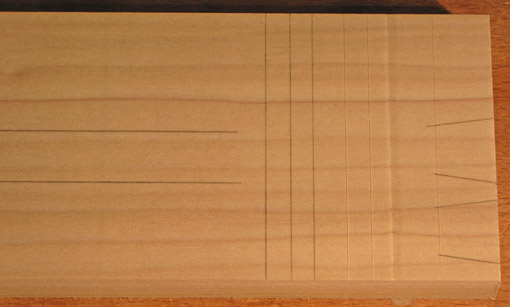
I made this alteration to the points on my set of gimlets. I found that the edge of a Japanese feather saw file (hatsuke-yasuri) did the job quickly and well, even on the 5/64″ gimlet, and better than a diamond paddle or a triangular Western saw file. I cut two slots on each gimlet, 180̊ apart.

The 75 mm “full cut” Japanese file that I used:

Does it work? Yes, fairly well and certainly a big improvement over the unaltered gimlets! The modified screw point cuts some fibers, makes boring easier, and produces some chips, although the chips don’t get cleared very well by the drill flutes. To compensate, I simply periodically pull out the gimlet to clear chips. Splitting is virtually eliminated. 

This simple modification turns a frustrating tool into a life-saver in a bind. In fact, I’ve gone from almost having given up on these tools to valuing them enough to make a nice little holder for them which attaches to the inside of a door of my hand tool cabinet.

Addendum: (10/21/10)

By “fairly well” I mean that gimlets still have their drawbacks. They are, after all, very simple tools that are substitutes for more mechanically sophisticated tools that are preferable – like a drill. So, in the context of a gimlet, I think I can say that this modification makes them work, here goes, “well!”

It helps to use the Japanese file to create a clean slot with an approximately 90° attacking edge, as pictured. This edge meets the wood aggressively and breaks the fibers. A sloppy “V” groove would have, in effect, a relaxed “rake” angle to meet the wood and thus be less effective.

Category: Tools and Shop  | 15 Comments
Author:
• Saturday, September 11th, 2010

Before using this unimposing little plane I was doubtful that it could get much work done but having put it to work in the shop I am convinced that it really performs. It brings an effective combination of toughness and control to curved work and hollowing.

The plane has a bevel-up A2 blade bedded at 20̊ and a 3 1/2″ long double convex sole with a shallow 27″ radius along its length and a steeper 3″ radius across its width. The blade is secured with a simple cap and thumbscrew mechanism and is adjusted by hand or by tapping with a small hammer. Nothing complicated with this tool, it goes right to work.

The “squirrel tail” handle is the key to controlling the plane. The dome of the tail nestles in the lower part of the palm of the hand while the fingers surround the plane’s body with the index finger settling on the round depression at the front of the tool. This allows one to adjust and balance hand pressure toward the front or back of the tool as needed in order to engage the blade to cut on a curved surface. I find this makes it easier and more natural to control than other convex sole tools such as a spokeshave.

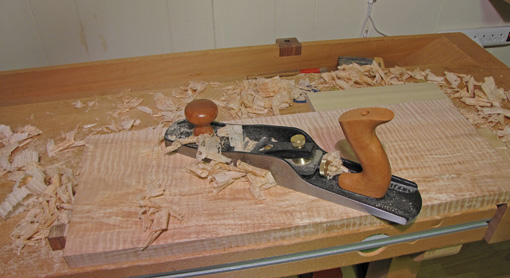
The mouth opening is quite wide which, along with the curved blade, and lightweight handiness of the plane, allow quick back and forth strokes, much like the action of a scrub or jack plane. I find this tool is best used as a sort of mini jack plane for hollowing. The photo below shows an example.

I bandsawed a shallow lengthwise curve into a 27″ long piece of plump 5/4 9″ wide cherry which will be used as the top of a wall cabinet. I used the convex sole plane to efficiently remove the bandsaw marks and refine the curve. The plane felt like an extension of my hand allowing me to work intuitively as I formed the curve to my liking. The shallow scallops that remained were easily removed first with a curved Surform rasp followed by an Auriou curved “ironing rasp,” hand scraper, and sandpaper.

[I will mention that removing a substantial portion of wood from one side of a board like this is likely to create problems as the internal stresses in the board become unbalanced. I plan to discuss in a future post how I anticipated and worked around this sneaky problem.]

While I’m very happy with the L-N convex sole plane and recommend it, I would consider some design changes if I could have my preferences. It is a bit undersized for medium scale work, although an increase in size might sacrifice some of its handiness. A slightly larger radius across the width of the sole would suit more of my work. Perhaps a choice of sizes and soles could be made. Finally, knurling or a coarse surface on the widest parts of the sides would allow a better finger tip grip. I guess I can add that myself.

This tool review is unsolicited and uncompensated.

Author:
• Sunday, August 29th, 2010

Here are three finishing tools that are very useful for controlling surface sheen and removing surface imperfections. I am discussing them here because among woodworkers these are probably generally less known than most finishing products and each has earned a solid place in my lineup.

Fibral Abrasive Wool can be used in place of steel or bronze wool. My sense is that the “Fine” wool, listed as 800 grit, is about equivalent to 4/0 metal wool. However, Fibral is a fundamentally different product than metal wool in that the abrasive grit which is bonded to the fibers, rather than the fibers themselves, does the actual cutting. While in this sense it is like Scotch Brite, it has the advantage of metal wool in that a wad of it can be formed into any size and shape.

Fibral is much more pleasant to use than steel and bronze wools and has almost completely supplanted them in my shop. I use it for everything where I formerly used metal wool, such as for controlling the final sheen of finished surfaces, especially irregular shapes, and for removing small imperfections. It can also be used like metal wool for smoothing dust nibs between coats of finish. For accessible flat surfaces, however, a light touch with fine sandpaper is still better and faster for that job, particularly since, as Bob Flexner teaches us, steel wool and grit-fiber products round over dust nibs rather than cut them off. Fibral, also available in medium and coarse grades, is not widely sold but can found at Beall Tool Company.

Mirlon Total is a wonderful product that combines surprisingly aggressive cutting action with great control and comes in ultrafine grits. It is densely grit-coated fiber available in 360, 1500, and 2500 grit pads and rolls. The two finest grits have become indispensable in my shop. For certain film finishes, especially water base poly/acrylic, I rub out the final dried coat with a 2500 pad (sometimes 1500) to produce an even, delicate satin sheen and remove all imperfections. A light buffing with wax completes the look. To work flat surfaces, I usually wrap the pad around a felt block. The pads are very flexible to easily get into confined areas and can even be crumpled to work almost like steel wool or Fibral but in finer grits. Mirlon Total is available in packages of three pads from Woodcraft, but a Google search will turn up at least several sources selling in quantities of 25 for less than half the unit price. 

By the way, for the rare times when I need to cut back and level a fairly heavy film finish, such as on a table top, these are not the products of choice. Sandpaper is best for that job.

The third “product” that bears mention along with Fibral and Mirlon Total is Bob Flexner’s tip to use the slightly abrasive property of brown paper. Just tear off a piece from an ordinary supermarket brown paper bag and use it for ultrafine final rubbing out of finished wood. If you’ve spent hours handling brown cardboard boxes, the effect on your hands must have convinced you of the abrasive action of heavy brown paper.

The project ain’t over ‘till it’s finished.

These reviews are unsolicited and uncompensated.

Category: Tools and Shop  | Comments off