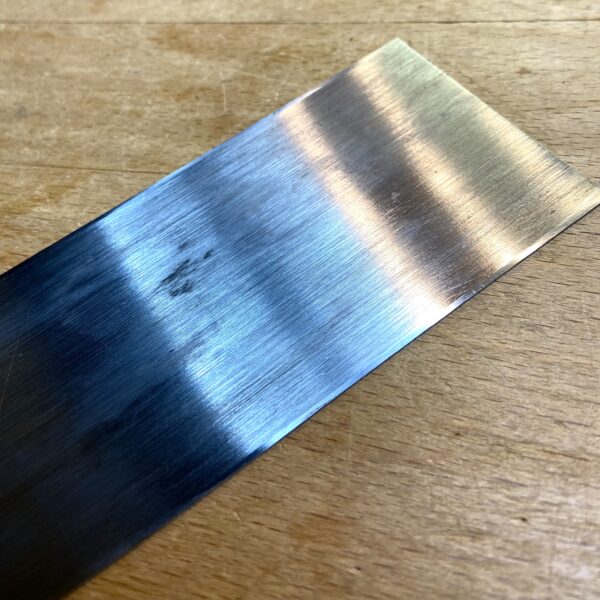
We well start from the beginning.
The edge is made flat, straight, and very smooth at 90°. This can be filed first, though I generally find this unnecessary because all can be readily done with sharpening stones. If you prefer, use a smooth mill file and a piece of wood to hold it square to the scraper edge.
I start with my 325/45µ DMT diamond stone, using a simple block of wood to keep the scraper edge square to the stone while consistently moving it to different spaces on the stone as you scrape it.
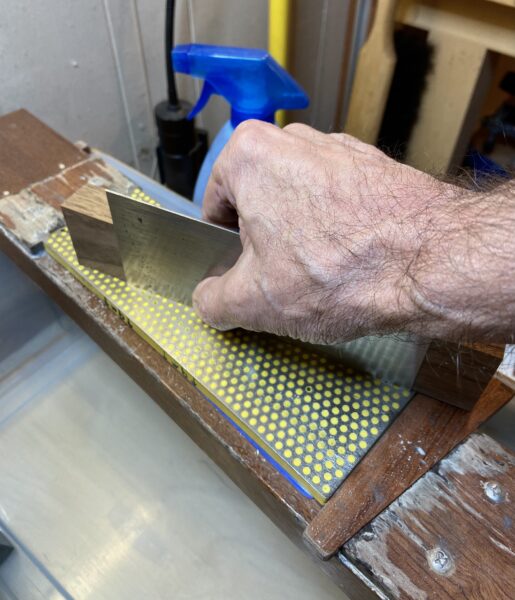
I do the same next on the 1200/9µ diamond face. Then I finish on the next finer step that I have available: the 8000/~2µ Kuromaku stone. To stop at 1200 is not bad but there is not much extra work to finish finer. Even 4000 is pretty good if that is what you have available.
Next, the same general process is done to the flat face. Here, however, there is no need to take forever doing the whole surface. Just a short width – say 1/8” or so – needs to be treated to meet with the edge.
The easiest way to do this is the same general method developed by the late master David Charlesworth for the general sharpening step of the back of a blade. He used a thin strip – I like a .020” strip of plastic – under the blade on one side of the stone, while the other side the blade only contacts the stone with a very narrow width. For scrapers, I again use a simple block of wood to keep the edge contacting the stone flat and straight. Thus, only the most outer small fraction of an inch gets sharpened, and it is much less work.
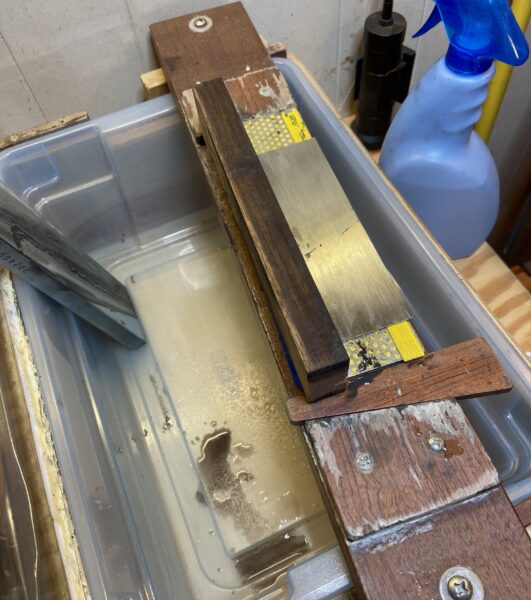
Just like the edge work up, I go through 325, 1200, and 8000. I usually like to use grippy, waterproof gloves for this work on the wetted stones.
I find that a little bit of back-and-forth between the edge and the side faces cleans things up nice and neat. And now you are done with the hard work!
Next, we will do the burnishing work.
