Archive for the Category ◊ Techniques ◊

Author:
• Wednesday, April 21st, 2010

A design on paper or a monitor can never move us like the presence of the real object. It isn’t a work in wood without the wood. Sometimes a special piece of wood is the genesis of a project, sometimes it follows the design, but either way, the choice of wood is never an afterthought. It goes hand in hand with the design.

I never get past the first idea or sketch without considering what woods might bring them to life. Sensitivity to the wood is essential to creating compelling, personal woodwork. I believe that one reason that a lot of the furniture that comes from non-woodworker design “experts” looks lifeless is that the wood is just “filled in,” like a color of paint.

Unlike stone, clay, glass, or metal, wood carries the exciting variety of biology for us to behold and use! Practically, this requires that we understand and account for its properties, quirks, and even its mysteries. The differences in choosing, for example, butternut versus bubinga will affect almost every aspect of a piece.

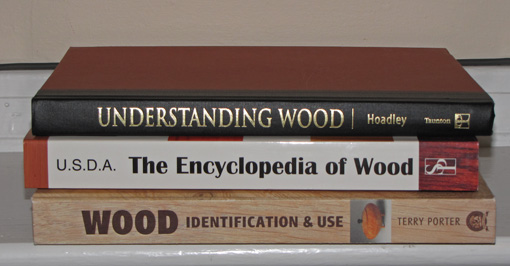
Research as to the characteristics, limitations and potential problems of the wood may be necessary, especially if using an unfamiliar species. Here are a few helpful sources: 

Understanding Wood by Bruce Hoadley. If there is any one “must have” book for woodworkers, this is it.

Wood Handbook/Encyclopedia of Wood from the Forest Products Laboratory. All 486 pages are available as a free pdf here. Click on “View” under “Wood handbook – All Chapters” for the 13.90 MB download. Also available from Lee Valley in printed form.

Wood by Terry Porter. A beautiful compendium of pictures and descriptions of woods to whet your appetite.

FPL Tech sheets Look on the right side of the page for “Wood Properties (Techsheets).” Very helpful data such as wood movement values for many species . 

Paul Hinds’ unbelievable website with a gazillion pictures of a zillion species of wood. 

Purdue Cooperative Extension site Select “Hardwood Lumber and Veneer Species” from the drop down list. Practical monographs on domestic species with helpful pictures showing the range of quality and figure within each species.

Most important, you’ve got to get your hands on the particular wood you are planning to use, see how it works, moves, finishes, and watch and live with it a little while before using it in the project.

For the mirror, the example piece for this series of posts, I wanted a densely figured wood that would look good in narrow widths. I held up some pieces next to the bathroom mirror: maple, other light woods, and walnut, just didn’t give the look I wanted. The reddish color and swirly figure of waterfall bubinga were hits. I had false started with some figured makore only to find that I seemed to be sensitive to the dust and I wasn’t as fond of the figure as I first thought. I also had to junk one of the pieces of bubinga that had some stresses in it. That’s wood for you. I love this stuff.

Next in the series: Researching the design and techniques.

Author:
• Tuesday, April 13th, 2010

“I change many things, discard, and try again until I am satisfied. Then, however, there begins in my head the development in every direction, and, inasmuch as I know exactly what I want, the fundamental idea never deserts me, – it arises before me, grows. . .”Beethoven

As you play with various ideas, one (maybe a few) seems particularly attractive. It grabs you and demands further exploration. After some development, it becomes a clear, strong, and compelling vision of your project. This is what I am calling the “concept.”

The concept is important because it will be a guiding, unifying vision throughout the rest of the design and building processes. It defines a piece: its look, mood, style, and aesthetic. It sustains you when doubts arise deep into making a project. The concept is a bit like a person you understand, trust, and love.

For most of us, highly skilled and exact drawings are not necessary to represent a concept. What matters is to have enough sketches, graphite or electrons, and a mental sense, to make the concept clear to you. Every detail need not be worked out at this point. Rather, the clarity of the concept is a reference that promotes consistency when deciding later which nuances fit or fight the look of the piece.

Like a song, there will usually be a “hook” – an aspect that draws keen interest within the unity of the piece. The concept need not be grand; a modest, simple theme sharply conveyed with conviction can be quite powerful. There must be a good sense of the size and overall proportions of the piece.

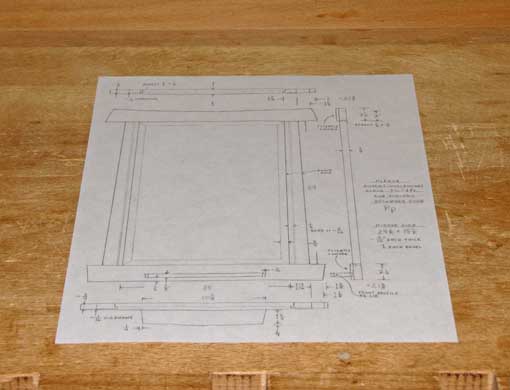
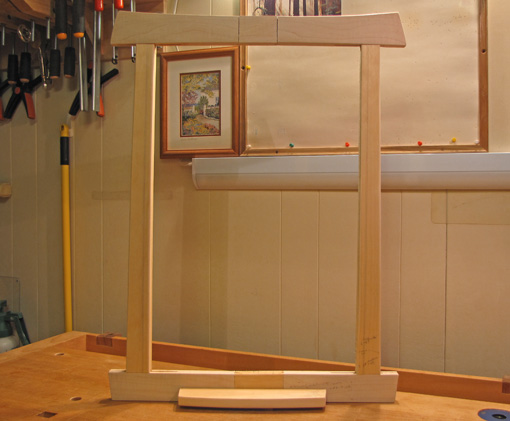
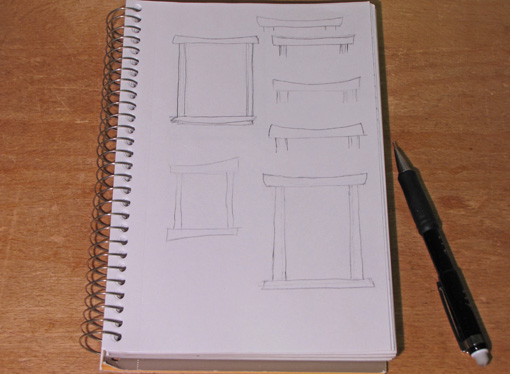
For the wall mirror, the example piece in this series, I wanted a Japanese motif, most significantly with curves contrasting with straight lines and angles. No mitered corners. The top of the frame was the hook for me. The straight line, trapezoidal sides lead the eye up to it. As I experimented with different shapes at the ends of the top piece, it was easy to pick the winner. The straight lines and angles of the bottom piece form a visually solid base. I later reworked the end angles. Later I experimented with adding a little shelf.

I envisioned the surfaces of the top and bottom pieces to be convex in the horizontal and vertical dimensions but I could not draw that. No problem – I worked it out later with a mock-up. I experimented with size and proportions using a medicine cabinet at home and some masking tape. I was not sure of every detail and dimension at this point, nor was everything on paper, but I was sure about the essential look of the piece.

I emphasize the need to have a concept! Some woodworking projects reflect the lack of a unifying, clear vision on the part of the maker. Features foreign to each other may be conglomerated or there may be no focus of interest, no reason for the viewer to care. Sure, we’re woodworkers and we all make pure utilitarian stuff too – I sure do – but if you want to make fine woodwork that excites and fulfills, develop a good concept to get you going.

This is fun!

Next: Wood

Author:
• Sunday, April 04th, 2010

An idea is a notion, an inkling. It is not a developed concept of a piece; that comes later. It is what you start with. Many ideas come to mind, some making a quick exit, some lingering, and some shining brightly. Some may gather light slowly, some may later fade, and maybe some will be true love at first sight.

There are two important matters in this. First, get a sketchbook and use it. It is a place to save ideas and to play with them. I like a small (6″ x 9″) book for convenient portability, though larger books offer the advantage of juxtaposing more sketches on one page. Maybe an iPad will do. Second, you must recognize a good idea – one that demands further exploration. Ultimately, that is a personal feeling that you’ve got to trust.

Ideas are found anywhere and everywhere. You may start with a specific functional need, such as a dining table to seat six people, or have some great wood that “tells you” what it can become, or just want to make any kind of fulfilling piece. In any case, look at lots of furniture, old and new, as well as architecture, nature, and more. Visual inspiration may come from sources that are seemingly distant from woodworking – pottery, roof tile, shoes, a doorknob, a turtle, or the dark recesses of your mind.

Go to Google Images and search Mayan art, coffee table, Greek temples, or whatever. Don’t be shy. Einstein said, “The secret to creativity is knowing how to hide your sources.” True, I suppose, but there should be no guilt involved. If you are designing a dining table, for example, look at more than just dining tables. Maybe a plant stand or a Japanese shrine will generate an idea for the table legs.

Doodle in your sketch book. Drawing ability is handy but not essential. Get something on paper that has meaning for you. I find it more productive to remember what I thought I saw and work with that, knowing that the image or motif has surely been churned in the machinations of my mind before it even becomes a sketch. Fine, I think. Maybe someone out there will make something truly 100% original, but probably not. I would bet all “original” designs are derivative to some extent. Those notions that “pop into your head” almost surely have some external basis.

On the other hand, unless you are doing reproduction work or working from plans, I feel there is no point in trying to copy or “be like” someone else’s style. It will probably be a poor copy because you are not that other person. Besides, why would you want to?

As you redraw your sketches, they become further modified and more your own. The new sketches can modify an overall look or refine only parts or details. Stay with it, explore, reject and develop as you wish. While there is still much work to be done in the design process, you are on your way to producing a clear concept of what you want to build.

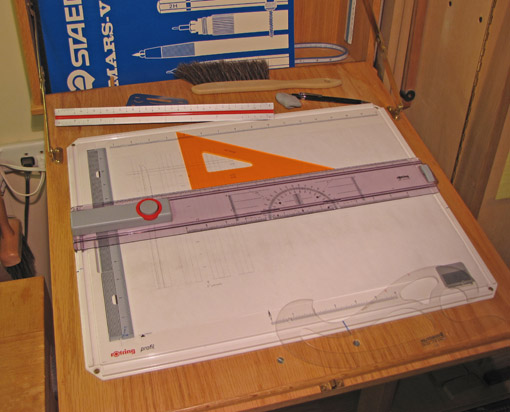
I posted this little sign below the handle of my drawing cabinet:

Next: the Concept

Author:
• Sunday, March 28th, 2010

This is the introduction to a series of posts that will explore the process of turning an idea into a finished piece. The context will primarily be original work, as distinct from making something from plans or reproduction work.

For woodworkers, understanding the stages of the creative process can help us refine and better utilize it. This is the guts of creative work. For many of those who appreciate fine woodwork, there is a fascination in the development of a piece from something in the mind, to lines on paper or screen, to wood. How does something get to be there?

The outline of the series is as follows:

1. Introduction

2. Ideas

3. Concept

4. Wood

5. Research

6. Mock-up

7. Drawing

8. Building

It should not be inferred from this outline that the process is quite so linear. The stages can overlap, switch order, repeat, and sometimes be skipped. Furthermore, the very nature of creativity can generate endless exceptions to everything involved with it. Nonetheless, there is a generally applicable map that leads a woodworker’s journey from a thought to the existence of a creation that stands on its own. The finished piece reflects the soul of the craftsman/artist as well as the integrity of the process from which it arose.

For me, making things is fun and exciting. Please join me in the exploration! I will reference, as an example, a fairly simple, small piece – a wall mirror. This will avoid unnecessary complexity that might distract from the essential concepts, and it will keep the photography easy. Note that the posts in this series will not necessarily be contiguous because along the way I may get the urge to post on other topics.

Author:
• Friday, October 09th, 2009

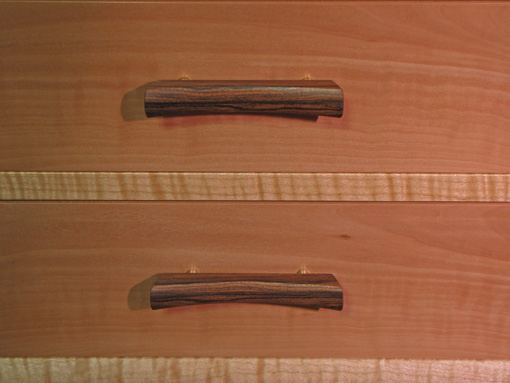
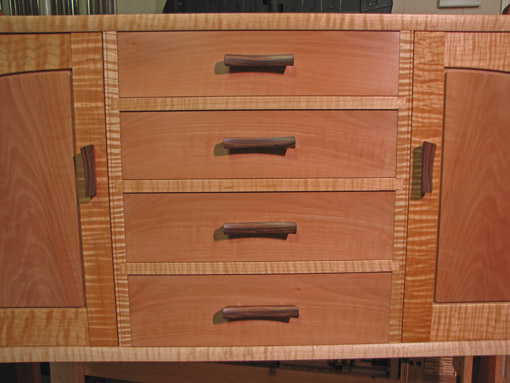
Making a drawer handle is a fun opportunity for creativity, but it ought not make a dissociated statement of its own. The handle should be consistent with the design of the whole piece while providing an interesting accent. I like a pull that is inviting to gently grab, yet is sturdy. For contemporary work with graduated-size drawers, commensurately graduated handle sizes may be a nice touch. I usually choose dark, dense, exotic woods for handles.

As I stated in the first installment of this series: “This is not the only way to make fancy drawers, nor do I propose it as the “best” way because that judgement depends on function and aesthetics which are ultimately the provinces of each craftsman for each project.”

I think the mystique surrounding drawer making is exceeded in woodworking only by finishing and chair making. I suggest forget that cloud of doubt. Crafting a nice drawer shares principles common to all woodworking:

  • understand the logic of the process
  • be exact, or perhaps more realistically, stay on the correct side of tolerance in the critical parts
  • try to be at ease in your work.

Believe me, these drawers are not perfect; no one’s are! I do, however, try to work at a level where I can enjoy the process and the product, and forgive little imperfections.

I wish you enjoyment and success in your woodworking.

Category: Techniques  | Tags:  | 6 Comments
Author:
• Tuesday, September 15th, 2009

Hopefully, the drawer will close with the front even all around with the edge of the opening. If not, now is the time to correct this by planing. Soften corners to your preference. Cut a substantial chamfer on the top of the entering edges of the sides.

Closing stops can be installed at the front of the frame to contact the back surface of the drawer front below the drawer bottom. The strongest designs are those mortised into the frame. This generally requires the foresight to make the mortises before assembling the frame. (No comment.) They can also be glued, screwed, or even mortised to the frame near the end of construction, though less conveniently. To ease installation, it is helpful to design the stop with an abutting placement, such as against the back edge of the divider. The photo above shows a simple drawer stop design that hooks over the divider and is screwed to the back of it. The small undercut chamfer, visible at the front of the stop, facilitates fine trimming with a shoulder plane after assembly.

For all but the smallest drawers, two stops are best to create an unambiguous closure across the full width of the drawer. Since the drawer is then in a good, neutral position, it will be easy to open without jamming. I prefer the front face to be a hair inside the edge of the housing.

Alternatively, closing stops can be placed at the back of the case on the runners.

Outgoing stops are optional. A simple, effective design is a small piece of wood, screwed to the back of the drawer divider, which contacts the back of the drawer on its way out, yet can be rotated 90 degrees to let the back pass by to remove the drawer. (You know, to show your woodworking friends.)

I like to bevel the bottom edge of the front of a flush fit drawer to prevent it from rubbing the bottom of the drawer frame. (The drawer is upside down in the photo below.) This way the drawer will run only on its sides. On very small drawers, it may look good to match this gap to the one at the top of the front.

The front is finished to match the outside of the piece. For the sides and back and bottom, think “less is more.” Personal preferences aside, there are a few points to keep in mind: avoid perpetually smelly oil finishes on the inside of the drawers or case, finish the bottoms before assembly, and avoid any film finish on the outside of the side pieces. A light coat of wax on the sides’ outer surfaces and bottom edges will help produce pleasant drawer action.

Next: getting a handle on it and closing thoughts for the series

Author:
• Tuesday, September 08th, 2009

Solid wood drawer bottoms are the primary topic of this discussion and are used in this project. However, plywood also deserves consideration as a good quality option. Stable, strong, and easy to prepare, thin hardwood plywood is readily available in many species and thicknesses with flatsawn and quartersawn face veneers. The laminate edges will not be visible except at the back. I do not think plywood bottoms, skillfully and tastefully employed, diminish the quality of a “high-end drawer” in modern furniture.

The thickness of a solid wood bottom should be commensurate with the overall size of the drawer, the load it is expected to bear, and the strength of the chosen species. The Port Orford cedar bottoms of these fairly small drawers are slightly over 5/16″ thick, while those for a chest of drawers might be ½” thick. Gluing up thin stock presents special issues which have been discussed in two earlier posts. Quartersawn wood is preferable because of its resistance to cupping.

The grain runs along the width so this dimension will be stable through the seasons, preserving the critical fit of the drawer width in its housing. The panel is raised on the outside (underneath) face, here with a simple square-edged field, to create 1/4″ thick tongues to fit in the grooves, keeping a small border of consistent width along the two sides and the front. Many woodworkers prefer a flat-beveled or coved panel. The bottom can be sized to leave a very tiny gap at the base of the grooves in the sides to avoid distorting the drawer when sliding the bottom in place.

Now we must deal with seasonal changes in the front-to-back dimension (across the grain) of the drawer bottom. Calculate rather than guess the amounts. Unless you are working on the driest day of the year, the bottom must extend beyond the back of the drawer. To accommodate seasonal movement, screws pass through open-end slots in the bottom and thread into the back. Make the slots long enough and locate the screws to allow for the largest dimension on the most humid day, but don’t make the slots so long that they will be visible from the inside of the drawer on the driest day. It usually helps to have a thick drawer back and to locate the screws toward the outer surface of the drawer back. (Since I have experience messing up this last detail because I didn’t think it through, I feel compelled to warn you.) Here I used practical washer head screws, but you may prefer the look of a flat head screw in a tapered-rim slot.

I think it is best to lightly glue the front edge of the bottom into the groove in the drawer front (only!) so all of the movement “collects” at the rear of the drawer. I use hide glue for this since its reversibility will come in handy if a damaged bottom ever needs repair or replacement.

For drawers that are very shallow (front to back), it is often possible to simply cut the bottom flush, screw it to the back without slots, and make the groove in the front deep enough to accommodate all the movement that will collect at the front end.

Next: final trimming, drawer stops, finishing.

Category: Techniques  | Tags:  | Comments off
Author:
• Wednesday, August 26th, 2009

Glue up in this method goes easily. No special clamping blocks are required; pressure can be applied directly to the sides with parallel jaw clamps because the surfaces of the tails are proud of the end grain of the pins. Blue masking tape applied to the inside surfaces will eliminate the unpleasant job of cleaning up glue squeeze out in confined areas. Use pinch rods to check the diagonals to ensure the drawer will be square.

After the glued assembly has cured, it’s time for the cool part. Plane the sides just down to the end grain of the front and back pins. This will allow the drawer to barely enter the housing, since the original fits of the front and, secondarily, the back, have remained unaltered during subsequent construction. A jig that is described in a previous post will greatly facilitate this planing.

At this point, I laminated the slightly oversized, slip-matched false fronts using plywood cauls, Unibond 800 glue, and more clamps than I probably needed. After drying, I sawed and planed them flush to the original fronts. Note again that the drawer making method described here will work equally well with regular fronts with lapped or through dovetails.

Check, and trim as needed, to ensure that the drawer lies flat, without twist. Now test the drawer to its opening, conservatively taking light shavings from the sides to get a sweet fit. Swish. It should fit neither like the glove on OJ, nor like your big brother’s boots. Consider the season in which you’re working, and remember that a few thin shavings make a difference. Experience has taught me that the sides do expand ever so slightly in humid weather, enough to bind a drawer that fit like a Ferrari piston in the dry season.

Trim the tops of the front and sides to create adequate clearance for seasonal change, allowing for the most humid time of the year. Keep the top of the front parallel with the top of the housing. Remember that, all else being equal, the gap at the top of a 6 inch high drawer will need to be about twice that of one 3 inches high. I use the Lee Valley Wood Movement Reference Guide, tempered with experience, to avoid stuck drawers during the dog days of summer.

Up next: down to the bottoms.

Category: Techniques  | Tags:  | 5 Comments