Archive for the Category ◊ Techniques ◊

Author:
• Monday, July 25th, 2011

From among my habits of work at the bandsaw, here are some that you may find handy.

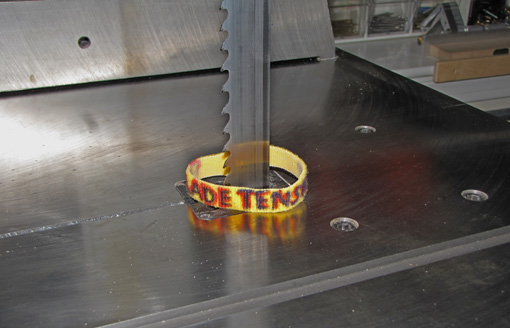
1- The yellow velcro band placed around the blade is a reminder to tension the blade before work. Starting up the saw with a loose blade is not a happy moment (yes, of course, I’ve made that mistake) but it could be particularly damaging to a carbide-tipped blade. The velcro is placed aside during work so replacing it when the work is done is a reminder to release the blade tension.

2- Much has been written about proper blade tension, but like all tool adjustments, the goal is good performance. The same blade used to saw 8/4 stock will very likely need more tension when it is used for a 10″ resaw. Whether cambering a plane iron, choosing a bevel angle for a chisel, or tensioning a bandsaw blade, it always pays to “close the loop” by using feedback from the tool’s performance to confirm or modify the adjustments. Wood density, blade cleanliness, and heat build-up are just a few of the variables that make it unwise to tension the blade without thought. 

3- After installing and tracking a blade and before going to work with it, it’s a good idea to close the doors on the saw, run it for just a few seconds, wait until it stops completely, and then open the doors to check the position of the blade on the wheels and make sure all is OK.

4- It is easier to follow a layout line when it is viewed with both eyes (binocularly). Sometimes the blade guard or the guide bearing assembly will block one eye’s view of the line, depending on where you position your head.

5- When bandsawing freehand, I always think, “Feed the line to the blade teeth.” This is just the opposite of handsawing and I often have to remind myself to maintain the correct mentality at the bandsaw after I’ve been sawing by hand.

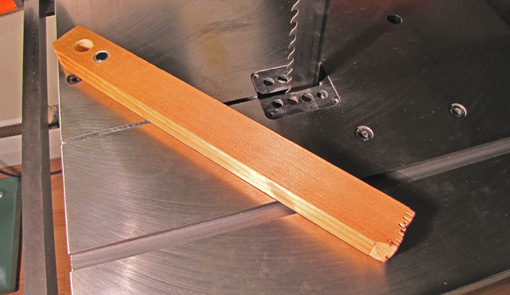
6- The push stick (below) has a rare-earth magnet which allows it to be stored within easy reach on the saw’s frame. The hole is a reminder of which end has the magnet. The short saw kerfs at the front end of the stick, which accumulate as it is used, can grip the corner of the wood as the cut nears completion. The stick has a limited life, of course, so the magnet is in a removable cup.

7- Large sawdust particles inevitably accumulate on the lower tire despite the actions of the wheel brush and the wood plate below the lower bearing assembly. A paint scraper held lightly against the tire as the wheel is spun by hand quickly removes the debris. A “synthetic steel wool” pad such as Scotch-Brite can also be used.

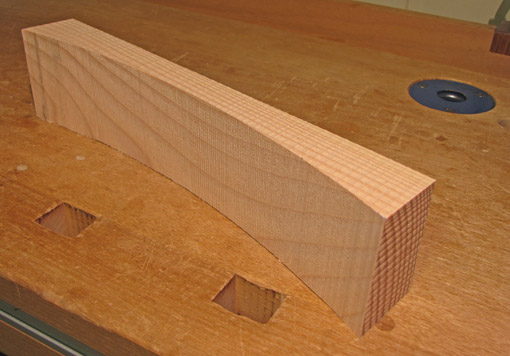
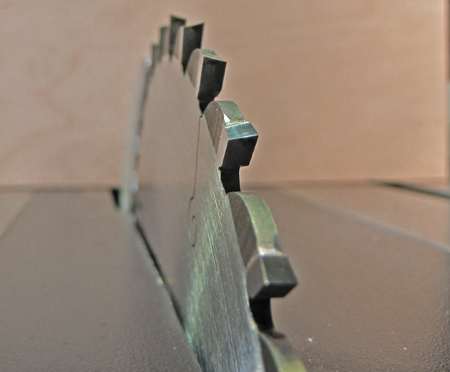
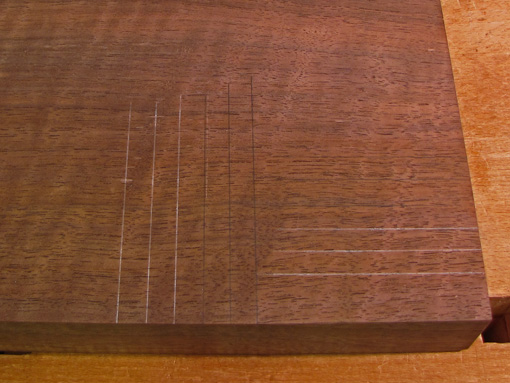
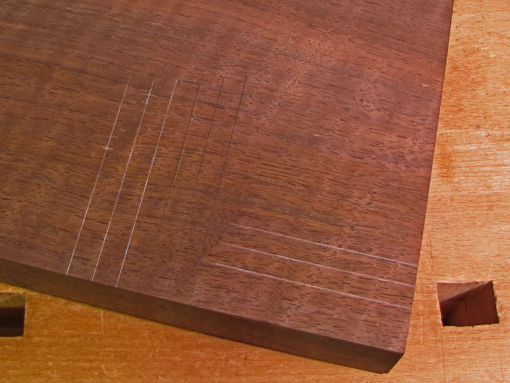
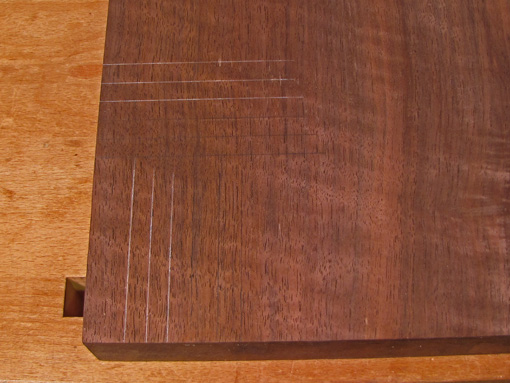
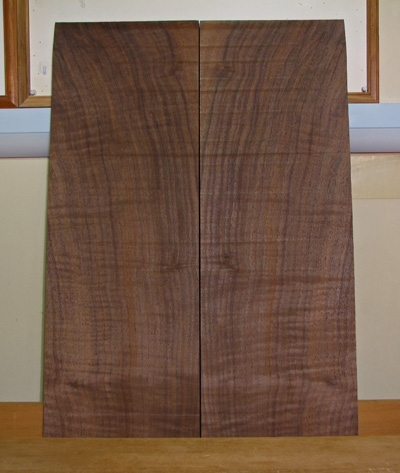
8- The variable-pitch, carbide-tip blade from Suffolk Machinery is a big help in resawing. It also is great for preparing leg stock and any other straight sawing of thick stock. Below is a 10 1/2″ wide Claro walnut board from Northwest Timber which I resawed with this blade. One of the many reasons why the bandsaw is so endearing.

I hope some of these tips prove useful in your shop.

Category: Techniques  | Tags:  | 2 Comments
Author:
• Tuesday, May 24th, 2011

This continues the frame and panel construction. So far, the panel template has been made, and now we must position and size the grooves in the frame and coordinate this with the panel thickness.

Rout the grooves in the frame parts with a 3 or 4-wing slot cutter bit. Use the appropriate bearing diameter, which will ride the straight and curved parts, to create the desired depth of cut. Allow for seasonal movement when planning the depth of the grooves in the stiles. (A straight bit, standing the frame part on its side, would be fine to cut the grooves in a straight edge, and though passable for a shallow curve, it is not ideal.)

Position the template on the selected area of the panel stock and secure it with double-stick tape. The thickness of the panel stock will be determined by the frame thickness and the location of the groove. In sizing a frame and panel, remember that the strength is primarily in the frame.

For example, in a 5/8″ thick small door frame, it would be reasonable to use a 1/4″ wide groove, positioned in the middle of the frame width, and a 3/8+” thick panel, raised 1/8+”. This will leave the face of the panel about 1/32″ below the level of the frame which will allow for finish planing or sanding the frame after glue up. The panel, of course, is finished before glue up.

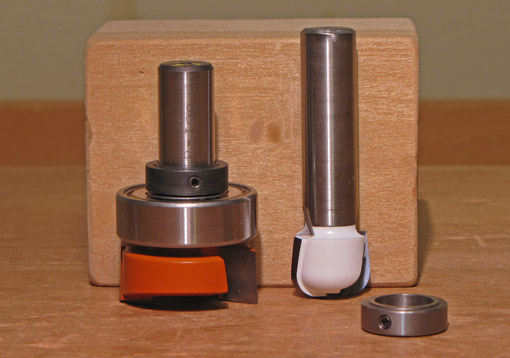
Raise the panel by hand-held routing with a square edge dado/planer bit or a short-radius bowl-and-tray bit which leave a smooth finish. These use a top bearing and have a short cutting length (1/4″ to ½”) to avoid the need for a template thicker than 3/4″. Examples of these types of bits are shown in the photo above. Adjust the depth of cut to yield the desired thickness in the panel edge. You are routing an outside curve, so go counter-clockwise (as viewed from above), cross grain first, and make the cut in two or more steps as needed. (I will not advocate climb cutting but I will do it for a final pass if the grain direction demands it.)

The result of the cut is shown in the photo in the previous post.

For a square-profile field, I round the corners. I pin the panel at the center of its width on the rails, from the back, with brass escutcheon pins and nip off the excess and file it flush. 

My method suits my designs – the beauty is in simplicity and the wood but with a degree of design flair. The frame members have plain edges and the field profile is simple. The curve in the rail can be created without a template or router, even freehand, because the panel template is made directly from the actual frame.

By contrast, curved-edge frame and panel work with a sticking profile on the edges of the frame and an elaborate profile around the field of the panel usually involves a pair of offset templates, one for the rail, another for the panel. Bearing-guided router bits create the rail edge and a fearsome horizontal raised panel bit creates the edge of the panel’s field.

In summary, this method is another approach to a traditional construction – the frame and panel – that is suited for clean, simple designs with the added interest of the curved edge. The method is direct and it works.

Category: Techniques  | 2 Comments
Author:
• Sunday, May 15th, 2011

A curved-edge frame and panel, especially an asymmetric curve, adds a nice flair to a piece. The curve is typically along one or both rails which are tenoned at both ends.

In general, for a frame and panel in my style of work, the panel is the star and the frame is the supporting cast. The panel is a highly figured, special piece of wood or at least contrasts with the frame. I find that a simple square profile or a very small radius cove bordering the raised field is the most effective way to display the beauty of the wood. An ogee or wide cove or bevel is a visual distraction from the effect I am trying to create.

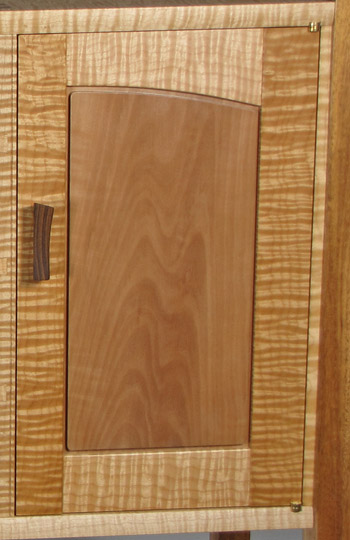
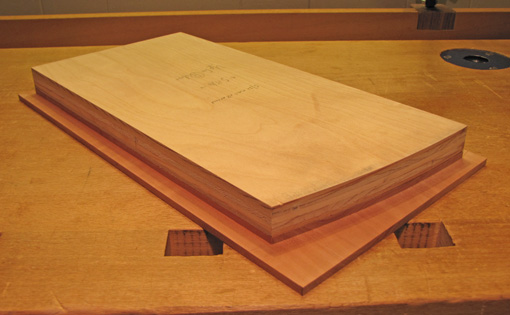
In making a curved-edge frame and panel, it can be challenging to match the curved edge of the raised field to the curve in the frame member. I will describe a simple, reliable method to create an even gap between the field and the frame. Basically, the frame is made first, then a template for the field is made using the dry-fit frame as a guide. The template is placed on the panel stock and a short pattern-routing bit creates the field. The photo above shows the template still on the panel stock after raising.

Start by making the curve in the rail according to your shop drawing. I do this by measuring the key points on the wood and drawing in the rest with an Acu-Arc adjustable curve, or by making a 1/8″ MDF template to transfer a layout line to the wood. [Tips for laying out curves.] Two parts can be made to match by clamping them together for the final fairing of their curves. For efficient production work, though not fundamentally necessary for this method, a plywood or MDF template can be made and used to guide a pattern or flush trim router bit.

Complete the mortise and tenon joinery for the frame. Dry assemble the frame and place it on top of a piece of 3/4″ MDF or plywood. Decide on a width from the inside edge of the frame to the edge of the field. Find a small washer with a rim width that matches that measurement. Trace onto the sheet stock with a pencil point held against the inner rim of the washer while pushing the outer edge of the washer along the contour of the frame.

Carefully cut to the curved line and fair the edge, keeping it square to the face. Use your eye to match its curve to that of the frame, creating an even width between the template edge and the edge of the rail; make minor alterations as necessary. Then cut the opposite end of the template. If you are building during either extreme of the annual range of humidity, alter the width of the template along the stile edges to anticipate the seasonal movement. For example, if you are building at a very dry time, slightly reduce the width (crossgrain) of the field because it will only be larger at other times of the year.

The template can be used to help in your selection of the panel wood. Draw around its edge onto the proposed wood to see exactly how the panel will look. The template can be used from both sides for two symmetrically oriented panels such as on a pair of doors.

All of this makes for a very direct way to control the fit and appearance of the panel.

The next post will discuss using the template to make the panel.

Category: Techniques  | One Comment
Author:
• Wednesday, November 17th, 2010

In nearly all of my woodworking projects, there are curves that can make or break the design. These are almost always curves without a constant radius, so I am relying on what looks “right” to my eye. I really sweat this aspect of the design process.

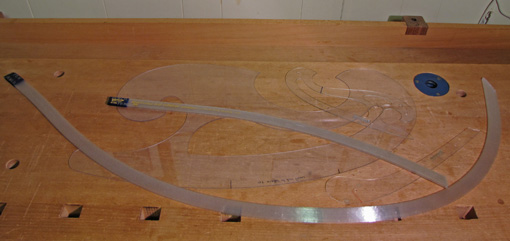
Acu Arc flexible curves are my favorite tools for laying out curves. French curves in regular and Woodhaven’s giant sizes are also helpful for sections of curves.

I do not like flexible rules or laths for laying out curves because it is awkward or impossible to control the contour in mid-curve. The curve is determined by the endpoints and at least one intermediary point and is then subject to the material properties of the layout device which may not produce the desired contour. I rarely use trammel points or a compass.

To design curves in a project, I start by gathering ideas and drawing in my sketchbook. I refine the promising sketches with scale drawings, repeatedly erasing and redrawing. To produce a full size mock-up, the results get transferred onto wood by measuring the key points and laying out a smooth curve using the Acu Arc. Sometimes I go from sketches to drawing directly on the wood. The mock-up is refined with spokeshaves, planes, and especially rasps.

I spend a lot of time looking at the mock up, leaving it, and returning to see how it strikes me at repeat visits. The bottom line: when it looks right and feels right, it is right, and that is a happy woodworking moment!

I transfer the key dimensions of the mock-up and drawing to make a template in quarter-inch MDF, using the Acu Arc again to refine the final layout. MDF works better than plywood, solid wood, or cardboard since it holds a clean edge and there is no grain to distract my eye or tools. The edges of the template should be square if it will be used on both faces for legs or as a template for router work.

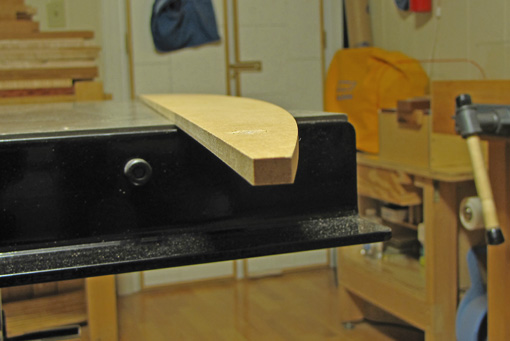
Looking down the curve, as shown in the photo below, is a remarkably sensitive way to see bumps and lumps that must be eliminated to “fair the curve.” Running one’s hand along the curve, like a sleigh ride over the hills, is also a very good way to sense smooth transitions and detect lumps and bumps which must be removed.

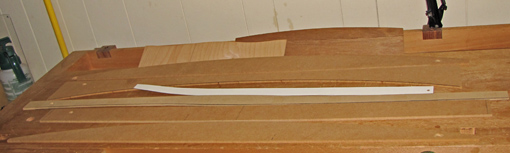
The Acu Arc has a natural tendency to produce a curve without bumps as you shape it to your wishes. Then you can hold it on the wood, and trace only a nearby section of the curve with a pencil, hold it further along, trace more, and so forth, proceeding incrementally. It is stiff enough to hold its shape when it is carefully lifted and turned over to form the mirror image curve on the adjacent face, as is usually done for making legs. It is made of translucent colorless plastic but I would prefer opaque plastic that would show the curve better against the background of the wood.

The AcuArc is available from Highland Hardware in 24″, 48″, and 72″ lengths, and from Lee Valley in 18″ and 36″ lengths. (The top picture in the online LV catalog shows the pencil too far from the hold-down hand – the Acu Arc will move.)

I label the templates, save them, and sometimes reuse parts of them in other projects. In due time, a style develops, and, who knows, maybe someone will notice.

Category: Techniques  | Tags:  | 3 Comments
Author:
• Tuesday, May 18th, 2010

At this point you very much want the piece to exist, to stand on its own, and so you are driven to build. You want it to “turn out” to be what you envision and hope for. Yet in between the compelling vision and the fulfilling object is the potential chasm of disappointment. This, frankly, evokes some fear.

To your rescue comes the teacher, and ultimately, the teacher is you. Let us consider what the teacher does, followed by an example for each:

  • He charts an effective course. This is the strategic order of the steps of construction. Will you glue up the wall cabinet case before or after building the doors?
  • He points out the critical junctures where you must bear down and get things right. Those last few plane shavings off the drawer sides greatly affect the fit and feel of the drawer.
  • He alerts you to possible pitfalls, many of them sneaky. How will the figure change when a piece is shaped into a convex curve?
  • He keeps a steady perspective on the big picture of the project, maintaining your faith. Are the little errors you’ve made so far going to significantly affect the final piece or should you not worry about them?

The teacher may be another person whose experience you borrow, but in due time (meaning after making your quota of mistakes) you must be your own teacher even as you remain a student. The important thing is to think through the four points listed above. Further exploration of how exactly to avoid that chasm of disappointment in creating a work in wood is a larger topic for another time, but the steps discussed in this series will go a long way to helping your project “turn out” the way you want it to.

As you build, there are still small but important decisions to be made because, as noted in the previous post in this series, drawings cannot fully represent the piece. This is much as a musician uses tools such as phrasing, articulation, and tone color to produce his personal interpretation of written music, staying within the fundamental conception of the composer.

Thus the music, or the woodworking creation, comes alive. You’ve done it, now it is there.

And yes, that is . . . happy woodworking. Best wishes to you as you pursue your ideas!

Author:
• Friday, April 30th, 2010

In developing your woodwork creation, you have so far: developed ideas into a strong concept to be made with beautiful wood, researched design, construction, skills, and tools, and used mock-ups to work out various issues. Is it time to make sawdust? Not yet. You should first build the project on paper or CAD with measured drawings.

Drafting the project allows you to work through the specifics of the construction and create an invaluable guide to keep you on course in making the piece. If this step is neglected, if you “wing it,” the odds are high of coming to an impasse in the course of building the project. It is better to use an eraser now than to add to the firewood pile later. Though the drawing process will include plenty of erasing/deleting, backtracking, more work with the mock-up, and some tedium, it is worth it.

Orthographic projection drawings – front elevation, side elevation, and plan views – are the most practical and useful of the pencil-and-paper methods. These are made to scale for the piece as a whole. It is helpful to draw certain key areas full size, especially to work out joinery and other details. It is generally not necessary to codify all of the innards of a piece with a pretty drawing, but it is not wise to leave things to chance and risk getting stuck in the middle of a project. The drawings also serve to plan the wood requirements, and are a record that may be referred to for future projects.

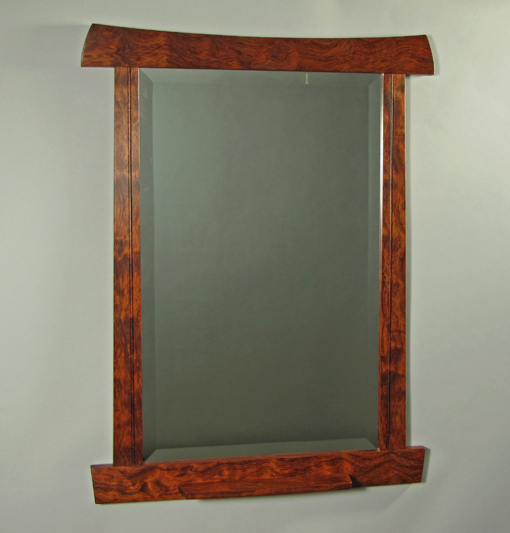
For the wall mirror, the example piece for this series, pictured below are front and side elevations and two modified plan views.

copyright 2010 Robert Porcaro

While it is possible to do some simpler and/or very familiar constructions working from a mock-up without drawings, I believe a woodworker should at least have basic drafting skills. The methods are far beyond the scope of the present discussion. I suggest Bob Lang’s Drafting and Design for Woodworkers as a manual for understanding and making drawings, as well to get going on SketchUp 3-D CAD. Bob now has an extensive set of video lessons, SketchUp for Woodworkers.

A word of context is in order. Valuable though they are, drawings and CAD are never more than graphic representations of a piece and cannot fully define it. They do not contain the workmanship and subtle personal details, such as refined edges and textures, that contribute immeasurably to a piece. This is part of the life that a craftsman imbues into the piece as he works.

And so you must build the piece, which is the subject of the next installment in the series.

Author:
• Tuesday, April 27th, 2010

I believe a mock-up, a model of the proposed piece, is an essential step in designing original woodwork. It should be full size if at all practical.

The mock-up allows the designer to sense spatial relationships and proportions from various viewing angles, as well as the overall physical impact of the piece with a veracity that cannot be duplicated with a paper drawing or even with a manipulable 3-D CAD creation. Such images cannot give you a real sense of how the size of a chair relates to your body, how a table fills space in a room, how intimate a small wall cabinet might feel, or how a curve flows in a table leg.

Perhaps until we have consumer technology to project a full size hologram in front of us, mock-ups are a must. Make them expediently from wood scraps, cardboard, plywood, tape, biscuits, foamcore, hot-melt glue, and so forth. Use a bandsaw, rasp, drawknife, scissors, marking pens, or whatever else is quick and easy. It should feel like playtime. Make just what you need to put the concept of the piece in front of you so that you can work with it.

Experience the proposed piece as you might approach it in a room. Sense how elements and sections relate to each other and to the whole. You may be pleased or unsettled, so change what you wish, guided by your vision of the concept of the piece. For some woodworkers and some pieces, it might be possible to do minimal drawing and work can proceed almost entirely from mock-ups.

It is often helpful to mock up critical elements of a piece with more precision, for example, a table leg or door handle. Perhaps compare two slightly different legs, one at each side of a mock table top, and glance right and left to see which one you like better. Some elements can be expedited. Drawer fronts might be drawn on a plywood sheet. Sometimes a partial mock-up containing the key elements is all that is necessary.

I find the Goldilocks method helps solve a lot of problems. For example, how much should a table top overhang an apron? I’ll adjust mock-up sections of a top and apron: too much for sure, too little for sure, then work within that range and somewhere . . . it feels just right. Unlike Goldilocks, I routinely revisit the mock-up later in the day or on another day to see if it still feels right.

What you think and feel is right and supports your concept of the piece, IS right. That’s the point! Trust yourself.

For the mirror, the example piece in this series, I bandsawed scraps, worked with rasps and an oscillating sander to get the curves about right, and joined the pieces with biscuits and screws. As you can see, I changed things by elongating biscuit slots and by splicing in center sections. I drew lines to represent beading of which I had also cut a sample section. I scribbled notes on the mock-up. I experimented with keeping or losing the shelf and with a contrasting circular piece in the top center of the frame.

Next in the series: Drawings

Author:
• Friday, April 23rd, 2010

So far we have been mostly considering what we would like to do for a project. Somewhere along the way we must consider if it can be done and how to do it. Certainly, those two issues are in the undercurrent of thought all along the way, aided by experience. Now the construction details, functional specifics, and the available skills and tools have to be dealt with for sure.

The discussion of these issues has been intentionally placed here in the sequence, not at the beginning, to encourage free creativity in developing ideas. If we were to start with directions for how tables have always been made, for example, this might inhibit new ideas, especially for one-of-a-kind work. However, the price for this freedom in producing ideas and concepts is that some will, upon research, prove impractical or impossible. Thus, in reality, the creative stages overlap and change order; there is no single correct path.

For research into construction methods and functional features of furniture, there are countless sources. Some of my favorites:

Bill Hylton’s Illustrated Cabinetmaking is a great place to start. Thinking of making a dining table? The chapter on that starts with measurements for leg room, elbow room, and so forth. Then he presents drawings and construction details for 14 ways of making a dining table, including leg and apron, trestle, pedestal, etc.

I also like Taunton’s project book series which includes Chests of Drawers, Beds, Desks, etc. Fine Woodworking and Popular Woodworking magazines’ back issues (both available on disc) are excellent sources. Will Neptune’s articles in FW are worth their weight in gold. Though I do not do reproduction furniture, I’ve spent many hours in years past studying Franklin Gottshall’s books.

Since I design all of my own work, I’m not following the plans in these publications, but I do try to understand as much as possible about how things were successfully done by others. If a woodworker is going to break from traditional construction, it behooves him to comprehend why it was done that way in the past, and carefully think through, and possibly trial run, any novel approaches.

For the wall mirror, the example piece for this series, I researched mirror glass – quality, thickness, beveling, etc. I also checked into how the mirror was secured into the frame in a few different published plans.

Do you have the skills to make the piece you want? I think it is important to not overreach, get stuck in a project that you cannot handle, and create a disappointment. (Yea, been there, done that.) On the other hand, this is a key stage where you can improve as a woodworker by researching and practicing new skills in preparation for a project. Perhaps you want to learn bent lamination technique, a padded shellac finish, or maybe just a new way to hold work on the bench. Let the requirements of the piece that you envision spur you to be a better woodworker. Here’s how.

Finally, you may have to, ahem, buy some new tools. This is the best situation in which to buy them – the need to use them to actually make something.

Next in the series: Mock-ups