Archive for the Category ◊ Techniques ◊

Author:
• Monday, May 07th, 2012

Tip #3: See the line with both eyes if you can.

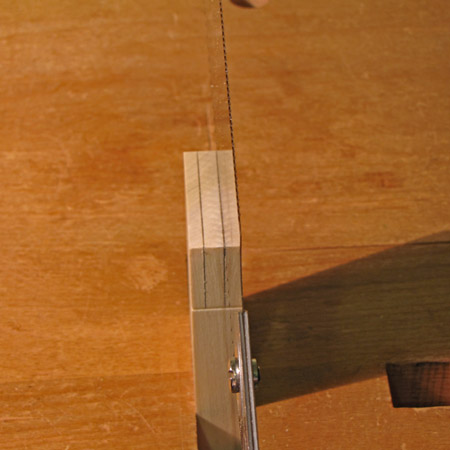
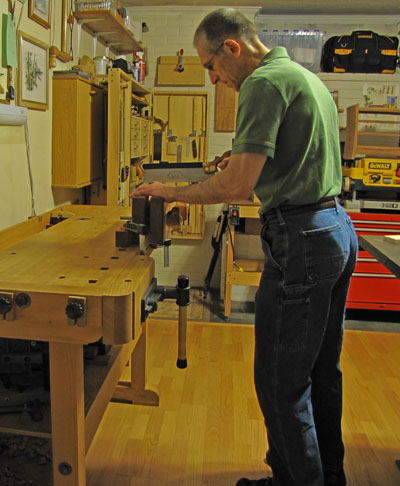
Most woodworkers feel more comfortable and work more accurately sawing with the line and the saw on a specific side, left or right. For right handers, the most efficient setup has the saw in the right hand and the line to the right side of the midline of the body. Both eyes view the line from the left and see the left edge of the kerf splitting the line and the remaining half-line trailing the kerf. The keeper wood in this case is on the left, the waste on the right. This arrangement is likely to be favored even in the minority of cases in which eye dominance does not match the side of hand dominance.

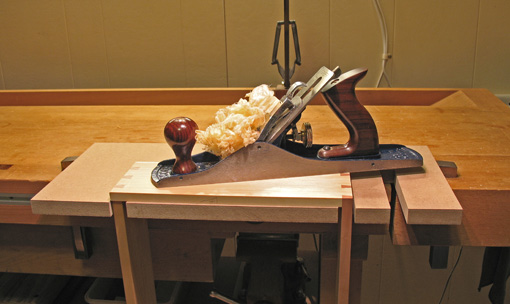
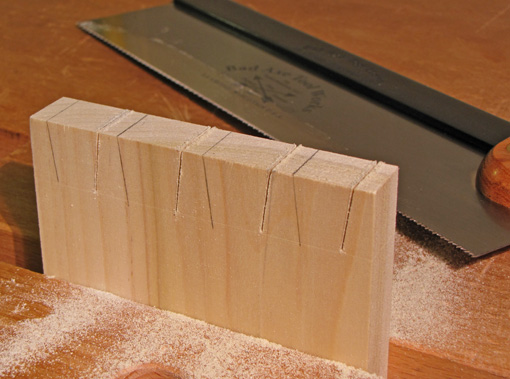
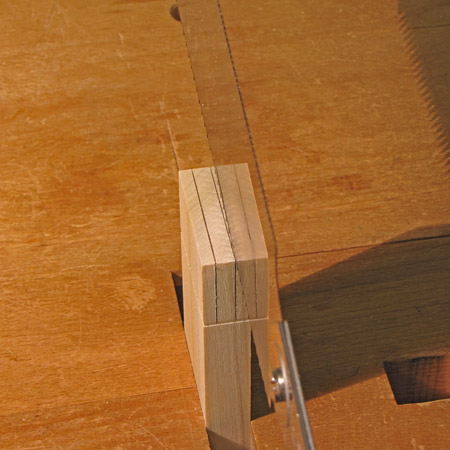
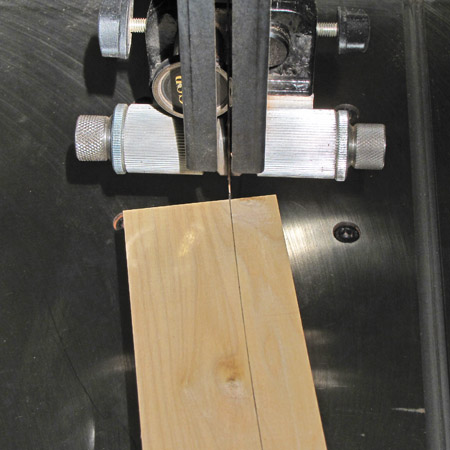
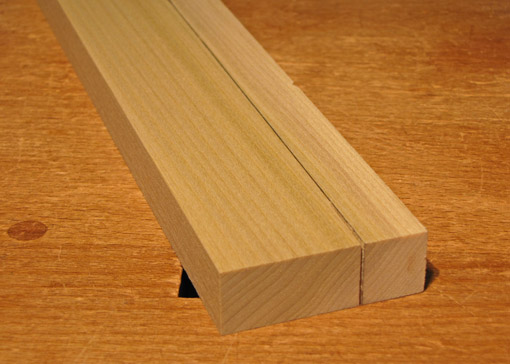
The photo at the top, demonstrating this setup, is the view with the right eye sawing a tenon. Below is the view with the left eye. The small disparity in vantage points permits stereoscopic (high level binocular) vision.

The key element is that both eyes view the line. If you are fortunate to have two good eyes that align properly, your binocular vision is an advantage over seeing the line with just one eye. The eyes also track better working together than alone. Try it.

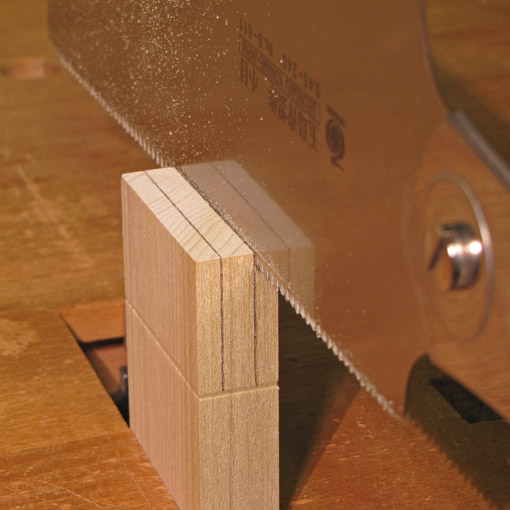
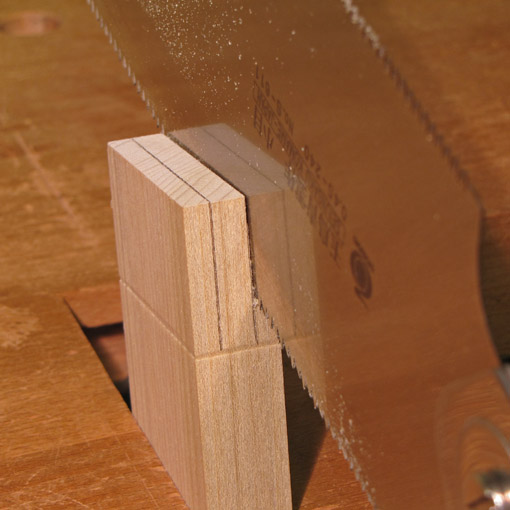
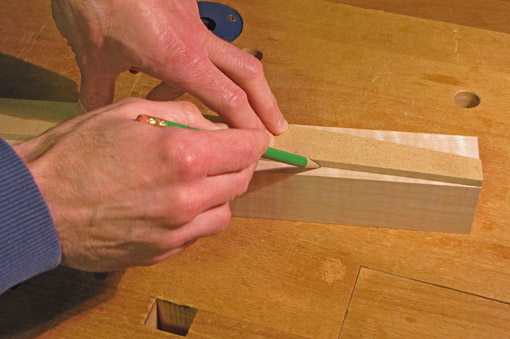
Sometimes this desirable setup cannot be achieved. A right hander finds himself with the right eye viewing the line from the right side of the saw, as in the photo below.

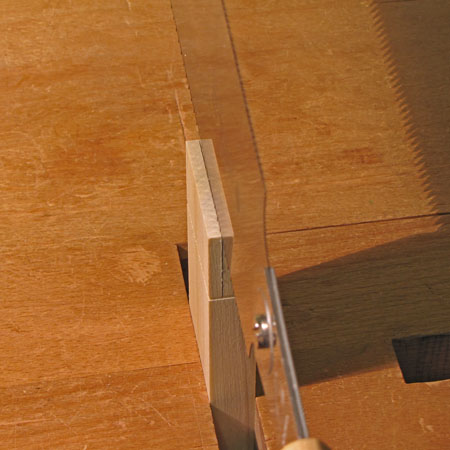
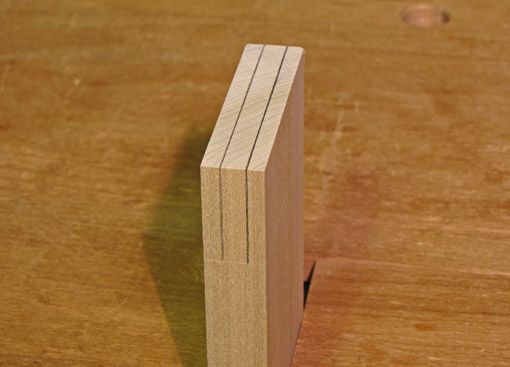
Since it is usually very awkward to shift the head fully to the right of the saw, the left eye views from the left side of the saw, as seen below.

The brain cannot blend these two very different images. One image is functionally “turned off” and you are then effectively working in the less efficient one-eyed mode. Sometimes this cannot practically be avoided.

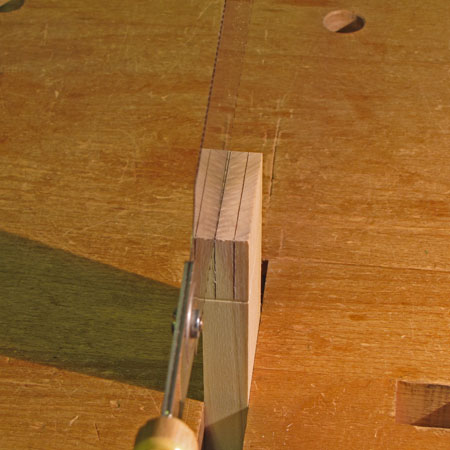
There is another situation to consider. This happens commonly at the bandsaw. One eye, usually the left, gets a good view of the line meeting the teeth, as in the photo below.

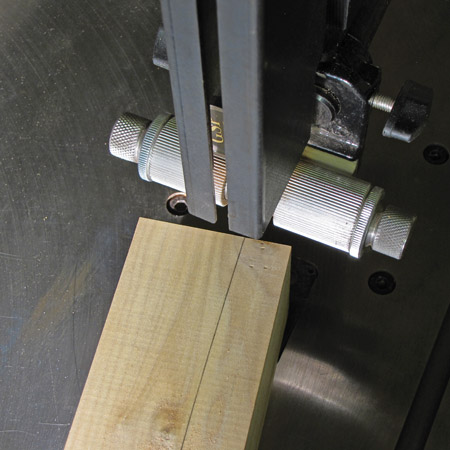
Oops, the other eye’s view is blocked by the blade guide/guard apparatus:

You may sense less visual precision without being immediately aware of the cause. The solution is to arrange your stance so that both eyes have a view of the line where it meets the teeth.

Because of the many sawing situations in the shop, there are exceptions to all of this. The basic principle is nonetheless helpful, and being aware of it can help your sawing.

Good lighting (angle and distance), a good quality line, and proper visual correction for the distance at which you are working, also contribute to seeing the line properly. And, yes, you do have to blow away the saw dust regularly, especially with Japanese pull-stroke saws.

Coming up: Do you need to see all of the lines? Can you? When does seeing them become less important?

Category: Techniques  | Tags:  | 4 Comments
Author:
• Monday, April 30th, 2012

Tip #2: Engage and stabilize your core.

“Core” muscles refer to the abdominals, obliques, hip flexors, spinal stabilizers, and the gluteus muscles. Strong, balanced, and activated core muscles allow the limbs to perform properly. Core involvement is the source of much of the precision and power of a tennis player’s swing, a fighter’s punch, and a sawyer’s stroke. Watch Chicago Bears linebacker Brian Urlacher demolish a ball carrier, or Boston Red Sox little guy Dustin Pedroia belt a ball over the fence, and you’re seeing core strength in action.

Pick up the saw, place one foot forward, and use your core muscles, especially the glutes, to find a balanced, stable stance. From there, the arm can operate with precision, intent, and strength. A stable core does not mean an immobile core, rather it is a controlled positioning and movement of the trunk. If the trunk is unstable, the arm flails.

Do not fall into the saw stroke, move into it. Maintain balance throughout the stroke. Do not use the bench or the work piece to prop up your body. A partial exception is when using a handsaw with a low saw horse or bench. Even in that situation, the non-sawing hand is really just an aid to the core musculature. You should not be falling on that hand with each stroke. Again, move into the stroke with intent and control, do not flail into it. You can still use your body weight for power, but in control using the core.

It was difficult to take photos for this post. I set the timer and quickly moved into position with the saw but I could only approximately convey the general ideas.

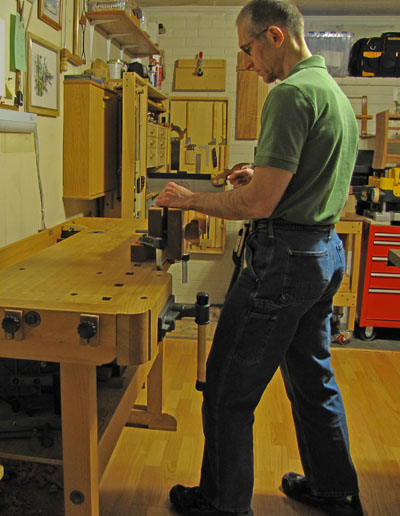
Whew, look at this guy. Bad news:

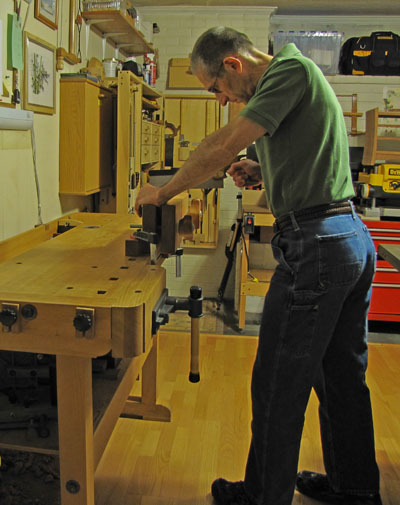
And this guy. Ouch. He won’t last a day in the shop.

In addition to sawing precision and strength, you will also have shop endurance. Woodworkers often complain of low back soreness after a day in the shop, especially with tasks such as sawing joinery and sharpening. The way to avoid this is to use a balanced stance and active glutes to take the excess effort away from the lower back muscles. This applies to machine work too, such as precision sawing at the bandsaw.

Try this: pick up the saw, channel your inner Bruce Lee, and concentrate much more on your stance and core activation – stable, not stiff; intent, not mushy. You may surprise yourself to find following the line is easier and more natural than if you think just about your arm and the saw, forgetting about the all-important core. Be Bruce grabbing the cobra.

The core matters in sawing. I leave it to you to do the homework. 

Category: Techniques  | Tags:  | Comments off
Author:
• Sunday, April 22nd, 2012

All would be right in the world of woodworking if we could saw perfectly to the line every time. Joinery would fit directly from the saw, everything would assemble neatly, we would never grow old, and pay no taxes. In the meantime, however, let us consider some ways to improve this ubiquitous woodworking task. The uncommon tips in these posts apply not only to hand sawing, but also machine sawing without a fence such as might be done with the bandsaw.

We know the basics: an appropriately designed, good quality saw, straight, properly sharpened and set. The work piece is securely held in an ergonomic position. The sawyer grips the saw properly with good hand-shoulder alignment, and produces even strokes engaging the length of the saw.

Tip #1: Consider the line and what it means.

The idea here is to have mental clarity as to just what the line represents and thus how you will saw in relationship to it. Mental clarity precedes physical success.

Consider several scenarios.

If the line is produced by drawing against a template as in, for example, sawing curved legs from rectangular blanks with the bandsaw, then the entire line is in the waste wood. If you split the line with the saw, there remains a half-line of extra wood to remove saw marks and fair the curve. If you want more margin for clean up, make a chunky line and saw right up to it without touching it. The key is to be clear about what you are aiming for and why.

If you use a pencil to mark out pins from the tails you’ve sawn, the line is fully in keeper wood. If you split this line, the pins will surely be too small. If you saw to one side of it, and no more, things should work out fine.

If a part is marked to length by registering it with the end of another part which is thus used as a template, the line will be fully in waste wood. Splitting it with the saw will make the resulting piece too long, but perhaps this is a desired allowance to allow for shooting it just right. Sawing to fully remove the line would be an attempt to produce an exact match from the saw. Again, the intent should be thought out beforehand.

As another example, I set my mortise gauge so the two points are at exactly the width of the mortise and mark out the tenon with this setting. I run a pencil line so the point rubs against both sides of the “valley” of the scribed line. I then know that if I split this line with my saw, the tenon will be just right.

Visually, I find it easiest to split a line with the saw. The visual cue is that as the cut proceeds I can see half of the line remains next to the kerf, and this remainder looks half as wide (easy to estimate) as the uncut line ahead. When sawing to one side of a line, it is easy to be too timid and leave extra wood, though if this is not excessive it may work out fine, allowing for a bit of clean up. Sawing to completely remove a line, but no further, is visually difficult since the result looks the same if you have done it just right or if you have sawn too far into the keeper wood.

The key is to be clear about the “context” of the line and anticipate the next step in construction. In all of these matters, the concept of one-sided tolerance is most helpful.

Category: Techniques  | Tags:  | 7 Comments
Author:
• Tuesday, October 25th, 2011

Using a straightedge is easy, right? Yes, but it does pay to use a technique that is both practical and consistent with the tolerance to which want to work.

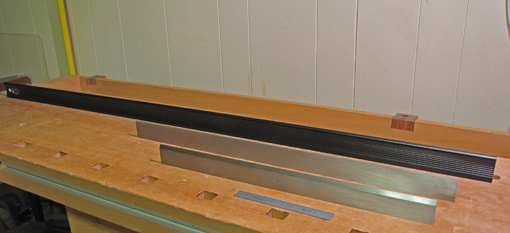
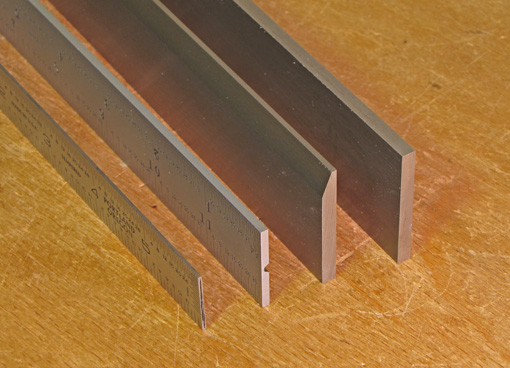
Pictured above are, from front to back, a 6″ Bridge City rule, the 18″ beveled Starrett #385, the 24″ unbeveled Starrett #380, and a Lee Valley 50″ aluminum straightedge. The photo below shows the thicknesses, from left to right, of the 6″ rule, a Starrett combination square blade, the #385, and the #380. The Lee Valley is about 7/16″ thick at its base. 

Let’s look at three techniques for using a straightedge and consider some of the related features of different straightedges.

1. Eyes won’t lie

This is the way a straightedge is usually thought to be used. You simply hold the tool against the surface and look for gaps against a light. Done properly, this allows the eye to easily detect gaps of 0.0005″ (half a thou) or less.

It is helpful to use a diffuse, linear background light, such as a fluorescent bulb, and a thin edge against the work, such as a beveled edge. If a wider edge is used, ensure that your line of sight is parallel to the surface. A false impression of accuracy will result if the light under a gap is blocked from view simply because there is an angle between your line of sight and the width of the tool’s edge.

This technique can be awkward and tiring because you have to hold the tool and the work up to the light, or bend and maneuver to view a stationary surface. It is good for testing a plane sole or other small, very precise work. The #385 or an accurate small rule are good choices. Avoid tipping the straightedge which can introduce errors caused by any slight bow of the tool along the length of its face.

2. Shim it, shim it again

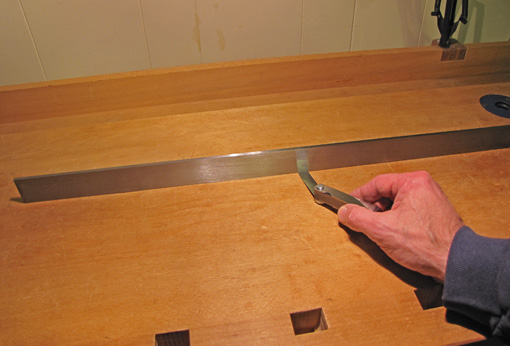
Here you lay the straightedge on the surface and use feeler gauges to seek out gaps. Look for hollows near the middle of the tool, but also press down near an end to check for gaps at the opposite end created by a bump somewhere in the middle.

A good way to work to a specific tolerance, say 0.001″ for a plane sole that you are lapping, is to put a leaf gauge under a wide-edged straightedge, and then gently pull the leaf to see if it drags the straightedge or slips through freely. The former indicates you are within tolerance (as long as there was no previous rocking of the straightedge), the later indicates a gap. Decide how large and where you can tolerate errors.

This technique is also handy to test a tablesaw top or jointer bed which you cannot lift and where bending is difficult or impossible to get your line of sight parallel to the surface.

The #380, or any tool with a similar wide edge, is a good choice for this technique.

3. Swing it easy

The first two techniques are slow and almost always overkill for wood preparation. So here’s the quick, easy, practical method that I suggest for dressing stock.

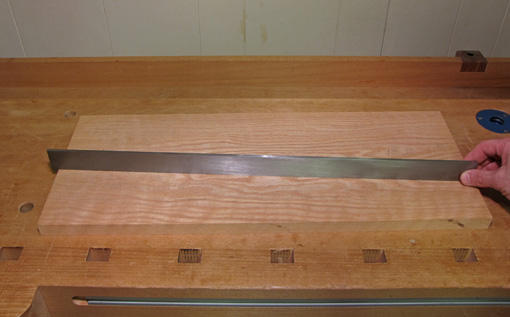
Set the straightedge on the wood, grasp and unweight one end, but do not lift it, and gently swing it along the surface. See where the tool “grips” or pivots. If it pivots just barely at the opposite end, the surface is slightly concave. If it pivots somewhere in the middle, you’ve got a bump. In woodworking, bumps are generally undesirable so you work with a one-sided tolerance, flat or a trace concave. You’ll quickly get the feel of this method.

Here is where a heavy, wide-edged, metal straightedge gives you a nice feel on the wood. The steel Starretts or the big Lee Valley aluminum work well.

This is convenient – no lifting or unclamping the work – and it quickly tells you what you want to know – that one-sided tolerance. It allows you to work in rhythm with your craftsman’s intuition.

In conclusion, the straightedge, while the simplest of tools, requires matching the technique to the task.

Category: Techniques, Tools and Shop  | Comments off
Author:
• Wednesday, September 28th, 2011

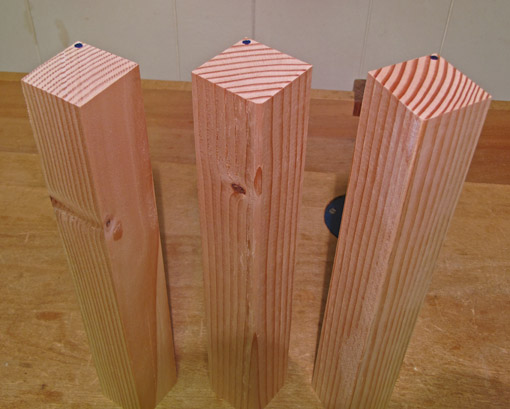
That title may make my spam-comment filter work overtime. Anyway, this post continues the discussion of managing figure in wood. Let’s look at the orientation of the annual rings in the rectangular blanks from which curved legs will be cut. Short sections of Douglas fir will be used to illustrate the principles.

All of this refers to legs which curve in three dimensions (planes). The curves may be cut on all four faces (e.g., a cabriole leg) or just two adjacent faces. Legs in which the curves are cut only on two opposite faces are curved in only two dimensions (picture the leg sandwiched between two flat sheets of plywood) and are a somewhat different matter. Bent lamination legs are an entirely different matter. Please do not ask me about legs which alter the time-space continuum.

The photo above shows the three possible basic orientations. The dot on the end grain indicates the inside corner of the legs. The two faces adjacent to this corner usually each have a flat portion where the aprons are attached with mortise and tenon joints.

In the three legs, from left to right, consider the endgrain patterns:

  • The annual rings are approximately parallel to one face and perpendicular to the other, producing one flatsawn face and one quartered face.
  • The annual rings are approximately 45° to all four faces and run “across” the inside corner.
  • The annual rings are approximately 45° to all four faces but run parallel to an axis from the inside corner to the outside corner.

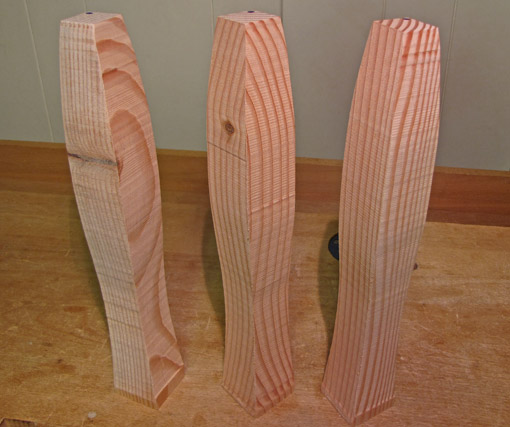
For simplicity, I cut the curves into two adjacent faces. The effects would be the same if curves were cut into all four faces such as in a cabriole leg.

Let’s look at the results.

The leg on the left is bad news. The irregular figure produced by cutting a curve into the flatsawn face is unpleasant in itself, and the inconsistent figure among the faces distracts from the shape of the leg.

The middle leg is an improvement but, to my eye, the figure lines fight the curves of the legs. There is too much run-on and run-out of the annual ring lines.

I like the leg on the right. By cutting the blank from approximately 45̊ riftsawn stock and orienting the growth rings in this way relative to the inside corner, a good lookin’ leg arises. The shape of the leg (though uninteresting in this example) coordinates with the figure.

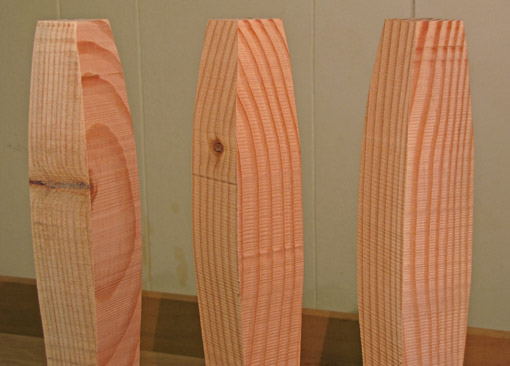
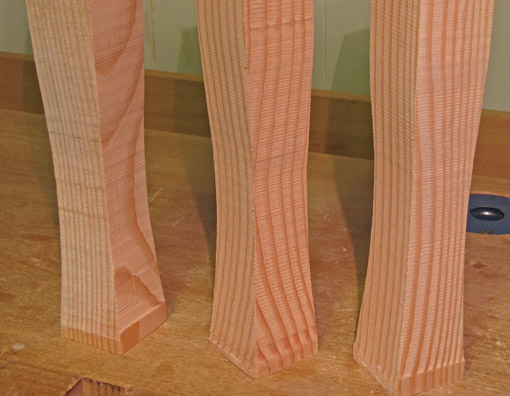
Here are closer views: 

Note that another disadvantage of the leg on the left is the exaggerated consequence of a small knot intersecting the cut line. Small pin knots, such as are common in cherry, can be difficult to avoid, but the middle leg demonstrates that they will have much less consequence with that grain orientation.

It is hard to find a thick, purely riftsawn board from which to make leg blanks, but most fairly wide flatsawn boards contain some effectively riftsawn stock toward the sides. I examine the end grain and face grain and carefully select the best sections of such boards. I pay attention to the straightness of the figure along the length of the board, recutting the edge to “straighten” the figure lines if necessary. I also try to somewhat coordinate bends in the figure with bends in the leg design.

Of course, you can choose however you like to use figure, but the key is to be aware of it and manage it. Making your design and the beauty of the wood work together, each enhancing the other, can bring class, beauty, and quality to your woodworking projects.

Happy woodworking to you.

Category: Techniques  | Tags:  | 2 Comments
Author:
• Tuesday, September 27th, 2011

Wood has figure that was created from life, which, in turn, helps bring life to a creation in wood. Throughout designing a piece, choosing wood, and building, I want to make the most of what the wood has to offer so a synergy develops between the design and the wood. This is not aluminum, Corian, or clay upon which a design is imposed; this is wood!

When cutting curves in wood, it is helpful to predict how the figure will change. The figure should work with, not fight, the contours of the piece. The interpretation of that task is subjective but it pays to be aware of and work skillfully with the figure. (Bent lamination, by the way, is a different matter.)

Here is a visual guide to some of the issues that arise in curved work. I used home center Douglas fir which has obvious figure lines created by the large difference between the earlywood and latewood. This is for purpose of illustration, it is not meant to be pretty.

In the photo above and the next two below, a concave curve (marked on the top surface) cut into the rift face causes the figure to bend. The end grain is emphasized with pen lines to show that the annual ring lines go downward as you go deeper into the wood. Thus, the concave curve creates a smiley bend from the straight face. A convex curve would do the opposite. 

Below is the result if we started with the block with the opposite face on top. (I just turned the same block upside down.)

Now let’s cut a similar curve into a nearly-flat-sawn face. The end grain lines meet the face at an extreme angle and so the figure changes rapidly as we cut the depth of the curve. The result is, to my eye, unattractive. Some of the figure lines run off the resultant face at the bottom and jump on at the top.

Now let’s cut the curve into the quartered face. Since the annual ring lines meet the face at about 90̊, there is almost no shift in the direction of the figure after the curve is cut. 

Of course, many other variables come into play, including the depth and consistency of the curves, and their placement in the piece. None of this would matter much in basswood which is nearly absent in figure.

The main ideas:

  • appreciate that the figure changes as curves are cut into wood
  • it is helpful to be able to generally predict how the figure will change
  • use this to the best advantage of the wood and the piece you are making.

Next, we’ll look at how this applies to curved legs. The appreciation of figure and legs, now there’s a worthwhile topic.

Category: Techniques  | Tags:  | Comments off
Author:
• Thursday, September 22nd, 2011

1. Be a control freak

Once a machine woodworking procedure starts, any unexpected event will occur suddenly, probably too quickly for you to react. At that point, your defense is whatever margins of safety, such as guards and hand clearances, that have been built into the setup and come into play after the mishap. You have to hope they are adequate to prevent injury.

The safest way to use a woodworking machine is to know, before starting, exactly what is about to happen. It should be a completely predictable operation. We know the machine itself will operate in a fully predictable manner (the blade or bit spins), and so your job is to thoroughly understand and control the interactions among you, the wood, and the machine. You must understand all the forces at work. In short, don’t hit the start switch if your mind harbors doubts!

Of course, still use the guards and clearances.

2. Cut or throw?

A machine blade or cutter, given the opportunity, will always throw the wood rather than cut it. You must deny the machine that opportunity by restricting the movement of the wood, and ensure that it has the capacity to cut the wood. Using hand-held power tools, it may be the tool itself, with your hands still holding it, that gets kicked.

All of the following mishaps, among many more, are essentially a cutter throwing the work piece because the operator gave the machine an alternative to cutting it:

  • Table saw kickback – the absence of a splitter/riving knife allows the kerf to pinch the rising blade which grips and violently throws the wood.
  • Thickness planer kickback – a short board is freed from the infeed roller before reaching the outfeed roller so the blades grab and eject the unrestricted wood.
  • Drill press – the rim of a bit, such as a large diameter Forstner, snags an unclamped work piece and throws it, or worse, pulls in the hand that is trying to hold it. Re-entering a hole with a spinning bit increases the chance of this disaster.
  • Bandsaw – wood held above the table surface is presented to a coarse tooth blade and gets slammed to the table, drawing the worker’s hands with it, possibly into the blade.
  • Router table – uncontrolled climb cutting (feeding the work piece in the direction of the cutting edge rotation) zooms the wood across the table, possibly carrying the woodworker’s hands into the cutter.

Well, I’m getting uneasy just writing these scenarios. Of course, these two concepts are just part of safe practice, and there are many more ways to get hurt with machines. However, keeping these two basic principles in mind – and in action – will go a long way toward using machines safely.

Stay safe in the shop!

Category: Techniques  | 3 Comments
Author:
• Wednesday, August 31st, 2011

Here is some help with pencil lines on dark wood. Though knife lines can be modified to produce the advantage of a physical feel for the correct location of a tool such as a chisel, most layout in woodworking is done with pencil lines. Marking out the tails for tails-first dovetailing and curved layout lines for bandsawing are examples.

Graphite pencil lines have a bit of sheen which helps their visibility but I still find them difficult to see, particularly if the line is along the grain on a wood like Claro walnut, which is dark and has color variations. So, motivated particularly by my love of Claro, I have experimented with various white or light-colored pencil and ink lines.

I tried Japanese ink “brushes” and very fine point drafting pens. I do not like marking out in ink because I do make mistakes and have no immediate plans to cease, so no ink for me.

I have scoured art supply stores and experimented over the years with various white pencils, occasionally trying bright yellows and other colors. Most are too soft to retain a sharp point for a practical amount of work.

The best pencil I have found is the Sanford/Prismacolor Verithin White #734. It can be sharpened to a point that is nearly as sharp as a #2/HB graphite pencil. It wears faster than a #2 but the point holds up well enough, especially if used with a light touch. It makes a nicely visible line on walnut. It is not as easily erasable as graphite, but decently enough using a white “plastic” eraser. They cost from 39 cents to a dollar apiece, depending on the quantity and the store.

The top photo shows sets of three lines of #2/HB graphite and #734 White going across and along the grain, made from a single sharpening of each pencil. The graphite lines along the grain are barely visible just above the white lines. The photos below show the same lines photographed from different angles.

An alternative is a white 0.5 mm mechanical pencil refill stick made by Pergamano and available from McAllister’s. I have not tried these because they cost $10 for 10 sticks and I would be concerned that they would break easily. Also, the point of the Prismacolor pencil can be easily altered using sandpaper. This is a more fussy job with a less durable result using 0.5mm lead.

No matter what instrument is used for layout, visibility and accuracy are greatly enhanced by using proper lighting. The two simple rules are strong and adjustable. Strong mostly means close, and the light source must be moveable to avoid glare and to cast shadows only in favorable locations. Every effort should be made to set up good lighting.

White #734 sharpened, I’m ready to indulge in Claro.

Category: Techniques  | 11 Comments