Archive for the Category ◊ Techniques ◊

Author:
• Friday, November 23rd, 2012

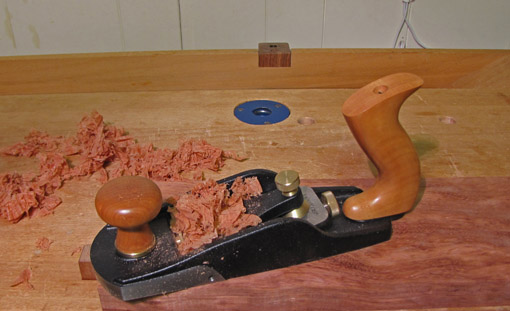
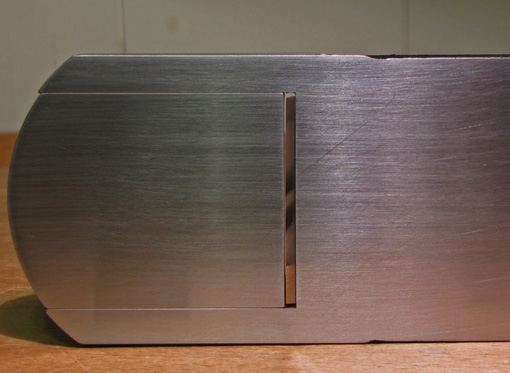
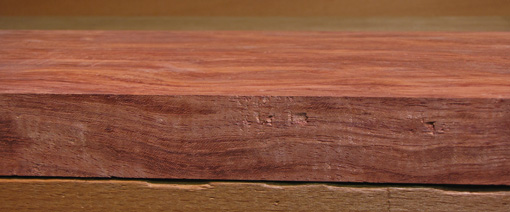
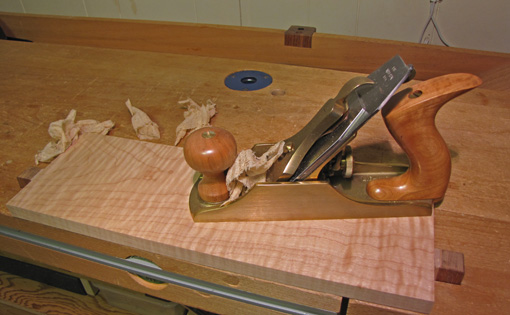
Hand planing can leave a superb final surface on wood. However, the beautiful figured woods that are one of the great joys of woodworking often cause tearout and play havoc with our efforts. This is the first in a series of posts that will explore a compendium of options for achieving an excellent finished surface on difficult woods.

When planning a project, I consider early on how to put the final surface on the wood, along with which finish to apply. Understanding an arsenal of options, and testing the tools and methods beforehand, gives me the wherewithal to use the woods I love.

There are several prefatory issues:

1. The topic of these posts is finish planing or “smoothing,” not planing for stock preparation. For the latter, even highly figured woods such as tight curly maple, can be successfully worked with a conventionally configured jack plane: bevel-down on a 45° frog with a 30-35° honing angle, or bevel-up on a 12° frog with a 38° honing angle. The key is to plane at about 60-90° to the grain, which means across the curls. (This is not skewing the plane; it is pushing the plane diagonally across the grain.) This leaves a somewhat rough surface but one that is adequate for dimensioning, and there is little or no tearout to clean up with the smoother.

This method may not work for swirly figure, such as waterfall bubinga. For that, a toothed blade in a bevel-up jack plane, planing with progressively shallower blade projections, works wonders. Clean up the surface with a conventional blade.

My preference for dimensioning figured stock is the DW735 with the Byrd Shelix carbide spiral cutterhead. Then comes smoothing with a hand plane.

2. Why use a plane at all for smoothing? Why not just sand? Well, for some woods and in some circumstances, I think sanding is the better option. However, I prefer to smooth plane when I can because, compared to sanding, it is faster, more pleasant, and better retains the trueness of the surface. Furthermore, for some woods (walnut comes to mind), the final surface is distinctly superior when hand planed. I also recognize that for some woods (bubinga comes to mind), depending on the type of finish to be applied, sanding is just as good as planing.

3. Sharpness is king. Using a very sharp blade, properly cambered, solves so many planing problems. Conversely, using a dull or poorly shaped blade edge for smoothing will create problems regardless of the type of plane, the angles used, and so forth.

4. Skewing the plane helps with almost all of the plane and blade configurations that will be discussed for smoothing. The physics of why it works is an interesting topic for another time, but beyond the scope of these posts.

5. For some woods and some circumstances, light sanding with fine grit such as 320 or 400 is appropriate after smooth planing. The main thing is to be sensitive to what you are trying to achieve with the wood, and not be governed by purist dogma.

So, in this series we’ll look at different tools and setups, their advantages and disadvantages, but with the theme that there are multiple good ways to get excellent results. The key is to know your options.

Category: Techniques  | Tags:  | Comments off
Author:
• Monday, October 08th, 2012

Finally, let’s look at the most doubtful part of the joint which is the adherence of the round dowel surface to the end grain portion of the hole.

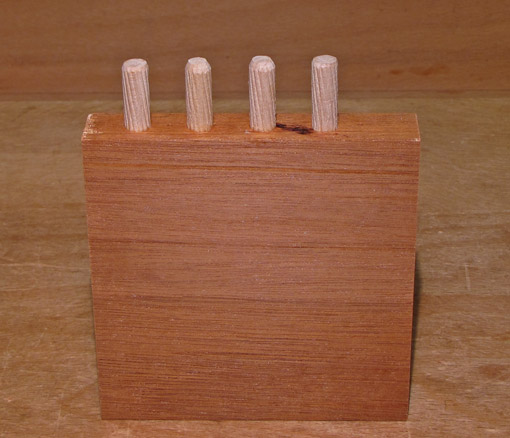
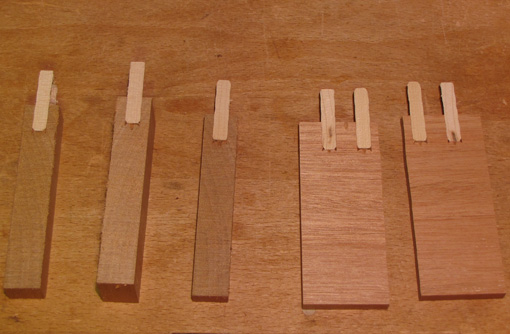
This time, 5/16″ diameter Laurier dowels were inserted 3/4″ into holes drilled with a brad point bit in mahogany to again mimic the face grain side of the dowel joint. After drying, some of the samples were cut with an orientation to to primarily examine adhesion to the end grain portion of the hole – see the three pieces on the left in the photo below. The two pieces on the right are oriented to primarily examine adhesion to the side grain portion of the hole.

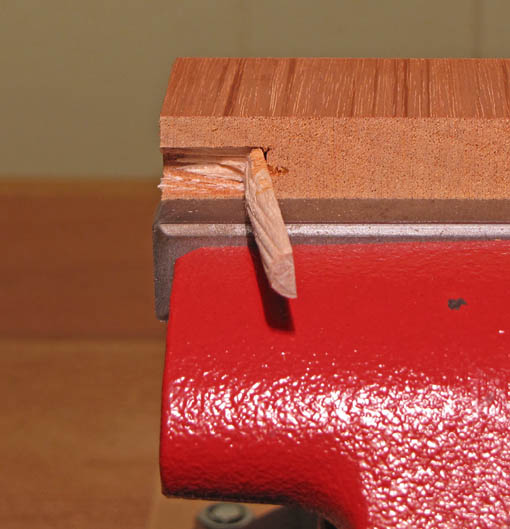
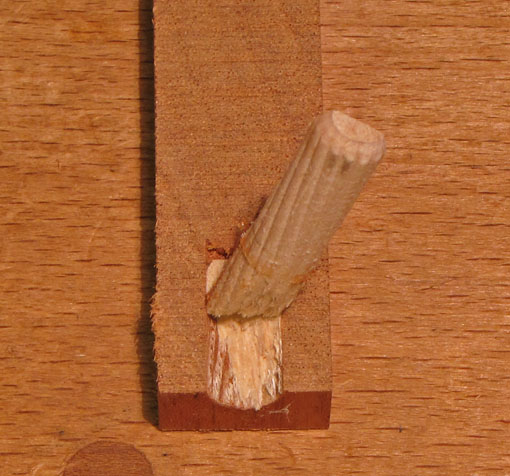
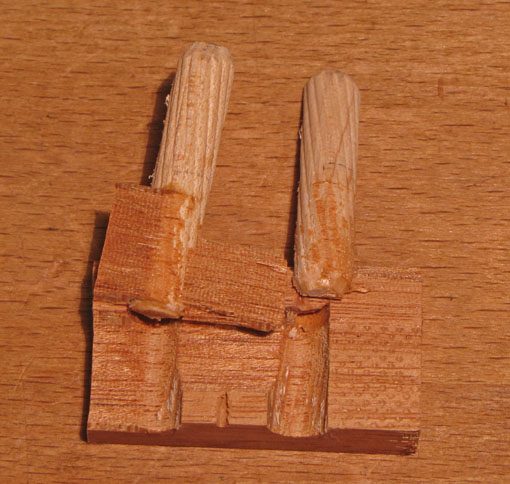
The dowels were smacked as described in the first post. The results shown are typical of several trials and they look good – the dowels adhere well to the end grain part of the hole, as seen in the first two photos below. For comparison, the next two photos show side grain and, from a separate trial, long grain adhesion.

This methodology is far from perfect. What is really demonstrated in many of the samples, essentially, is that the half joints are stronger than the half dowels. It does, nonetheless, give some sense of what is going on inside those holes with dowels glued into them. While not a joint strength test and certainly not scientific, this gives some insight into the behavior of the components of dowel joinery.

All in all, I am not surprised that in the test of the real world, the dowel joinery in my cabinets has held up well. Furthermore, these little experiments will help me proceed more knowledgeably building future projects, and I hope they will help you with your work.

Author:
• Monday, October 08th, 2012

Now let’s turn our attention to the face grain side of the joint where the grain of the dowels is perpendicular to that of the board. This is similar to a multiple mortise and tenon joint but among the important differences is that, because the dowel is round, there is limited side-grain-to-side-grain glue surface. So, it is reasonable to question the glue adherence of the dowel in its hole.

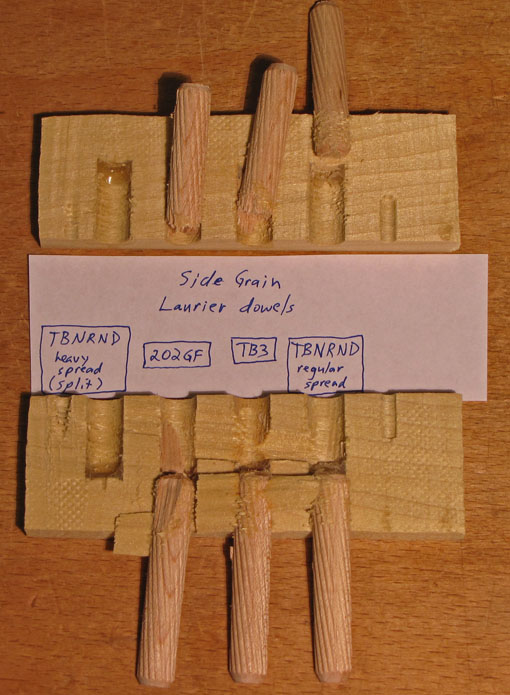
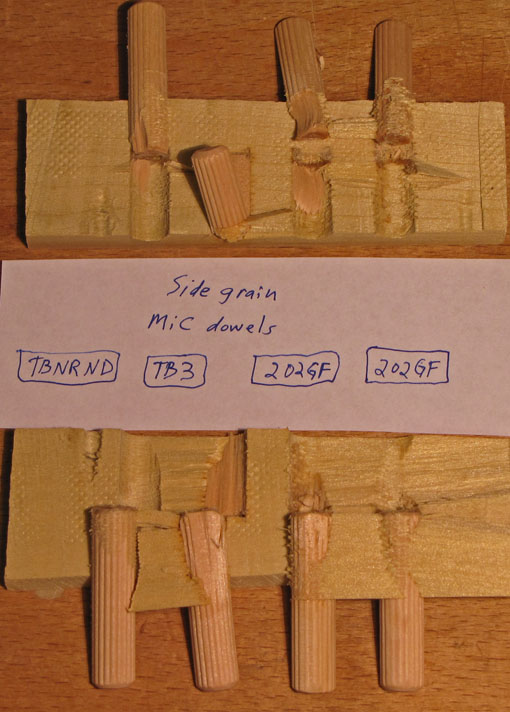
To mimic and investigate this part of the joint, 3/8″ diameter Laurier and Made-in-China dowels were glued 3/4″ deep into holes drilled with a brad point bit. The next day, the wood was resawn through the middle of the dowels. The dowels were then smacked to failure as described in the previous post. The orientation of this procedure primarily examines the adhesion of the dowel to the side grain portion of the hole.

As seen in the photos above, both the Laurier and the made-in-China (MiC) dowels performed well with both Titebond III and 202GF glues. The Laurier dowels were preferable in the long grain side of the joint, so they are my choice for dowel joinery, along with TB3 or 202GF glue.

Titebond No Run No Drip (TBNRND) glue did not create good adherence, and a heavy spread of it in one of the holes caused enough resistance to inserting the dowel that the wood split. It is an excellent glue for some jobs but I don’t think the best choice for this one.

Dowel joints have the same sort of cross grain dimensional change conflict as, for example, a multiple mortise and tenon. Nonetheless, I find these tests reassuring regarding the quality of the glue line in dowel joints.

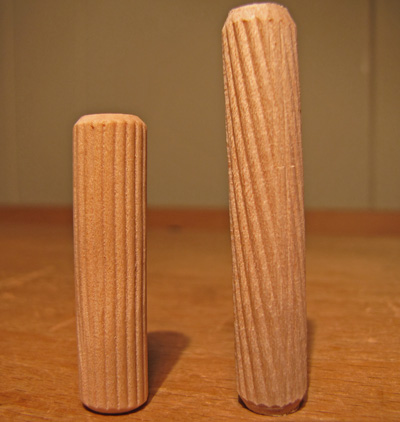
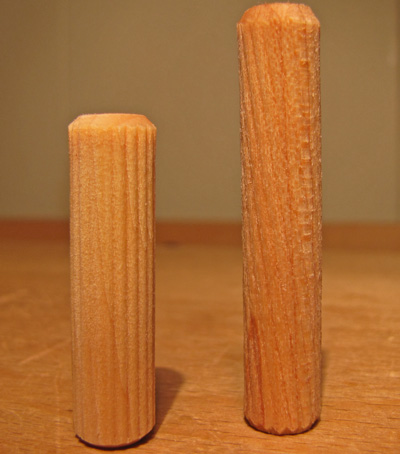
Here is another reason I prefer Laurier dowels. Their spiral grooves are shallower than the straight grooves of the made-in-China (and similar) dowels, as seen in the photo below. After a 15 minute soak in water (the second photo below), which mimics the response to water based glues, the Laurier grooves expand more to take up the space in the joint. The Laurier grooves are formed by compression, and therefore will retain their expanded profile.

But wait, there’s more! The most suspect issue with a dowel is how it adheres to the end grain glue surface in its hole. That will be addressed in the next post.

Category: Techniques  | Tags:  | Comments off
Author:
• Monday, September 24th, 2012

In casework, doweling can be a good choice to join the end grain of one board to the face grain of another across their widths. This method for making cabinets was described and popularized by the late James Krenov in The Fine Art of Cabinetmaking. While noting that dowel joinery opens up many design options where the sides meet the top and bottom of a cabinet, Krenov warns us to use good judgement in selecting it for a piece; though durable, it is not for heavy-duty work.

The joinery in the pieces I have made with this method has remained tight for many years without a hint of problem. Nevertheless, some doubts have lingered in my mind about a joint that involves relatively little side grain gluing surface compared to the gold standards of mortise-and-tenon and dovetail joints. I wanted to see what was really going on inside dowel joints.

To do that, I had to make ’em and break ’em. My qualitative observations, combined with some intuition and educated guessing, are informative enough for my purposes. This is not a joint strength test, nor is it scientific. The photos show typical results.

First, let’s look at the “end-grain side” of the joint where the long grain of the dowel is parallel to the long grain of the board.

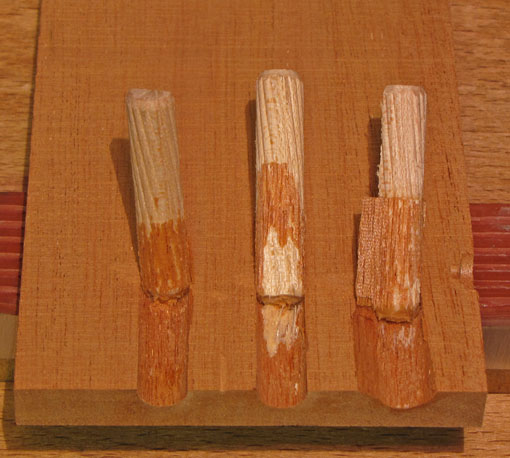
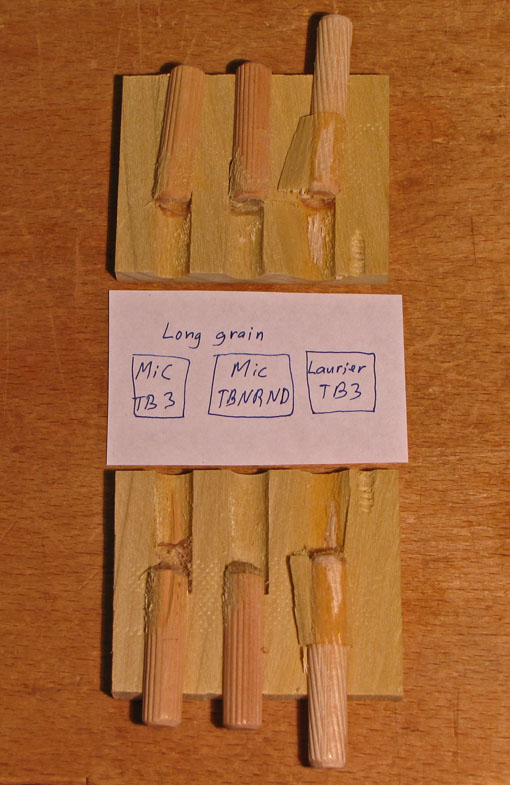
Using a DeWalt Pilot Point bit and a Krenov-style jig, 3/8″ holes were bored in poplar in the long-grain direction, deep enough to allow 3/4 inch of dowel insertion plus room for excess glue. Glue was spread only in the holes. After 24 hours, the wood was sawn through the middle of its thickness. Each half was secured in a vise, and each dowel was then hit with a hammer toward the open face to make the connection fail. The photos show the dowels snapped backwards, exposing the half hole.

From left to right,above:

1. A made-in-China (MiC) dowel glued with Titebond III. Fair adhesion – some wood is torn away.

2. A MiC dowel glued with Titebond No-Run No-Drip glue. The bond largely failed as evidenced by the relatively clean surfaces.

3. A Laurier brand dowel, made in Canada, glued with Titebond III. Plenty of wood failure, indicating a good joint. That’s what I’m looking for.

Update Aug 29, 2017: A reader has informed me, based on information directly from Laurier, that Laurier dowels are no longer being manufactured. The owner has retired, and the machinery that makes the dowels is for sale.  A few sizes remain available at justjoinery.ca

The TB No-Run No-Drip glue is very viscous, and handy in that it doesn’t run down and collect at the bottom of the hole. However, in other tests I found it did not spread well over the Laurier dowels which have less space for the glue in their spiral flutes. There was too much resistance to inserting the dowels, the glue got pushed down, and too much pressure was created. I thought it might work well with the more deeply fluted Chinese-made dowels, and they did go in easier, but TB III still made a better joint with them.

So, for long grain dowel insertion, I’ll go with Laurier dowels and Titebond III. (In other trials, Lee Valley’s 202GF performed similarly to TB III.)

Lee Valley sells the Laurier dowels. Grizzly sells the Chinese-made dowels. To keep myself out of trouble, I emphasize that these are not scientific tests, and my conclusions that I am sharing with you are for my purposes in my shop. These should be regarded as anecdotal findings. Please refer to the manufacturers’ and vendors’ literature and make your own choices.

Of course, there is the other half of the joint to consider – the face grain board. Obviously, the same dowel must be used but it does not have to be the same glue in each half. So, in the next post, we’ll look at side grain insertion of the dowels with various options. This is the part of the joint that creates more doubt for me since much of the dowel surface is bonded to end grain surfaces inside the hole. The results of my tests surprised me.

Author:
• Sunday, August 12th, 2012

In managing the fit of the height of a drawer in its housing, the seasonal changes are larger, and thus not a matter of such fine tolerances as with the width which was discussed in the previous post. Let’s take a closer look.

A four-inch high drawer front in flatsawn solid maple will expand about 1/8 inch when the ambient air goes from 35% to 80% relative humidity. For flatsawn cherry or walnut, the change will be about 3/32 inch. For quartersawn wood, the values will be about half to two-thirds of those. Wood finishes will slow but not eliminate these changes, as shown by the work of the US Forest Products Laboratory.

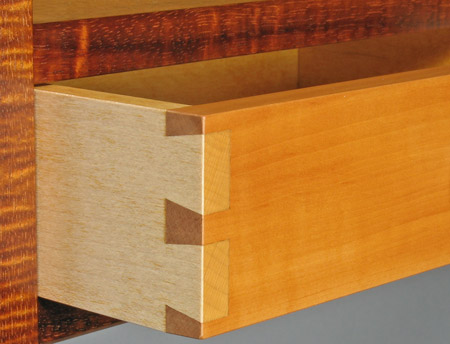
If you are building inset drawers and the humidity in your shop is at the low end of that range, allow those amounts of clearance from the top edge of the drawer front to the divider or case member above it. If the drawer is eight inches high, double those clearance amounts; for a two-inch drawer, halve them. (The drawer in the photo is just over two inches high.) The tops of the drawer sides are made flush with the front, while the top edge of the drawer back is made a bit lower than the sides.

This means that during the dry season, the clearance space above each drawer front in a group will be proportionate to the height of the drawer. This will look odd only to those who do not understand wood. For overlay or lipped drawers, appropriate clearance must still be made but it is, of course, hidden by the front.

Remember too, the depth of a solid-wood case with the grain running vertically will similarly change with the seasons, and thus the length of the drawer must be calculated for the time when the case has the shortest depth, plus a margin of safety.

Woodworking lore and some authors extol “piston-fit” drawers whereby pushing in one drawer in a set will cause others to be forced outward from the resulting air pressure within the case. Well, this can be done and is not very difficult to accomplish. For fun, you might try it on the way to building useful work. To me, “piston-fit” implies virtually zero clearances – which may work for small drawers at one particular time of the year, but not for practical woodworking. Proper clearances for the sides, front, and back that render a drawer functional year-round preclude a true piston-fit. It should not be considered a hallmark of top-quality drawers.

Really, you’ll feel much more comfortable when your drawers have a practical fit.

Category: Techniques  | Comments off
Author:
• Sunday, August 05th, 2012

Drawers must work throughout the year. There is no virtue in constructing an ego-feeding science project with a “piston-fit” in February only to find that you, or worse, a client, are unable to open the drawer in August. Let’s take a closer look.

In the “High-End Drawers” ten-part series on this blog that ran intermittently from July to November 2009, and in the article “4 Steps to a Sweet-Fitting Drawer” in Fine Woodworking magazine #224 (January/February 2012), I describe a reliable process for producing a good drawer fit. But just as with a good suit, a good drawer fit means not too tight and not too loose. With wood, however, we have the added complication of the inevitable changes in moisture content that occur with seasonal humidity changes. A zero-tolerance “piston fit” in February will be all wrong in August.

Let’s think it through.

Consider the width of the drawer in its case. In both solid-board and frame-and-panel constructions, the width of the case remains essentially stable throughout seasonal humidity changes, since it is defined and limited by long-grain pieces. Even the expansion of the side walls of a solid-board drawer pocket will occur on the outsides, not within the pocket.

The drawer sides are oriented to expand laterally. (Their expansion in height will be discussed later.) As an example, hard maple, typically quartersawn for drawer sides, 3/8″ thick, will expand .012″ (12 thou) over a humidity increase from 35% to 80%. Drawer sides normally receive little or no finish, so these changes can, at least theoretically, occur rapidly. There are some mitigating factors though, including that the drawer spends most of its time secluded in the case, and the sides are somewhat bound by the joinery, usually dovetails. However, PVA glues retain some elasticity, as evidenced by the tiny elevation of tails above the endgrain of pins in very humid conditions. It should be noted, however, that this theoretical amount of expansion does not seem empirically to fully manifest.

Does this matter? Yes, it does. With the incremental construction method wherein the final step of fitting the drawer to its pocket is to plane the sides down to the level of the endgrain of the pins of the front and back, the drawer width can easily be fit to tolerances of a few thousandths of an inch.

So, if during the dry months, the drawer width is fit like a piston with a clearance of say a couple thou between the sides and the case, it is sure to be too tight in the humid months.

Is this all just theoretical? Not at all. I can tell you from experience that it matters. Years ago, during a low-humidity season, I made some nice drawers with a piston fit. I felt proud and thought that since they were small drawers, all would be fine during the coming summer, and I could get away with this exercise in ego-stroking perfectionism. Not so. The following August, neither drawer could be opened.

That is not practical woodworking. The perfect defeated the good. That Fall, I made things right.

Right now, in an August steam bath here in the Northeast US, drawers in pieces that I made several years ago operate well but with almost no remaining clearance. That’s fine. In the dry winter, the fit of these drawers do indeed have more play in width, but are by no means sloppy.

In summary, if you are building a drawer during very humid weather, fit the width to be very snug. If you are building a drawer in the dryness of February, you must leave some allowance.

Ah, but how much allowance should you make when building in dry conditions? It depends on the thickness of the drawer sides (less for thin sides), the species of wood, and the conditions where the piece will be housed. More play is appropriate in large, practical drawers than in small, delicate drawers. It helps to keep your shop from getting too dry in the winter. This will reduce the range of estimating that you have to do.

To avoid a stuck drawer, stay on the safe side but don’t go so far as to make a clearance that feels at all sloppy in dry conditions. For a small drawer, building in dry conditions, I like to at least get a sheet of paper, maybe two, in there on each side. Experience helps a lot; I go by how it feels. The theoretical expansion amount calculated above will be too much allowance.

Of course, haha, if your piece will be placed in a climate-controlled museum, don’t worry about any of this!

Next, we’ll look at the height of the drawer and appropriate clearances. That’s important too, but less finicky.

Category: Techniques  | 3 Comments
Author:
• Sunday, May 13th, 2012

Tip #5: Be assertive “to the line.” Timid does not work.

To determine if your saw strokes are following the line, you have to observe sufficient incremental progress to close the loop of intent and result. In other words, you have to see how it’s going.

An ineffective strategy is to go very slow, with the supposition that although such extreme care is time consuming, at least things won’t go wrong. Yet if each stroke is barely consequential, such as when using a saw with too many teeth per inch for the job, it is difficult to know how it’s going and how to adjust. Much like learning to ride a bicycle, being overcautious will prevent you from ever learning. At some point, you have to let it flow, even if sometimes you will fall.

The answer is not a dovetail saw with 32 tpi. This is not to suggest being reckless or careless, but appropriately confident.

A similar problem is taking too much clearance from the line. This leads to excessive clean up maneuvers, creating more opportunities for things to go wrong and to lose direction. One-sided tolerance, an awareness of directional errors (discussed in another post), is one of the key concepts in craftsmanship, but it should not be misconstrued as an excuse for timidly missing by a mile.

When sawing, the visual and physical senses continually inform each other. As you see success developing, your movements gain assurance. The physical sense takes precedence as the cut proceeds, and as assurance builds, speed can increase as an easy flow develops[In the cuts above, I did the one on the right first, not quite fully assertive, then went at it and split the line nicely on the other three, picking up speed.]

There is a solution to all of this: practice! And if you miss, get another piece of wood. I’ve had a lot of practice at that! Truly, we’re all students.

Happy sawing!

Category: Techniques  | Tags:  | 7 Comments
Author:
• Friday, May 11th, 2012

Tip #4: Since you can only watch one line at a time, see one line while you feel the other.

For most sawing, you are viewing a single line while using a physical registration for the other axis of the saw. I will explain.

In ripping with a handsaw, you follow the line with your eyes and the saw after establishing and then maintaining the saw at 90 degrees to the wood surface. When sawing a dovetail tail, most woodworkers start the saw along the end-grain line, establish that 90 degree relationship, and then view and follow the line down the wood.

In both cases your eyes track one line as you feel the angle you initially established with the saw by using an estimate of position (ripping with the handsaw) or another line (dovetailing). In dovetailing, you can use both lines to position the saw before you start. You can also use peripheral vision to sense the saw’s squareness to the length of the bench or a wall behind it. Yet when you are actually sawing, that initial line on the end grain is really only there to start you out. It is not necessary to continue to watch the remnant of it as you cut down the face-grain line, as long as you maintain a true stroke in one plane.

In any moment, the eyes can only watch one detail. Yes, there is peripheral vision, but even a small distance away from the spot you are “looking at” (technically, on which you are aligning the very tiny center of your retina, the foveal center), the vision is not very clear – not clear enough to follow a fine line. So if you attempt to follow two lines at once, the best you can do is to quickly jump your eyes back and forth from one line to another, and this must be done in the rhythm of your sawing stroke. The feeling one might have of actually accurately viewing two lines at the same time is an illusion.

Now, consider sawing a tenon. For some reason, it is often recommended to follow the end-grain line on top of the wood at the same time as you follow the line down the side of the wood. In other words, to saw a triangle into the wood in one motion.

In this method, the two contact points of the teeth biting into the wood grow further apart from each other as the cut proceeds. Yes, by aligning your eye, the two lines could be viewed as one, but the saw teeth are biting at two ends. Again, the best you can do is actually jump the eyes from one spot to the other.

The better way, in my opinion, is to cut the single end grain line first. The eyes follow one line and the saw is held vertical by feel. I like to establish the cut first at the near end, then the far end, work each cut toward the middle, then cut the full width as the saw is established in a kerf. I advance just until the teeth are buried, as seen in the top photo.

[By the way, if the saw blade is shiny, the vertical orientation of the saw can be checked before starting by observing the continuous straight line created by the top corner edge of the wood and its reflection in the blade. See the photos. I don’t find this necessary, but it is a neat trick to know.]

Then I saw the line down the side of the wood, only watching that line. The saw does not bite further in at the far end of the wood, only on the near side, going down the line. The initial kerf established on the end grain is the “line” I feel, as I watch the line down the side. See the photo below:

I proceed similarly on the opposite side. Next, the final remaining internal triangle of wood gets cut almost entirely by feel since there are kerfs all around it. At this point, I do not want to redirect the saw; I’m just going with the flow, by feel, with what has already been accurately established.

A similar sequence is useful in accurately crosscutting beams by hand, such as a 4×4.

Seeing and feeling work together to make accurate sawing.

Next: attitude matters.

Category: Techniques  | Tags:  | 2 Comments