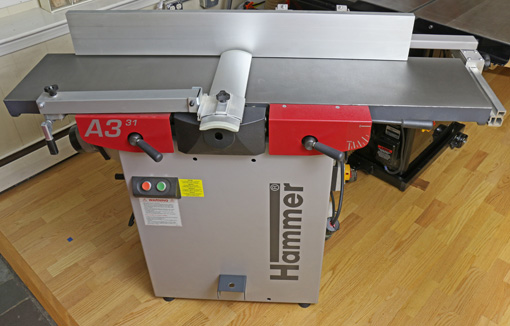
In the previous post in this series, I recounted my stock preparation history culminating with the Hammer A3-31. Prior to discussing the ins and outs of the Hammer machine, let’s look at the rationale for a combination jointer-planer in the small shop.
I’m guessing most of us share the following woodworking profile. We have:
- A strong desire to build things from wood that exceeds the desire to dawdle with woodworking tools.
- Less time than we want for making things.
- Less shop space than we’d like.
- Less money than we want.
To get a pile of wood transformed into a finished project, the stuff needs to be taken to the desired thicknesses, with flat parallel surfaces and a straight, square edge before being ripped to width and crosscut.
Here are some options:
1. Handwork/hybrid
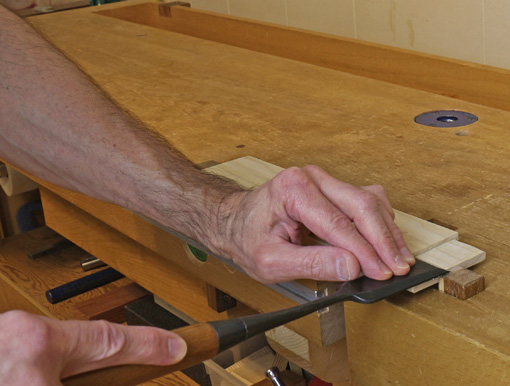
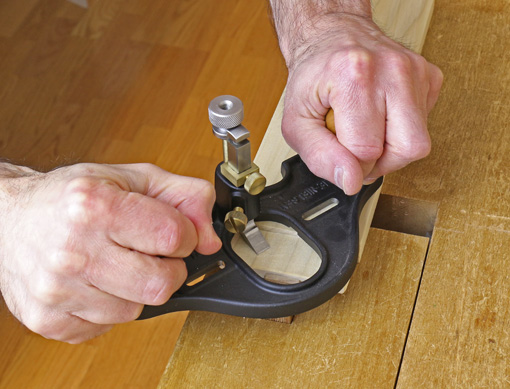
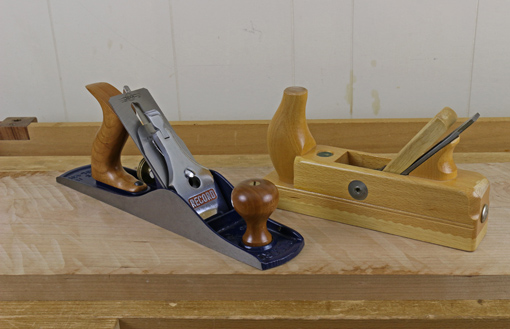
Doing it all by hand is just too slow and tedious for most of us, but a hybrid approach employing a portable thickness planer is very practical. One face is made flat but very rough using scrub and jack planes, just enough so it does not rock or distort on the planer bed, and there is no bow (lengthwise curve on the face). The planer flattens the opposite face, the board is then flipped and the planer makes the first face flat and parallel. Then hand plane a straight edge.
Don’t forget too that a well-tuned bandsaw with adequate blade height can do a pretty good job as a jointer and thicknesser followed by clean up with hand planes.
2. Exceptions
It does pay to be able to fully prepare a board entirely by hand just as a baseball player must be able to bunt – it isn’t used often but a complete player artfully brings up the skill when needed.
Some boards are too short to safely feed to a thickness planer and hand work is a must.
Also, there is an occasional board in which I want to preserve every hair’s breadth of thickness, and conservatively flattening one face by hand is a less risky method.
For very wide slabs, elaborate router jigs can be set up but finding a local commercial shop with a megabeast thickness sander makes more sense to me.
3. Separate jointer and planer machines
The big problem here is that jointers with widths that approach even inexpensive portable thickness planers are big and expensive. To me, it makes little sense in terms of expense, space, and work efficiency for most small shop furniture makers to have a $2000, 600-pound, 8″ jointer with a 7 foot bed paired with a 13″ thickness planer. Or how about 5 or 6 thou for a 900 pound 12″ jointer?
One interesting exception to this mismatch situation is Grizzly’s G0706 12″ jointer that has a 60″ bed.
4. Combination jointer-planer
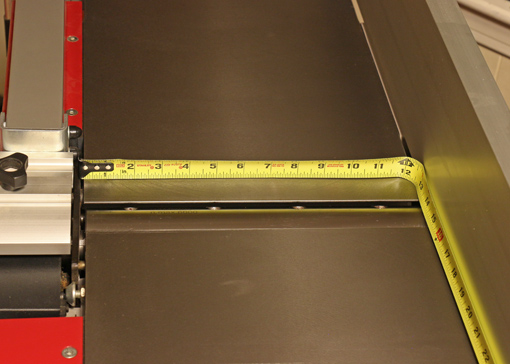
In a single machine with a fairly small footprint, you get an excellent 12″ of planing and matching jointing capacity. This opens up a world of managing wide boards with ease. This is value.
There is a range of prices starting at about $1800 up to twice that, among options that include Rikon, Grizzly, Jet, Rojek, Minimax and Hammer. Pair one of these bad boys with a steel frame bandsaw with a matching 12″ capacity and life is very good.
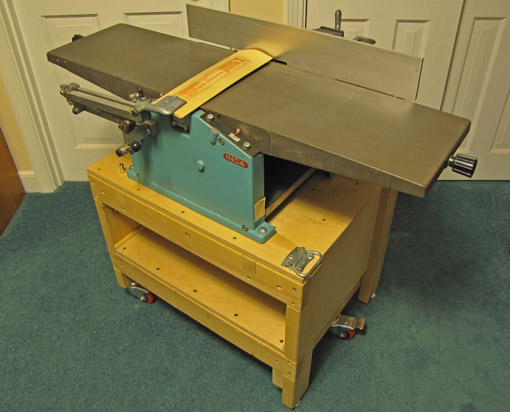
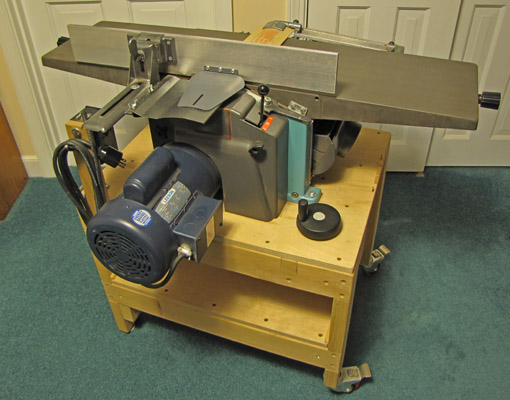
Lower budget 10″ models are available, including Rikon, Jet, and Grizzly. I will say that I really appreciate the extra two inches and extra beefiness of my current Hammer over the 10″ Inca I had. Hey, how about 16″? Sure, if you’ve got the space and money, but for most of us it’s not necessary for most furniture making.
In the next post in this series, I’ll go into some detail about my Hammer A3-31. Previewing, here are two non-issues: bed length and change over between functions.
 Heartwood readers, I invite you to check out Craftsy, an online craft instruction site that has recently added woodworking to its blog repertoire, with
 Readers of this blog may have noticed that the author has a few pet peeves. Among them are