Archive for the Category ◊ Tools and Shop ◊

Author:
• Thursday, June 04th, 2009


A Google search will yield many references to carbide burnishing tools used to form the hook on a scraper. I first came across the use of carbide in a commercially made burnisher in the old wooden-body version of Veritas’ Variable Burnisher which houses a short carbide rod. (The body of the current version is a molded man-made material.) I later purchased their Burnisher which has a 1/8″ carbide rod projecting 3/4″ from a simple handle. Despite its small size, I found myself using this tool in preference to all of the many (too many) steel burnishers I’ve bought or made over the years. I just needed more length.

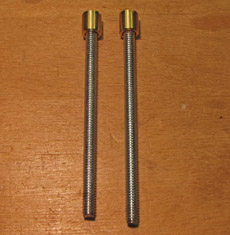
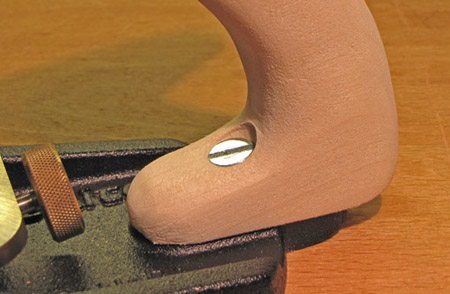
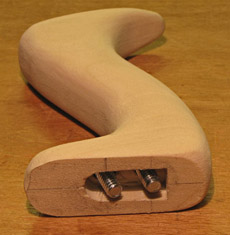
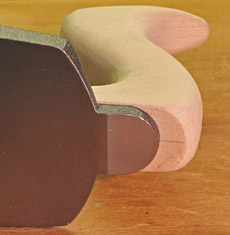
Pictured above is my homemade Burnisher for Life. Three and one-half years ago I asked the folks at Innovative Carbide to make a 3/16″ diameter 12″ highly polished carbide rod. I explained the intended use and they recommended an appropriate grade of carbide (10S) with excellent wear resistance. It cost about $50. I drilled a hole in a $4 handle to house 5 ½” of the rod with a press fit, which thus is effectively stored for future use, though I doubt it will be needed any time soon.

This is by far, no contest, the best burnisher I’ve ever used. The very hard and smooth carbide gives effortless, controlled burnishing. The length, though more than necessary, allows a combination of forward and sideways motions creating smooth action against the steel.

There are a few other homemade carbide burnishers to be found on the internet, but currently there is no need to make your own. Lie-Nielsen and Blue Spruce make carbide burnishers that look excellent, as expected from these makers, though I have not used them. The Blue Spruce is listed as 1/4″ in diameter and the Lie-Nielsen appears to be similar. I like the pressure produced by the 3/16″ diameter but I’m sure 1/4″ would work well and, I suppose, be sturdier.

A full size carbide burnisher, store bought or homemade, is relatively expensive but I’ll bet once you try one, it will be the only kind you’ll want to use.

Category: Tools and Shop  | 8 Comments
Author:
• Tuesday, June 02nd, 2009

I find myself using only two of the three scraping tools pictured here. The odd one out for me is the #80-type cabinet scraper, with the spokeshave-like wing handles. While there is a wide range of valid opinion on this subject, and a legion of other scraping tools, here are reasons for my preferences.

The humble card scraper is the ultimate in simplicity and utility in a woodworking tool. I use .024″ thick scrapers for general smoothing, and .020″ scrapers for more delicate or focal tasks. I keep a .032″ scraper for unusually heavy work but find it too tiring to bend for general work. I do not use scraper holders since they decrease the sensitive control of the tool in my hands. Since I am using the scrapers for finishing a surface, not dimensioning it, the card scraper works well on areas up to a small table top.

All of these scrapers are hardened to about Rc50. Lie-Nielsen, Bahco, and Lee Valley are fine brands. I keep a few .020″ x 1″ x 2″ mini scrapers (from Lee Valley) that are very handy for touch up work in restricted places. I also keep some softer .020″ scraper stock to easily file into special shapes. Gooseneck and curved scrapers complete the set.

The cabinet scraper’s main disadvantage is its short sole. It lacks both the handiness of the card scraper and the control of the scraper plane. Despite skewing techniques, I find it is unreliable at the beginning and end of boards, and has neither the finger tip control nor the steadiness to avoid occasional blade chatter. The one pictured is a fine quality tool that I’ve owned for over 20 years, and the aftermarket Hock blade is excellent, but it now mostly sits idle. I’ve briefly tried the Veritas model which has a slightly longer sole but it didn’t fly for me.

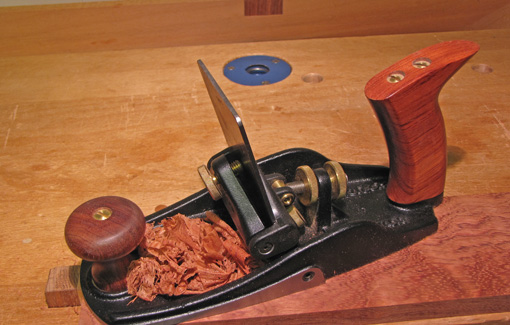
The folks at Veritas have, fortunately for us, a healthy obsession with scraping, and one product of this is their superb Scraping Plane which has a variable blade angle and the ability to bow the .055″ blade. I once owned a Kunz version but it lacked the ability to bow the blade. Lie-Nielsen makes a similarly large scraper plane, an excellent tool, but its much thicker blade is a different working approach which I found too fastidious to deal with.

With the Veritas, cutting depth is controlled with a combination of the blade angle and the amount of bow. Varying each of these also alters the cutting feel, useful for different woods. The large sole keeps the work flat and prevents digging in, while the tool’s mass helps avoid chatter.

After much experimenting, I find it easier and more effective to prepare the blade with a 90 degree edge (like a card scraper), contrary to the usual recommendation of 45 degrees for scraper planes. This seems to give a more solid, though less aggressive, cutting action, and is pleasingly reminiscent of a card scraper, but with the mass and registration of the big body plane.

Category: Tools and Shop  | 4 Comments
Author:
• Wednesday, May 13th, 2009

Here are some brief thoughts on these tools and a good excuse to own both.

Skew chisels are handy for getting into acute angles, such as the sockets of half-blind dovetails, as well as for easy access to square corners, such as cleaning out a hardware mortise. The skew chisels pictured above are available from Lee Valley, $27.50 for the pair, nothing fancy. They are about ½” wide and come with sturdy, though unattractive, hooped handles. For fun and aesthetics, I made Hondouras rosewood replacement handles intended for pushing, not striking. The edge forms a 65 degree angle with the length of the chisel on the acute side.

An interesting tool sits between them, a Matsumura “bachi nomi” or fishtail chisel, available from The Japan Woodworker in various sizes, $39-$53. The 5/8″ edge forms an 86 degree angle with each side. This allows use in many tight spots but is not sufficiently acute to easily clean out lap dovetail sockets. The geometry of the bach nomi makes it more amenable to striking than that of the skew chisel.

These two types of tool, one common, the other unusual, have some overlap in their function but I feel both are worth owning, especially since I am a big fan of Japanese chisels in general.

Category: Tools and Shop  | 4 Comments
Author:
• Tuesday, April 28th, 2009

To a woodworker tooling up a new shop or upgrading an established one, I suggest the second major machine acquisition should be a good quality bandsaw. Nope, not a table saw, not in the number two slot. True, the table saw rips and crosscuts very well but is far less versatile.

The great freedom afforded by a good bandsaw can change your relationship to wood. Here’s a sampling of some bandsaw work:

  • cut curvy legs from 12/4 mahogany
  • resaw a 10″ figured board into bookmatched panels
  • make your own 3/32″ veneer
  • select out furniture parts from stock irrespective of their orientation to the original edge of the board
  • cut tenons
  • cut and dry some wood from a tree felled in your backyard
  • try some sculptural work
  • rip laminates for bent lamination work
  • cut out cartoon characters and toys for your kids

A bandsaw will generally not rip as cleanly as a table saw, but with an excellent blade it does a surprisingly good job that is just a very few hand plane passes away from finished. For clean, accurate, consistent crosscutting, it must be conceded that the table saw is the clear winner. Still, the shooting board can take care of that issue. Nonetheless, if I had to give up one of these two machines, there is no doubt the table saw would go because the lack of a bandsaw would be far more limiting to my range of designs and work.

The bandsaw also takes up much less shop space than a typical table saw. There is an additional, hard to define virtue of bandsawing. It is the machine work that I liken most to hand tool work. I feel in touch with the cutting action and in control of the work, unlike with the table saw where, after the setup for a cut, the machine essentially rules. A bandsaw is also way more just plain fun to use than a table saw, jointer, or planer.

I would strongly suggest a steel frame saw in preference to a cast iron version. While a review of specific machines is beyond the scope of this post, I suggest to look for at least 10″ cutting height, preferably 12″ or more. Lower priced steel frame saws in the $800-900 range, such as the Rikon 10-325 or Grizzly G0457, are not more expensive than a quality cast iron model plus a riser block. Better still, move up to a Minimax or Agazzani.

So just as my New England Patriots (to raise the hackles of lots of readers) produce consistent winners by building the roster based on players’ value and versatility, go ahead and add a quality bandsaw early on in your woodworking lineup. Just remember, the pursuit of perfection is fraught with agony. (Yea, yea, I know: 18-1.)

Category: Tools and Shop  | 14 Comments
Author:
• Sunday, April 26th, 2009

New woodworkers setting up their first shops may wonder which major machines should be purchased first, second, and so forth. Similar issues confront experienced craftsmen looking to upgrade their machine arsenals. Answers to tool questions such as these must always take into consideration the type of projects planned, the methods and skills used, and shop space. Furthermore, quality woodworking is a very personal endeavor which precludes definitive answers in matters such as these.

This discussion applies to the type of woodworking that I think is done by many readers: building mostly furniture and accessories, using a combination of machines and hand tools. Examples of projects, for necessity or just for fun, include tables, chests, jewelery boxes, bookcases, and maybe a chair, using mostly straight but also some curved or sculptural elements. It is assumed that money and time are limited. (Good bet, I think.)

My suggested first major power tool is the portable thickness planer. Why? It accomplishes very well a difficult, essential task with relatively little expense and shop space.

For $350 to $650, one can buy a machine that will perform its job at a very high level. Most woodworking projects start with flat boards of uniform thickness. So why not buy a jointer first? A jointer with the analogous quality and versatility as a portable thickness planer would cost far more, and its tasks are far easier to do by hand than is thicknessing.

A flat surface prepared by hand, preceding thicknessing, can be done reasonably quickly and does not have to be pretty. It may even contain residual furrows from a scrub plane and tearout, so long as it does not contain cup, bow, or twist. Thus it can register properly against the bed of the thicknesser for the other side to be planed, then the board is flipped, and so forth.

Spending much more money on a good jointer, or worse, buying a cheap or narrow jointer destined for early obsolescence, will produce a flat face but leave the arduous task of hand thicknessing. The portable thickness planer quickly frees the woodworker from some of the most limiting habits in woodworking – using pre-dressed wood and defaulting to 3/4″ stock.

I like my DeWalt DW735. I use it with a dust collector but its blower allows use without one, making it easier to start up a shop.

Next: suggested major machine number two. More money, of course, but here comes the fun. Big hint: it’s not the table saw.

Category: Tools and Shop  | 6 Comments
Author:
• Wednesday, March 18th, 2009

When I was shopping for a new bandsaw last year I was not able to find much written by Minimax E16 users so I am posting this to help woodworkers looking to buy a new bandsaw. I’ve been happy with the E16. It is a very important tool in my shop and I’d buy it again. This is my view of the machine, unprompted by the company in which I have no stake.

The MM16, which has a 4.8 HP motor and resaw capacity of 16″, is probably the better choice for many woodworkers, but I bought the E16 based on its price and size that fit my needs. The E16, with a 2.4 HP motor and resaw capacity of 12″, is about 200 pounds lighter and has a smaller table, making it more maneuverable in my small shop, a critical consideration for me.

The performance of the saw has been excellent. The E16 has ample power to handle everything I’ve thrown at it, showing the moxie, for example, to accurately and smoothly resaw 10 inch wide walnut and some very dense 8 inch pear using a Timberwolf VPC 3/4′ x 0.25″ x 2-3 tpi blade. The blade runs true without barreling. A carbide tipped blade also can be used on this saw.

Set up involved a lot of clean up, though that did give me a chance to learn about the saw. I think this is typical of most major woodworking machinery. You will need to obtain and wire your own power cord. The mobility mechanism, using the lever bar, is easy to use, plants the machine steady on the floor, and saves the hassle of buying and fitting a separate mobile base. The doors do not open separately as was described by the seller, but I really don’t mind.

The manual is poor and, while I have long experience bandsawing, it could be a problem for someone new to it. Virtually everything on the saw can be adjusted as needed and I found most of the tuning to be straightforward and intuitive. The Minimax folks were knowledgeable, helpful, and responsive when questions arose.

I like the simple, heavy cast iron rip fence which is easily adjustable for drift. The table tilt mechanism is solid but can be a bit balky when making large angle adjustments. The trunnions give the table good support. The table insert is easily leveled. Tracking the blade has been easy and so far I haven’t even had to change the factory setting for the lower wheel position on its axis. Blade changes are about as easy as I can imagine on a bandsaw. (It still would be nice if they magically changed themselves!) The spring and frame are easily strong enough to tension the resaw blade. The tension gauge, just a printed sticker, could use an upgrade, but at least it allows for approximate repeatability once you determine good tension for each of your blades.

The rack and pinion guide post is a pleasure to use and, over its excursion, accurately maintains the positions of the bearings relative to the blade. I had to hack saw off a bit of the blade guard in the back to allow the upper thrust bearing to move into proper position for some blades. This does not affect the safety aspect of the guard. I think this is a design defect and I have notified Minimax. (photo above right)

I had wondered if the Euro style blade guides would be a problem, not having prior experience with this type of guide, but was happy to find them easy to adjust and they perform well. The hex head screw that holds the position of the lower thrust bearing was awkward to reach with a wrench so I replaced it with a thumb screw. To allow outside access to the screw that locks the lower blade guide assembly, I drilled a hole in the sheet steel and replaced it with a longer socket head screw. (photo right)

The electro-mechanical brake works fast and is a handy feature to keep work moving along in the shop. I used a file to round the rough corners of the foot pedal.

Dust collection is excellent. The dust port is not a standard 4 inch fit – it’s just a bit too big. I rigged an adapter using a short length of plastic hose.

The videos on the Minimax website are well done and helpful. Particularly instructive are Sam Blasco’s videos using the MM16 machine. Product support from Minimax has been excellent.

In summary, based on my experience with this machine, if this is the general category of bandsaw that will meet your needs, I heartily recommend the Minimax E16. The best thing I can say is that when it’s time to use it in a project, I feel confident and at ease. That’s what you want from a good tool.

Category: Product reviews, Tools and Shop  | Comments off
Author:
• Monday, March 09th, 2009

Camellia oil is a pleasant, easy to use rust inhibitor for tools. This oiler makes it quick and neat to apply.

The project starts with squared-up blocks, each 2 1/4″ x 2 1/4″ on the end grain. One is 3″ long, the other 1 1/4″ long. I used poplar since I had some on hand and it is not so dense as to make the boring and shaping too tedious. A 1 3/4″ Forstner bit in a drill press is used to bore a 2″ deep hole, centered on the end grain, in the larger block. This is a lot to ask of a Forstner bit so much of the waste is best removed beforehand with multiple 1/4″ holes. For safety when using the Forstner, I immobilized the workpiece with clamped blocks on all sides. I never fully retract the bit and reenter the hole with the bit spinning; it could catch the edge of the hole and violently throw the workpiece.

Similarly, a 1 7/8″ diameter hole, 7/8″ deep, centered on the end grain, is bored in the smaller block. By sawing, planing, rasping, and sanding the larger block is formed into a cylinder with a wall thickness of about 1/4″. Turners could accomplish these steps on the lathe and may wish to use denser exotic woods.

Next, a heavy coat of epoxy is applied to the bottom and inner walls of the holes in each piece and to the end grain surface surrounding the rim of each hole. This prevents oil from bleeding through the wood. After the epoxy has dried, the area around the rim of each hole is flattened with sandpaper which gives it a non-sticky, matte finish. The outer parts of each piece, where there is no epoxy, are finished with two coats of varnish.

For the oil wick, cotton T-shirt cloth is tightly rolled and bound with string. The bundle is about 2 ½” long, to project about ½” beyond the rim of the cup, while its diameter fits snugly.

The cotton is generously soaked with Camellia oil, repeating as the oil slowly permeates the bundle. The oiler is stored upside down with the projecting cotton fitting into the hole in the smaller block, with clearance around the sides and below. The cotton acts as a substantial reservoir for oil which is replenished as needed. A light swipe of the oiler over tool steel surfaces will leave a thin coating of the Camellia oil. The design allows one-handed use.

For general oiler construction and dimensions, I used information in Toshio Odate’s superb book, Japanese Woodworking Tools: Their Tradition, Spirit, and Use, which describes a traditional Japanese oiler made from a section of bamboo. The general idea of an oiler stored upside down in a holder is borrowed from an oiler made many years ago by a woodworker.

This oiler has passed the test of practical use in my shop: it’s simple and it works. I hope you find it useful.

ADDENDUM: Here are a few afterthought improvements after using the oiler for some years.

I now line the oiler with rolled felt from a craft supply store instead of cloth. This makes the oiler neater in use.

If I had to make this again, I would adjust the diameters of the holes in the top and bottom sections. The top section hole should be 1/4″ smaller (not 1/8″, as above) than the bottom section hole. This would make it easier to plant the top section into the bottom without catching the edge of the liner on the rim of the hole in the bottom section. You can adjust the dimensions of the block and wall thickness of the top section (make it a bit thicker) accordingly, depending on the wood available to you. Remember that you can, of course, always glue up stock if thick stock is not available.

Category: Tools and Shop  | 4 Comments
Author:
• Saturday, March 07th, 2009

An extremely accurate granite surface plate might seem superfluous in a woodworking shop but I find my 9″ x 12″ x 2″ 30 pound rock to be very handy. It is simply a smooth and very flat slab of black granite, with a phenomenal surface tolerance, even on this economy model, of 0.0001 inch, which is about 2.5 microns.

Its main use in my shop is to accurately flatten other tools, such as plane soles. I use aluminum oxide or silicon carbide abrasive paper adhered to the plate with only water, or just hand held or taped in place for working on small tools. I can flatten the sole of a 9″ smoothing plane, especially easily if it is a bronze plane, or even somewhat larger planes, though certainly not a 22″ jointer.

Used with a feeler gauge, it serves as a reference to verify the accuracy of layout tools, such as straightedges, and any other tool that is supposed to have a straight/flat surface. For those who like sandpaper sharpening, the granite plate can be used as a base for the abrasive paper when extreme accuracy may be desirable, such as when flattening the back of a new blade.

I like knowing that there are a few dependable references in the shop – the granite plate, a Starrett straightedge and square – with which to vet other tools. They’re like the Constitution of the shop and the woodworker is the Supreme Court. However, I then have only myself to blame for the inaccuracies in my work!

I bought my granite plate at a local industrial supply house for about $35. Woodcraft, Japan Woodworker, and Enco have good buys on them. A 12″ x 18″ x 3″ or a 9′ x 24″ x 3″ plate may be more useful but the weight goes way up to about 85 pounds. Obtaining your plate locally will save a lot of money on shipping.

Category: Tools and Shop  | 4 Comments