Archive for the Category ◊ Tools and Shop ◊

Author:
• Sunday, February 15th, 2009

The handles on most clamps are round in cross section and quite smooth. Shiny things may sell well, but when it comes time to bear down on clamp screws, slippery handles make it difficult to transmit strength. Wrapping the handles with cloth friction tape is an easy and effective solution.

The tape is made of cotton cloth impregnated with butyl rubber making it tacky on both sides, though it does not tend to leave adhesive residue on tools or hands. It is quick work to wrap the handles in a simple spiral pattern as the tape adheres to itself and to the handle. The enhanced grip will make you feel like you’re Popeye after he downs a can of spinach. (For younger readers, that means like a ball player on ‘roids.)

Some handles are impractical or unnecessary to wrap, such as those on my Jet parallel bar clamps. When I want to torque up those, I use rubber palm gloves to make the job faster and easier. These gloves are also a big help when pulling horizontally stored boards at the wood dealer.

I bought the friction tape, $2.50 for a 30 foot roll, and the gloves, about $7.50, at my local Ace Hardware, though both are widely available.

Category: Tools and Shop  | Comments off
Author:
• Thursday, January 15th, 2009

In general, I have nothing against oxygen; I use it on a regular basis. I just do not like its predilection to hook up with the iron in my tools. Like all tool folk, I hate rust. Hoping to prevent this unholy molecular union, I’ve tried many methods and products over the years. Here are the proven performers: three non-toxic, virtually problem-free products.

Camellia oil. This gets wiped onto all my hand edge tools and some steel measuring tools with either an oily rag or an oil rub, a wad of soaked felt in a wooden cup. This very light oil has a pleasant fragrance, and only a minimal film is required to prevent rust. I’ve never had any problems with the oil interfering with gluing or finishing since I use a quick cleaning wipe on edge tools before putting them to wood. Freshly sharpened tools get oiled promptly after the water is wiped off, but I make sure oil stays away from my Shapton stones. One 8 ounce bottle lasts a few years for me.

Corrosion X. I use this on cast iron machinery surfaces and for other power tool applications. I much prefer it to the several other products I’ve tried, including Boeshield and Top-Cote. I wipe it on and rub it in infrequently, when I think of it, perhaps every few months. The manufacturer claims Corrosion X is non-toxic, non-carcinogenic, nonflammable (in the pump spray form), has no silicon, and has only 8.6% VOC. I find it has only a mild odor.

Bull Frog Vapor Corrosion Inhibitor. This is a yellow foam pad, about 10 inches square, containing the non-toxic, odorless VCI chemical which settles on metal in an invisible layer only a few molecules thick. The pad is rated to protect 50 cubic feet of enclosed space. I cut it into several proportionate size pieces to protect the contents of various tool cabinets and boxes. This is cheaper than buying smaller strips. It lasts at least one year and works well without a hint of problems.

Here in the Northeast US summers can get very humid. An electric dehumidifier in the shop keeps humidity moderated for the sake of my tools as well as the wood.

This multi-pronged approach has kept rust at bay in my shop. I hope it helps in yours. Go Rust Busters!

Author:
• Tuesday, January 13th, 2009

These simple but very effective little planes come in a variety of blade types and contours. I love ‘em.

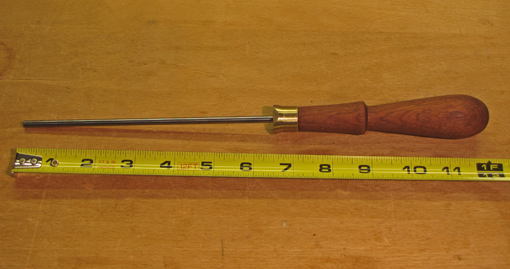
The 9 mm round over plane is, ounce for ounce, one of the most useful tools in my shop. The good quality laminated steel blade is a wedge fit in the 4 3/4″ body and is easily adjusted with light hammer taps. To get a solid feel for the cutting action, I grip the plane with my thumb and fingers on opposite sides near the mouth. It cuts a rounded chamfer which gives a slightly softer look than a plain flat chamfer. To hone the bevel side of the blade, I use a 5/8″ dowel covered with sticky-back 3M micro-abrasive film. This plane is about as simple and problem free as a tool can be.

I use the mini rabbet plane on the pull stroke for trimming the shoulders of small tenons where a metal plane might be unwieldy. The projection of the laminated blade must be adjusted carefully, but lacking a chipbreaker, this is an easy task. The skewed blade produces a smooth cutting action while the long length of sole in front of the cutting edge allows for secure registration of the plane prior to entering the cut. The sole and sides are easily tuned on a flat surface with sandpaper.

These tools are good examples of “just enough” design – they work beautifully with no frills.  Japanese mini planes earn their place on the tool roster. They are available from many suppliers, including Hida Tool, who carry a good selection.

Category: Tools and Shop  | 2 Comments
Author:
• Tuesday, December 23rd, 2008

It is easy to see how the #1 bench plane might not be taken seriously as a real working tool. With a 5 ½” sole and 1 3/16″ width blade, here sitting beside the 8 pound, 22″ #7 jointer, it may be regarded as merely a nifty miniature suitable for collectors. However, I don’t collect tools, I only want gamers on my tool roster, and the #1 is fit and ready to play.

The blade is bevel down, with a cap iron, on a 45 degree frog which is adjustable to control the mouth width. There is the usual blade depth adjuster nut, while lateral adjustments are easily done by tapping with a small hammer. I use a two-handed grip as with a larger bench plane, but with only the left thumb and first one or two fingers on the front knob and the right thumb and two or three fingers gently holding the tote.

I find the #1 is useful for many tasks. The obvious one is planing small pieces where a full size plane would obscure any view of the work and tend to tip at the start and finish of the cut. It is handy to use on assembled projects where I need a light, maneuverable plane, such as in trimming joinery or truing a table top bearing part.

When I want my hands very close to the cutting edge for a sensitive feel of the blade on the wood, the #1 gives me the control I need. For example, it works well planing around the joint line at the junction of a rail and stile in a small frame. The #1 can also fix small defects in surface finish planing where a larger plane would bridge the area.

It is true that a block plane could do much of this. However, I keep the #1 tuned like a bench plane, with a slight camber in the blade, and the plane lends itself to a two-handed grip, so it feels more natural and controlled to use the #1 for these tasks. Note that because there is not much momentum behind the cutting edge, the blade must be kept very sharp.

This is certainly not among the first few planes to buy and it is a role player, but it’s not a bench warmer and it has definitely earned its place on the team.

I will continue to laud some of my favorite tools on this blog, particularly if I think they are not well known or just really cool.

Category: Product reviews, Tools and Shop  | Comments off
Author:
• Thursday, December 18th, 2008

When I first started using dovetail saws there were not many good choices among Western saws. I couldn’t find any high quality, ready to use, new Western back saws so the options reduced to refiling a poorly designed new backsaw, reconditioning an antique saw, using a frame saw, or what I finally chose, using Japanese saws. Over 25 years later, I have to admit that I’m still trying out saws.

And why not? There are great options now available in Western saws, including Lie-Nielsen, Adria, Wenzloff, Lee Valley, and the Gramercy dovetail saw that I now have. My favorite Japanese dovetail saw so far has been the Harima-Daizo rip dozuki, available from Tools for Working Wood. This saw has aggressive rip teeth that can be tricky to coax into a smooth start. A light touch is a must. Once started, the saw tracks extremely well, producing an amazingly clean, thin kerf. There is, however, little room for error. With a saw plate of about .012″ and a total set of about .002″, this thoroughbred does not take kindly to redirection. You’ve got to be on your game from the start.

Japanese dovetail saws in general have some other problems, though all are surmountable. Sighting the line can be difficult in some woods as the saw pulls sawdust toward the marked side of the wood facing you. I do not have the skills to sharpen a Japanese saw. I also can’t fit a fret saw blade in the kerf, so removing waste by sawing involves more steps.

Now to Joel Moskowitz’ masterwork: the Gramercy dovetail saw. It has much of the personality of a good Japanese saw though in the opposite direction with a stiffer blade. It is light weight, appreciates a sensitive touch, and has a tuned, smooth cutting feel. Starting the cut is easy and reliable. The canted blade feels very natural pushing into the cut – notice in the photo that it’s really just the reverse direction cant of a Japanese saw. The kerf is, of course, wider but I contend that thinner is not necessarily better, provided the saw has a proper set. It is the quality of the kerf that matters; it must be have sharp, clean walls for the craftsman to track a line well.

The photos show sharp, clean kerfs from both saws, from the front side (top photo) and from the back side (bottom photo). The Gramercy saw, with a .018 saw plate, 19 ppi hand filed and hammer set about .003 each side, achieves a nice balance between tracking and room for error correction. It cuts about as fast as my Japanese saw – plenty efficient, even in 3/4″ maple or oak.

Excellent Japanese and Western tools are the products of two highly evolved tool systems. They both work, they both have advantages and disadvantages, but most important, a craftsman can adapt to either and do quality work. The choice probably comes down to feel and experience. Birds have feathers, bats have hair; they both fly. I will use both of my saws, I think because I can’t resist either one.

Joel has produced a gem which I highly recommend, especially to devotees of Japanese saws. He even offers a sharpening service. [This review is unsolicited and unpaid. I just like the saw a lot.] 


Category: Tools and Shop  | Comments off
Author:
• Tuesday, November 18th, 2008

I was long accustomed to using a classic joiner’s mallet to strike my chisels when I started using this brass mallet last year. It is a “Tite-Hammer” made by Glen-Drake Tools with a 14 ounce brass head and an ergonomic handle that must be held to be appreciated.

The wooden joiner’s mallet requires a large commitment of forearm movement and significant shoulder muscle involvement. This delivers the necessary punch when chopping a mortise with a heavy duty mortise chisel. However, for chopping dovetail waste and similar joinery tasks, a modest wrist movement with the Glen-Drake hammer easily supplies enough power. It’s somewhat like deftly tossing a crumpled ball of paper into a waste basket a few feet away, keeping the elbow low. This motion is less tiring and more efficient, especially when working in a seated position, which is generally how I like to chop dovetails. The mostly wrist action is also a better way to produce controlled, delicate tapping on a chisel without tensing the shoulders. This all makes a valuable contribution to my ease and endurance in the shop.

There are additional features of this tool. Since it occupies a only a small space on the bench, it is easily placed down and retrieved close to the work. The brass head is relatively kind to edge tools. I like the flat face of the head for chopping, while the rounded face comes in handy for other tasks such as tapping together joints.

When I pick up this unassuming tool, it feels like it is just growing out of my hand. The contours of this tool must have been designed, not at a drafting table, but with trial and error, a rasp, and learned hands. It is assembled with a nifty wedged through-tenon and a brass pin through the head. It’s simple and works beautifully, so, yeah, it’s my kinda tool.

I find the 14 ounce, the largest of four available sizes, packs a good wallop but is easily maneuverable with a light touch and does not tire me at all. I do not have a personal or financial interest in the company; my recommendation is based on personal experience and presented for the benefit of my fellow woodworkers.

I will continue to laud some of my favorite tools on this blog, particularly if I think they are not well known or are underappreciated.

Category: Tools and Shop  | 6 Comments
Author:
• Sunday, November 02nd, 2008

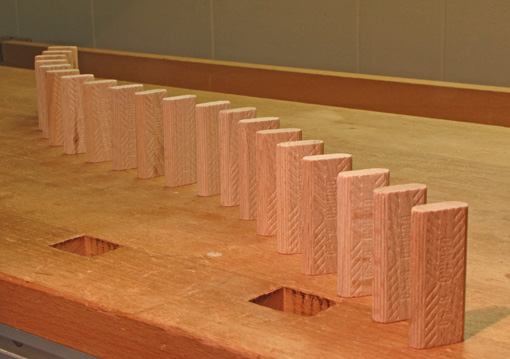
This is one my essential habits of work that I think, while decidedly unspectacular, warrants sharing with my fellow woodworkers. When I’m in the shop it’s usually only a short time before I need a small piece of scrap wood for something. It may be for a stop block on my router table fence, a clamp pad, a spacer for clamping stock in the tail vise between dogs, a thin shim to set a door gap, a square block to guide freehand drilling, or for countless other uses.

Candidates for the box o’ blocks usually are produced as squared, uniform offcuts from the table saw or bandsaw. That little box almost always seems to have what I need, from a shim that’s, oh, just a bit under 1/32″ to a stout block to hammer against to reset a tool handle.

The box contains reminiscences of distantly completed projects such as old tenon cheek cutoffs. I’ve been using this box long enough that I can fondly remember when my then very young daughter and I would play in the shop gluing together little scraps. For her, the main purpose of the box was to save nifty pieces of wood to play with. So the box has served more than one purpose, and, come to think of it, so does the shop. Furniture and memories are built there.

I’m pretty sure this tip is not in any woodworking textbook but that box o’ blocks has served well.

Category: Tools and Shop  | 2 Comments
Author:
• Wednesday, October 22nd, 2008

I injured myself earlier this year doing a procedure in the shop that I knew full well was not safe. A story familiar to woodworkers, I thought it would be OK, just this once. I fed a short piece into the thickness planer which ejected it faster than an baseball umpire tossing a manager who kicks him in the shin. A corner of the wood hit the tip of my thumb creating a handsome gash. Funny thing, I saw the blood drops on the floor before I felt the pain. Not OK. I was lucky, however, especially considering that my thumb at the moment of impact happened to be at the midline of my body, directly in front of, ahem, valuable anatomical parts.

After a fun-filled trip to the emergency room for some embroidery on my wound, I did some stern attitude adjustment. I posted this sign at the outlets where I plug in all my machines. It tells me what I must first ask myself when doing procedures in the shop. I taped the hospital ID bracelet to the sign (for the photo, the blue tape covers my medical record number) to remind myself that bad stuff happens and it could have been a lot worse.

Machines are dumb, it’s the human who is supposed to be smart, I got it. Let this be my first and only significant woodworking injury. Perhaps post a sign in your shop, without the bracelet – and without the injury. Happy woodworking.

Category: Tools and Shop  | Comments off