Archive for the Category ◊ Jigs and Fixtures ◊

Author:
• Sunday, December 01st, 2019
shooting tips

Another question from a reader: “My trouble in shooting is (I guess) in advancing the wood.  I often find myself in a situation where I’m feel like I’m pushing the wood very firmly against the toe of the plane and still not getting any bite from the blade.  This problem seems to come and go and I have yet to diagnose what I’m doing wrong.”

There are at least two possible reasons for this.

1. The blade may not be sharp enough, causing it to skid on the wood rather than cut it. The whole system (workpiece, plane travel, blade edge) may be deflecting, preventing the blade edge from engaging the wood. 

Of course, end grain is harder to cut than long grain. Paring end grain is how many woodworkers test an edge. However, there is another reason why sharpness is so critical that is peculiar to shooting. 

Planing in the usual manner with a bench plane, we intuitively sense that we can extend the working life of a gradually dulling edge by pressing down harder with the plane. Related to this, we find that it is necessary to advance the blade further (depth of cut adjustment) to get it to take the same shavings as when it was sharper, though with more effort. Eventually, we head back to the sharpening bench.  

Brent Beach offers a technical discussion relevant to this. The basic idea is that the extremely narrow lower wear bevel in a sharp blade has less area against the wood, and so is able to generate more pressure (force per unit area) on the wood than does a dull blade with a wider lower wear bevel. The sharp blade compresses the wood and bites into it.       

In shooting, the plane does not ride on the wood, it rides on the edge of the track, and so you cannot regulate the edge pressure against the wood as you can with ordinary planing. The blade has to be sharp enough to cut without your “help,” so to speak. Actually, I have found myself intuitively trying to shove the workpiece toward the plane as the blade dulls, but that is awkward at best, and tends to produce inaccuracies.  

Furthermore, end grain is less compressible than side grain. 

2. Another possibility is that the fence is set slightly greater than 90°. This will cause the workpiece to register against the sole of the plane near the fence but not reach the sole where the cut begins. It only takes, say, a couple thou of error for this to happen. Furthermore, as an insufficiently sharp blade moves along to eventually meet the workpiece, it might push it away rather than cutting into it. (This is another example of the general principle that a tool, hand or power, given the opportunity, will move the workpiece instead of cutting it, and/or move the tool itself.)

The shooting board fence may start out dead-on at 90°, but if it is not very firmly set, it is easy for it to eventually get pushed to greater than 90° because that is the direction of your force on it in use. 

In summary:

1. Sharp – wicked sharp – is a must for shooting!

2. The shooting setup has to be not only statically accurate, but also dynamically stable in use.

Category: Jigs and Fixtures, Techniques  | Tags:  | 4 Comments
Author:
• Sunday, November 24th, 2019
shooting board

A reader described the following frustration he is experiencing with end grain shooting.

“I have a problem getting perfectly square ends when shooting them on my shooting board.

“I have a homemade plywood shooting board and use a Record 5 1/2 on its side to shoot. I’ve checked everything, and everything is square to each other and the plane is sharp, however when shooting end grain the plane takes more off the near edge (closer to the front) than the back edge. 

“Am I doing something wrong?”

If you are getting this inaccuracy despite having everything set up square and true, the glitch may be in the shooting stroke itself. The blade can grab the workpiece on initial contact and slightly pivot it away from the fence at the opposite end. This can easily happen with wide workpieces. 

But first let’s check a few things with your set up.

The sole of the plane should be flat, at least in the critical areas. Use a very wicked sharp blade with a straight, not cambered, edge, and a fine, even blade projection.

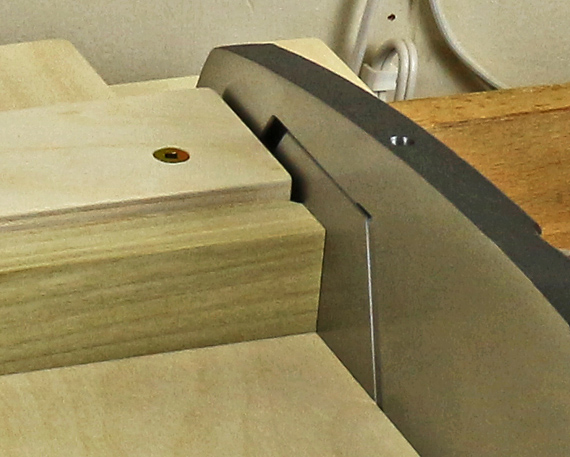
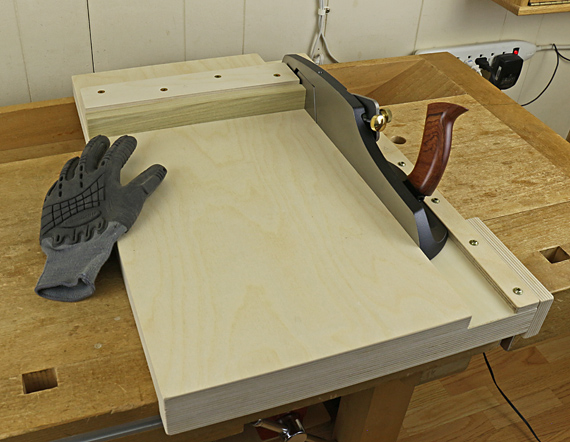
The track edge that the sole of the plane runs against in the shooting board must be straight. Ideally, the shooting board should have a snug channel in which the plane travels to prevent it from deviating during its run. (This will not work with a bench plane with a rounded side hump but not as well as with a dedicated shooter.) Wax the channel and/or use UHMW plastic on the running surface. If your shooting board does not have such a channel, take extra care to hold the plane firmly (without tipping it) against the running edge throughout the shooting stroke. 

The fence must be straight, of course. The best way to square the fence is to place the sole of the plane (with the blade retracted) firmly against the track edge, then place a square against the sole of the plane and the fence. This directly assesses the elements that produce the square edge on the workpiece. The fence has to tolerate considerable pressure in use, so make sure it is fastened securely.

The fence also has to be long enough to register an adequate length of the workpiece so the workpiece does not budge during the planing stroke. I sometimes had problems with my old shooting board that had a fence that was too short. My current shooting board’s fence is 11 1/4″ long. Books often show shooting boards with a fence that is too short for furniture work. 

A grippy glove on the hand holding the wood is a huge help in keeping the workpiece steadily registered and in advancing it after each cut. Otherwise, inaccurate registration can creep in, especially with wide workpieces, and especially as you fatigue. As a diagnostic experiment, try positioning a workpiece just right, then clamping it in place, shoot, and see if you get a square edge. 

In summary, your shooting “machine” must be set up accurately, but also must be dynamically stable in use.

Mystery frustrations like this reader is experiencing afflict all of us woodworkers but are rarely addressed in books and other teaching media where the descriptions are often idealized. Rest assured, however, there are solutions. 

I hope this helps, dear reader, but if you are still stymied, let me know. We’ll get it right.

Category: Jigs and Fixtures, Techniques  | Tags:  | 13 Comments
Author:
• Thursday, November 21st, 2019
Veritas shooting plane

Shooting is a gateway skill to precise hand tool woodworking. So get started by shooting with the planes you have. 

The basic requirements are:

  • Mass. You want substantial momentum to firmly and steadily carry the blade through the cut after you get it started, especially for end grain shooting. 
  • The side of the plane should be square to the sole. If you only have a not-so-great plane, use tape to shim the side. I did this with my old Record jack plane when it was the only one I had. [Please see in the Comments section reader Michael’s germane point and my lengthy reply for more details on the squareness issue.]
  • It helps a lot to have a comfortable, secure grip to consistently apply pressure where it is needed. Dedicated shooting planes have this feature. 
  • The blade must be sharp. Sharp! A dull blade is not only harder to push through the cut, but accuracy will suffer as the plane and the blade itself deviate from a true path. 

For end grain shooting:

Best: a dedicated shooting plane. 

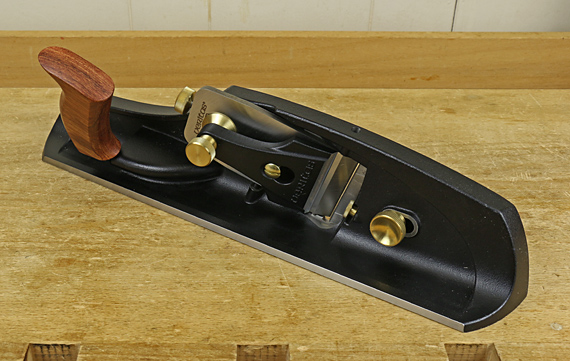
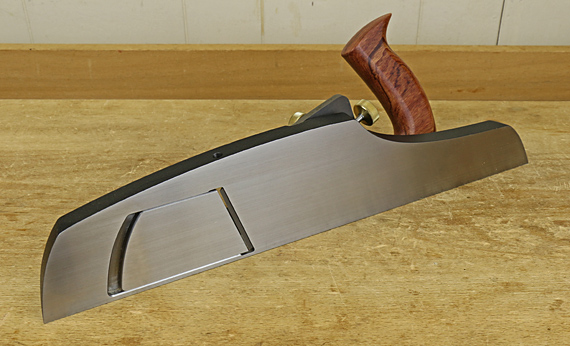
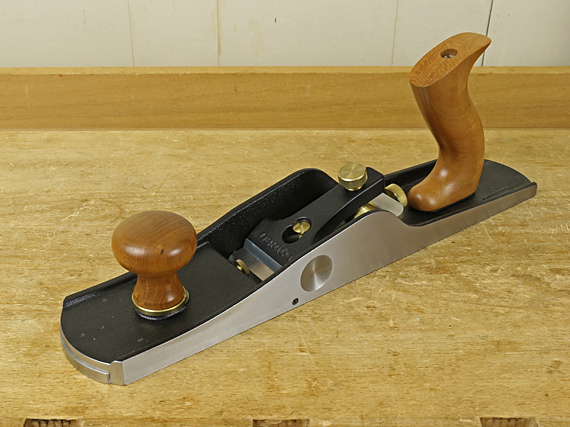
Veritas shooting plane

I use the Veritas shooting plane, and love it. Comfortable and accurate to use, it meets all the requirements above. The adjustable-angle handle properly and comfortably directs pressure, and the 20° skew really eases the blade through the cut. The bevel-up design is easy to set up and adjust, and provides excellent support to the blade close to its edge.

Is it worth spending about $350 dollars on a plane just for shooting? In view of all the other expenses involved in woodworking, yes, it is. (See the first sentence of this post.)

Lie-Nielsen also makes a great shooting plane, which I have had a chance to use briefly. This massive tool uses a bevel-down design and a skewed, Bedrock-style adjustable frog. Personally, I like the Veritas design and features, but both merit consideration. 

I use a straight edge blade for end grain shooting – no camber

Good: a bevel-up bench plane. 

Veritas jack plane

The Veritas BU jack plane is perhaps the most versatile plane of all, and a good shooter. The BU design gives good blade support, and makes it easy to swap dedicated blades for its varied uses. You can get a decent grip on this plane for shooting.

Adequate: a bevel-down bench plane. 

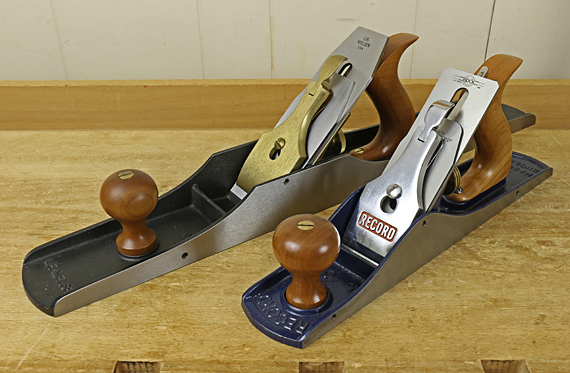
I used a BD jack and jointer for shooting for years. I do not consider these ideal but they can get the job done. Don’t let anyone tell you that you “can’t” cut end grain with a bevel-down plane. Use a sharp blade, and set the chipbreaker close to the edge to reduce deflection.

bevel-down jointer and jack planes

Gripping a bevel-down bench plane for shooting may be a bit awkward for some. With the jack, I squish the base of my thumb behind the side hump and plant four fingers on the lever cap. A grippy glove can help. (So then you’ll have one on both hands.) 

For long grain shooting:

Compared to using a plane with the blade on the bottom (the “regular” way) this is just a matter of different manual mechanics. The plane is not running in a track as in end grain shooting. 

So, a BU or BD bench plane is fine, as long as it has decent mass and stability, the side is square to the sole, and you can get a decent grip. And . . . the blade is sharp.

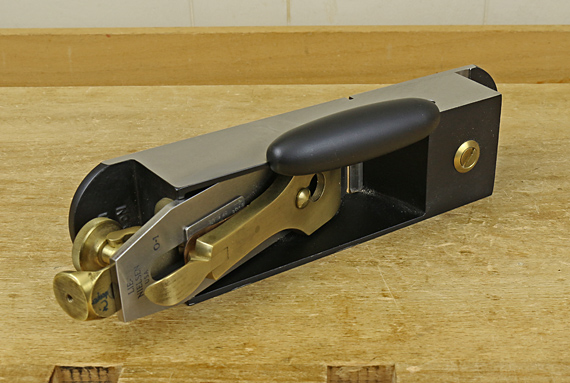
I like my Lie-Nielsen #9 “iron miter plane,” which I’ve dedicated to long grain shooting, because its beefy, boxy design makes it stable through the stroke, and it handles exceptionally well with the “hot dog” grip. This is a bevel-up design with a 20° bed. (Hmm . . . ) Unfortunately, I don’t see it on their website any more. Veritas sells a somewhat similar plane. 

Lie-Nielsen #9

I keep the #9 set up with a straight edge blade, mostly because it is easier to maintain and works well for the thin stock that I’m usually using when long grain shooting. A mild camber, such as for a jointer plane, is also a good option, especially if you will be long grain shooting thicker stock, or if you are also using the same plane and blade for general tasks.

Author:
• Thursday, October 31st, 2019
long grain shooting

Long grain shooting does not get the attention this valuable technique deserves. A cousin to end grain shooting, it is just as simple in principle but more so in practice. 

We are simply planing straight and square along the long grain edge of a board by laying it flat, elevating it, and using the plane on its side, which must be accurately square to the sole.

In general, this is most useful for workpieces about two feet long or less. This stock is often fairly thin, and may also be narrow. A good example is preparing quartersawn pieces to glue up for small to medium drawer bottoms.

It is difficult to balance a plane on the edge of a workpiece thinner than about 1/2″ held in the front vise. Shooting is a much more stable setup, and still allows a good sense of the nuances along the edge – straight or cambered. (An alternative is to plane two or more boards at once in the front vise.)

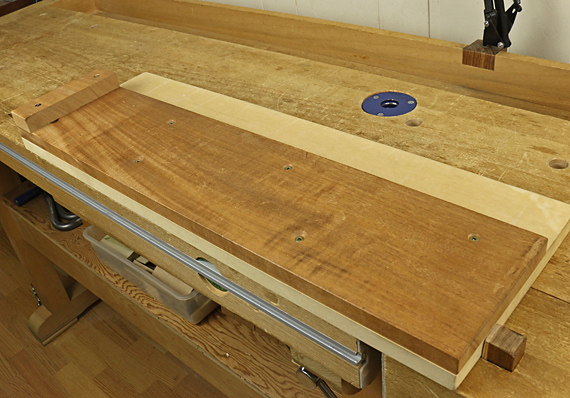
All you really have to do is lay the board flat on a support board with the long edge of the workpiece slightly overhanging the edge of the support piece. The sole of the plane is therefore riding only on the work piece, unlike with end grain shooting. In fact, a minimalist setup could be to just place a support board underneath the workpiece, and clamp the pair to the workbench, upon which the side of the plane will ride.

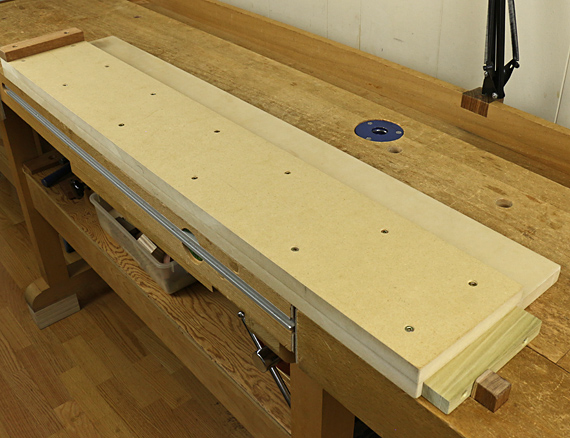
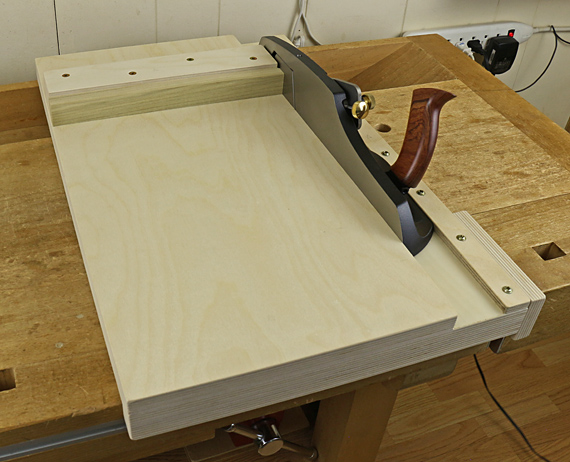
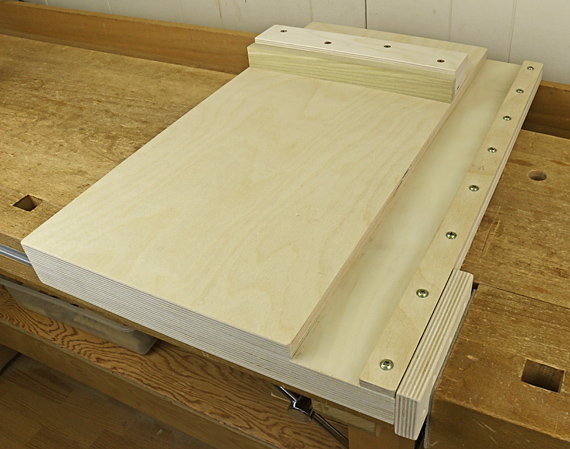
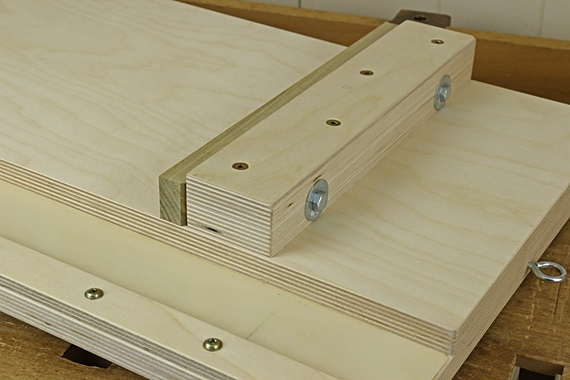
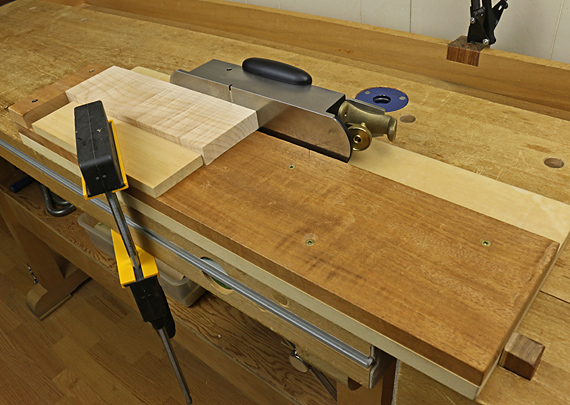
I use a dedicated long grain shooting board (below) that accommodates work up to about 24″ long. (Long time readers may recognize that it has been modified from its former role in end grain shooting.)

shooting board for long grain

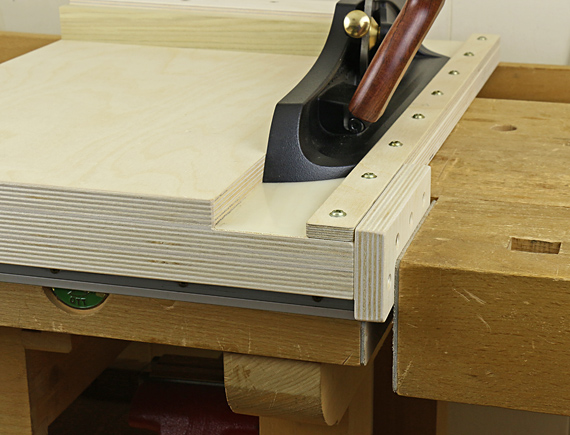
This arrangement allows me to reach over the workpiece and plane the edge that is facing away from me, which creates similar body mechanics to the usual way of pushing a plane. The PSA-backed UHMW slick plastic installed on the plane track makes the work easier.

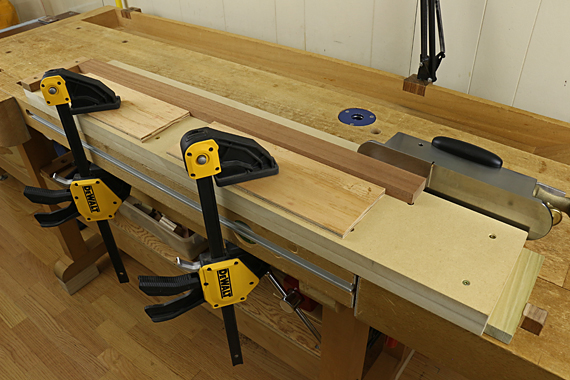
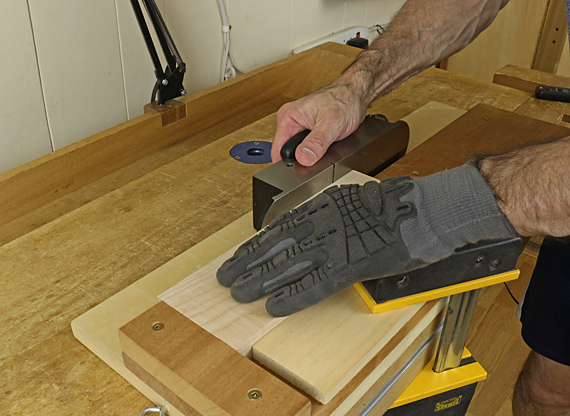
long grain shooting

The workpiece (the curly maple in the above photo) must be controlled in all directions. For lateral control along the length, I use an ad hoc arrangement with a scrap board clamped to the near side of the shooting board. Alternatively, you could make a more elaborate jig with a wider, permanent, adjustable, screw-mounted lateral-control board on the side away from you, and plane the edge facing you. This seems awkward to me.

The end of the workpiece meets the front stop. Ideally, this is a square meeting but that is not essential. Mild downward pressure on the workpiece is supplied by you. You may be able to get away without using the clamp and lateral stop board for small pieces. I find the grippy glove (top photo) makes the work easier for all setups, small or large, clamped or not.

There is no reason to over-complicate this technique. Keep it simple and use it often. 

Next: planes for end grain and long grain shooting.

Category: Jigs and Fixtures, Techniques  | Tags:  | 2 Comments
Author:
• Saturday, October 19th, 2019
Tormek with felt wheel

For a long time, I have not liked the leather honing wheel on the Tormek. I never used it for general sharpening because I prefer stones, but even for knives, gouges, and an occasional touch up of other edges, I find it fragments easily and does not hold the honing compound as well as I would like.

I finally got around to setting up the wheel with felt. It was easy to remove the leather and scrape clean the plastic base of the wheel. 

I got the felt from McMaster. I first tried PSA-backed felt just for the convenience of applying it to the wheel. The hardest available in this style was “Firm” F1. A 3/16″-thick strip proved to be still too soft.

The harderHard” felt is available only in sheets without the PSA backing. I cut the 1/8″-thick, 12″ x 12″ sheets into strips and applied them with 3M General Purpose 45 spray adhesive using simple butt joints to make a continuous layer around the wheel. The S2-20 (durometer 50A) works best. The S2-32 (durometer 80A) is nominally about half as compressible as the S2-20 but the difference does not seem to matter for this purpose. I prefer the texture of the S2-20 as it seems to grab the honing compound better.

Because I use the wheel for fine finishing, I charged it with 0.5 micron diamond. Mineral oil-based paste and water-based spray will both work but I think the paste is better. They cut fast but can get expensive over time. An economical alternative is a stick of Formax “green micro fine honing compound,” which I surmise is also about 0.5 micron, available from Woodcraft. Of course, it cannot cut as fast as diamond but with patience it can still produce an excellent edge. 

My preference is mineral oil-based synthetic diamond paste from Beta Diamond Products. It cuts fast and consistently, and a little bit goes a long way. I find the jar easier to deal with than the syringe. 

Bottom line: the felt replacement works very nicely; I like it a lot better than the leather wheel. It is especially helpful for knives, gouges, and is even handy for quick touch ups of plane blades and chisels. I keep these touch ups very light because I don’t want to round the edge too much, which would interfere the next time I work the edge on stones.

Category: Jigs and Fixtures, Tools and Shop  | Comments off
Author:
• Wednesday, January 31st, 2018

tenon shoulder jig

This simple jig makes it easy to produce highly accurate tenon shoulders on the table saw. Admittedly, it is a nicety, not a necessity, but I have been delighted with the consistently excellent results from it.

The special feature is that both edges of the fence are used, in turn, to register the work piece. This allows you to work from a single reference edge of the rail. This is hand-tool style – you do not assume the two edges of the rail are exactly parallel. Yes, they probably are, close enough at least, but I like potential errors to cancel whenever I can. Setting up a jig like this means I only have to be dead on once – when I make the jig.

This means that the edges of the fence must be absolutely parallel to each other. They are, within a thou.

Also, a sled is a generally more accurate way to crosscut on the table saw because the work piece does move against any surface. Of course, the miter slot must be accurately parallel to the blade for this jig, or for any device that slides in the miter slot, to work well.

Making the jig

The overall dimensions of the jig are 21″ x 14″.

build a tenon shoulder jig

Trim the UHMW strip to a snug fit in the miter slot, and then attach it to the 3/4″ MDF base of the sled using screws entering through the top. Locate the runner so that there is a little bit of the base extending to the right beyond the blade. Then, trim the right edge of the sled by sliding the base in the miter slot. The other three edges of the base are not critical; cut them only for a neat appearance.

The fence is 3/4″ MDF, 2 1/2″ wide. Stable, quartersawn hardwood is probably a better choice of material because it is easier to trim straight and square, but I got lucky when ripping this piece of MDF so I used it. Using 1/4″-20 flat-head bolts through the bottom of the base, attach the fence square to the right edge of the base. T nuts make it easier to tune the angle now, or later if needed.

Neatly add PSA 220-grit sand paper to both working edges of the fence. The big knob in the middle helps in maneuvering the sled.

In use

A stop block is easily added to my VSC table saw fence. Mark the reference of edge of the rail. Adjust the blade height. Remember to readjust the blade height if you are making a tenon that is not centered on width of the rail.

Cut one shoulder . . .

cutting tenon shoulders

and then the other, using the same reference edge of the rail.

tenon shoulders on the table saw

You also can make the little “connecting” (edge) shoulders with this jig on the table saw. However, errors can creep in. When the rail is held on its long edge, it can register differently against the stop block than when it is held on its face. This will result in the end shoulder(s) not aligning with the face (main) shoulders. So, I often prefer to do these by hand, which is easy.

As always, there’s more than one good way to get the job done.

Author:
• Sunday, January 28th, 2018

tenon shoulder trimming jig

Tenon shoulders must meet stringent standards to produce a good joint – straight, at the correct angle to the length of the rail (usually 90°), accurately paired on both sides of the joint to meet the surface around the mortise, and in position to make the length of the rail fit the overall structure. Thus, whether produced by machine or by hand, you need a reliable method to tweak tenon shoulders. A shoulder plane has no equal for this task, but it needs a good work setup to make it function well.

This jig meets that need. In 2016, I wrote in detail about the jig that I had been using for many years. I usually use my Clifton 410 small shoulder plane or, for large work, the big Lie-Nielsen. For small work and other delicate adjustments, I like my little Japanese shoulder plane, used on the pull stroke.

To use both styles of planes, the jig should be reversible. Why didn’t I do this a long time ago? I removed the front cleat, and repositioned the bottom cleat, which fits in the tail vise, to the middle of the base.

tenon shoulder jig

Now I can use the jig for push-style shoulder planes:

tenon shoulder trimming

And, by rotating the jig 180° and using the other end of the fence, for pull-style shoulder planes:

Japanese shoulder plane

In either direction, the plane moves toward a hardwood backup piece that prevents spelching at the exit end of the work piece. This replaceable element is secured with deeply countersunk screws. The graphics on the top remind me of the presence and depth of the screw heads.

tenon shoulder trimming jig

After this revision, the jig is reduced in overall size to about 8 1/2″ x 12 1/2″, but that does not matter. It can accommodate even large work pieces by using a scrap of wood under the rail for outboard support. The toggle clamp, along with the self-clamping effect of always working toward the fence, keeps the work piece secure.

The jig is quick and easy to build, and I think you will find it helpful for this exacting task.

Category: Jigs and Fixtures  | Comments off
Author:
• Saturday, December 30th, 2017

curved cork sanding block

Customized shaped blocks are a must for properly sanding concave curves. They are a key player on the Tools for Curves team. Cork has the ideal flexibility and resiliency for backing the sandpaper.

Lately, I have been making the blocks entirely from cork. These work better and are easier to make than what I formerly used, which was shaped wooden blocks with a layer of cork added to the working surface. By the way, I have experimented with pink foam board insulation and found it difficult to shape reliably.

To make these all-cork blocks, you need thick stock. It is wonderfully easily to cut with a handsaw or bandsaw, and shape with a moderate-grain rasp. The curve does not always need to be a constant radius – simply draw it freehand and saw. Refine it with the rasp, ensuring that it is just a bit steeper than the steepest section of the work piece.

cork block

Make the thickness of the block to your liking based on how you want to grip the block. The block pictured at the top is about 1 1/2″ thick. You can try to size the block for optimal convenience in cutting the sandpaper from standard 9″x11″ sheets, and to minimize waste, but good function and feel in the hand are the more important factors for me.

Saw kerfs 3/4 -1″ long about 1/2″ from the top face of the block to house the ends of the sandpaper. Hand pressure will naturally keep the paper in place (see below) even in fine grits and more so in coarse grits. No wedges or clips are needed. The chamfers at the beginning of the slots toward the working face are important.

curved cork sanding block

To install the sandpaper:

Enter one end just a little into the slot, then bring the other end around the block and push it almost all the way into its slot. Working back the other way, snug the paper around the block and then push the original end as far as possible into its slot. Make a final tightening of the paper by pressing the paper it against one of the chamfers then use your fingertips to goose the paper even more into the slot.

cork sanding block

The simple design of these blocks along with this paper insertion procedure produce a tighter hold on the sandpaper against the surface of the block than any commercial curved block that I have used (none of which I like).

Finally, the light weight of an all-cork block is an asset not to be underestimated in the countless (ugh!) reciprocation of sanding work.

Find thick cork by searching online. Try “cork blocks” or “cork yoga blocks.” I suggest the Corkstore (Jelenik Cork Group), which currently sells a 9×5″x5″x3.5″ yoga block for $19.25, and 12″x8″x2″ block for $17.10. This is a nice fine grain cork that is easy to shape reliably. Dick’s Sporting Goods sells a 9″x4″x6″ block, so you might be able to find it locally.

Category: Jigs and Fixtures  | Tags:  | Comments off