Archive for the Category ◊ Tools and Shop ◊

Author:
• Wednesday, June 29th, 2011


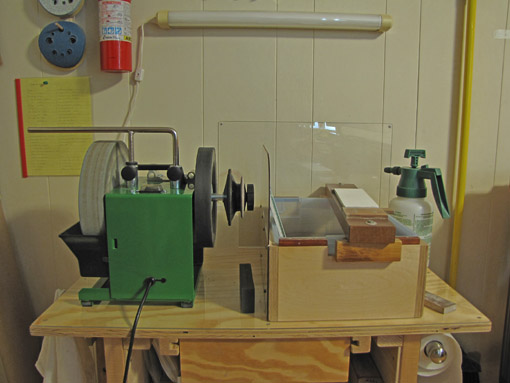
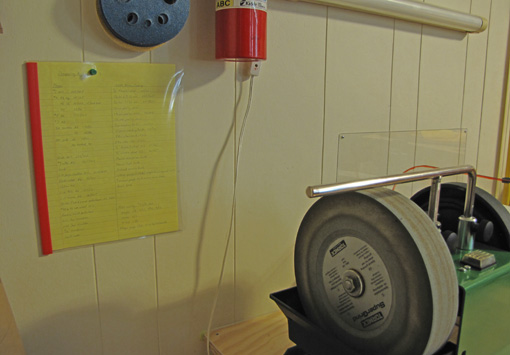
The yellow sheet, thumb-tacked to the wall near my sharpening bench, saves a lot of time and guesswork. On it, I’ve listed the primary and secondary sharpening bevels for each of my edge tools.

Writing or scratching this information directly on each tool is awkward and often hard to read. It’s much easier to keep this sharpening “recipe” list. It is written in pencil because I sometimes change the angles as I get to know the performance of the steel in a new tool, or if I prepare a tool for working different woods. It pays to observe the edge wear and feel of an unfamiliar tool, taking note of any chipping and the resistance of the tool in the cut, and account for these in the next sharpening. Thus, the recipe develops from knowledge of the type of steel and feedback from the performance of the specific tool.

I grind the primary bevel on the Tormek, setting the angle from the recipe using Tormek’s proprietary gauge. I prefer to grind to just short of the tool’s edge which avoids unnecessary clean up on the coarse/medium waterstones. With the exception of most knives and some carving tools, I do not like the Tormek’s leather wheel for honing.

The Kell bevel gauge is handy to check tools, particularly since the Tormek gauge can sometimes induce inaccuracy if a lot of steel is removed during grinding. Most of the time, though, I just work directly from the recipe and try to get back to woodworking as soon as I can.

Category: Tools and Shop  | 5 Comments
Author:
• Monday, June 27th, 2011

If your shop is large enough to set up a tennis court after clearing out all the equipment, you may stop reading here. On the other hand, if you’re like most of us and could use more shop space but are limited by the building, such as your home, where your shop is located, here is an approach that may help: overlapping space.

The volume of a major machine itself is much less than the space required to use it, which includes the infeed and outfeed pathways. Thus, the functional depth of a portable planer is not just the two feet of the machine, but is about 12 feet to plane a 5-foot-long board. By altering and coordinating the table heights of the machines, shop space can be surprisingly expanded by effectively overlapping the working areas of the machines.

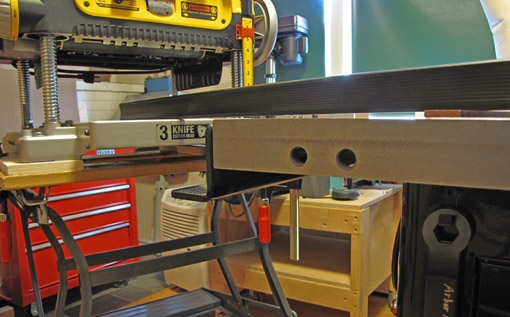
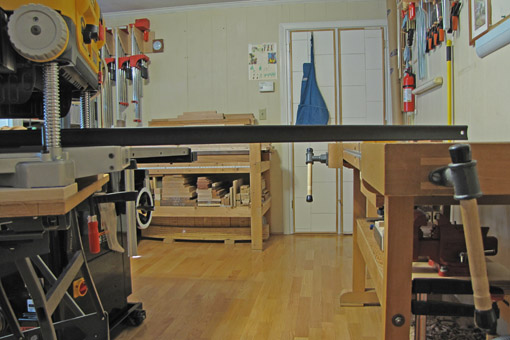
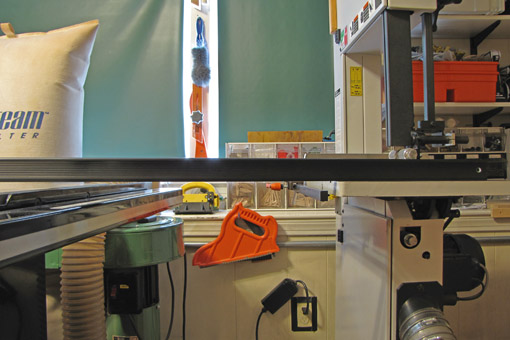
The photos show the DW735 planer with an attached 3/4″ plywood platform sitting on a Workmate. The additional height raises the planer bed so boards will clear the table saw and the workbench, as demonstrated with a long straightedge. The second photo below similarly shows my bandsaw table is slightly higher than the table saw. 


Of course, there is a limit to what can be accomplished with this – everything cannot be higher than everything else – but it pays to strategically work out shop systems with this idea in mind. Some heights cannot be easily changed, such as my bandsaw, but others are custom made, such as the router table. All of my major machines are on wheels except the DW735, but some are easier to move than others, so this also must be taken into account. The walk-around space also is a factor, such as being able to freely get around the planer from the infeed to the outfeed end.

When working this out, use a long straightedge, such as a jointed board, because the slope of the table tops can vary surprisingly, even in a shop with a level floor. Using only a tape measure to compare heights will be misleading.

Each woodworker will have to work this out for his own shop requirements, but the main idea is to think not just of the plan view of the shop layout, but also of the vertical relationships. Therein, more shop space can be found!

Category: Tools and Shop  | 3 Comments
Author:
• Monday, April 11th, 2011

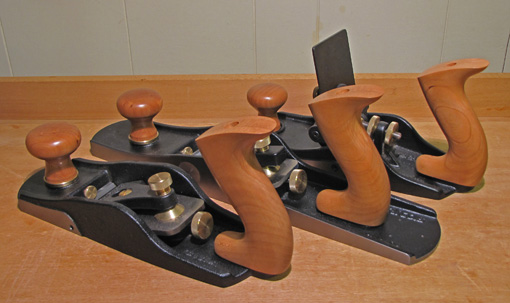
Veritas Tools, the manufacturing arm of Lee Valley, makes excellent tools, delivers outstanding customer service, and has added numerous innovative products to the woodworking world. However, the totes (rear handles) on their planes are another matter. Maybe some woodworkers like them, but I, like many others, can only wonder, “What were they thinking?” I feel that the Veritas tote is graceless and unfriendly to the hand, especially for a long session of planing.

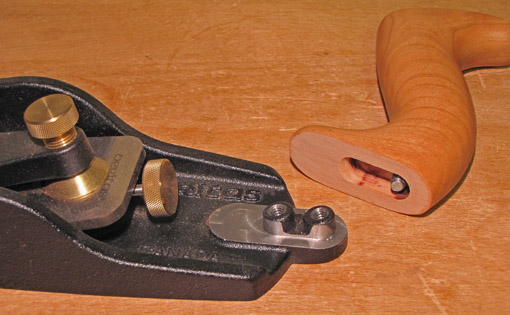
After experimenting with options to accommodate Veritas’ two-bolt mounting system, which I wrote about here, I decided it was better to stick to furniture and leave this job to an expert, especially after getting in touch with Bill Rittner, who already was producing handles for vintage Stanley planes. I came to realize that making excellent plane handles is harder than it first seems.

Bill and I corresponded for months as I tested his prototypes and gave feedback while Bill sweated every nuance of a comfortable and functional tote and knob for these planes. His handles have subtle shaping that really matters to a craftsman. Furthermore, he came up with a simple, effective solution for the Veritas mounting system that permits a more curvy, friendly handle than the OEM.

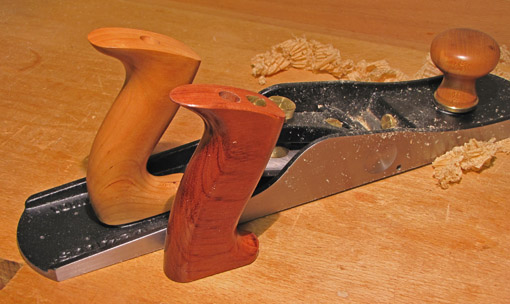
Bill’s toolmaking skill and insight was evident throughout the development process, just as it is in the final product. Wow! The handles feel great right away and just as superb after a long session of planing. They install with zero fuss and lock down as snug and solid as you could want. And don’t they look great?! I’ve got them on my Veritas bevel-up smoother, low-angle jack, and large scraping plane. Even the finish is just right – silky smooth but not slippery or glossy.

Ahh, relief at last. Now I enjoy my Veritas planes without misgivings. What else can I say? Dump those OEM clunkers but don’t go it alone. Contact Bill at rbent.ct@gmail.com and have him make a set for you. I think you will be very pleased.

[As usual, this review is unsolicited and unpaid.]

Addendum 2/3/2012: Bill’s great plane handles are available from his Hardware City Tools website

Author:
• Thursday, March 17th, 2011

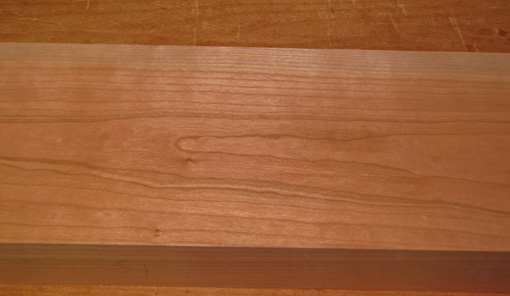
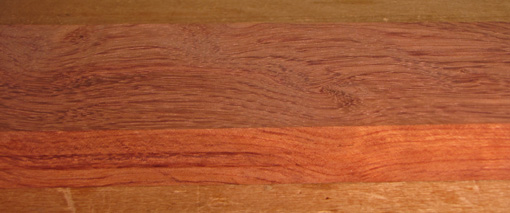
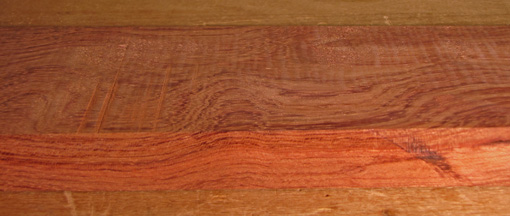
The nasty waterfall bubinga in the top photo, above, shows the clean, tearout-free surface produced by the Shelix, while the lower photo shows ugly tearout, visible toward the far edge of the board, from a conventional cutterhead. This is the great advantage of the Shelix for the work I do.

But how does the scalloped surface – see the previous post – left by the Shelix fare in the building process?

First, assessing this surface for flat and square is not a problem. True, if you hold a straightedge across the wood and back light it, you can see tiny gaps created by the valleys of the scallops. However, the straightedge (or square, or winding stick) sits on the peaks of the scallops and permits an adequately accurate evaluation.

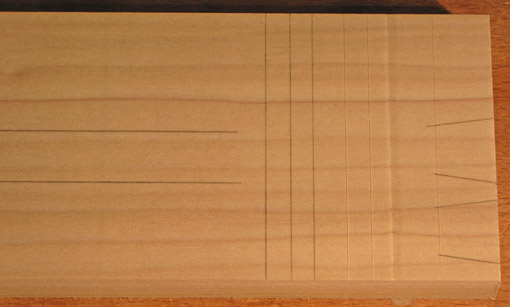
For marking out, I wondered if lines would look squiggly. Again, no problem. I marked with a fine pencil point across and along the grain, laid out dovetails, and knifed lines across the grain (and made a “V” shoulder on one of them). See below: the markout looks fine to me and would be easy to follow with a saw or to chop against.
How about glue lines? Just as with a conventional cutterhead, I would not use a Shelix surface for edge gluing. (Anyway, the Shelix is on my planer, not the jointer.) I always hand plane the machined surface to increase accuracy and the quality of the glue surface. No machine can remove a thousandth of an inch in a controlled manner and leave behind a pristine, unbattered surface the way a hand plane can.

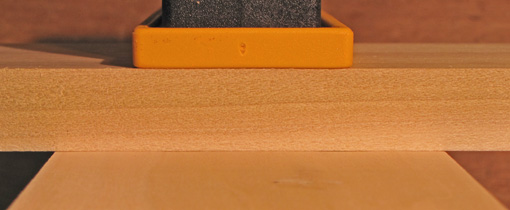
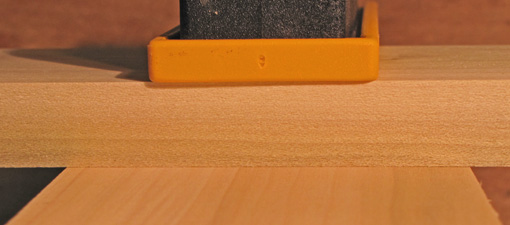
However, for bent laminations I want to glue directly from the machined surface and I do not own a thickness sander. I have not tried this yet with the Shelix but I think urea formaldehyde glue such as Unibond 800 or URAC 185, which I use for laminating, would easily fill the tiny voids created by the scallops. These are barely noticeable in the photo directly below which shows the meeting of two crossgrain Shelix surfaces. For comparison, the photo below that shows the meeting of two handplaned surfaces.

Maybe there will be times when I don’t want that scalloped surface but I doubt it will be often, especially as I get more used to the Shelix. I still have my Inca 10″ jointer-planer but will probably use it only as a jointer for the vast majority of work.
Well, when it comes time to clean up the Shelix-machined surface, how goes it? Wonderfully! This is an unexpected advantage of the Shelix. When hand planing, the peaks of the scallops register the sole of the plane and stringy shavings are first created. The shavings widen as the valleys are approached and finally planed away. So, for figured species it is actually easier to avoid tearout when handplaning (or scraping) the Shelix surface compared to a conventionally machined surface. Furthermore, the gradual removal of the peaks makes it easy to evenly plane the width and length of a board because the shavings indicate your incremental progress and tell you when you are done. It is somewhat like cleaning up a toothed plane surface.

The shavings first look like this:
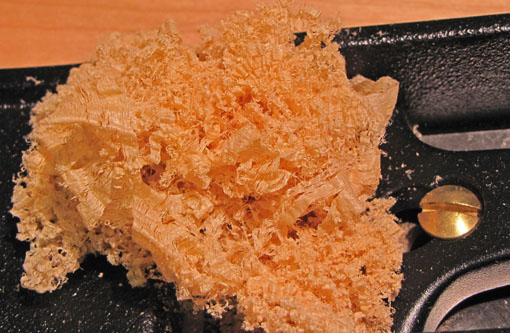
This photo shows, from right to left, the progression of shavings:
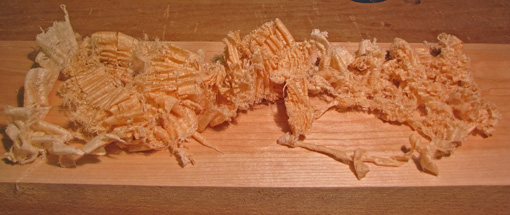
With all this in mind, I think for most projects, I will be able to hand plane away the scalloped surface, or partially clean it up, at the same point in building that I would for a conventional machined surface, and when I do clean it up, it will go very well. For example, to dovetail a box, I would clean up the inside surfaces, mark and cut the dovetails, glue up, then plane the outside surfaces.

While it truly takes a long time and varied circumstances to fully assess the value of a tool, I think I’m on board with this thing. I’m especially more confident dealing with figured woods.

[This review is uncompensated and I have no relationship with Byrd Tool.]
Author:
• Sunday, March 13th, 2011

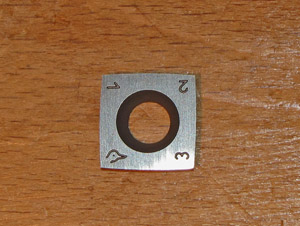
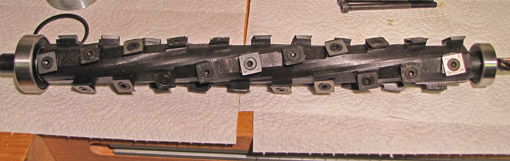
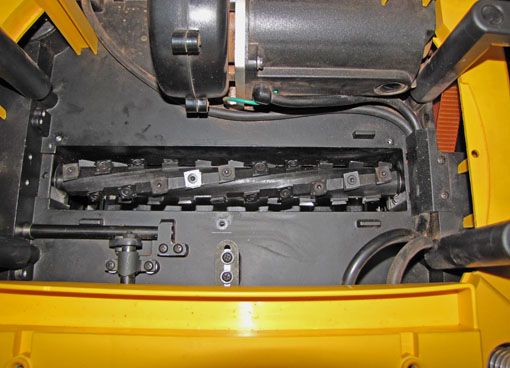
The Shelix employs three helical rows of 11 carbide cutters, arranged so that each cutter’s path is partially overlapped by other cutters. The edge of each cutter is slightly cambered (actual width of the cutter pictured above is about 5/8″) and meets the wood at an angle to the axis of the cutterhead (see below) for a shearing cut, much like skewing a handplane. Each cutter can be rotated three times to use a fresh edge when, after a long time, one has dulled. This is very different from 13 inches of blade meeting the wood all at once.

So, how does the Shelix perform? In short, beautifully. However, it produces important differences in the wood surface compared to a standard cutterhead.

The first thing I tested was the consistency of thicknessing across the width of the bed. I passed two 3/4″ wide wood strips simultaneously through the planer at each side of the bed. They came out less than 0.001″ different from each other in thickness. Wow.

The planer seems to vibrate slightly more with the Shelix but this does not seem to get translated to the bed or the wood. Noise is reduced – still loud enough for hearing protection, but not the scream produced with the OEM blades. Planing wide stock demonstrated that the Shelix gives the DW735 significantly more functional power. Dust collection improved from excellent to great, with fewer shavings sticking to the rubber rollers.

I fed this beast some nasty woods, including waterfall bubinga, curly and quilted maple, lacewood, rowed mahogany, and brittle curly pear. I took passes that I expected to be too deep and fed some wood in the wrong grain direction. The results: no tearout! The only exception was very slight on the lacewood (which hates machine blade surfacing) but much less than with the OEM blades. It laughed at the docile, straight-grained cherry in the photo below.

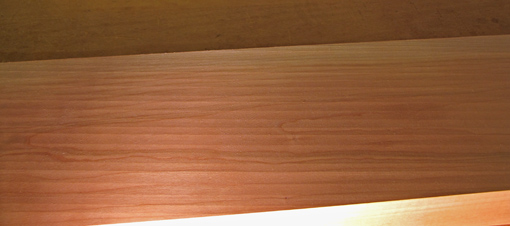
So, where’s the “but . . . ?” Look at the photo below, showing the same cherry board as above, but in a low, raking light. Notice the scalloped rows produced by the cambered cutters. The depth of the scallops is about 0.002″. This is different from what we’re used to with machined surfaces.

I thought at first that the scalloped surface would be a disadvantage. I wondered if referencing off such a surface would be compromised. Obviously, any machined surface is not the final one for furniture, but I wondered how this surface would clean up, and at what point in a project I would start to do so. More intriguing, could the scalloped surface have any advantages? All of these questions must be addressed to be able to integrate this new tool into the process of a woodworking project.

Next: answers to the above.

Author:
• Monday, March 07th, 2011

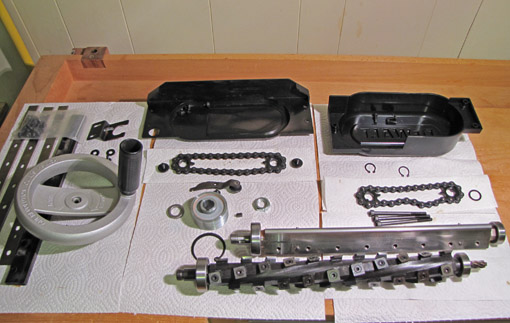
The Byrd Tool website has outstanding illustrated step-by-step instructions for the DW735. The photo above shows the parts laid out after the OEM cutterhead was removed. It is without its blades just behind the Shelix in the photo above.

Referring to those instructions, here are a few helpful tips:

  • Step 4. The cutterhead lock cannot be reinstalled with the Shelix which does not have a flat on its shaft.
  • Step 10. Also remove the rocker tensioning arm (it is removed in the second photo in Step 11).
  • Step 11. It is difficult to remove and reinstall the nut on the end of the head. It seems to be about 22mm  is a 23 mm hex (per report from a reader, see comments) for which I do not have a socket head. I used a locking pliers on the nut and gripped the pulley with grip gloves.
  • Steps 13 and 15. You need a snap ring tool for this installation. The small external snap rings in step 15 are delicate.
  • Step 14. There are 3 screws on that cover, not 4.
  • Step 22. Removing the helical gear from the OEM cutterhead is very difficult. The ridiculously tiny hexhead is very hard to grip, and it quickly gets rounded. Locking pliers finally worked. The same goes for reinstalling the helical gear on the Shelix. In order to tighten it, I needed a helper with heavy gloves to grasp the cutterhead which I wrapped in layers of cloth. Yes, it is standard right-hand thread, in case, like me, you have doubts when trying to remove it from the DW head.
  • Step 24. The supplied plastic cover sheet helps a lot but cut it a few inches narrower.
  • Step 25. The bearings fit VERY tightly in their housings. Lots of pounding with a dead blow hammer is necessary to seat them.

Next: the Shelix design and its performance in the shop.

Author:
• Monday, March 07th, 2011


I have had my eye on carbide segmented cutterheads for a while. After studying the options and particularly after reading Glen Huey’s excellent article in the February 2011 Popular Woodworking, I decided to get the Byrd Shelix cutterhead for my DeWalt DW735 planer.

Most of my pieces use highly figured woods. I had been having trouble getting good surfaces from the planer on some of these difficult gems of nature, despite using appropriate technique. I don’t expect a machine planer to yield a finished surface, of course, but tearout surprises can require corrective handwork sufficient to change dimensions and relationships. Parts meant to match and reference surfaces were disturbed; there was too much backtracking and unpredictability. This affected my work flow and was frustrating.

In considering a segmented cutterhead, I first had to decide if the DeWalt DW735 was a good enough machine in which to invest. After years of use, its design, quality, and reliability are proven. So, primarily for the joy of using my beloved figured woods, I took the plunge: $447 for a Byrd Tool Shelix – “she” for shear, and “helix”. (Sounds like a part to soup up a motorcycle or something.)

Below is the Shelix in all its medieval-looking glory. Thankfully, it comes with the bearings attached

In future posts, I will discuss the basic design and performance of the Shelix, and how this tool is integrated into the work flow of a project. The latter issue is the most important one and required the most thought to make this a sensible investment.

The post immediately following this one lists tips for installing the cutterhead.

Author:
• Sunday, February 27th, 2011

The utility of a tape measure is mostly early in the building process, later steadily diminishing as most parts are cut in relationship to other parts or structures that are already in the project rather than to absolute dimensions. In general, we only measure when we have to. It is usually safer and more accurate to relate one part directly to another. This allows the effect of small absolute inaccuracies to cancel.

Nonetheless, when you are choosing boards at the wood dealer, breaking down stock to approximate sizes, and dimensioning a project’s primary structural parts, such as the length of a table leg, the tape measure is on duty. So let’s take a look at this humble tool.

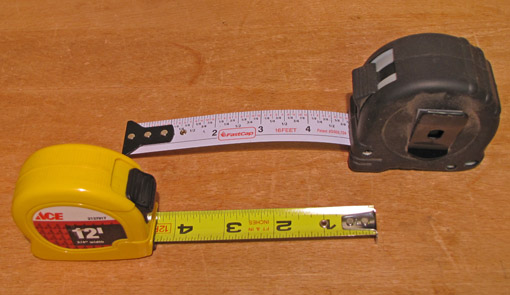
In choosing a typical cupped-blade tape, I think for most furniture makers, an 8 or 10-foot tape with a ½” wide blade is too short and too floppy. It certainly will not do the job when sorting boards at the wood yard. On the other hand, a 25-foot tape with a 1″ wide blade is fine for that but seems too big in the shop where the deeply cupped blade and heavy case are cumbersome for marking out. A 12-foot tape with a 3/4″ blade is a good compromise. It has enough overall length, adequate stand-out stiffness, and is fairly convenient to mark from – the blade can be rocked so the edge meets the wood to eliminate parallax when marking. Look for a tape with neat, fine increment lines. I’m happy with my Ace Hardware model, pictured above.

Most tapes read left to right – hook it at your left, pull out the tape toward your right and the numbers are facing correctly toward you. Tapes that read right to left are marketed to be more convenient for right-handers, like me. The idea is that you pull the tape toward your left with your left hand, the numbers are facing you correctly, and your right hand makes the mark. I find the standard left-to-right tape is just fine since the tape is used in many different ways and it does not bother me to read it upside down sometimes.

The zero point accuracy of the hook varies from tape to tape so check it against a quality steel rule. Assuming the incrementation is accurate (a dubious proposition), if the tape is reading short, the hook can be shimmed with a bit of tape on its inside face. If it is reading long, you can try to file the inside face but that’s difficult. The more practical way to manage layout is to simply use one tape for all the related parts of a project. The tiny absolute errors almost never matter and the consistency will make all be fine.

When the marking reference is on a surface, meaning that the tape is not hooked over the end of a board nor is the end butted against something, you’ve got to start the measurement somewhere on the tape and the using the end is awkward at best. Let’s say you want to measure and mark 32 ½” starting from a line on the wood. Do NOT place the 1″ mark at the reference line thinking that, sure, you’ll remember to mark at 33 ½”, because you will NOT. Well, at least I will not. Instead, I use the 10″ mark on the tape for zero and mark at 42 ½”. True, I could make a mistake and be 10″ off, but that really does not happen because that error would be visually obvious. Give it a try; it works reliably for me.

Also consider the flat tapes from Fast Cap. While this is not a tape for the wood yard because it has no stand out stiffness at all, it has advantages in the shop because it lays flat on the work and effortlessly eliminates parallax. I have the 16-foot “Standard Story Pole Flatback” model, pictured above, which has a clear zone on the bottom of the tape which is easy to mark with a pencil and is erasable. In addition, this is an overall well-made tool with other convenient features. Again, though, don’t mix tapes for related parts of a project; choose one and stay with it.

Category: Tools and Shop  | 7 Comments