Archive for the Category ◊ Tools and Shop ◊

Author:
• Thursday, November 03rd, 2011

This is the best shooting board I have ever used. I believe it is probably the best available anywhere. Tico Vogt made it and he can make one for you – the Super Chute 2.0. A shooting board is an extremely useful, almost magical, tool that can greatly elevate your control of woodworking processes. After watching Tico develop and improve his version of this tool, I finally had a chance to use it last week at a Lie-Nielsen Hand Tool Event at the Connecticut Valley School of Woodworking.

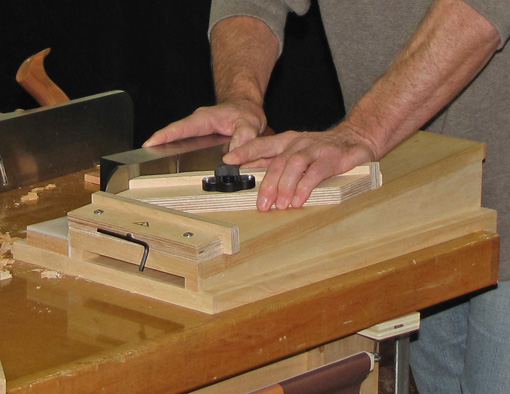
That’s Tico in the photos using his Super Chute 2.0.
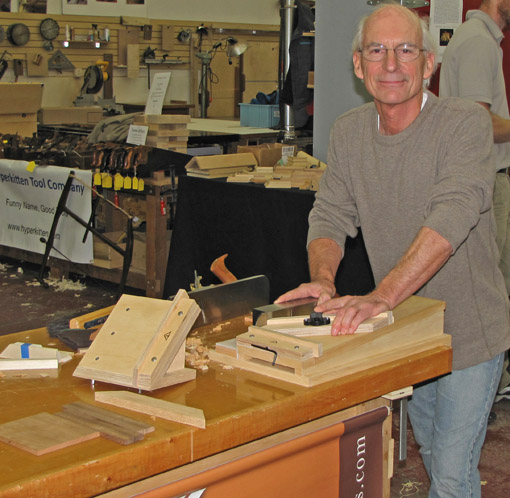
It was like slicing baloney with a sled on an ice track. Tico showed me the tool’s incredible quality details and nuances that only could come from a seasoned woodworker who knows from experience what really works in the shop. To elaborate on all of them here would make this post too long, but I will point out a few highlights.

The plane rides on a track of super-slick UHMW plastic. Importantly, the work piece sits on an angled bed which facilitates a strong stroke with the plane and distributes wear and cutting resistance over a greater width of the blade than a flat bed would. The 90̊ and instantly-installed 45̊ fences register in eccentric bushings which make their angles micro adjustable. The fences are also laterally adjustable to completely eliminate end grain spelching. To my mind, these user-controlled features respect the skill and intelligence of the craftsman using the tool. A donkey ear miter attachment that installs easily is also available.

Tico uses CNC technology and sources components manufactured with a high degree of sophistication to a produce a product with quality evident throughout. No, it’s not cheap; excellence never is. This is Lie-Nielsen-type quality in a shooting board.

A plane such as L-N’s sweet #9 makes shooting all the more of a pleasure but don’t feel you must have a dedicated miter plane to start shooting. A well-tuned and well-sharpened jack plane, bevel-up or bevel-down, can shoot very effectively. Shooting is a gateway technique, easily learned, that will allow you to produce precise ends on components of casework. It is a must for making precision high-end drawers with hand tools.

This review is unsolicited and uncompensated. I just think the Super Chute 2.0 is a heckuva tool.
Author:
• Tuesday, October 25th, 2011

Using a straightedge is easy, right? Yes, but it does pay to use a technique that is both practical and consistent with the tolerance to which want to work.

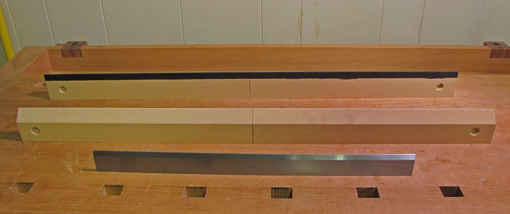
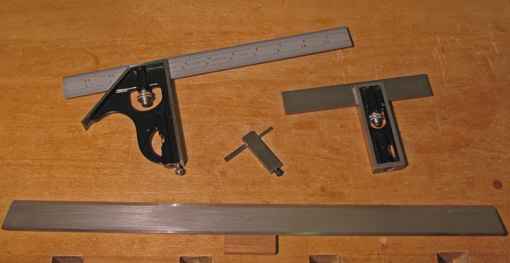
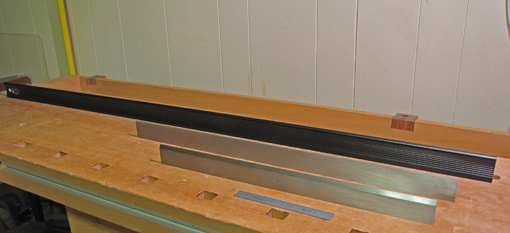
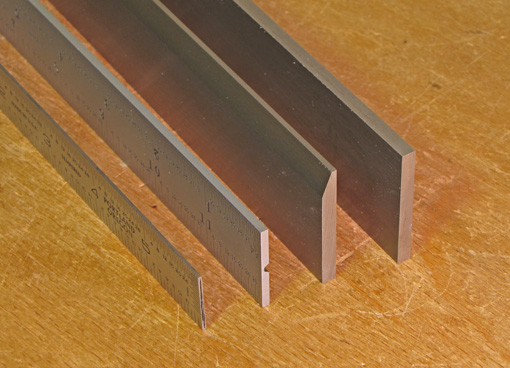
Pictured above are, from front to back, a 6″ Bridge City rule, the 18″ beveled Starrett #385, the 24″ unbeveled Starrett #380, and a Lee Valley 50″ aluminum straightedge. The photo below shows the thicknesses, from left to right, of the 6″ rule, a Starrett combination square blade, the #385, and the #380. The Lee Valley is about 7/16″ thick at its base. 

Let’s look at three techniques for using a straightedge and consider some of the related features of different straightedges.

1. Eyes won’t lie

This is the way a straightedge is usually thought to be used. You simply hold the tool against the surface and look for gaps against a light. Done properly, this allows the eye to easily detect gaps of 0.0005″ (half a thou) or less.

It is helpful to use a diffuse, linear background light, such as a fluorescent bulb, and a thin edge against the work, such as a beveled edge. If a wider edge is used, ensure that your line of sight is parallel to the surface. A false impression of accuracy will result if the light under a gap is blocked from view simply because there is an angle between your line of sight and the width of the tool’s edge.

This technique can be awkward and tiring because you have to hold the tool and the work up to the light, or bend and maneuver to view a stationary surface. It is good for testing a plane sole or other small, very precise work. The #385 or an accurate small rule are good choices. Avoid tipping the straightedge which can introduce errors caused by any slight bow of the tool along the length of its face.

2. Shim it, shim it again

Here you lay the straightedge on the surface and use feeler gauges to seek out gaps. Look for hollows near the middle of the tool, but also press down near an end to check for gaps at the opposite end created by a bump somewhere in the middle.

A good way to work to a specific tolerance, say 0.001″ for a plane sole that you are lapping, is to put a leaf gauge under a wide-edged straightedge, and then gently pull the leaf to see if it drags the straightedge or slips through freely. The former indicates you are within tolerance (as long as there was no previous rocking of the straightedge), the later indicates a gap. Decide how large and where you can tolerate errors.

This technique is also handy to test a tablesaw top or jointer bed which you cannot lift and where bending is difficult or impossible to get your line of sight parallel to the surface.

The #380, or any tool with a similar wide edge, is a good choice for this technique.

3. Swing it easy

The first two techniques are slow and almost always overkill for wood preparation. So here’s the quick, easy, practical method that I suggest for dressing stock.

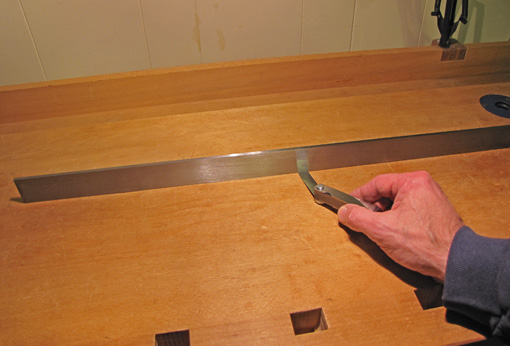
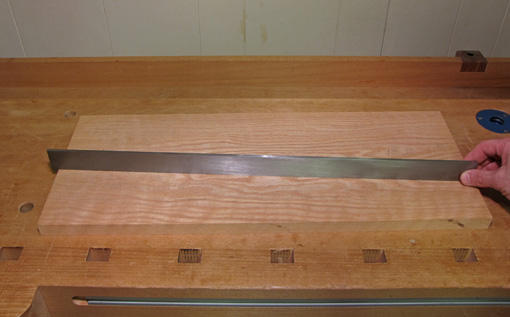
Set the straightedge on the wood, grasp and unweight one end, but do not lift it, and gently swing it along the surface. See where the tool “grips” or pivots. If it pivots just barely at the opposite end, the surface is slightly concave. If it pivots somewhere in the middle, you’ve got a bump. In woodworking, bumps are generally undesirable so you work with a one-sided tolerance, flat or a trace concave. You’ll quickly get the feel of this method.

Here is where a heavy, wide-edged, metal straightedge gives you a nice feel on the wood. The steel Starretts or the big Lee Valley aluminum work well.

This is convenient – no lifting or unclamping the work – and it quickly tells you what you want to know – that one-sided tolerance. It allows you to work in rhythm with your craftsman’s intuition.

In conclusion, the straightedge, while the simplest of tools, requires matching the technique to the task.

Category: Techniques, Tools and Shop  | Comments off
Author:
• Thursday, October 20th, 2011

It can be argued that a straightedge is unnecessary. When using a handplane, for example, a woodworker can sense the flatness of a board from the bite of the blade and the shavings produced as the work progresses. As another example, the ultimate test of an edge-to-edge glue joint is how the boards meet each other rather than an external standard. You would, however, mostly have to just trust that your planes’ soles, tablesaw top, jointer beds, and so forth are accurately flat.

As a practical matter, a high quality straightedge is a fundamental reference tool that is very useful in the shop and is easy to acquire. I prefer factory-made metal straightedges, but wooden straightedges can be made in the shop to a very high standard. 

Here’s a simple method:

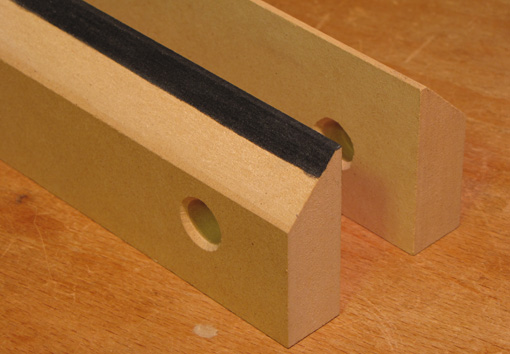
Start with two pieces of a stable, fine-textured wood such as mahogany or cherry, quartersawn, flat, with straight grain, about 2″ wide, 18″ – 30″ long, and 3/8″ – 1/2″ thick. MDF will also do. Join the two pieces face to face by clamping, or by pinning with nails or dowels that are snug but removable. Bevel a pair of adjacent edges to make each 3/32″ – 1/8″ wide.

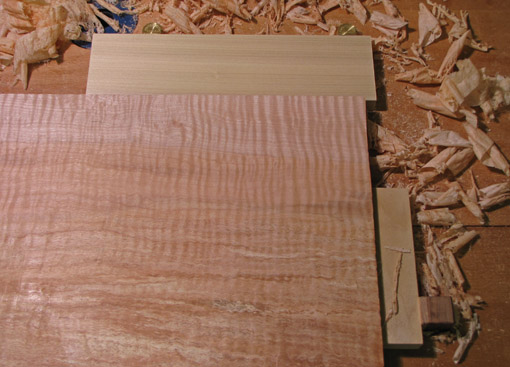
Now plane both the thick and the thin pairs of edges as flat as you can. I think the easiest way to accurately plane the edges is to shoot them. Put the plane on its side, clamp the pair of sticks on a flat board with a pair of edges overhanging, and plane away. Uncouple the pieces and check the edges against each other.

You can start off by simply ripping each piece on an accurately set up table saw and then go to the planing steps.

Because two edges are being planed together, they will have the same type of inaccuracy – concave or convex – at the same places. The inaccuracy will be effectively doubled when you place the edges against each other and compare them against a lighted background. [There is no realistic possibility of creating a falsely acceptable result by producing one concave edge which happens to mate with the other edge being symmetrically convex.] Work until you achieve whatever level of accuracy that you think is practical for your work.

You now have made two straightedges AND a pair of winding sticks!

I made the 30″ winding sticks, pictured above, from 3/4″ MDF. Only minimal planing was required to refine tablesawn edges. They’re good to about 0.001″ over their lengths. I use them only as winding sticks, which is another topic for another time.

For straightedges, I like steel and, in some cases, aluminum. A quality metal straightedge, such as a Starrett, is accurate to an extremely high tolerance and has the advantage of durability. I like the weight, contact feel, and affordability of a steel straightedge in lengths up to 24″. For longer ones, aluminum keeps the weight and cost down. Properly cared for, these tools will last a lifetime.

Next: a selection of straightedges and techniques for using them.

Category: Tools and Shop  | 4 Comments
Author:
• Tuesday, September 13th, 2011

When I want an absolutely reliable reference measuring tool, I reach for a Starrett. It’s that simple.

We’ve all had our frustrations with tools that seemed promising when new but proved to be deficient in design or construction and thus do not perform. I particularly avoid tools that are unnecessarily complicated or are merely solutions chasing a problem. Worst of all are tools that are made just to be pretty. On the other hand, don’t get me wrong, there are some great small-scale toolmakers out there making high quality, useful, and often innovative products.

Reliable primary references for straight and square are necessities in the shop – specifically, a straightedge at least 24″ long and a combination square (a large machinist square is a more expensive and less versatile alternative). Don’t skimp on quality for these; they are lifetime tools. Get Starretts and be done with it. (A flat reference, such as a granite surface plate, though not a must, is also helpful and can be had economically.) My Starrett tools include a 24″ straightedge, a combination square with a hardened head and 12″ and 18″ blades, a 6″ adjustable square, and several others that would be considered more optional than basic.

The integrity of most shop procedures and tools can be traced to verifications using these reference tools. Examples are a flat jointer table with a square fence, the soles of handplanes, a table saw crosscut jig, shop-made jigs, and so forth. Things such as these allow you to start a project on a reliable basis rather than dealing with fundamental inaccuracies that will be carried like an infection through the building process.

Top grade straight and square reference tools are like the Constitution of your shop and you’re the Supreme Court.

Starrett is a solid American company with a proud history, and is technologically current and innovative. They continue to manufacture most of their precision tools at their Athol, Massachusetts plant, working to unsurpassed tolerances. Every one of their measuring tools that I own or have seen has been exquisitely well finished. A Starrett is a mensch at the bench.

Author:
• Friday, August 05th, 2011

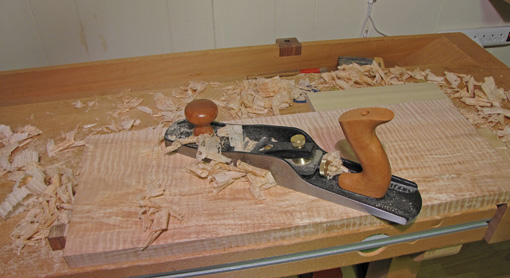
As discussed in the previous post, one of the keys to successful work with the jack plane is the use of a vigorous diagonal stroke. To stabilize the board from the pressure in multiple directions, I like to use Veritas Bench Pups, Bench Anchors, and Wonder Pups in various configurations, usually along with regular bench dogs, as shown in the photo above. Other options for use of these handy devices and shop-made stops at the right and left sides of the workbench are discussed in these two earlier posts.

Beware when planing thin boards, say under ½”, which can flex. It may be necessary, for example, to place shims, such as blue tape or veneer, under a convex surface facing the bench for a similar reason that you would not place a non-flat surface on a thickness planer machine bed. Likewise, it is often necessary to place shims under the high corners of a twisted board.

To set the blade projection, I use these steps: I sight from the front of the sole, with light adjusted to reflect off the thin flat at the rear of the mouth (I file that flat when I set up a new plane). I advance the blade enough to see it to correct the lateral adjustment, then back off the projection to a minimal amount. I start stroking the plane on the wood, back and forth, gradually advancing the blade, often using my left hand on the feed screw and my right on the tote. I’ve found this method gives better results than using sight alone, or running a narrow scrap against the blade.

The long infeed length of the Veritas BU jack makes it feel almost like a jointer. It’s easy and natural to move the plane back and forth rapidly without lifting it, like scrubbing the wood. This gives excellent tactile feedback to be able to sense when the surface is approaching flatness.

The Veritas BU jack has some other nice features. The lack of a cap iron (“chipbreaker”) makes swapping blades very easy. I find the little set screws on each side of the plane near the mouth help to quickly position the new blade. The mouth opening can be adjusted in seconds to accommodate different shaving thicknesses. This is far easier than adjusting the frog on a bevel-down plane. I also like the Norris-type combined feed and lateral adjustment mechanism, though some woodworkers do not.

I strongly suggest getting rid of the awful handles that Veritas puts on their planes and get a set from Bill Rittner – I think you will find that they dramatically improve the feel of the plane.

These features make the Veritas BU a good choice for your workhorse jack plane. That said, I also have a 30-year-old Record #5. They each have their advantages, I use both of them regularly, and will not be parting with either. If you want me to declare a winner, I can only say that there’s more than one good way to do most everything in woodworking. I hope these posts will help you find your way.

[These endorsements are unsolicited and uncompensated.]

Category: Tools and Shop  | 2 Comments
Author:
• Sunday, July 31st, 2011

A jack plane, including this one, is mostly used to true the surfaces of a board and dimension it. It follows coarser tools – the mill saw or, if substantial thickness must be removed, the scrub plane. It is followed by the jointer plane, if needed, and then the smoothing plane or other methods, such as scraping and sanding, to create a finished surface on the wood. Thus, the jack is a fairly rough tool. Yet it is expected to leave a surface without major defects to avoid having to remove too much wood with subsequent tools.

The role of the jack plane dictates its setup. The blade should be sharpened with a moderate camber – a balance between the need to remove wood quickly and leave a decent surface. Judging the proper amount of camber comes with experience, may vary from job to job, and is most easily determined by eye, but it is important to note that a blade that is bedded at a low angle with the bevel up requires more camber, as judged from a 90̊ view, than a blade which is bedded at a higher angle with the bevel-down. Please refer to an earlier post for a full explanation of this.

I prepare the blade with a primary bevel of about 30̊ and a secondary bevel of about 38̊ which, with the Veritas’ 12̊ bed, yields an attack angle of about 50̊. Going significantly higher than this makes the plane simply too hard to push through the wood for this type of work. A smoothing plane is a different matter in this regard. There, fewer and finer shavings are taken, so higher attack angles are practical and may be necessary to avoid tearout.

But wait, isn’t the main point of a BU jack to use high attack angles and prevent tearout on difficult woods? No, not in my opinion. A jack plane does most of its job best when used diagonally across the grain. This makes it easier to accurately remove surface distortions and avoid tearout, obviating high attack angles. I regularly jack plane curly woods diagonally or even nearly perpendicular to the grain.

For the few occasions when a 50̊ attack angle creates significant tearout even with a diagonal stroke, such as with very swirly grain, it is time to employ one of the wonderfully handy advantages of a BU plane. The regular blade can be easily swapped for a toothed blade (sharpened at 40°). This magical blade can manage the most cantankerous of woods.

A further negative consequence of using a blade sharpened with too large an angle (such as 48̊ to produce a 60̊ attack angle) in the BU jack is that it becomes difficult to set the projection of the blade. It is frustratingly difficult to find the middle ground between a shaving that is too light for jack planing and an impractically deep projection, especially if the blade is starting to dull. Imagine trying to pare with a dull chisel sharpened with a 48̊ bevel – you’ll either scrape the wood or dive into it, with little control.

As you near the end of the job with the jack, back off the blade projection to increase accuracy and improve surface quality, thus getting the wood ready for the next stage of preparation.

The next post will discuss securing the board to the bench for jack planing, steps in setting the blade projection, and some particular features of the Veritas BU jack.

Category: Tools and Shop  | 2 Comments
Author:
• Wednesday, July 27th, 2011

I had no specific purpose for this square, but because it looked like it might be a player, I added it to a larger order from Lee Valley Tools. After unpacking the shipment, I nonchalantly placed it aside into the tool well of my workbench.

Over the next few weeks, I found myself picking it up over and over for all sorts of measuring and squaring tasks. This may be the best way to assess the usefulness of a new tool: leave it on the “bench”, like an extra player, casually go to it now and then, and as you become increasingly impressed with its performance, promote it to the starting line up.

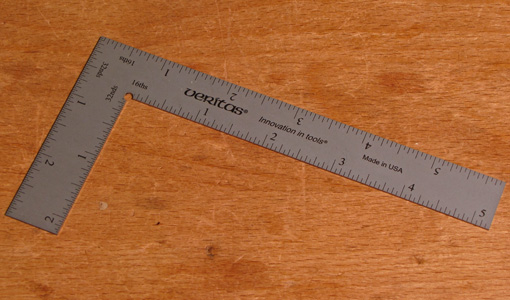
Here’s how this tool earned its role as a starter for me. First, it is very handy – small and light. The clean graduations with a sensible height organization and the satin finish make it easy on the eyes. The scales on both legs start at the inner and outer corners and are the same on both faces so I don’t get confused or make errors. I generally prefer to visually split 1/16ths rather than use 1/32-inch gradations but it is helpful to have the 1/32nds on the small legs for fine work.

It works beautifully as a short hook rule, such as to check stock thickness. Also, either leg butts securely against a surface for accurate inside or height measurements. Overall, I like handling the “L” shape more than using a 6-inch rule.

When I evaluated it using a Starrett combination square as the standard, I found it far exceeded Lee Valley’s statement of accuracy. It was straight and square within 0.001″ over its full length.

And, it’s got a 38″ vertical leap and clocks 4.4 in the 40. Just kidding.

As for dislikes, I find the large relief on the inside corner to be unnecessary, and it prevents penciling a line all the way to that corner. (Veritas seems to like this inside corner design. I find it very annoying on their otherwise excellent saddle square.) Also, a flat square like this will be inaccurate if it is held so as to occupy more than one plane when checking a corner. This is not a criticism of this tool but just a reminder of the nature of a flat square and that it does not replace a regular square.

In summary, this little guy is a gamer, a go-to tool in the shop.

[This review is unsolicited and uncompensated.]

Author:
• Wednesday, July 13th, 2011

This is really about efficient use of existing space. To actually make more space would involve things such as moving to a new building or knocking down walls – difficult options for most of us. So to make the most of what you’ve got, think beyond the square feet of floor space, look up, and think vertical and volume.

Loving wood as I do, my small shop was getting cluttered with the lovely stuff and I was no longer at ease in my little playground. After a few minutes of sitting on my workbench and staring at the walls, I began to discern where empty vertical space could open up after only minor rearranging.

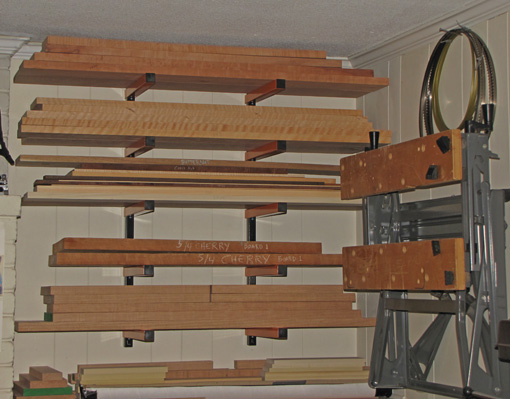
I installed two inexpensive Portamate wood racks after being reassured by a structural engineer that the wall studs would easily take the 500+ pound loads. Instead of the shorter screws that came with the racks, I used 4″ TimberLok heavy-duty wood screws (and grade 8 hardened washers) since about 1 ½” of the screw length is taken up passing through the brackets and spacers. The top photo shows a rack installed in a small alcove that was previously underutilized.

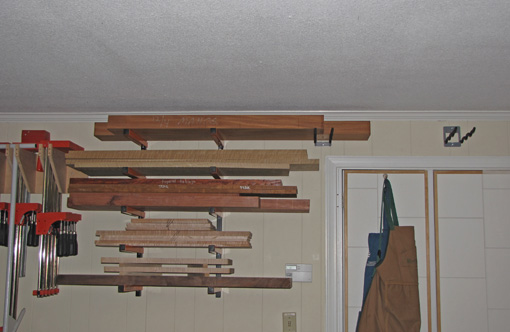
Because most of my woodworking is not large scale work, most of the wood I have in storage has been crosscut to about 4 feet long or less. However, the capacity to store some long boards for a long time is still necessary. In the photo above, notice the two utility hangers toward the right, near the top of the wall. Without interfering with anything else in the shop, they make use of the space above the door to allow storage of boards 8+ feet long. The Portamate rack has also opened up more space for the scaffold-type rack that is below it (beyond the frame of the photo).

I am once again at ease in my space. This helps clear my mind as I am working and makes the work more pleasant. Ahhh, the shop.

Category: Tools and Shop  | Comments off