Author:
• Friday, December 14th, 2012

Planes, bats, birds, and bees: they all fly. The object is to get there.

In this segment, the final installment in the series, let’s look at some different but very effective plane designs that you may want to consider.

Japanese planes make use of a very thick blade tightly nested, bevel down, in a dense oak body (“dai”). Most of these are bedded at 40-42°, with very few higher than 45°, even for denser hardwoods. Does this contradict what we know about bed angles for Western metal planes? No, because other factors are involved.

The superb results possible with these planes are achieved first and foremost with blades that can be sharpened to phenomenal edges. The blades are a lamination of very hard, high-quality steel worked by masterful makers, and a soft iron backing. A heavy chipbreaker, also laminated, meets the main blade with great precision.

The sole is prepared so it contacts the work only at the toe and just in front of the blade. This makes the plane hug the wood through the stroke. The geometry of the throat is strategically designed to shepherd the shaving off the wood and through the plane. The resiliency of the dai buries vibration. Along with numerous other subtle refinements in design and preparation, these seemingly simple planes can produce beautiful results even though they are nominally just a bevel-down blade at 45°.

For years I used Japanese planes for smoothing before selling them away while transitioning to only Western planes to simplify my tool world. Though fussy to set up and maintain, I miss them sometimes.

Terry Gordon, in the land down under, takes a different approach in his wooden planes. Before my second tool purge, I used his very effective smoother, and, admittedly, I miss it too. He uses a 6mm thick blade which is bedded bevel down at 60°, without a chipbreaker, in a body of dense Aussie hardwood. They resemble Chinese planes.

Wait, how can this work, isn’t a chipbreaker essential? Once again, other factors change the game. The synergy of this high attack angle, a heavy blade held snugly in a dense body, plus a tight mouth, allows the plane to manage difficult figured woods.

Now at some point, it just is not worth trying to finish plane some woods in some situations. The factors to take into account include:

1. The wood! This is not just based on the species, but should be an assessment of what a particular board is telling you. Cherry could be a docile pushover or the curly cherry from hell.

2. The finish to be applied, oil or film. For example, the moderately open grain of walnut finished with oil will look better crisply planed, while the tight texture of properly sanded maple is fine under three coats of polyurethane. Experiment.

3. Where the wood is in the piece. Finishing planing a curly maple panel is a different matter than struggling to do the same with a curvy leg in the same wood. As another example, sanding is not likely a good way to fit drawers.

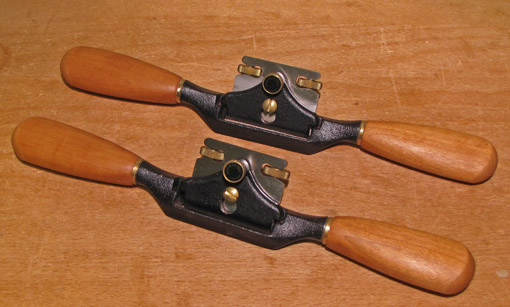
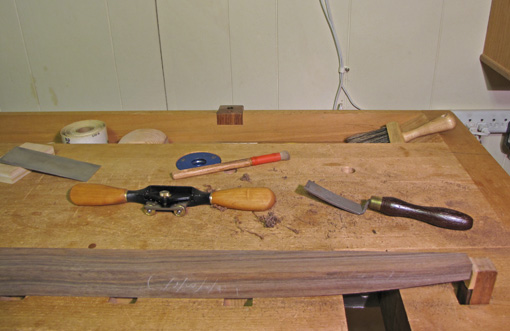
Thus, consider the other options. Scraping can almost always be employed to save a lot of sanding by using the scraper plane and/or hand scrapers, straight and curved. Set up and technique for the scraper plane can be found in this three post series: 1, 2, and 3.

I have two random orbit sanders in my shop and plenty of sandpaper. While I do not relish the work of sanding, I will do what is necessary to get the results I want for a particular piece in a particular wood.

That’s what it’s all about. It all flies.

Category: Techniques  | Tags:  | Comments off
Author:
• Sunday, December 09th, 2012

Bevel-up planes are another approach. While still basically a jigged blade that cuts wood, they have important differences from bevel-down planes.

The geometry of the edge, how it is supported, and how it interacts with the wood matter greatly in cutting tools. As an example, think of a piece of paper. It is a powerless cutting tool when approaching your finger square on – it collapses. Yet, when effectively stiffened by an extremely skewed approach, it can draw blood annoyingly well. Geometry matters.

Bevel-up planes allow the use of thicker blades that are supported closer to the cutting edge than in bevel-down planes. Both factors dampen flutter and, along with alterations in the attack angle, obviate the need for a chipbreaker to pre-tension the blade edge. The Veritas Bevel-Up Smoother (above) has a 3/16″ thick blade that is supported up to about 3/32″ from the cutting edge.

This gives bevel-up planes some wonderful practical advantages. Blades changes are easy; there’s no fussing with a chipbreaker. On Veritas planes, the Norris-style adjuster conveniently controls depth and blade angle with one knob. Mouth adjustments are much faster than closing the throat by adjusting the frog on a BD plane. The gap below is about 0.010″.

The strategy here is simple: change the attack angle by simply swapping blades. With a 12° bed, a blade honed at 33° gives an attack angle of 45°. 38° and 48° honings give attack angles of 50° and 60°, respectively. Again, it is the angle of just that last bit of blade length near the edge, well within the width of a secondary bevel, which matters to the wood.

So, here we are back at a 60° angle to greatly reduce tearout, but it is not the same geometry as the 60° achieved with a 10° back bevel on a 50° frog in a bevel-down plane! The BU plane is driving a 48° wedge into the wood, while the BD plane is driving a 30-35° wedge. Add differences in blade mass, edge support, and edge tension, and these are two different animals, theoretically and in practical feel at the workbench.

Sharpening is also different. I find it is more difficult to get a keen edge honing a blade at 48° than at 30-35°. Remember too that the lower bed angle must be taken into account when estimating the amount of camber required. Please see here for the reason.

I continue to advocate that bevel-up smoothing planes are better with the blade bedded at about 20°. This would require a blade honed at 30° to make an attack angle of 50°, and honing at 40° to attack at 60°. Those are easier to sharpen and are narrower wedges to drive through the wood.

None of this should be construed as saying I do not like BU smoothers, or that BD or BU is categorically better. Both can perform beautifully but they must be understood to get the most out of them. Ultimately, the wood will speak. 

In the top photo, my BU smoother is hustling through figured bubinga. The photo directly above shows the wavy grain and what a jointer machine did to it. Tearout is virtually eliminated with the BU smoother but getting a 48° wedge through this hard stuff is tough. I like it better on less dense curly woods and rowy woods such as the quartered face of some mahoganies. It has also worked unexpectedly well on curly pear. You must experiment and pay attention to the wood.

For choosing which to buy, I think either BD or BU can generally get the job done if you knowledgeably configure the various elements of the plane to suit the work at hand. It is not necessary to own both types of smoothing planes, but I admit that I like having a variety of options.

And yea, I also kind of like messing around with them too.

Next: still more ways.

Author:
• Friday, November 30th, 2012

The #4 bench plane, about 9 1/2″ long with a 2″ wide blade, is probably the most popular smoothing plane among woodworkers, and will be the focus of this discussion. Some prefer the maneuverability of the smaller #3, and some like the added weight and 2 3/8″ blade of the #4 1/2, but all of these bevel-down smoothers can be used in several configurations to effectively work a range of easy to difficult woods. It is a matter of employing various strategies.

Strategy #1: Choose a 50° frog.

Bevel-down smoothers are, unfortunately, usually configured with a 45° frog as standard. Lie-Nielsen’s great planes are available with 45°, 50°, and 55° frogs. Other brands, such as Clifton, Wood River, and Anant, do not, to my knowledge, offer this important choice.

Why 50°? This will smooth tame woods, such as plain walnut and poplar, about as well as a 45° frog. In some cases, the 45° frog can produce a slightly more cleanly severed surface, but the difference is nearly imperceptible and, in most cases, a very sharp blade negates any practical difference between the two.

Yet, wonderfully, for most moderately figured woods, a high-quality #4 with the advantage in reducing tearout of the 50° frog, along with a properly prepared blade and chipbreaker, is all you need. I do not want the expense and hassle of changing frogs, and the 50° is more versatile than the 45° or 55°. Furthermore, with the alterations discussed below, a higher attack angle can be created without changing out the 50° frog.

This presupposes a well-tuned, high quality plane. To digress somewhat, here is a partial list of important features:

  • The sole must be flat in the key places, especially at the toe and around the mouth.
  • The frog should be accurately machined and of good design, such as Lie-Nielsen’s, and adjusted to create a tight mouth, just enough to pass thin shavings without congestion.
  • The blade must be properly cambered. How much camber? Ideally, shavings under 0.001″ thick should feather out to nothing toward the sides of the blade edge.
  • The chipbreaker should be set close to the blade edge. How close? Well, it depends on the wood, the chipbreaker edge design, and the thickness of the shavings you are taking, so you must experiment a bit. About 1/64″ gap is a starting point.
Strategy #2: Take very thin shavings!
“But Rob,” you say, “that’s just obvious.” Yes, but to do this, you must have all your ducks in a row, as described above, and a damn sharp blade. A dull blade precludes very thin shavings and promotes tearout, regardless of all other factors.

So, there are two corollary tips:

  • Taking thin shavings means taking lots of passes, which leads to using a duller blade, unless the wood surface is properly trued beforehand. In other words, use your smoother only to smooth, and as little as possible. Set the surface up with your truing planes.
  • Consider an O-1 steel blade for most of your smoothing in moderate woods. It is easier to sharpen and shape, and probably can be made sharper, than A-2. It will likely dull faster though, or maybe just differently, so it will need touch ups.

Strategy #3: When the going gets tough with mean and nasty woods, try raising the attack angle by using a back-beveled blade.

I keep a separate blade for my #4 with a 10° bevel on the back (the “flat” side). Because this setup is used in tough woods, the abrasion resistance of A-2 steel is an advantage, and the back bevel facilitates sharpening. With the 50° frog, this creates an attack angle of 60°, which is a big advantage in eliminating tearout. It is much like having a separate plane with a 60° frog, which you therefore do not need.

The back bevel needs only to be very narrow since it is really just the first tiny bit of blade that matters – the first several thousandths, probably, that are involved in severing the fibers. At the sharpening bench, I use a magnetic angle gauge, in conjunction with a strip of wood on the stone, to make a reproducible back-bevel angle. The front-side bevel should not be too steep; 25° is plenty, creating a total bevel of 35°. More than that and the blade “wedge” will be too thick and, I feel, offer too much pushing resistance in the wood. The chipbreaker cannot be set as close to the edge with a back bevel but that does not matter as much due to the high attack angle.

Going higher than a 60° attack angle, by whatever method, does not seem to make planing go better, even in very difficult woods. The cutting action becomes more like scraping. I find that the best course of action for those situations is to simply use a scraping plane or hand scraper.

In summary, with one high-quality, well-tuned bevel-down smoothing plane, with one frog, and two well-prepared blades (three is a luxury), you are equipped to venture into smoothing lots of wonderful woods.

Of course, there are more options, and they too work. Next: Bevel-up strategies.

Category: Techniques  | Tags:  | Comments off
Author:
• Friday, November 23rd, 2012

Hand planing can leave a superb final surface on wood. However, the beautiful figured woods that are one of the great joys of woodworking often cause tearout and play havoc with our efforts. This is the first in a series of posts that will explore a compendium of options for achieving an excellent finished surface on difficult woods.

When planning a project, I consider early on how to put the final surface on the wood, along with which finish to apply. Understanding an arsenal of options, and testing the tools and methods beforehand, gives me the wherewithal to use the woods I love.

There are several prefatory issues:

1. The topic of these posts is finish planing or “smoothing,” not planing for stock preparation. For the latter, even highly figured woods such as tight curly maple, can be successfully worked with a conventionally configured jack plane: bevel-down on a 45° frog with a 30-35° honing angle, or bevel-up on a 12° frog with a 38° honing angle. The key is to plane at about 60-90° to the grain, which means across the curls. (This is not skewing the plane; it is pushing the plane diagonally across the grain.) This leaves a somewhat rough surface but one that is adequate for dimensioning, and there is little or no tearout to clean up with the smoother.

This method may not work for swirly figure, such as waterfall bubinga. For that, a toothed blade in a bevel-up jack plane, planing with progressively shallower blade projections, works wonders. Clean up the surface with a conventional blade.

My preference for dimensioning figured stock is the DW735 with the Byrd Shelix carbide spiral cutterhead. Then comes smoothing with a hand plane.

2. Why use a plane at all for smoothing? Why not just sand? Well, for some woods and in some circumstances, I think sanding is the better option. However, I prefer to smooth plane when I can because, compared to sanding, it is faster, more pleasant, and better retains the trueness of the surface. Furthermore, for some woods (walnut comes to mind), the final surface is distinctly superior when hand planed. I also recognize that for some woods (bubinga comes to mind), depending on the type of finish to be applied, sanding is just as good as planing.

3. Sharpness is king. Using a very sharp blade, properly cambered, solves so many planing problems. Conversely, using a dull or poorly shaped blade edge for smoothing will create problems regardless of the type of plane, the angles used, and so forth.

4. Skewing the plane helps with almost all of the plane and blade configurations that will be discussed for smoothing. The physics of why it works is an interesting topic for another time, but beyond the scope of these posts.

5. For some woods and some circumstances, light sanding with fine grit such as 320 or 400 is appropriate after smooth planing. The main thing is to be sensitive to what you are trying to achieve with the wood, and not be governed by purist dogma.

So, in this series we’ll look at different tools and setups, their advantages and disadvantages, but with the theme that there are multiple good ways to get excellent results. The key is to know your options.

Category: Techniques  | Tags:  | Comments off
Author:
• Tuesday, November 13th, 2012

If you are looking to acquire hand tool skills and can get to, or live in, the north-central Massachusetts or southern New Hampshire areas, consider contacting Steve Branam, author of the Close Grain blog. Earlier this year, Steve started his Close Grain School of Woodworking in Pepperell, MA.

Learning hand tool skills can be confusing and take longer than necessary if you go it alone. In Steve’s words, “Part of what I want to convey is that this is well within the scope of most people’s ability.” As you can see from the outline of the skills he teaches, his approach is systematic and thoughtful. It is skills-based learning, rather than project-based, which makes a lot of sense to me. I also like his down-to-earth approach, devoid of hyperbolic claims of quick and easy perfection.

The best part is that Steve offers you three ways to learn. At his Pepperell location, you can attend group classes. There you can also get private instruction from him in which you have the option of choosing the skill areas you want to work on. Thirdly, Steve will actually travel to your shop/home (within a 60-mile radius of Ayer, MA) for private instruction. In all cases, he even provides tools and materials, or you can use your own tools. There is no excuse left for sitting on the hand tool sidelines or floundering with trial and error.

By my calculation, Steve has somehow managed to circumvent the normal human requirement for sleep. Actually, this is my way of expressing admiration for his entrepreneurship as well as his dedication to sharing woodworking skills.

Category: Resources  | Comments off
Author:
• Saturday, November 10th, 2012

My recent hike in New Hampshire’s White Mountains prompted this thought.

As we attempt in our woodworking shops to make objects of some small beauty, I believe we are merely borrowing from the ultimate source of beauty, the Creator, to bring joy to us and to those who appreciate our work. That is truly happy woodworking, for which I am grateful.

Happy woodworking to you, dear readers.

Category: Ideas  | 4 Comments
Author:
• Wednesday, October 31st, 2012

Fresh designs are exciting to conceive and build. The effort and risk involved in developing a new design concept lead to a feeling of accomplishment when the work is done. By virtue of their novelty alone, such pieces draw attention, and tend to be called creative, imaginative, clever, or even brilliant. New interest is created, boredom is avoided, and challenges are met. Creativity expands.

Yet, if every project is fresh and different, when will you have a chance to refine your work? Most truly excellent work is a result of refinements of previous attempts at the same or similar idea. Such work builds upon a previous design concept by refining elements such as proportions, materials, textures, workmanship, and meaningful embellishments. The integration of the elements is also refined.

That’s how the best work comes about. It’s true of furniture, jokes, recipes, tools, music, and on and on. You have to work on something to make it better! Your work does not always have to be new and different. And as for “original,” I’m not sure there truly is such a thing. On the other hand, appreciating the value of refinement does not excuse working an idea to death, getting stale and unimaginative, complacency, or creative laziness.

As an example, look at the work of the late Sam Maloof. His iconic rocking chairs are the products of years of refinement of a core style concept, but his work is never boring. Still, early Maloof is not as good as later Maloof.

Another good study in refinement is Albert Sack’s Fine Points of Furniture books in which his keen eye identified the “good, better, best” of early American furniture and its features.

Now, here are some related bite-sized opinions for thought. The “arteests” and the arbiters of cool in some parts of the high-end craft world seem to reflexively give extra credit to work which is new and different, but often lack the attention span to extol work which is less flashy but has undergone sustained refinement. New is not automatically better. On the other hand, the approach from some corners (Architectural Digest?) seems to take it as axiomatic that the refined work of modern masters such as Maloof, Jere Osgood, and Silas Kopf cannot be as good as that of the 18th century masters. Oh, how I disagree with that!

In summary, while there is much value to fresh ideas, we should not forget the role of refinement in producing the best work.

Category: Ideas  | Comments off
Author:
• Sunday, October 28th, 2012

It is usually difficult to accurately concentrically enlarge a hole, especially when working with unpowered or electric hand-held drills instead of a drill press. Furthermore, the sides of the previously drilled hole tend to grab the larger bit and pull it in faster and deeper than desired, sometimes creating a ragged rim at the top of the enlarged hole. A simple tool that has saved the day for me a number of times over the years is the step drill bit.

The one I use, pictured above, has 13 steps, each 1/32″, from 1/8″ to 1/2″. Simply seat the appropriate diameter step in the original hole and drill down to the step of the desired size. It may be helpful to mark the desired step. The resulting shallow hole at the top can now concentrically register a regular bit for the new hole size. Of course, this won’t manage every situation, but it is a helpful option to have in the shop. I have never found a bit with 1/64″ steps.

These bits, sometimes called “drill tree” bits, are designed for drilling in thin metal and plastic, and for that I have found nothing better. They advance smoothly and produce a very clean hole with none of the grabbing or tearing common with regular twist bits.

They are available at home centers and hardware stores. It pays to keep an eye out for tools that are not intended for woodworking but which can nonetheless be useful in the wood shop. “Step drill” can also refer to concentrically ground twist bits, similar to those used for drilling pocket holes. W.L. Fuller in Rhode Island makes an incredible selection of step twist bits, including custom tooling.

Correcting one’s mistakes and finding a way out of jams are like every other skill: with enough practice, you get good at it. I’ve given myself plenty of practice, so I hope passing on these little tips will be helpful to you.

Category: Tools and Shop  | 3 Comments