• Saturday, August 24th, 2013
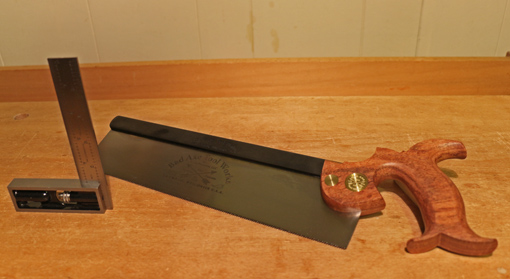
Woodworkers estimate a 90° angle all the time in their work.
For example, as you follow the line when rip sawing by hand, you estimate by eye and feel the position of the saw square to the surface of the board. Similarly, the initial placement of the tenon saw in the vertical plane, as the cut begins, is done by estimation. When chopping the baseline of dovetails, you estimate a 90° angle for the chisel, even if you then choose to slightly deviate from it to undercut.
I wondered, how accurate can we be with this kind of estimation? After doing some simple trials with a magnetic angle gauge, my conclusion is: amazingly accurate.
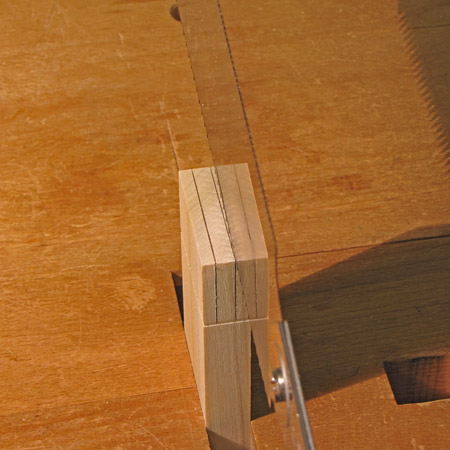
I placed the gauge in a position out of my view on the sawplate of my Bad Axe hybrid dovetail/small tenon saw, an exquisitely balanced, multi-purpose backsaw. I placed the saw, as if to start a cut, on a board’s straight edge, which was exactly parallel to the workbench surface. When I sensed the saw was vertically square to the wood, I asked an assistant to read the gauge.
Initially, the weight of the gauge on the right side of the saw tended to confuse me (a woodworking Heisenberg Uncertainty Principle?) but I was able to recalibrate my senses after several trials. As long as I paid attention to my senses of sight and feel, not allowing unnecessary thought to interfere, I was usually within 0.5° of 90°, despite the hindrance of the heavy gauge. I feel sure I could be even more consistent without the annoyance of the test gauge.
A 0.5° error would cause a deviation of only 0.009″ over the length of a 1 inch cut. A 0.25° angular error corresponds to a 0.004″ deviation – the thickness of a sheet of copy paper.
Of course, the initial estimation is validated or corrected as you saw, following the layout line on the face of the work piece. However, well begun is half done, and even as the sawing proceeds, I believe that a lot of ease in accuracy can come from retaining the sense of the saw’s initial placement.
The ability to estimate square is enhanced by awareness of peripheral vision references, close and far, such as the edges of the work piece, the horizontal top of the workbench, the vertical wall behind the bench, and even the front and back edges of the bench being parallel to the wall behind it. It is equally important to feel the balance of the saw in your hand.
Intuitively estimating square is one way of speeding up woodworking and getting into a working rhythm. I have not found it helpful to employ tricks such as observing the reflection of the work piece edges in the sawplate to determine perpendicularity. In addition to being unnecessary, it requires too much distracting shifting of the eyes and head.
Other experiments can be tried, such as crosscutting a board square by eye, or drilling a hole. The accuracy of the results may surprise you.
This is not a case against proper layout lines, and certainly it is not for setting up a jointer fence. The point is that in the course of our woodworking, we are routinely estimating square, and we can be pretty darn good at it.
Developing trust in your senses is one of the joys of craftsmanship!