Archive for the Category ◊ Techniques ◊

Author:
• Sunday, January 26th, 2014

IMG_1172_edited-2

Come on, woodworking isn’t really so hard to do. Just have all your stock flat, straight, and square, cut to the layout line, and never make a mental error. Everything will go just fine.

Just kidding.

But starting saw cuts accurately does help to make woodworking, especially joinery, go much better. “Well begun is half done” is true for this task. Accordingly, it is worthwhile to explore nuances of technique.

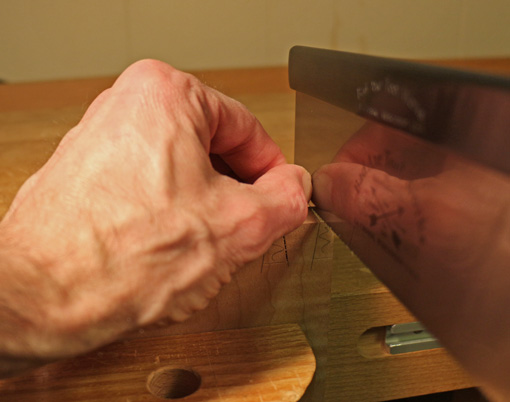
Laying the saw teeth on the wood and pushing without any guidance is generally too unreliable. So the left (free) hand is set on the wood and a finger, usually the thumb, contacts the saw plate above the toothline to provide stabilization.

This can be done with the thumb alone, but it is more stable when the side of the index finger is placed against the pad of the thumb while the hand rests on the work piece. However, the thumb pad tip is squishy, so it works better if it is also firmed by pressure from the index finger.

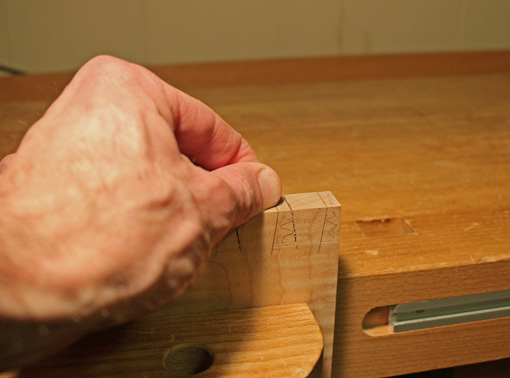
Even better is to angle the thumb a bit to the left so as to engage the hard thumbnail tip against the saw plate. The index finger acts to not only stabilize the set up but to help bring the saw teeth to the proper place to start the cut and fine tune the placement.

I find that using the thumb knuckle is less controllable since it is not on the most distal portion of the finger.

Below, with this angle of the thumb, only the soft tip will contact the saw plate.

IMG_1173_edited-2

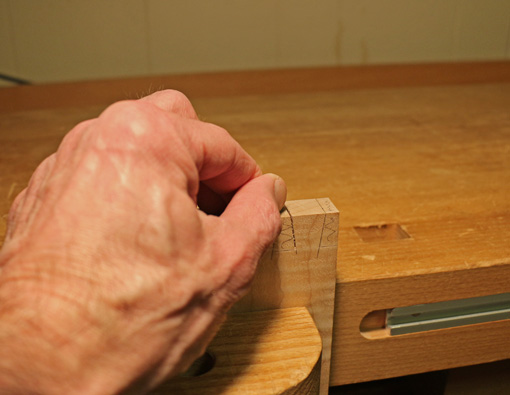
Below, I’ve re-angled my thumb so the nail will contact the saw plate. This will vary depending on the angle of the cut, sight line considerations, wrist flexibility, and even the length of the nail. In some situations, it may be too awkward or impossible.

IMG_1174_edited-2

Is this getting too punctilious, picky, or perhaps persnickety? I don’t think so. These are the bits of technique that are not mentioned in books but can make a real difference in work. Though these finger configurations work for me, the key point is to work out the details to suit your hands and the circumstances of the task to achieve the control and ease that is part of good craftsmanship.

Category: Techniques  | 2 Comments
Author:
• Tuesday, December 31st, 2013

IMG_1158_edited-2

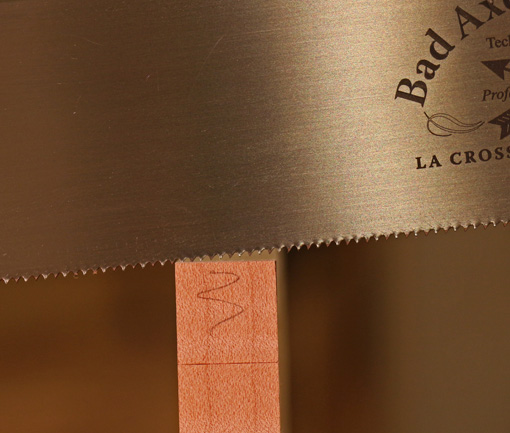
How and where would you start this saw cut? Do you start at the near or far end of the board, or attempt to score the entire width on the first stroke? Do you drag your Western saw backward or push your Japanese saw forward to preliminarily score the wood?

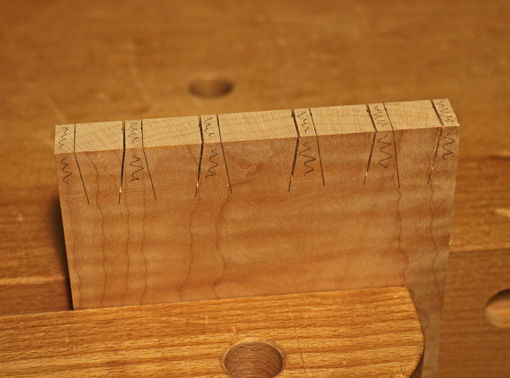
This is no small matter. Accurately starting the saw cut is probably the most critical manual step in dovetailing, especially when sawing pins that have been laid out from previously cut tails.

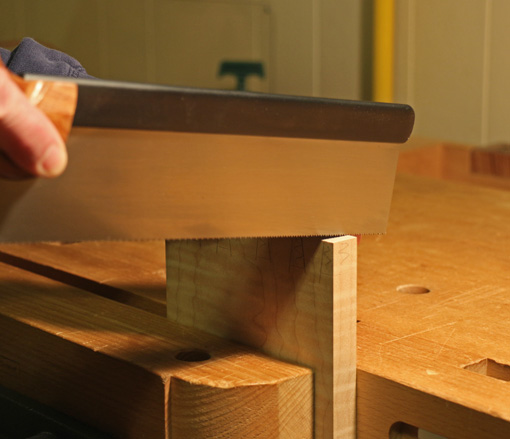
Without a doubt, the smoothest and most accurate method for me is to slightly raise the handle of my Western push saw and start the rip cut at the far end of the board. A Japanese pull-cut saw would be started at the near end. This also works for the crosscuts at the sides of the tail board, as well as for sundry other woodworking cuts.

Though I am empirically convinced of this, let’s explore why.

As the saw teeth approach the top surface at the far corner of the wood with the saw handle raised, the rake angle is effectively relaxed (a greater “negative” rake), which makes for a less aggressive and more controllable entry into to wood. Approaching from the near corner (with the saw handle lowered) would effectively increase the rake angle, creating a positive “hook” rake, which is aggressive and tends to catch and jump on all but the softest woods.

IMG_1159_edited-2

Now, the degree to which one should raise the handle varies with the saw, the wood, and personal feel. If the saw is held too flat on the wood, it may skid on the end grain as you try to engage too much wood at once. Held too steeply, the saw tends to catch the far corner of the wood. Goldilocks this – experiment with your saw and the particular wood at hand. A generally light touch, letting the saw do the work, is part of all this, of course. Bad Axe saws may come filed with a helpful relaxed rake at the toe, which must be taken into account.

As a bonus, this method, applied to either Western push or Japanese pull saws, deposits the sawdust away from, not into, the line that the saw is advancing upon.

Some woodworkers like to start a push saw at the near end, reasoning that this pushes down the fibers, much like planing with the grain. I find that factor is outweighed by the rake factor, making that approach less reliable for me.

Likewise, I find that starting the cut by dragging/pushing the saw opposite to its normal cutting direction tends to make the saw skid and creates a kerf with a scalloped bottom that tends to catch the teeth when they are then propelled in the normal direction. It seems to me a generally mushy technique that is unnecessary with a good quality saw.

When we start a usual rip or crosscut on the flat surface of a board held horizontally, knee on the board, we are doing much the same as starting the dovetail cut in the manner that I prefer, though with a more aggressive angle, and the added advantage of sawing the fibers “down” when ripping. In fact, some people like to start the dovetail cut at the near side of the board with the saw held at an extremely low angle simulating ripping a board with a big ripsaw. The problems with that, in my opinion, is the business end of the work piece must be less rigidly held quite far above the vise jaw, and you have to start by following two lines at once.

The key point is to recognize the importance of a good start to the saw cut, experiment, and find what works best for you. Much of good craftsmanship is built on recognizing and managing the critical junctures of procedures.

And that, of course, leads to happy woodworking.

IMG_1162_edited-2

Category: Techniques  | 3 Comments
Author:
• Tuesday, November 19th, 2013

IMG_1081_edited-2

One of the most difficult aspects of learning and refining craftsmanship is understanding and sensing when something is just enough and not too much.

Consider sharpening a plane blade: sharper is better, at least within a practical range. However, the camber in the edge is a subtle quality – too little and too much are both detrimental to function. The craftsman must understand the purpose of camber for the particular type of plane at hand, as well as have a visual and tactile sense of when the amount is good.

In drawer fitting, proper preparation of the carcass is essential to good results. For this, we must go beyond the simplistic idea that it should be as square as possible, if for no other reason than achieving perfectly square is impossible, and thus we must understand how to bias the imperfection.

It will be much easier to fit a fine drawer with a nice action if the carcass interior is a bit wider at the back than at the front. It must never narrow in width toward the back. Different carcass types – solid wood, frame and panel, a table with drawer guides, etc. – will dictate different ways to create this adjustment, but there is always a way.

We are faced with the matter of “a little bit.” It is sweet for a drawer, especially a smaller one, to have an easy pull to start, then tighten against the sides of the opening as it is almost fully withdrawn. Conversely, it is a sour drawer that gets pinched at the back as it is almost fully pushed in, while the front is excessively loose in its opening. It just doesn’t seem happy to be there.

In building a small jewelry chest of drawers with a solid wood carcass with an opening about 16″ wide and 11″ deep, I incorporated the necessary tweak by shooting the end grain of the top and bottom pieces slightly out of square. I would not normally measure the amount. Instead, I work by feel and eye to get a sense of just enough width that will allow the drawer to move unencumbered in its housing after an initial struggle to enter it.

“But Rob,” you say, “enough is enough already! How much?”

OK, OK, I measured it using shims. The sides are each out of square by about 0.007″ over the 11″ depth, for a total difference between the front and back interior width of just under 1/64″.

More important, I think that will be just enough but not too much.

IMG_1085_edited-2

Pictured above: a direct comparison between the front and back widths.

Category: Techniques  | 4 Comments
Author:
• Thursday, October 17th, 2013

IMG_1039_edited-2

This will start a few posts here on sawing tenons by hand, but first let’s first ponder the mortise and tenon joint in general. A joint that has been used successfully for thousands of years certainly deserves some thought.

What accounts for the joint’s legendary strength? Imagine trying to snap an “L”-shaped M&T construction. The mechanical lock of the tenon shoulders meeting the wood surface around the mouth of the mortise effectively transfers the imposed stress to the glued surfaces of the tenon cheeks against the mortise walls.

The stress on the glued surfaces, in turn, is a shear stress – and we know how wonderfully glued wood surfaces resist shear stress. Voila: a strong joint!

In fact, rarely will a reasonably made M&T joint itself fail. Rather, it is the wood around the joint that is more likely to give way.

Looking at the mortise and tenon strength tests detailed in Fine Woodworking magazine issue#203 (February 2009), we can see that it is almost always the wood around the mortise that failed, even when the tenon itself was too weak to hold up. In the real world, I cannot recall seeing any decently made tenon break, but I have seen the wood around the mortise fail.

I also observe that the only real danger to a tenon pulling out in a properly made joint is from the all-powerful forces of hygroscopic wood movement conflict. This may produce some gapping at the shoulder line, especially in injudiciously designed joints.

In most woodworking instruction, much attention is paid to proportioning the thickness of the tenon with respect to the thickness of the rail. Recommendations are typically that the tenon should be 1/3 – 1/2 as thick as the rail itself.

Yet, knowing from where the M&T derives its strength and how it is capable of failing, it behooves us to look at the proportions of the joint as a whole:

  • Especially consider the robustness of the wood surrounding the mortise.
  • Consider the area of shear-stress glue surface – the tenon cheeks.
  • Consider the nature of the dimensional conflict within the joint. The corollary here is that glues with a bit of give, like PVAs, have an advantage.

One more possible consideration is the lever arm force exerted on the stile (mortise member) by the tenon. In the FW article, look at how the humble stub-tenon and biscuit joints failed: the stile split along the grain near the end of the tenon depth. That’s a lot harder to do with a deeper tenon where the leverage works out to be not as lopsided, and the tenon engages more peri-mortise wood, not to mention the direct value of the greater glue surface area.

I hope, readers, you are not now expecting me to delineate a set of rules for proportioning a good M&T joint. Sorry, there are simply too many construction situations and circumstances. However, thinking clearly about what is going on in the joint and the considerations listed above should bring you to good joint designs. Furthermore, frankly, there is a good amount of slack here – even non-ideal but more-or-less reasonably designed M&Ts will hold up.

But don’t make a sturdy 3/8″ thick tenon to sit in a mortise with a 1/8″ outside wall!

Coming up: sawing tenons by hand, starting with sensible joint layout.

Category: Techniques  | 2 Comments
Author:
• Thursday, September 19th, 2013

IMG_1038_edited-2

The previous post discussed the creative destruction that I optimistically think contributed to my development as a woodworker. Thus, probably slower and with more angst than necessary, I think I’ve learned a few things worth sharing. Surely, readers, you have many points to add, but here are some key factors that come to mind that I believe contribute to a successful woodworking project, which, for me, is one that brings the “quiet joy” of which Krenov spoke.

  • Plot a smart order of construction steps. Don’t back yourself into corners that make succeeding steps more difficult than they need be. Think and think ahead.
  • Recognize appropriate tolerances in stock preparation, joinery, tool tuning, and so forth. Know where you must be very close and where you have some room. We all recognize the damage caused by sloppiness, but compulsive attempts at unnecessary perfection waste energy when building.
  • Know where the critical junctures are in the process. Some steps are make-or-break, so bear down on these.
  • Likewise, be cognizant of the major pitfalls. Usually, they are apparent only if you stop and think.
  • When possible, work in a self-correcting manner. For example, it is often a waste of time trying to get two surfaces to meet right off, and easier to plane small excesses flush as a final step.
  • There are many small touches that cannot be shown in the shop drawing, such as how ends and edges are softened. These decisions properly come along as the work progresses, but they must be consistent with your style and the design concept, and so you must maintain aesthetic awareness as you build.
  • Choose finishes as part of the design, not as an afterthought when the piece is assembled. Experiment on scrap to find a finish that supports the design concept.
  • It is nice to challenge yourself, but not to the point where you cannot maintain reasonable composure as you build. That’s no fun, and the piece will probably show it!

In marked contrast to the disappointment that can sometimes come from trying to make fine things, it can be exhilarating to work in control, in the flow, and in the moment, making something that you dearly want to be.

Here are best wishes as you pursue your path to the joy of woodworking.

Category: Techniques  | 5 Comments
Author:
• Saturday, August 24th, 2013

IMG_0831_edited-2

Woodworkers estimate a 90° angle all the time in their work.

For example, as you follow the line when rip sawing by hand, you estimate by eye and feel the position of the saw square to the surface of the board.  Similarly, the initial placement of the tenon saw in the vertical plane, as the cut begins, is done by estimation. When chopping the baseline of dovetails, you estimate a 90° angle for the chisel, even if you then choose to slightly deviate from it to undercut.

I wondered, how accurate can we be with this kind of estimation? After doing some simple trials with a magnetic angle gauge, my conclusion is: amazingly accurate.

I placed the gauge in a position out of my view on the sawplate of my Bad Axe hybrid dovetail/small tenon saw, an exquisitely balanced, multi-purpose backsaw. I placed the saw, as if to start a cut, on a board’s straight edge, which was exactly parallel to the workbench surface. When I sensed the saw was vertically square to the wood, I asked an assistant to read the gauge.

Initially, the weight of the gauge on the right side of the saw tended to confuse me (a woodworking Heisenberg Uncertainty Principle?) but I was able to recalibrate my senses after several trials. As long as I paid attention to my senses of sight and feel, not allowing unnecessary thought to interfere, I was usually within 0.5° of 90°, despite the hindrance of the heavy gauge. I feel sure I could be even more consistent without the annoyance of the test gauge.

A 0.5° error would cause a deviation of only 0.009″ over the length of a 1 inch cut. A 0.25° angular error corresponds to a 0.004″ deviation – the thickness of a sheet of copy paper.

Of course, the initial estimation is validated or corrected as you saw, following the layout line on the face of the work piece. However, well begun is half done, and even as the sawing proceeds, I believe that a lot of ease in accuracy can come from retaining the sense of the saw’s initial placement.

The ability to estimate square is enhanced by awareness of peripheral vision references, close and far, such as the edges of the work piece, the horizontal top of the workbench, the vertical wall behind the bench, and even the front and back edges of the bench being parallel to the wall behind it. It is equally important to feel the balance of the saw in your hand.

Intuitively estimating square is one way of speeding up woodworking and getting into a working rhythm. I have not found it helpful to employ tricks such as observing the reflection of the work piece edges in the sawplate to determine perpendicularity. In addition to being unnecessary, it requires too much distracting shifting of the eyes and head.

Other experiments can be tried, such as crosscutting a board square by eye, or drilling a hole. The accuracy of the results may surprise you.

This is not a case against proper layout lines, and certainly it is not for setting up a jointer fence. The point is that in the course of our woodworking, we are routinely estimating square, and we can be pretty darn good at it.

Developing trust in your senses is one of the joys of craftsmanship!

Category: Techniques  | Comments off
Author:
• Monday, July 22nd, 2013

IMG_0629_edited-2

Surgeons employ a technique which woodworkers would do well do borrow.

Immediately prior to starting an operation, all action stops and the entire surgical team participates in a “time out.” Everyone takes a fresh look  – a figurative step back – and makes sure all details have been attended to. This includes technical matters such as physiologic indices and medications, but also seemingly obvious things such as patient identity, the procedure to be performed, consent, laterality, and operation site.

In other words, there is a deliberate break in the workflow to ground the situation – to stop and create clarity. No removing the wrong kidney from the wrong person.

A woodworker with a stack of boards ready to mill, or a set of mortises or dovetails to cut, is in a similar situation, ready to move into the next phase of a project. At the outset of the procedure, you must make plainly clear to yourself:

  • What you are trying to accomplish relative to the requirements of the project.
  • The critical steps that will determine success, and the critical things to avoid.
  • Are the basics all set?

If all of this seems just too obvious, let each of us recall his last forehead slap after a costly mistake performing a no-brainer procedure . . . let’s see . . .oh yea, that one . . . I’m done. OK, now we can talk.

Here’s an example. Imagine you are at the jointer and planer with a stack of boards. Stop. Time out. Name the task. Be more precise than just intending to dress the boards to 3/4″. Think, for example, that it is OK to be 1/64+” fat, but not OK to go under 3/4″, and minimizing tearout would save a lot of hand planing later. Since this is curly maple, the passes need to be thinner than usual. And oh yea, one piece needs to stop at 7/8″, so that one is marked and separated.

Is the machinery ready: jointer depth, guard in place, outfeed plan, and dust collection hooked up? Are all the boards oriented and properly marked as to face and end? Is this safe – what is my hand and pushing device procedure all the way through?

The point is that the while the content of the time-out thoughts or verbalizations are very simple, it is highly valuable to take a minute to do the time out. Most woodworking mistakes, and usually the biggest ones, happen because of a failure to heed what should have been apparent.

It takes just a quick time out to recognize that.

Happy woodworking.

Category: Techniques  | 5 Comments
Author:
• Sunday, July 14th, 2013

IMG_0528_edited-2

Sanding blocks with a curved face can be very effective for smoothing and, with coarse grits in the right circumstances, even shaping curved surfaces in furniture making. I use spokeshaves, specialty planes, rasps, and scrapers to shape and smooth curved surfaces, but not to the exclusion of the humble sanding block.

They can be made quickly and easily with the bandsaw or bowsaw. For working concave surfaces, the curve of the block should be slightly steeper than the steepest part of the curve of the work piece. For convex work, a flat block is adequate for working shallow curves. For working steeper convex curves, the block’s curve should be slightly shallower than that of the work.

IMG_0525_edited-2

The top of the block should be shaped friendly to the hand using saws and rasps. I like to steeply cut down the corner of the block near the base of my right thumb, as well as the diagonally opposite corner.

The backing surface for the sandpaper should be have some type of firm cushioning, similar to a random orbit sander. For most broad surfaces, I like the high-friction cushion material available in with a pressure-sensitive adhesive backing from Lee Valley. PSA-backed 1/16″-thick sheet cork is firmer and thus good for narrower, smaller scale, or more detailed work.

Cutting regular sandpaper sheets and wrapping them around these sanding blocks is particularly annoying because of the curved surface. I much prefer using PSA-backed sandpaper that comes in large rolls, such as that available from Klingspor. It is quick, effective, and wastes less sandpaper, especially if the block is made to the width of the sandpaper roll. It is also reduces hand fatigue because there is no need to grip the paper to the block.

IMG_0527_edited-2

A gum rubber block is usually associated with cleaning retained sanding dust from the sandpaper on power sanders, but it also works quite well on these sanding blocks, especially when doing heavy work.

As with any sanding, it is important to remember that only the coarsest grit – the first one in the sequence – should do any required  shaping. (Though most or all of the shaping will have already been done with other tools.) All the subsequent grits simply remove the scratches made by the previous grit until the surface is smoothed to your satisfaction.

In time, one accumulates a small collection of these curved sanding blocks, so some will coincidentally be just right for future projects. This is simple, effective woodworking – one more tool for working with curves.

Category: Techniques  | Tags:  | Comments off