Archive for the Category ◊ Ideas ◊

Author:
• Sunday, May 01st, 2011

Myth: Woodworking is easy. If you simply follow [whatever clever procedure], you can do it quickly and it will come out perfect every time.

Reality: As with doing anything well, woodworking takes a lot of skill, few procedures go lickety-split, and there is a degree of uncertainty in making any piece.

Where is this myth promulgated? Look at several issues of most woodworking magazines: “made easy,” “perfect every time,” “quick, fast,” and similar catch lines are rampant. TV and, of course, ads also seem to thrive on this approach. Perhaps this sells but it must discourage many woodworkers who find a different reality when they get into the shop.

Also, I wonder why, in conversation with fellow woodworkers, I more often hear how a particular technique is so easy and “no problem,” than about the likely reality of uncertainty, trials, and mistakes that preceded such ease. I guess this is understandable since most people like to talk about their successes more than their failures. I’m sure I’m guilty of this here in the blog.

High quality woodworking requires artistry, imagination, engineering, knowledge, physical coordination, and patience. Building a piece involves many subtractive processes and without constant awareness, errors are prone to accumulate. Different woods require alterations in technique and often hold surprises. So, maybe it’s just me, but I think woodworking is not easy.

As for “quick,” sure, to get things done and to make money, work in any field has to move along efficiently. However, speed comes only after study and experience; without those, quick usually means poor results.

Perfect every time? Even if one employs highly systematic procedures, even with machinery, there is a host of gremlins poised to thwart perfection in woodworking. Among these is variability in the wood itself, tool sharpness, and tool calibration. Excellence certainly is an achievable goal, but perfection is not a realistic expectation to hold out to students of woodworking – and we’re all students.

I learn more from the hype-free literature and discussions that are out there, where I can appreciate the difficulties as well as the successes of woodworking. That’s the real stuff that makes for happy woodworking.
Category: Ideas  | 6 Comments
Author:
• Friday, April 29th, 2011

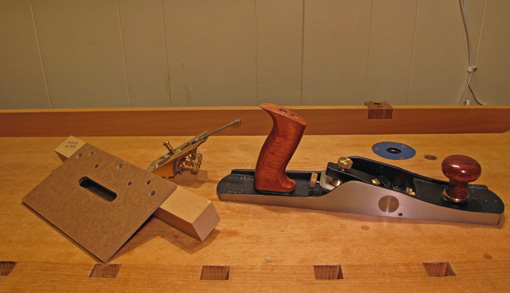
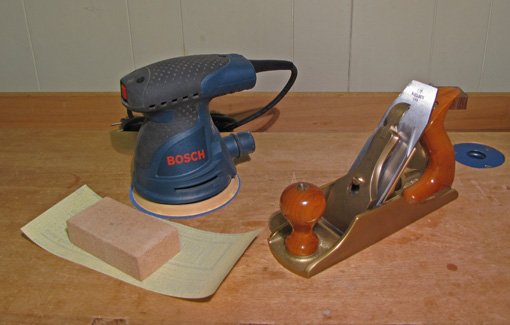
Myth: a well-tuned handplane is the best choice for final wood surfacing prior to applying the finish

Reality: Sometimes yes, but it depends.

Disclaimer: Because I am the writer, “reality” is through my eyes. Yours may differ. I recognize an element of subjectivity in issues such as this. Nonetheless, the “myth – reality” approach has a nice jolt to it, and this blog is about woodworking, not metaphysics. (I work wood. Therefore, I am?)

The method to produce the most desirable surface on the wood prior to finishing depends on the wood, the finish that will be applied, and the physical circumstances of the piece.

This is best demonstrated by a set of examples.

A dense, hard, small-pore wood such as bubinga, with either an oil or a film finish such as varnish, will look every bit as good with fine hand sanding as with the most careful planing. A flat surface could be completed with planing or finished off with sanding, while rasps, scrapers and sandpaper could be used for a curvy leg. All will look equally good when finished.

On the other hand, Port Orford cedar looks resplendent directly from a sharp smoothing plane, with a clarity that sanding cannot match. I like this beautifully fragrant wood without any finish.

What about curly big-leaf maple, one of my favorites? A well-tuned smoothing plane with a high cutting angle can handle it but I feel that sanding, finishing by hand with 320 or 400 grit, produces an equally beautiful appearance when the piece is finished with gel varnish, my preference for big-leaf. I use whichever method is easier for the circumstances.

Curly cherry is a difficult one. After experimenting with various samples, I am convinced that sanding muddies the figure, which looks inferior to the clarity produced by planing, and this effect persists even with a thin film finish such as padded shellac or wipe-on varnish. The same is generally true, though less so, for curly pearwood with a thin water-base acrylic finish.

Mahogany? I find that hand sanding and planing yield surfaces that look the same under shellac or varnish. This wood is so often rowey that I usually find it easier to complete the surface preparation with sandpaper. Oaks? Both methods seem to work equally well in most cases. Claro walnut? It depends on the figure and the choice of finish but I plane when I can since it does seem to preserve clarity when an oil finish is used.

There are other considerations, such as the peaceful, dust-free experience of planing. Planing is usually faster than sanding, maintains the trueness of a surface more reliably, and usually produces crisper edges. On the other hand, edge tools are often impractical for contoured work, yet we can use rasps, scrapers, and sandpaper to sensitively produce the desired shapes.

The point is that it depends! In making choices for surfacing, the woodworker has to consider the wood, the intended finish, and the circumstances of the piece, and may need to do some experimenting. You must be observant and make choices based on your concept of the piece, not on purist generalizations. Trust your perceptiveness and judgement, more than what anyone, including me, tells you.

Category: Ideas  | Comments off
Author:
• Sunday, February 13th, 2011

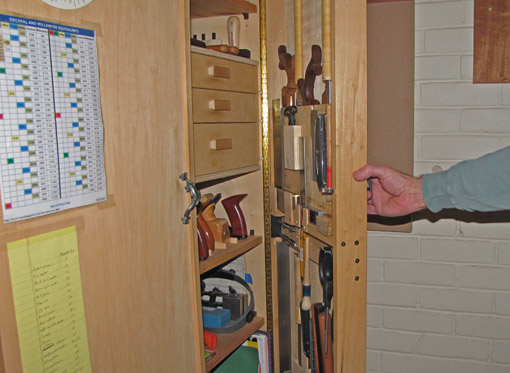
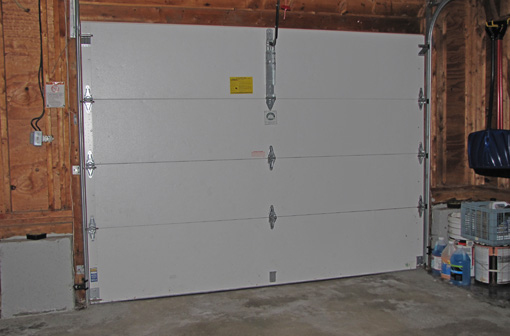
Does the door to your home woodworking shop look like this?

Many, if not most, home woodshops are banished to the garage. There the floor is usually concrete, it is often cold, and, worst of all, the area is intermittently shared with a car, lawnmower, and the accumulated junk of modern life. Is this a good place for your beloved tools and woodworking?

Of course, there may simply be very limited options – a garage shop or no shop. Maybe other awkward or uninviting places such as a hallway (been there) or the basement dungeon (been there too) will have to do. In fact, maybe the garage or basement can be improved to become more comfortable and pleasant.

However, at least consider using a room in the house for your woodshop – yes, a real room. For at least the workbench and hand tools, a small room will do just fine. The machines and most of the wood storage could stay in the garage, maybe with some help from the attic or even a closet.

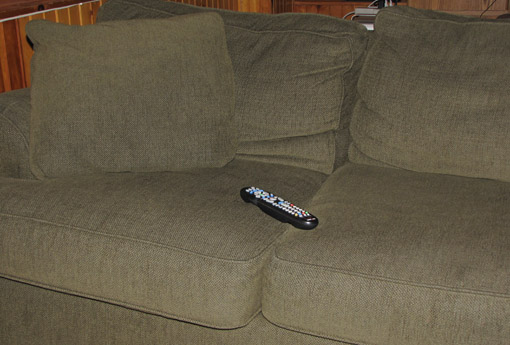
Isn’t the TV, excuse me, the home entertainment system, a higher priority? And what about the rest of the family? I don’t know, you’ve got to work that out for your situation. The point here is this: if woodworking is important to you, consider using important space for it.

Many people devote considerable space, time, and money to passive entertainment, with which I feel our society is too preoccupied. Many people seem to seek an almost continuous stream of it. I have nothing against entertainment, but it is the balance that I question. There is likely more fulfillment and joy in free hours devoted to creativity – wood, word, music, etc. – than in a video game. We make our choices.

I suggest considering what is valuable to you and have your living space reflect that, within the bounds of practicality, life’s compromises, and the needs of those near and dear to you. Good luck and happy woodworking.

Category: Ideas  | 8 Comments
Author:
• Sunday, January 30th, 2011

If you are looking for ideas for a project, an excellent source is Lark Books’ 500 Series. While this series covers many craft media, woodworkers will find the most inspiration from 500 Cabinets, 500 Tables, 500 Chairs, 400 Wood Boxes, and 500 Wood Bowls. Even if you are not looking for ideas, there is much in these books to appreciate and enjoy. You will probably do lots of nodding, plenty of eye widening, some jaw dropping, and, naturally, some wincing.

The books, all stout 8″ x 8″ paperbacks, sell for about $12-14 on Amazon.

Each book delivers a huge quantity of outstanding work. There are no artist’s statements or lengthy ruminations, just a quality photograph, occasionally two, of the piece, with the artist’s name, a title for the piece, and size, material, and finish information.

I like to look at lots of sources, in print, online, and best of all, in person. Aside from the sheer pleasure of it, this activity expands my creative thinking as the imagery mixes and reacts with my own design chemistry. The eventual product is, hopefully, something meaningfully personal.

When looking through these or similar collections, ideas come from all directions. A box may start a chain of thought for a cabinet, or a chair for a table, and so forth.

To be clear, I am not advocating lifting designs, a form of theft, and purporting them to be yours. Yet, there is unlikely anything completely original since we all absorb what came before even as we make our own discoveries.

By way of disclosure, my work is in one of these books, which gets me a single free copy, but this review is not compensated. I just like the books.

Category: Ideas  | 2 Comments
Author:
• Tuesday, December 28th, 2010

Well, a bad day in the shop sure beats a good day doing a lot of other things! Seriously though, I want to explore the unnerving phenomenon of why sometimes working wood I feel like I can do no wrong, everything just flows, and yet at other times I feel like a neophyte who needs all the good luck in the world for things to go right. Can you relate to this?

I am not referring to obvious interference from things such as fatigue, worries, tool failure, wood disappointments, struggles with a new technique, and so forth. Rather, the mystery is why, absent apparent hindrances, some woodworking sessions are strained, poorly productive, lacking in confidence, or simply a struggle without ease.

Here is the best I’ve been able to discern. At least, I’m convinced that what follows is the key for me.

I believe that to be simultaneously effective and at ease in woodworking requires heightened awareness of how the process at hand, each moment of it, fits into the larger picture of the piece being made. In other words, one does not just execute isolated procedures, such as sawing to a line, but maintains a background cognizance of the larger role of the task at hand in what is being created.

Working with this sense of direction produces focus and concentration. It also extends beyond the piece in process to a larger commitment of purpose about one’s woodworking in general. Everyone has his own view in this regard, of course, but it should be carried into the shop and kept alive in the background.

Work flow in my shop deteriorates and mistakes creep in when tasks are abstracted from their larger purpose. The right approach is, for example, to plane a board flat, not as an isolated goal, but to work it flat enough, appropriately nuanced, so the board will fulfill its role in the piece. Yes, this is a simple notion, but it is easy to get carried astray in the course of all the steps in building a piece.

I find that a quick mental warmup to attend to these matters greatly helps my focus when starting work in the shop. In short, a clear sense of purpose, at all levels, is the key to a good day in the shop!

Does working wood thus imitate life in general?

Category: Ideas  | 5 Comments
Author:
• Saturday, December 11th, 2010

This is about a way of working that is a mentality more than a specific technique. Above all, it is about awareness.

Accuracy is essential in woodworking – layout, cutting, surfacing, fitting, and so forth. We strive for this, perhaps even aiming for unattainable perfection, like a shooting at a bull’s-eye.

Consider William Tell, who, legend holds, was forced by a tyrant to take one attempt to shoot an arrow through an apple sitting on the head of the archer’s son. If he missed, the tyrant’s soldiers would kill the boy. Though he courageously took careful aim at the apple, surely Tell shot with the awareness that to miss low would kill his own son. If he missed high, at least there might be a Plan B to save his son. Fortunately he did not need to use the extra arrow under his coat, but one wonders what might have ensued if the first shot missed.

In woodworking, all inaccuracies are not equal. It is not like aiming at a concentric circle target. To do good work, one must be not only intent on hitting the mark but also cognizant of the consequences of the different directions of missing the mark. This awareness comes from understanding the significance of the task at hand and where it fits into the project as a whole.

This does not mean one should saw everything fat, nor does it excuse being timid about working to the line. It does mean that the concept of a one-sided tolerance can be applied to most woodworking tasks. Here it is: try to hit it right with an accuracy appropriate to the function of that part of the project, with an awareness that errors in some directions are less consequential (and perhaps fully tolerable) than errors in other directions which can seriously compromise the work.

As an example, in sawing a tenon, strive (courageously) to saw to the layout line but be aware that sawing it too thin is a considerably bigger nuisance to correct than sawing a bit too fat, which can be quickly remedied by paring or planing. In the bigger picture, you are aware that a loose tenon will compromise the strength of the structure. The same general idea can be applied to cutting dovetails, fitting drawers and doors, even flattening a board.

By contrast, you broaden your tolerances planing a chamfer with a block plane. If it looks about right, fine.

This is a much more effective approach than pursuing the illusion that you must or might get it “perfect.” Don’t believe the “perfect every time” promise in some woodworking ads and literature. It is neither necessary nor real.

Be always aware of: How does this process that I’m doing at the moment, fit in and affect the whole of the piece? (In this way, does art imitate life?)

With this approach, the craftsman works with ease and confidence. He does not pursue, nor is intimidated by, perfection. Rather he knows what he is after in reality and how to work effectively toward it. Put another way, the craftsman accepts his humanity, and does not fight it but rather works with it to function effectively. In this work of creativity, the craftsman is superior to any machine.

Category: Ideas  | 2 Comments
Author:
• Thursday, September 09th, 2010


Thank you, Heartwood blog readers


I started this blog two years ago believing that woodworkers have a lot to gain from sharing information and ideas in this format. That belief has been reinforced, the readership has grown far beyond anything I anticipated, and there has been much gracious and encouraging feedback. This is not a farewell, just a juncture at which to say, “Thank you,” dear readers.

Of course, you have a wealth of choices in the internet woodworking world, so I am very appreciative of the time you spend here in this little corner of it. I hope the Heartwood blog has advanced your woodworking and spurred your enjoyment of it.

I will continue to present thoughtful, useful content. The topics arise from the sawdust and shavings of my shop, devoid of hype and armchair pretenses. The writing will continue to be largely technical though often laced with reflections and sentiments that accompany my woodworking.

If you are even slightly inclined, do leave comments on the posts, please. Other readers and I would like to hear from you. I must continue to hold all comments for approval because even though the Akismet program filters out many thousands of spam comments, some do find their way through.

So far I’ve posted about 45,000 words and 200 photographs, enough to fill a nonfiction book. This is a labor of love and I can only say that I hope to continue to be able to devote the time.

For now, thanks for reading and happy woodworking!

Rob

Category: Ideas  | 14 Comments
Author:
• Friday, June 25th, 2010

Thoughts arising while sweeping the shop floor, waiting for boards to come out the back end of the thickness planer, or putting away tools . . .

A principle known as Occam’s Razor holds that the simplest explanation for a phenomenon is usually the best among reasonable, verifiable, non-simplistic possibilities. In other words, eliminate the burden of the unnecessary. I propose the Woodworker’s Edge: let this principle apply to woodworking jigs. The simplest jig that gets the job done quickly and well is the best jig. The idea is to make woodworking projects, not elaborate jigs. Simple, effective jigs are cool jigs.

I wish someone would manufacture a 12″ jointer with about a 55″ bed. I mean just the jointer, not a jointer-planer combination and not an aircraft carrier monstrosity. I could use it along with my DW735 portable thickness planer. I imagine it would save a large share of the cost of a combination machine, not to mention changeover hassles, while retaining the advantages of the 12″ width. 

I wish Lie-Nielsen would make a 55 degree frog for their #4 smoothing plane (2″ blade width) as they do for their #4 ½ (2 3/8″ blade width). 45 and 50 degree frogs are available for both planes. I’ve used the #4 bronze nearly since it was first produced, and later replaced its 45 degree frog when the 50 became available. It is my all-round smoother and I’ve never used the 45 frog since. It seems the 55 would make even more sense for difficult woods in a #4 than in a #4 ½ since the narrower plane would reduce the pushing force required.

Speaking of planes, the rear handles on Veritas bench planes are . . . well, if you use them you know . . . not exactly agreeable to human hands, at least not to mine. I do understand that they are fixed with two bolts instead of the usual one and the straighter profile accommodates this. I have two of their low angle planes and otherwise like them very much. Lee Valley is a wonderful company. But the handles, please, guys, can you do something?

I wish more wood was sawn into different thicknesses within one flitch. That way table legs, aprons, and tops could be made from consistent wood taken from one flitch without having to resaw the dried lumber. I guess this would be a lot of trouble for the sawmill and maybe just too impractical, but it would be nice to have such lumber widely available. Using 8/4 lumber for all the parts of a table requires a lot of resawing.  There is always a bit of a gamble, certainly considerable waste, and more work in resawing 8/4 lumber to get 3/4″ finished stock.

I don’t think techniques need to be advertised as they so often are in woodworking publications: “foolproof, super-easy, super-quick, perfect every time,” etc. Woodworking is wonderfully accessible, but it is not that easy, not that quick, nothing works out perfectly every time, and techniques do not need to be foolproof because woodworkers are not fools. I guess the following is less marketable: “Here’s a clear, sensible procedure that works for me, and, after some practice, will give you excellent results as long as you are careful, patient, and use the proper tools.”

I’d buy that.

Category: Ideas  | 6 Comments