Archive for the Category ◊ Tools and Shop ◊

Author:
• Monday, April 22nd, 2013

IMG_0993_edited-2

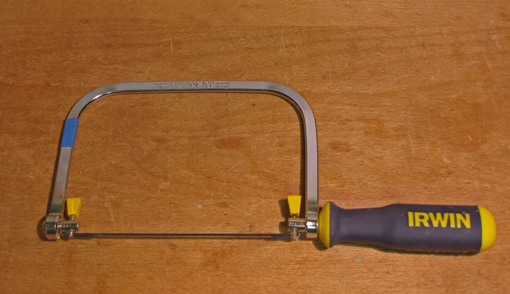
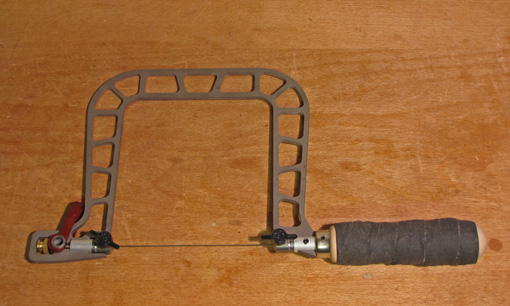
Why part 6? Parts 1-5 were posted in 2010, and cover the main Western and Japanese handsaws and joinery/backsaws that I use. I have since added the Bad Axe dovetail saw to that group and it has risen to the head of the class. This post will cover bowsaws. Part 7 will cover coping and fret saws. Part 8 will cover miscellaneous accessory saws. 18 saws isn’t a lot, right? Right.

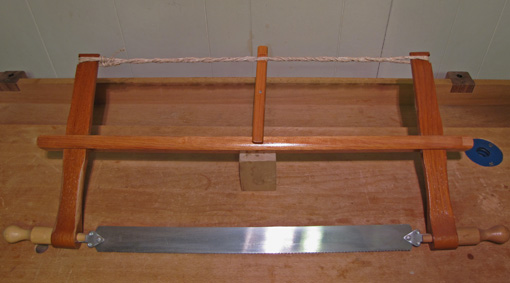
The Woodjoy bowsaw, pictured above, is my bandsaw without a motor. Glenn Livingston produces this thoughtfully designed and beautifully made saw along with other excellent tools. It is a very sturdy tool with about 16″ between the stiles. The toggle system easily permits half turns, which is important in properly setting the blade tension.

The “Turbo-Cut” blade, listed at 400mm (15 3/4″) long but with a comfortable 13 1/2″ of tooth line, has super-hard (>Rc 70) Japanese-style teeth, 15 tpi. The pattern, which could be considered a modified ikeda-me, is seven three-bevel crosscut teeth followed by a pair of special rakers that have their end bevels cut in the opposite direction from those of the crosscut teeth. It crosscuts fast, and seems to rip even faster.

The blade is about 5/16″ wide, .024″ thick, with the teeth widely set to a .048″ kerf. This makes it surprisingly maneuverable following curves, though the cut is fairly rough across the grain.

For power, comfort, and accuracy, I prefer to use this saw with a horizontal push cut, and the frame is plenty rigid enough for that. Some may prefer a horizontal pull cut, or a vertical push cut, though the latter may be difficult at typical workbench height.

IMG_0994_edited-2

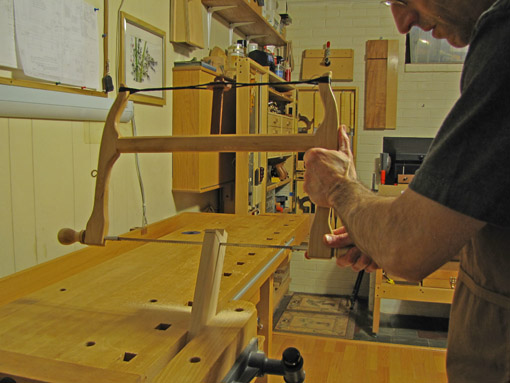
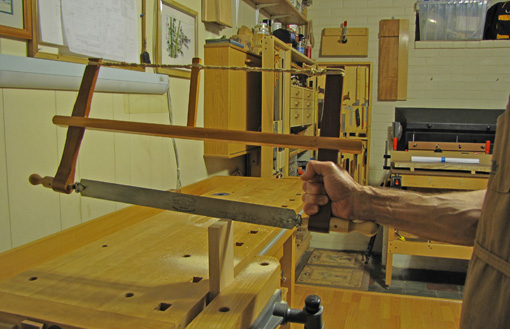
This is a fairly heavy saw, so here is how I hold it for cutting curves. I grip the handle with my dominant right hand, similar to holding a straight-handle dovetail saw, and align it with my right shoulder. This reliably steers the saw while my left hand provides passive support near the end of the rail. The saw works best when you let it do the work and use as much of the blade length as you can with every stroke.

This saw could quite reasonably be used in a hand-tool-only shop in place of a bandsaw for roughing out curved table legs and other heavy curved work. It has the moxie and the control to easily handle 8/4 maple.

I like this size saw for curved work. Woodjoy also makes larger sizes, and Turbo-Cut blades are also available in 1 1/4″ width.

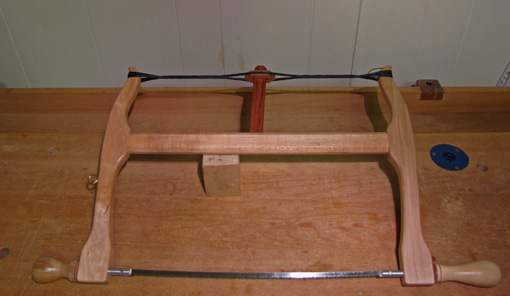
I bought the bowsaw pictured below more than 30 years ago. It was made in Denmark by JPBO but, as far as I know, is no longer available. This is the model of saw that was preferred by the late great teacher Tage Frid. He used it with a horizontal push stroke for joinery and crosscutting, and vertically for ripping stock.

IMG_0992_edited-2

Not long after buying it, I replaced the original blade with one labeled “The K and P Saw, Western Germany,” also no longer available. An excellent blade, it is tapered in thickness from the teeth to the back, so it can be prepared with very little set. The blade is about 19″ long and has 10 tpi, which I file rip. Frid advocated a rip filing for both ripping and crosscutting.

This saw is surprisingly light yet rigid, probably due to the width and orientation of the frame members – unlike most bowsaws, the wide dimension of the rail is horizontal. The toggle system is less refined than on the Woodjoy saw, but half turns are still possible by loosening and reinserting the toggle stick in the opposite direction, then retightening it.

I find I get the best control and endurance by holding it by the lower part of the fairly wide stile.

IMG_0997_edited-2

This saw does not get a lot of use in my shop now but it is still handy to have for various ripping tasks. I find it is especially accurate and comfortable for cutting tenons, though I’m in the habit of using the ryoba for that.

Because I like using my bandsaw so much (“the hand tool with a motor“), I also don’t frequently use the Woodjoy bowsaw. Nonetheless, I still want both of these hand tools in my shop – they give me options and they’re ready when I want them.

Next: the fret saw and the humble coping saw.

Category: Tools and Shop  | Tags:  | Comments off
Author:
• Sunday, February 10th, 2013

IMG_0955_edited-2

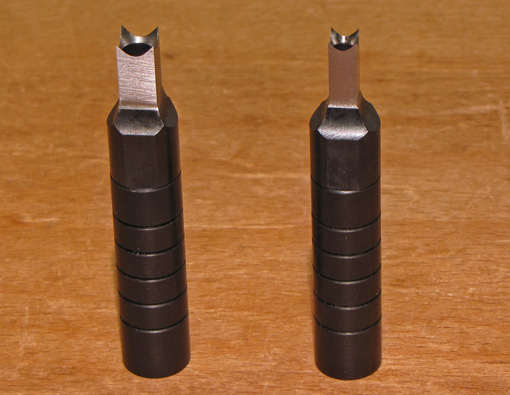
Lee Valley Tools recently made available Square Hole Punches that easily form a square hole for filling with a square peg.

A simple peg or, even better, the drawbore method, are time-tested ways to reinforce mortise and tenon joints. I prefer the look of a square peg, but it is much easier to use a round peg inside the joint. I have tried various methods such as whittling the lower portion of a square peg into a roundish shape. Still, it is fairly tedious to neatly form the square portion of the hole with standard tools.

I have tried using a corner chisel and experimented using a hollow chisel mortising bit for this. Despite some success, I was still not happy with those methods. Lee Valley has made this much easier with their Square Hole Punches. Please see their website for how they work. I’ve tried them out in the shop and they work well.

They are well made and cleverly designed – except for one problem! However, I think this problem could be solved by adding some options to another one of their new tools, the Dowel Former. I sent the following message to Lee Valley. I invite your comments.

Hi Lee Valley folks,

I would like to suggest a coordination between your excellent Square Hole Punches and your new Dowel Former.

As you know, the diameter of the round hole in each Square Hole Punch is 3/64″ less than the size of the punch. I think I understand why. If the hole were larger, the thickness and strength of the wall of the punch would be compromised. If it were smaller, it would be too hard to drive the punch. Because the punches are sized in common convenient measurements, such as ¼” and 5/16″, the holes are necessarily odd sizes in the 64ths, such as 13/64″ and 17/64″, respectively.

However, when using the punches, I would like to use the drilled hole to insert a round peg for the mortise and tenon joint, and then fill the square hole with a square plug. I think for many woodworkers that would be the major benefit of the Square Hole Punches. However, to my knowledge, dowels are not available in odd sizes such as 13/64″, 17/64″, etc. Machining my own dowels is a hassle I would rather avoid. Whittling them to those sizes is tedious and inaccurate. True, I can make my own dowel plate but it is not likely to be as good as what you can manufacture, and I like working wood more than metal.

One solution would be to make the Square Hole Punches a bit larger, so that the holes would be in 32nds. For example, the ¼” punch could be 17/64″ and its hole would then be 7/32″. But, once again, who has a 7/32″ dowel? Not a good solution. Another approach would be to make the punches in sizes such as ¼” + 3/64″ = 19/64″ and  5/16″ + 3/64″ = 23/64″ so the round holes will be handy diameters, namely ¼” and 5/16″, respectively.

Enlarging the round hole is not a good solution. It would likely create inaccuracies and sloppiness, especially since enlarging it up to the next common dimension would make its diameter equal to the width of the square hole.

I think there is an easier approach. I suggest keep the Square Hole Punches just as they beautifully are, and make inserts available for your new Dowel Former to form dowels which fit the holes in each of your Square Hole Punches. I suspect this could be done relatively easily without a lot of retooling (unlike altering the sizes of the punches), and, if I understand correctly, you manufacture the Dowel Plate at your facility since it is a Veritas tool.

I present this suggestion in the context of having the highest regard for your company and the contributions you have made to the craft of woodworking. I plan to post this suggestion on my blog at www.rpwoodwork.com/blog and invite comments, as readers so often come up with good ideas and constructive suggestions.

Thank you very much,

Rob Porcaro

Category: Tools and Shop  | 6 Comments
Author:
• Saturday, February 09th, 2013

IMG_0897_edited-2

Here are more morsels of shopology from the “sawdust and shavings of my shop” that I hope will be helpful for readers.

1. Recognize the difference between efficient rhythm and dulling repetition. Finding the sweet spot can improve the quality, speed, and enjoyment of your work.

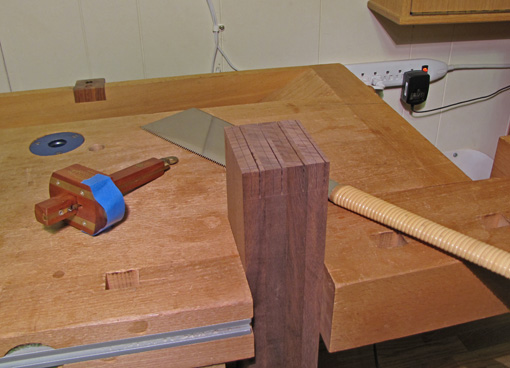
For example, in the above photo, sawing the cheeks for four tenons in a bunch put me in a nice sawing groove, accurate and fairly fast. After four more sets for the other ends, I was ready to move on to other tasks. Immediately doing likewise for another set of rails, would probably have put me over the threshold of monotony, and induced careless inaccuracies.

2. It is helpful to have a separate sharpening station, however modest, so you do not have to clear space on your bench for sharpening gear and the mess that sharpening can create. A dedicated station will also encourage timely attention to edges.

3. Milling rough lumber to finished thickness in one session can be risky, especially if there is substantial thickness or distortion that must be removed. If there is any doubt at all, it is safer to mill to near the final thickness, watch the wood for a few days, then, when it is convincingly settled, go to the final thickness. Then joint the edges and square the ends.

4. Keep router collets clean at all times. A slipped router bit is not fun. I use cotton-tip swabs before putting the router away after use. And clean the pitch off the bits before putting them away. I like CMT 2050 cleaner for that.

5. Be cognizant of the “zoom power” that you are working in. There is a larger margin for error for joints and edges in a basic pine bookcase than in a small, fine walnut jewelry box. Working at the wrong zoom power can create undue stress in the building bookcase, and obtrusive sloppiness in the box. Be practical.

6. Move and adjust the light to where you need it. Just do it. Then resume working.

7. There is almost always a smarter and less smart order to do things in building a project. Without going too crazy, take some time to think about the planned outcomes of processes and what can commonly go wrong. Then plan a course.

8. Without reinventing the wheel, it pays to once in a while rethink common procedures, constructions, and tool setups. Without a doubt, there is always more to learn, and I want to put at least some of it to use in my shop.

Happy woodworking, dear readers.

Category: Tools and Shop  | Tags:  | 6 Comments
Author:
• Sunday, January 20th, 2013

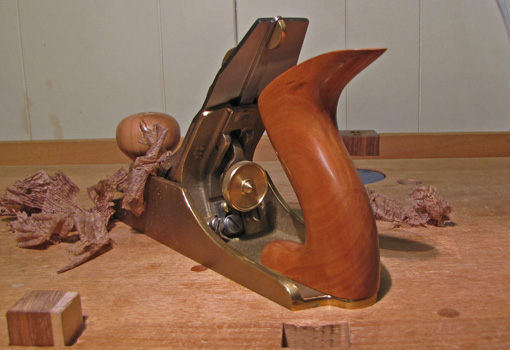
The Lie-Nielsen bronze #4 has for years been one of my favorite tools in the shop, but is now even better with an aftermarket tote and front knob made by Bill Rittner. Now, this is not a situation like I have previously described with the Veritas totes. The L-N OEM tote is very good. The upgrade, however, is in another category: heavenly.

It may be hard for readers to understand my effusiveness about a shaped piece of wood without being able to reach into the above photo and pick up the plane, so I recommend visiting Bill’s website and reading about his tool making background and how he has refined plane handles. In working with Bill last year evaluating some prototypes, I was amazed at the level of refinement to which he has brought this work.

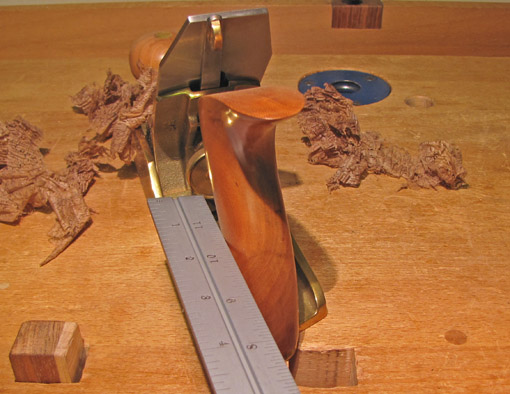
As demonstrated in the photo below, the tote does not have any flat on its side. (Check your planes’ totes.) The cross section is actually elliptical, which fills the hand satisfyingly.  The fit and finish are superb. If you enjoy and appreciate the nuanced work of a sophisticated craftsman, this is a luxury that is well worth it. Really, I find myself eager to use the plane just so I can hold it.

As I have mentioned in several other tool recommendations on this blog, this review is unsolicited and uncompensated. I just like to support craftsmen making honest offerings of great products.

Author:
• Monday, January 14th, 2013

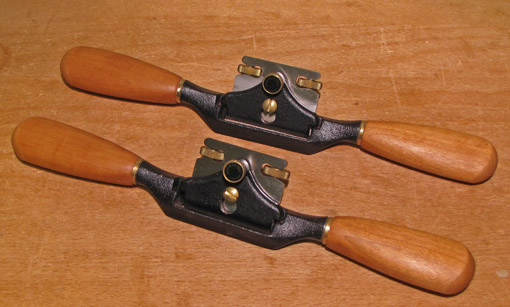
The Veritas flat and round metal spokeshaves are excellent tools that have performed well for several years in my shop. However, I greatly dislike the handles on these tools as supplied by Veritas. I will explain. 

The OEM handles are round in cross section, and rather small. This makes it difficult to control the spokeshave in the most critical aspect – its rotational pitch on the long axis of the tool with respect to the wood surface. This means how you tip the spokeshave to effectively engage the blade into wood. The smallish round handles make it hard to find and maintain proper positioning. The tool tends to rotate unless it is gripped tightly, leading to undue fatigue.

This is true even if you place your fingertips on the body of the spokeshave, as many woodworkers prefer. The fingertips are fine tuners, while stability and power comes from the body of the hand against the handles.

Fortunately, the Veritas design facilitates installing user-made replacements, which I did soon after I bought the tools, using hardware available from Veritas.

I made my handles larger and, most importantly, flatter – vaguely like a chubby beaver tail or an elongated cactus branch. I can feel and maintain the registration of the spokeshave against the wood better than with the OEM handles. My handles originally were longer but I shortened them, so now I can tuck the rounded end against the outer part of my palm.

The flatter handles are a tricky to install because you want them to attach in a specific orientation, unlike the round-cross section OEM handles. One end of the hanger bolt used to attach the handle goes into the tool body with machine threads. Coarse wood threads on the other end go into the wooden handle. The wood threads must enter just right amount into the handle so it will be in the desired position when the machine threads are tightened into the body. There are right hand threads on both sides of the body, and therefore they tighten in opposite directions as they face each other.

I eventually got it right after trial and error. Making the two faces of the handle symmetrical doubles the opportunities to align the two handles.

Perhaps a tang with machine threads on one end that attach to the body would make it easier to align user-made handles that are not round in cross section. I wonder if Veritas would consider such an accessory.

I made the handles from cherry. I like a woody, not slick, feel to tool handles so I applied a single coat of oil-varnish.

As always, woodworkers will have their personal preferences in these matters of the hand and the tool, but here I have explained the reasons for my preferences. Now the Veritas spokeshaves are just right in my hands!

Category: Tools and Shop  | 5 Comments
Author:
• Sunday, October 28th, 2012

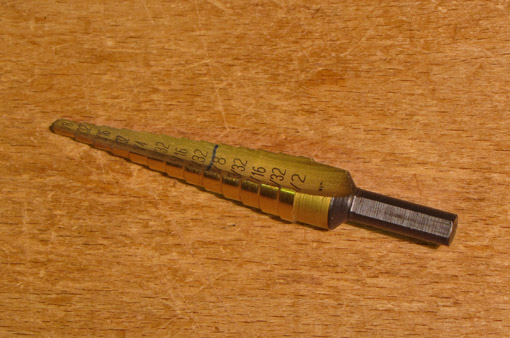
It is usually difficult to accurately concentrically enlarge a hole, especially when working with unpowered or electric hand-held drills instead of a drill press. Furthermore, the sides of the previously drilled hole tend to grab the larger bit and pull it in faster and deeper than desired, sometimes creating a ragged rim at the top of the enlarged hole. A simple tool that has saved the day for me a number of times over the years is the step drill bit.

The one I use, pictured above, has 13 steps, each 1/32″, from 1/8″ to 1/2″. Simply seat the appropriate diameter step in the original hole and drill down to the step of the desired size. It may be helpful to mark the desired step. The resulting shallow hole at the top can now concentrically register a regular bit for the new hole size. Of course, this won’t manage every situation, but it is a helpful option to have in the shop. I have never found a bit with 1/64″ steps.

These bits, sometimes called “drill tree” bits, are designed for drilling in thin metal and plastic, and for that I have found nothing better. They advance smoothly and produce a very clean hole with none of the grabbing or tearing common with regular twist bits.

They are available at home centers and hardware stores. It pays to keep an eye out for tools that are not intended for woodworking but which can nonetheless be useful in the wood shop. “Step drill” can also refer to concentrically ground twist bits, similar to those used for drilling pocket holes. W.L. Fuller in Rhode Island makes an incredible selection of step twist bits, including custom tooling.

Correcting one’s mistakes and finding a way out of jams are like every other skill: with enough practice, you get good at it. I’ve given myself plenty of practice, so I hope passing on these little tips will be helpful to you.

Category: Tools and Shop  | 3 Comments
Author:
• Saturday, September 15th, 2012

It is tempting to judge this saw on its looks, and there it is certainly a winner. Moreover, the range of choices available in the handle wood, saw nuts, and back allow the customized aesthetics of this tool to be especially pleasing. More substantively, the fit and finish are magnificent; there isn’t a hair out of place. My Bad Axe 10″ dovetail saw has a .018″ plate, 16 tpi rip teeth, set about .002 each side, with a mesquite tote, blued steel back, and brass saw nuts.

However, a tool must be ultimately judged by its performance, which simply means how it can help you make things out of wood. I’ve used this saw for about nine months now, and, despite some excellent Western and Japanese alternatives to which I had become accustomed, the Bad Axe has become my clear favorite.

When I pick up this saw and approach the wood, it feels just right in my hand. Though relatively beefy for a dovetail saw, the handle contour, low hang angle, and especially the balance work together to impart eagerness to go at the layout lines. When the saw does bite into the wood, the truly superlative sharpening completes the functional integration. In many side-by-side tests with my other saws, I  have gotten the most consistent accuracy and feel the most confident with the Bad Axe. It is now the saw I reach for.

A bit of relaxed tooth rake toward the toe of the saw helps start the cut. The tooth line is canted about 1/8 from toe to heel. These are both helpful features, though, to find quibbles with the design, my preference would probably be an increase in both of these.

The Bad Axe Tools Works website gives detailed technical information on the saws, and, ultimately, you will have to get one of these saws in your hand to appreciate how well it works.

There is something more important that I want to tell you about this tool. I think of it similarly as my Japanese Daitei chisels and French Auriou rasps. The Bad Axe saw is a tool with a soul, but in this case it is a characteristically American one. This is born of the personal commitment of its maker, Mark Harrell, a man who has spent much of his life serving America. Mark understands saw making history, listens to the input of many woodworkers (disclosure: including me), and is passionate about innovation, refinement, and excellence in producing a saw that you will not mistake for any other. Further, he allows for a range of your choices in saw plate, filing, handle size, and materials.

Yes, the soul of the tool is meaningful and I sense it when I bring the Bad Axe saw to the wood.

Author:
• Saturday, September 08th, 2012

I don’t mean to complain but . . .

1. Ulmia used to make a little vise that I’ve only seen in The Fine Art of Cabinetmaking by James Krenov, and months too late on Ebay. It is an Ulmia “Hilfs-Spannstock” (auxiliary vise) model #1812. [Note: One vise jaw is stamped “LSP-2816-4” and the other “LSP-2817-4” but I don’t think those are model numbers.] It can be clamped to the workbench top for holding small work, but, more usefully, can be secured in the tail vise to hold thin, small, and narrow parts. I have a shop-made alternative plus another option to be discussed in a future post.

2. The Lie-Nielsen convex sole block plane gets plenty of use in my shop since almost everything I make involves multiple curves. I like the shallow 27″ radius along its length, but it would be more useful for me if the 3″ radius across its width were shallower. Thus, even better would be a few different models with different radii. The plane is very handy to use but, for my taste, could still could be a bit bigger overall, and would be easier to grasp with grooves on the sides as finger grips.

3. I wish the Lie-Nielsen #2 had an option of a 50° frog as do most of their other bench planes. I think 50° is the best basic go-to angle for bevel-down smoothing planes and would make the handy 7 1/2″-long #2 more valuable.

4. The rose-head countersink with radially-asymmetric flutes that Lee Valley used to make is just about perfect, but as far as I know, has disappeared from their product line.

5. Veritas (Lee Valley) makes saddle squares and other, similar, markers which are very nice except for the annoying cut-away on the inside of the angle which is supposedly to vault saw whiskers. Who has these big saw whiskers and why would you want to preserve them? The cut away causes your layout line to deviate at the corner, often just where you need it most. This type of feature is found on machinist squares to vault metal burrs but is a disadvantage on tools used for marking continuous layout lines on wood.

The above suggestions are made here with great respect for these excellent companies.

6. The old Disston “Stronghold” style file handles are unbeatable. I have a supply in different sizes but, as far as I know, they are no longer manufactured. I wonder if the patent status would permit their manufacture again by some company.

7. I don’t know about you, but my hand gets tired using a coping saw or fret saw, even of the best quality. Because the handle is parallel to the blade, one is forced to use it with a bent wrist. There ought to be some way to rig a handle which is nearly perpendicular to the blade, much like a backsaw. I suspect this would also make it a more accurate tool. Uh oh, I think I just put a bug in my ear.

8. Finally, I request a magic lantern which grants me just these three wishes: an instant sharpening system which requires no time or effort whatsoever, a board stretcher (especially for width), and, most of all, a clock that doesn’t move unless I want it to. I’ll pay for shipping, no problem.

Readers, you undoubtedly have your own lists, and if I thought about it longer, my list could certainly exceed this one. Thanks for reading.

Category: Tools and Shop  | 11 Comments