Archive for the Category ◊ Jigs and Fixtures ◊

Author:
• Wednesday, April 03rd, 2013

IMG_0972_edited-2

Having covered the design and construction of the sharpening station in the previous four posts, I will now discuss how I use the system. This is not meant to detail my sharpening techniques, but, in general, I want to get an excellent edge on the tools as efficiently as possible so I can get back to working wood.

First, I gather the dull tools and assess their requirements. Then I make a trip to the bathroom to fill the pump spray bottle, get water to fill the Tormek tray if I will be using it, and do any emptying required on my part since failing to attend to this last necessity will surely interrupt the rhythm of a sharpening session.

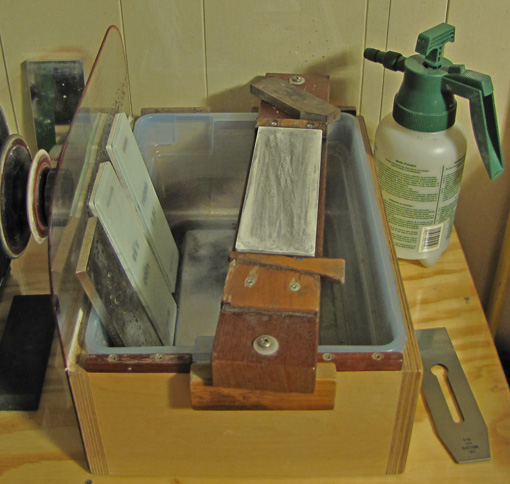
At this point, the entire operation is independent of a water source. I get the Shapton stones out from their dry storage and select the shopmade angle gauges needed after consulting my recipe chart. I bump the bridge into a fixed position, then secure the first stone in place with a tap on the wedge from the tool to be sharpened, and then give it a little spray of water. I lean the other stones on the left wall of the basin with their bottoms facing outward. I store the tools on the right side of the sharpening bench or, if there are several, on the left end of the workbench on top of the Tormek cover.
IMG_0973_edited-2

Grinding on the Tormek is done first if needed, but most sessions involve only honing secondary bevels. I work through the succession of stones, spray clean each when done, and lean it against the basin wall. Depending on the number and types of tools being sharpened, I may go through all the tools with each grit, or bring one blade through the whole process. In any case, I avoid letting wet steel sit for long because corrosion can start quickly, especially in O-1 steel.

Some blades, such as a smoothing plane iron, get a light stropping with diamond paste on leather.

Before leaving the bench, I reflatten each stone on the bridge with the Shapton diamond plate (trying to forget what I paid for it, even when it was cheaper than now), then rinse and pat dry the stones, and store them leaning against the wall or the outside of the sharpening box. Later, I return them to their boxes.

Just about all of the mess and water is contained in the basin, which can be emptied now or later. Since I generally like a tidy shop, I wipe away any errant mess on the sharpening bench with a rag or paper towels.

I oil the tools as soon as possible. Most important, I get back to working wood with sharp tools as soon as possible!

Once again, I emphasize that this is the setup and system that works quite well for me. I have presented it in hopes that readers will find it helpful for anything from gleaning a few tips to using the entire design. In any case, as I always emphasize, craft is necessarily personal, and each woodworker must find what works best for him or her.
Author:
• Friday, March 22nd, 2013

IMG_0979_edited-2

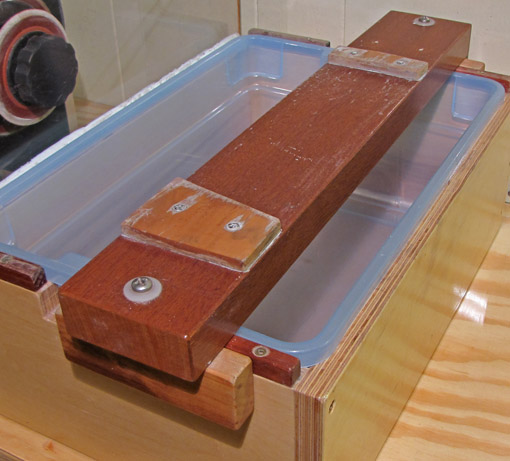
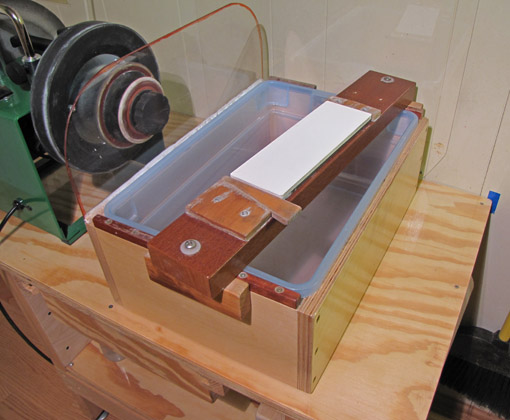
The bridge gets soaked repeatedly, of course, so to avoid wood movement and distortion as much as possible, I used quartersawn mahogany and finished it heavily with polyurethane. It is 3 3/16″ wide, 19″ long, and 1 3/16″ thick. Aluminum or painted steel might be good alternative material, though the wood has endured very well.

A key feature of this whole system is its absolute rigidity in use. The bridge must not shift at all while you work blades back and forth on the stone, yet must be easily removable for clean up while wet.

Cleats, 4 5/8″ long x 1 1/2″ wide x 3/4″ thick, are each attached to the bridge with a single stainless steel round-head wood screw and a nylon washer, just loosely enough to allow them to freely rotate. First, screw the rear cleat in place. Then, to position the front cleat for attachment, use a shim about 0.04″ (1 mm) thick (such as a non-flexible 6″ rule) between it and the outer wall of the box. This will create a slight gap.

In use, a firm sideways bump at the front end of the bridge, to angle it and thereby close that gap, makes it lock tightly to the walls of the box. An opposite bump releases it. This is quick, stable, reliable, and durable. If you prefer it to be less diagonal then shown here (which works well for me), use a thinner shim when attaching the front cleat.

IMG_0982_edited-2

The stone is held firmly in place on the bridge with a simple wedge system. Attached using SS screws, the rear cleat is at 90° and the front cleat has an angled edge, placed to position the stone slightly toward the front of the bridge. The cleats are about 5/32″ 9/32″ thick, which will keep them below the level of my Shapton Glass Stones for a long time.

The wedge angle of 10° works well; a shallower angle might make it hard to remove when wet.  The loose wedge is 4″ long so its ends extend beyond the sides of the bridge to allow easy tapping in and removal. I usually use the blade I’m working on to tap the wedge.

The cleats have been ideally placed for the 8 1/4″ long stones that I use, but the loose wedge is long enough to accommodate stones from about 7 3/4″ to 8 1/2″.

I’ve tested the stiffness of the bridge by leaning on it and using a straightedge and feeler gauge. It deflects only 0.0005″ (half a thou) at most. Nonetheless, to avoid error accumulation, I flatten the stones while wet after use, still in position on the bridge, using a diamond lapping stone.

Next: I’ll describe how I use the system.

Category: Jigs and Fixtures  | Tags:  | Comments off
Author:
• Friday, March 22nd, 2013

IMG_0982_edited-2

This and the next installments of the series will describe the box-basin-bridge apparatus for hand sharpening. This setup is quickly put into service and can be left as is after finishing the sharpening session – the mess is contained and may be efficiently cleaned up later.

Good ergonomics are important to this system, especially proper height adjustments. The height of the bench and its components will depend on your stature and body mechanics, the grinder and stones you use, how you construct the box-basin, and your sharpening techniques. Therefore, if you are building a sharpening station like this (or any other kind), please do not accept my height specifications. Rather, experiment and adjust everything to your situation, then build. By the way, I am right-handed.

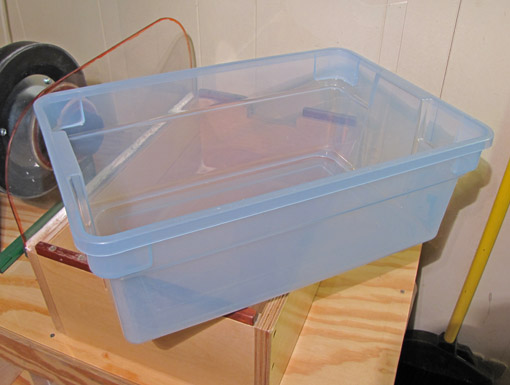
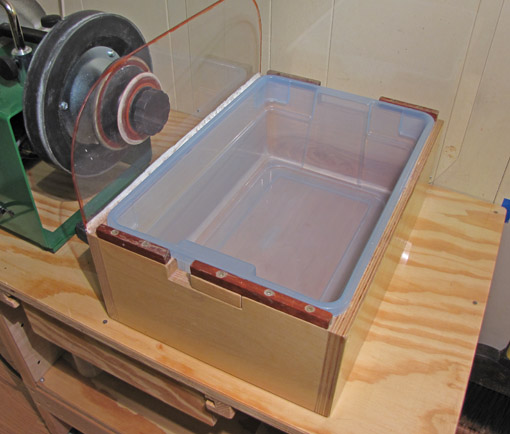
The basic idea is a plastic basin spanned by a bridge that holds the sharpening stone, but the basin is not nearly rigid enough, so a strong box must surround it.

Buy the tub first, then build the box to fit snugly around it. In my setup, I used a sturdy Rubbermaid brand storage container with outside measurements of 15 3/4″ x 10 3/4″ x 5 3/4″ high, including the 1/4″-wide x 1/2″-high lip that surrounds the top edge. The inside dimensions of the box are therefore 15 1/4″ x 10 1/4″, and 5 1/2″ gives a little extra space in height.

IMG_0975_edited-2

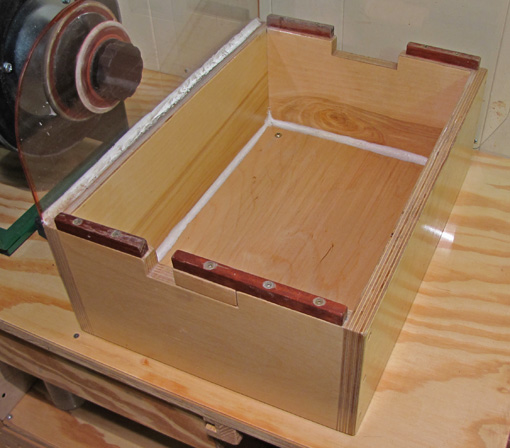
The box is made with butt-jointed 3/4″ plywood sides, and a 1/4″ ply rabbeted bottom, all glued, screwed, and finished with polyurethane. The inside seam where the bottom meets the sides is caulked. A polycarbonate spray shield, attached with screws, covers the left outer side and extends 6 1/4″ above it. The corners are rounded, the edge is made more visible with red marker, and the seam is caulked.

IMG_0974_edited-2

The box is screwed to the benchtop through the inside of the bottom near each corner. It is positioned just 1″ from the front of the benchtop for good ergonomics, with 5″ of handy space to the right.

IMG_0976_edited-2

Note the notches in the front and back walls of the box to permit easy removal of the basin. As you can see, I made them unnecessarily large and had to insert a patch at the front to extend the area where the bridge could grip.

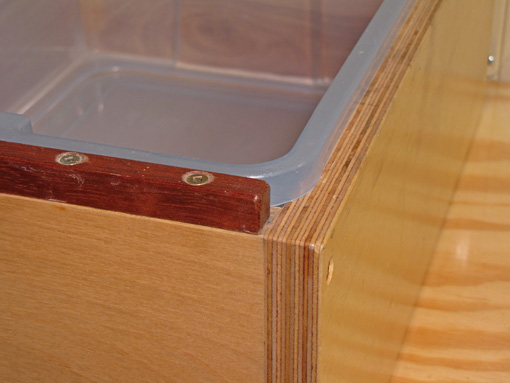
The bridge must rest on a rock-solid footing, not the top edge of the basin, so hardwood risers, 3/8″ wide and slightly more than 1/2″ high, are screwed to the top edges of the box at the front and back. It is important that they are proud of the top edge of the basin and slightly shy of the outer walls of the box.

IMG_0978_edited-2

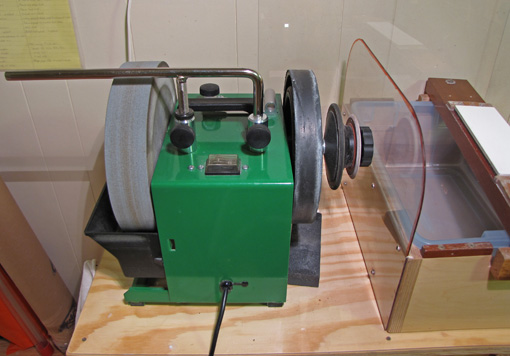
There is still plenty of room for the Tormek on the left side of the bench.

IMG_0984_edited-2

Next: the details of the bridge that holds the sharpening stones.

Category: Jigs and Fixtures  | Tags:  | Comments off
Author:
• Thursday, March 14th, 2013

IMG_0968_edited-2

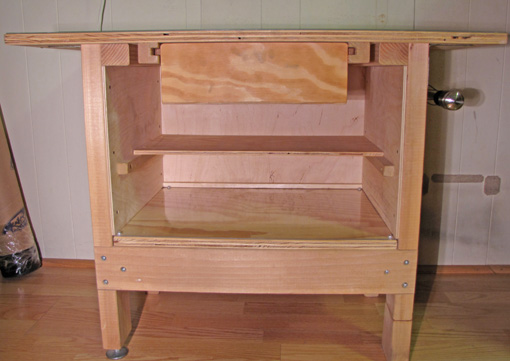
The base frame is 23 7/8″ wide, 15 3/8″ deep, and 24 1/2″ high, built using the straightest, driest, clearest 2x4s I could find at the local home center.

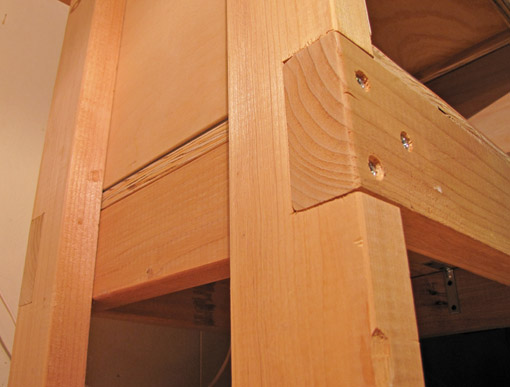
The lower front and back rails are notched into the legs. The lower side rails are simply butt-jointed and screwed from the outside to the front rails, and from the inside to the legs. Use glue and #12 or #10 x 3″ deep-thread screws. A leveler is installed on the front left leg.

The spliced sections on the lower right legs are evidence of some of the evolution of the bench. There had been heavy-duty locking casters there, but I found I did not need them, and they slightly decreased the rigidity of the structure.

The 2×4 upper side rails are notched into their widths to accept the tops of the legs, and are glued and screwed in place. There are no front or back top rails. The back and sides are closed in with sturdy 1/4″ 5-ply, glued and screwed to the 2x4s for rigidity.

IMG_0969_edited-2

The top measures 33 7/8″ wide x 19 1/2″ deep, and is centered laterally but overhangs the front of the frame by only 1″. The surface of the lower shelf is 10 1/2″ above the floor. Both are 3/4″ exterior-grade SYP 5-ply attached with strong steel L-brackets. The top is also screwed to the upper side rails from underneath.

An important feature is the 3/32″ polycarbonate sheet over the top and lower shelf to protect them from water. (I use waterstones, but the surfaces should be likewise protected from oil if you use oilstones.) Acrylic can also be used. The top sheet is secured with small stainless steel flat-head wood screws, carefully countersunk, which is nicer than the round head aluminum screws and tiny rubber washers that I used for the lower shelf.

The upper (inner) shelf, 3/8″ 3-ply, is spaced 5 1/8″ above the lower shelf and is 10″ deep. It is screwed to simple side supports that are screwed all the way through into the legs.

The top surface of this sharpening bench is 25 1/4″ above the floor. This is what works for me (at 5’9″) with the box-basin-bridge apparatus (which I will detail later) for hand sharpening, and the Tormek machine. I can work comfortably, bringing body weight to bear as needed.

The height is a critical issue, but everyone is different and so you must decide what will work for you. I suggest, as the most reliable approach, going through the same sort of process that I have recommended for deciding on a workbench height. Yet, if after building and then using your bench for a while, you find that you misjudged, don’t worry, you can always shorten the legs or even splice on some extra.

The drawer is 15 3/8″ deep overall with a 12 1/2″ wide x 4 1/8″ high front. The construction is simple rabbet and groove using exterior plywood, glued and screwed. The front and back are 3/4″ thick, the sides 1/2″, and the bottom 3/8″. Inside depth is 3 3/16″. The drawer is side-hung, using 1/2″ x 1/2″ cherry rails that fit in matching grooves in the 1 3/8″-square oak supports, which are screwed to the top from underneath.

Go heavy duty on everything with this. This sharpening bench is the type of tough, practical, non-fussy shop fixture that I like. I think it also has its own rugged good looks that fit in well in a woodshop.

Next: the box, basin, and stone-holding bridge apparatus.

Author:
• Wednesday, March 13th, 2013

IMG_0971_edited-2

Sharpening is such an important part of woodworking that it deserves its own place in the shop. A dedicated bench is made with features conducive to efficient sharpening, such as an ideal height, just as your workbench is designed for efficient woodworking. Furthermore, bringing sharpening gear onto the main workbench interrupts the workflow of a project, and can create considerable mess where you do not want it.

In this series of posts, I will discuss my sharpening bench and setup, the product of many years of evolution, which I have been using in essentially its present state for about ten years. It works well for me but I hasten to add that there are lots of good ways to do these things. This series may be the source of only a single handy tip, or you may want to duplicate the entire setup.

Let’s start with the bench itself. The key features are:

  • It’s compact, with a projected footprint of only 4.5 square feet.
  • Very rigid and strong, it does not move or wobble when sharpening.
  • There is storage for all sharpening paraphernalia.
  • It is inexpensive and easy to build.
  • Most important, it is suited to the task.

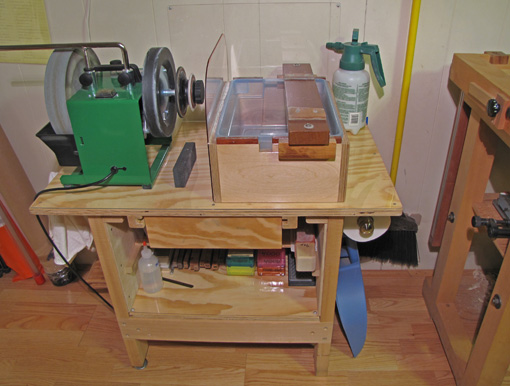
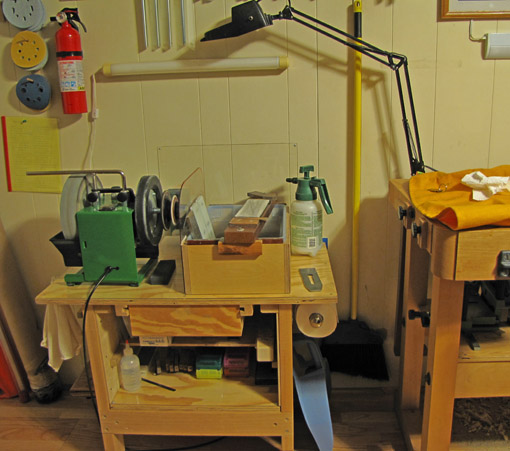
The photo above shows the sharpening bench in its inactive state, nice and neat, though minus the Tormek’s cover. The edge of the tabletop is only 8 inches to the left of the woodworking bench.

Good lighting, an absolute must, is supplied by a fixture above the bench on the wall (just out of range of the photo), and by moving an articulated-arm lamp (with a large magnifying lens) into the workbench’s left-side shop-made bracket (visible near the corner of the woodworking bench).

Water is imported from a nearby bathroom using the pump sprayer bottle, seen on the right. The rear wall is protected from overspray and splashes by a polycarbonate (or acrylic) plate. Paper towels are close by on a dispenser on the right side of the bench, and there is a hook for rags on the left. A scraper/small saw vise is barely visible hung on the left side, in the back.

The yellow paper with a plastic report cover, tacked to the wall on the left, is my sharpening “recipe” sheet.

Thus, when standing in front of this bench, everything is at hand. True, I’d still rather be working wood, but I am ready to sharpen!

In the next post, I’ll discuss the details of the design and construction of the main unit. Later, I’ll cover the box-basin, and the various functionalities of the setup.

Author:
• Tuesday, September 18th, 2012

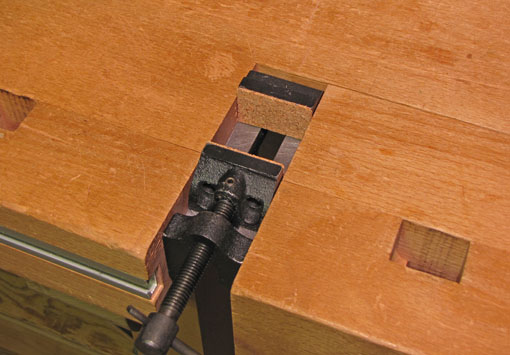
Ulmia used to make a small vise that could, among other uses, be held in the workbench tail vise to hold small or thin work pieces. It is Ulmia model #1812 “Hilfs-Spannstock” (auxiliary vise). [Note: one of the vise jaws is stamped “LSP-2816-4” and the other “LSP-2817-4” but I don’t think those are model numbers.] It can be seen in The Fine Art of Cabinetmaking, section 3, where the author, James Krenov, discusses Japanese saws (page 145 in my copy, the 1977 Van Nostrand Reinhold hardcover edition). I use two alternatives, neither quite as elegant as the Ulmia, but handy nonetheless since they hold small pieces of wood that would otherwise be problematic to work on.

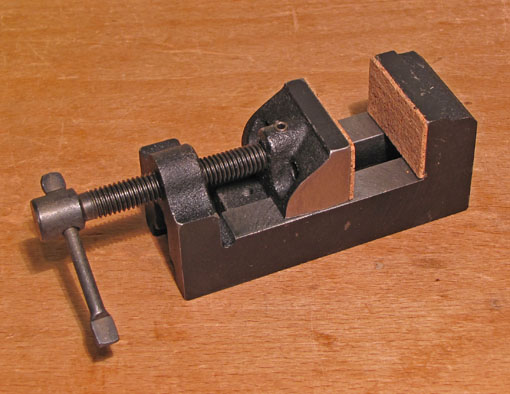
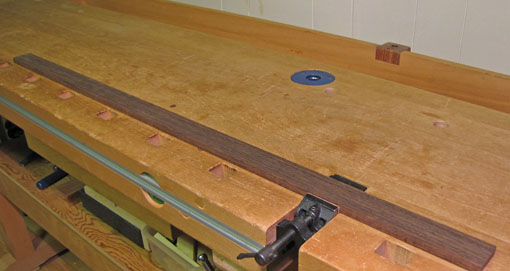
The first option is strorebought, quick, easy, and cheap. (How do like it so far?) Pictured above, it is a drill press vise (MSC #56451263, $21.32), 5″ long, with 1 1/2″ wide jaws. I filed the sides of the moveable jaw so it would move freely when clamped in the tail vise, and replaced the steel jaw faces with very thin corkIt is clamped in the tail vise with the jaws projecting enough above the level of the bench top to securely hold the work piece but below the level of the top surface of the work, so as not to interfere with a plane, chisel, scraper, or other tool.

Unlike the Ulmia, the screw feeds through a threaded portion of the base structure, and thus it projects outward as the vise is opened. This is why I chose the 5″ model over the 7 1/2″ model which, though it has a larger capacity, would tend to get in my way. The Ulmia’s moveable jaw is itself threaded underneath, so the knob remains stationary as the jaw is moved in either direction. There are more expensive precision-made drill press vises available but this one does the job just fine.

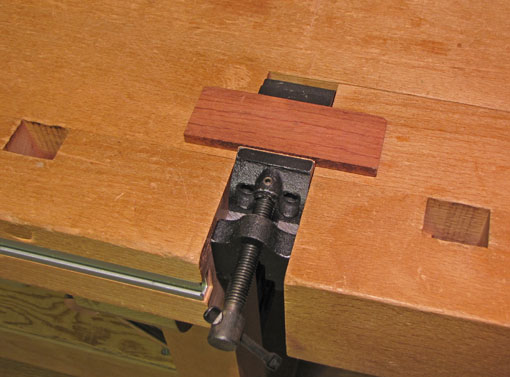
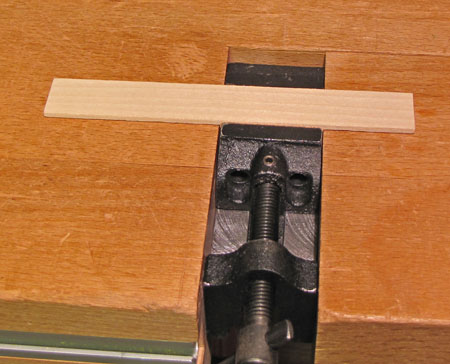
Below are some examples of what it can hold. The piece of maple in the second photo is less than 1/8″ thick.


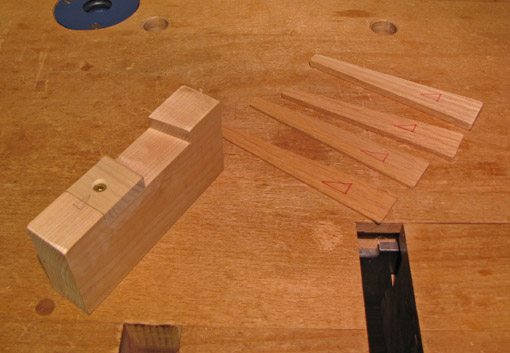
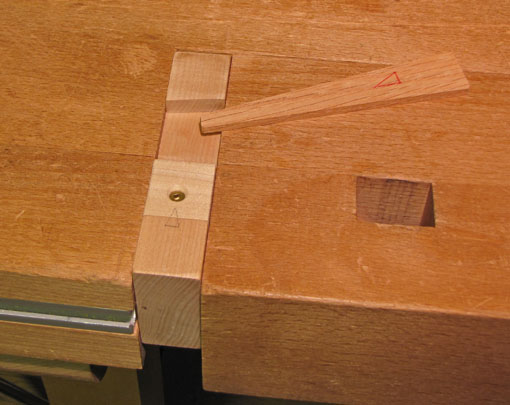
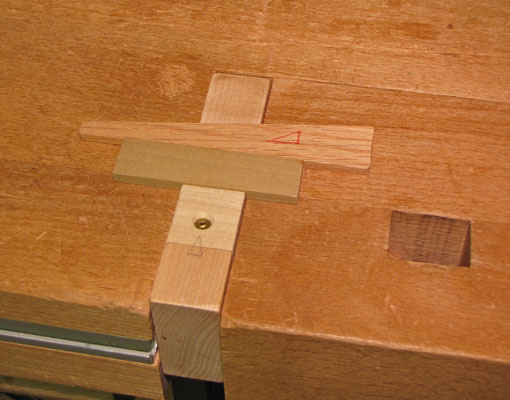
The second option is shop-made, fairly quick and easy, but costs next-to-nothing. (How’s that?) It is simply a 4 1/2″ x 2 1/4″ x 1″ block of hardwood with a 3/8″-deep recess with a 1:7 angled border. It is held in the tail vise with some of the recess projecting above the level of the bench top. A tap on a wedge of the appropriate thickness holds the work piece, tightening further as you push a plane on the work piece. Note the removable spacer, held by a screw, which can expand the width capacity of the vise. [My article in the November 2007 Popular Woodworking shows this and many other shop-made workbench accessories.]

 Here it is, set up:

And, in use:

As always, I hope these tips will help you build things in your shop, and have a great time doing it!

Author:
• Sunday, January 29th, 2012

There are lots of ways to store hand tools. Among these are drawers and cabinets under the workbench, open shelves and pegboard systems, a large lidded joiner’s chest, Gerstner-style chests, steel mechanic’s chests, and wall cabinets. Some woodworkers may even feel comfortable with their tools simply scattered about the shop and constantly shifting places.

Why store your tools in an enclosed unit? Tools work best when they are kept free of debris and rust. An ordered, safe place for tools improves your efficiency. In short, your tools are valuable and deserve their own place.

This series has described my approach; it works for me. It is neither perfect nor original, but it does have a solid rationale and will hopefully be useful for ideas as readers make or alter their own set ups.

Here is a summary of the underlying concepts in this tool cabinet.

1. Space economy:

  • Small footprint; use of airspace (For me, this is the biggest advantage of this design.)
  • Outer surfaces, top, and stand are put to use
  • Efficient use of room inside the cabinet

2. Accessibility and convenience:

  • Majority of tools can be reached directly without shifting other tools out of the way
  • Little or no bending
  • The cabinet is placed next to the workbench
  • Wide-open presentation of the tools provides mental access to them
  • No need to use separate saw guards and tool sheaths

3. Flexibility:

  • Layout is easily changed as tools are added or retired
  • Generally logical storage
  • Storage conflicts are resolved based on the frequency of use and protection required by the tool 

4. Practical:

  • Simple, undandified aesthetic
  • Simple construction
  • Inexpensive
  • Durable

This tool cabinet with its many features substantially adds to my ease and clarity in the shop. Most important is to set up your tool cabinet and your shop to suit, to the extent possible, how you prefer to work. In this way your environment contributes to your ease and efficiency, and ultimately, to the quality and joy of your work.

Author:
• Thursday, January 26th, 2012

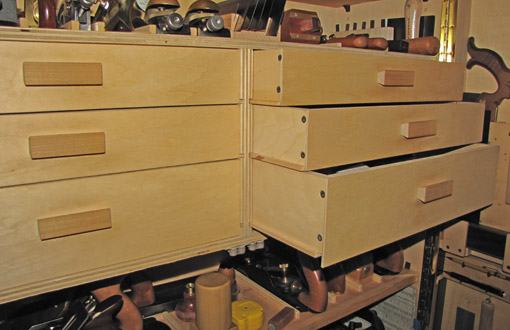
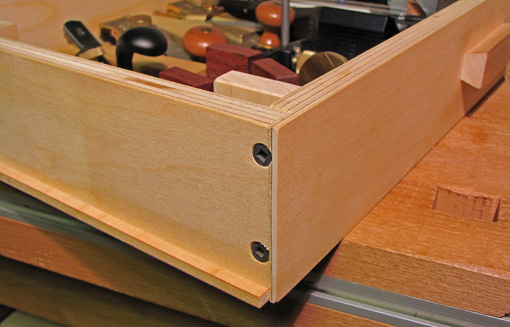
The six drawers are very simply constructed. Half-inch poplar 5-ply is used for the front, sides, and back, and 1/4″ maple-faced plywood for the bottom. The sides and bottom are glued and screwed into rabbets in the front piece. The back is butt-jointed to the sides. The bottom extends out from the sides and is screwed to the sides and back from underneath.

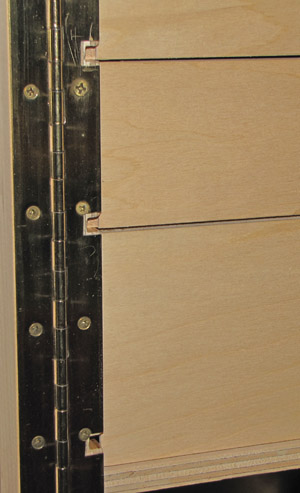
The bottom runs, with a little paraffin, in 1/4″ x 1/4″ dadoes in the cabinet side and the center partition. The piano hinges get in the way of the dado but no problem, just hacksaw out tiny squares in the hinge to clear the way. The drawers have not failed in 25 years. 

Let’s take a look inside.

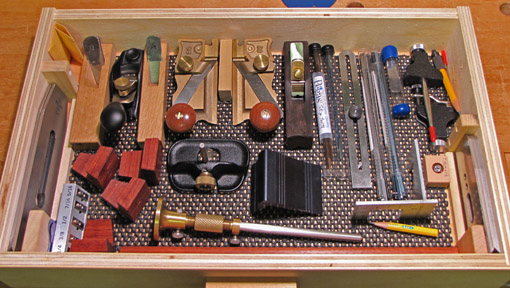
The upper right drawer contains small planes, layout tools, and coping and fret saw blades. Notice the compartments on each side for plane blades, pairs of which are stored with their beveled faces together. The bottom of the drawer is lined with Zerust material, a soft rubbery mesh which emits harmless corrosion-inhibiting vapor. This material is grippy like a router mat and so prevents tools from shifting, bumping, and rattling when the drawer is open and closed. It lines all the drawers.

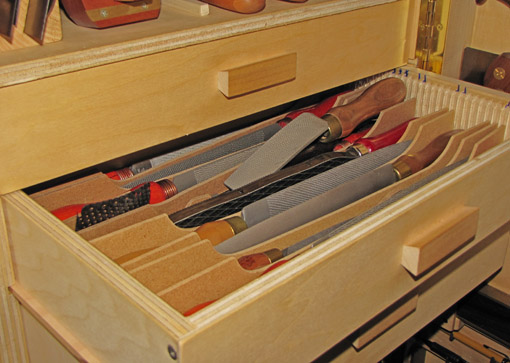
Next below, the rasp drawer is the most engineered of the group. 1/8th-inch MDF slats are held in the slots of stick-on plastic divider holders. The spaces so constructed are wide at one end and narrow at the other to make maximum use of the room in the drawer. The divisions can easily be rearranged and, of course, have been many times. 

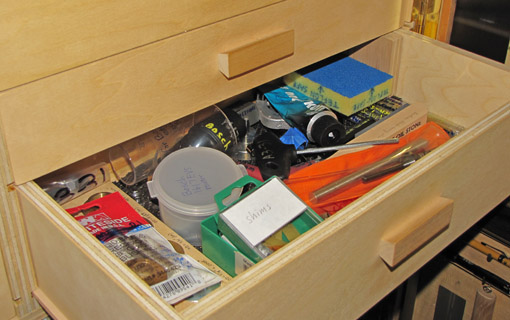
Next below is the most jumbled drawer containing machine accessories such as wrenches, tiny parts, router template bushings, and so forth. The top drawer contains sets of coping and fret saw blades (hand tools) in plastic tubes, but this drawer has power jig saw blades in the same type of tubes. This is an example of my preference to group tools by general class, when practical.  

The three drawers on the left side also each contain logically grouped tools. The top left drawer has metal files, small diamond hones, metal cutters, and so forth, while the drawer below it has adjustable Starrett squares and other layout tools, and below that are drilling accessories.

The storage – divided or free-form – is appropriate to the tools. Thus, spanner wrenches get jumbled together, tiny shims get stored in a plastic box, while edge tools, rasps, and precision layout tools get the protection they need.

Next: summary and conclusions.