Archive for the Category ◊ Ideas ◊

Author:
• Tuesday, February 23rd, 2010

Remember the old joke about the lost tourist in New York City who asks a local, “How do I get to Carnegie Hall?” The reply: “practice, practice . . .”

I am sometimes asked by novice woodworkers how best to acquire and practice skills. Well, aside from exploiting the myriad sources in media and in person, one must get into the shop, practice, and make sawdust. The inquiry truly applies to woodworkers at all general skill levels who are broadening or deepening their involvement in the craft. Woodworking is a vast field and no one is an expert at all phases, so skill acquisition is an ongoing issue for all of us. 

Here is my suggested approach. Let’s say one wants to learn hand cut dovetailing. I would start with isolating the process. Prepare some short pieces of easy-going poplar and cut joints. Ponder and practice layout, sawing to lines, chopping, and so forth. Think about what went wrong, tune your tools, test the limits of accuracy, and experiment. This is like practicing scales in learning a musical instrument. I would not start with a drawer, or even a box, because that creates too many distractions from the core technique.

However, I would soon, very soon, make something with dovetails. It should be a simple, manageable project that might generate some discomfort but not beyond what you feel you can reasonably handle. I would not await perfection in “practicing scales” because there is no such thing, it will be boring, and sooner or later, you have to integrate that core skill into making a bit of music. The music makes the skill meaningful.

So make a little etude piece of woodwork. Simple can be interesting. It will not end up on the back cover of Fine Woodworking. So what. It will contain some mistakes and you won’t be able to correct all of them. So what. It will, however, be yours and will bring you some quiet joy.

Forging ahead, try a small drawer. Now your dovetail “scales” and “etude” experiences will be used to make another box, but this time it will have to fit neatly into a case, which itself will have to be properly constructed if there is to be any chance at all of a good fit. You are integrating skills and they are thus becoming more meaningful.

You will be subtly adapting your dovetail skills to suit a more complex construction. Your designs, aesthetic desires, and the functional requirements of the piece beckon for further refinement of the core skill. Thus you are developing beyond a technician to a craftsman. The music’s beauty is the ultimate impetus to the dance of the fingers on the strings. This is fine woodworking that embraces technique but with a purpose beyond technique: to create a fulfilling piece of personal woodwork.

I think I am a good self-teacher, but at various times I’ve made mistakes at all of these stages. I’ve dwelled too long on isolated technique, overreached in attempting projects I wasn’t ready for, and inhibited my design ideas from fear of breaking new technical ground. That’s the other thing about practicing and getting good at woodworking, you will never stop making mistakes. You will, however, understand them and know what to do despite them.

Happy woodworking indeed!
Category: Ideas  | 9 Comments
Author:
• Sunday, November 15th, 2009

Recognize the date? “The Eagle has landed.” This was a joyous and monumental accomplishment for our country and all humankind.

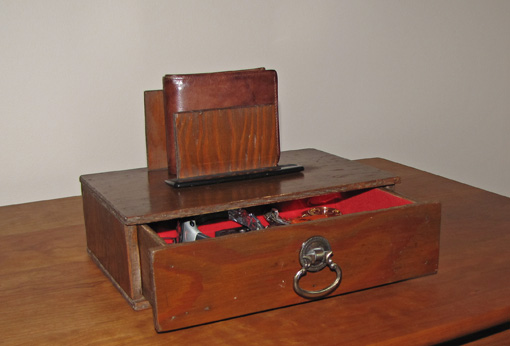
At 14 years old, I had my own little additional private cause for joy that day having finished my first drawer. I knew then, and certainly now, that this crude fir plywood nail-‘em-up dresser valet was a long way from fine craft but the drawer moved in and out and it closed well. It could hold things. I made it.

The drawer and I have survived the ensuing four decades of use. Can’t complain, I suppose.

So, what of the youthful hours spent in the basement messing around with wood and tools, trying to make things? There were boxes, bird feeders, bookcases, tie racks, more boxes, and on and on. (Note to mom: thanks for putting up with sawdust in the laundry room.) It is enough just to have enjoyed the time.

Yet, looking back, there were also lessons learned about planning a project and progressing through the steps, a certain discipline of thought and action. Further, valuable experiences were accumulated: the feel of tools in the hands and of steel on wood, the quirks of wood, and how things can go wrong and right.

Most meaningful, is the honest joy in having an idea and making it simply be there. That and the drawer endure, so I feel very fortunate.

Category: Ideas  | 6 Comments
Author:
• Saturday, October 17th, 2009

You know how it is. You are committed to a project, sweating the details, maybe doubting some design features, maybe doubting the entire aesthetic or structural concept of the project, and wondering whether anyone will ever care about the joint you are fitting or the curve you are shaping. You may wonder if you will later care, or even remember, about a design decision or construction detail that now seems so vexing.

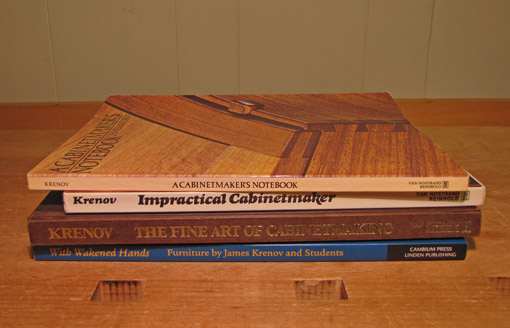
Don’t worry, you care and so do many others who will appreciate your work. This is an important part of Krenov’s message, that your work matters, that it matters to do it well, and that it will be appreciated by not everyone, but enough people to make the effort worthwhile. People can and will discover that “quiet joy.”

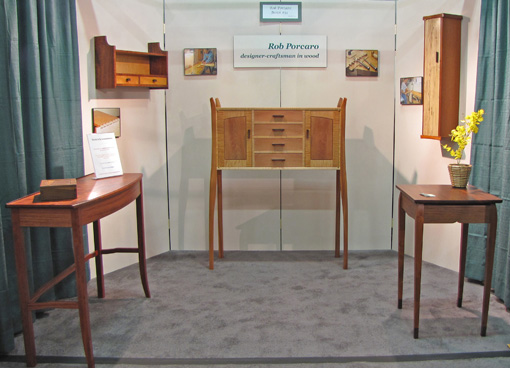
Last week I had the privilege and pleasure to display my work at the Paradise City Arts Festival in Northampton, Massachusetts, a high quality juried show with 260 booths in a variety of craft media including glass, ceramics, jewelry, painting, fiber, wood, and furniture. The three-day show was very well attended, attracting lots of folks with a well-nurtured appreciation of fine craft.

Yes, people notice; they get it. It was exciting to see people running their hands along a curved table leg, inspecting exposed joinery, asking about matching figures in the wood, feeling the gentle action of drawers and door catches, taking in subtle design elements, and so forth. The pieces on which I had lavished mental and physical efforts were now able to stand on their own, to just be what they are with no required annotation or message while people discovered them. In this way, these objects support a meeting of aesthetic minds between maker and appreciator which is gratifying for both.

It is worth staying with it on that project because you and others will share that quiet joy. That is a path to happy woodworking.

Category: Ideas  | 17 Comments
Author:
• Thursday, September 10th, 2009

It is difficult to gather my thoughts and feelings on the occasion of James Krenov’s passing away yesterday. His teachings mean so much to me as they do to so many woodworkers.

James Krenov was pivotal in my coming to embrace the understanding that making fine things from wood, imbued with a personal touch, mattered in this world. I have liked making things in wood since youth, knowing that this was part of me, but beset with the refrain that it might be little more than self-indulgent puttering. Jim Krenov’s clear and independent spirit, beautifully communicated through his writings and his work, gave me the support to see the value in what I was trying to do.

So many times I go into the shop accompanied by Krenov’s voice, reminding me that the work is worth doing well because it can have meaning to me and to others, and creates a quiet joy that enriches our lives. It is about connecting with one’s soul and seeing the real value in the process and the product. I think that is truly happy woodworking.

There is a beautiful and profound life that harbors in the wood we love. There is also a special life in the little objects we make. For me, as for so many woodworkers, an important part of that vitality comes from the enduring spiritual contribution of James Krenov. I am very grateful. Farewell JK, long live your spirit.

Category: Ideas  | 8 Comments
Author:
• Sunday, September 06th, 2009

[Note to Heartwood readers: the series on drawer making has a few more entries on the way.]

This is the time of year when NFL rosters get pared down to the final 53 players. It is often reported how veteran players attribute much of their success to the unspectacular but important training, preparation, and performance principles that promote survival in the extremely competitive league. These are not matters of specific football technique, but rather are work habits that allow their physical abilities and football skills to flourish.

Sure, I have relentlessly gleaned woodworking understanding and technique from countless sources over several decades. I love learning. Yet there are mundane shop work habits, borrowed or discovered, that I have come to value as equally important. Readers, let me share with you just some of the things about which I’ve had to “get my mind right.”

1. Know, don’t hope, what a process will yield. When bringing steel to wood while building a project, it should be clear to you what the result will be. Your hand may wander, your line may be a bit off, but there must be reliable intent and integrity in the process before you start. This allows the craftsperson to work with confidence and relaxation. For example, if you find yourself thinking, “Maybe if I feed the router this way, it might cut OK,” it’s time to step back and rethink.

2. Be neither blind to innovation nor saddled with doubt. Trial runs and testing are useful, especially for unfamiliar processes, but give yourself credit for what you already know. While there are almost always several ways to get a result, if you have learned a good, efficient method, go with it and get the job done.

3. When constructing multiple parts, it is often helpful to carry the process to completion on one part to see how early steps influence later results. This gives you a chance to modify steps to improve the final product. It often helps, therefore, to make an extra part.

4. Before leaving the shop for the day, note where you left off, perhaps write it down, so when you return you can resume work without hesitation. For example, “drawers fit, no more trimming.”

5. Put away tools when a job is done. Keep your bench and mind clear.

6. A process in one wood may not work well in a different species or even a different board of the same species. Remember, wood is a biological product, it varies. Making a mortise and tenon in bubinga feels different from making the same joint in pine.

7. Attempt to cut to the line while knowing what happens if you are off on one side or the other. Leaving large margins of safety because you’ll “make it exact later” is a way to never get good at woodworking. Go for it. If you make a mistake, relax.

8. Creating useful and beautiful things from wood is one of the fine things in life. Be grateful, be humble, give thanks.

Happy woodworking!

Category: Ideas  | Tags:  | 4 Comments
Author:
• Saturday, June 27th, 2009

What can someone who just likes making things out of wood humbly learn from a musical genius like Beethoven? I remember reading many years ago a quote by Beethoven that struck me with its depiction of his invincible creativity:

I carry my thoughts about me for a long time, often a very long time, before I write them down… I change many things, discard, and try again until I am satisfied. Then, however, there begins in my head the development in every direction, and, inasmuch as I know exactly what I want, the fundamental idea never deserts me, – it arises before me, grows, – I see and hear the picture in all its extent and dimensions stand before my mind like a cast, and there remains nothing for me but the labor of writing it down…

“my ideas…sound, and roar and storm about me until I have set them down in notes.”

What does this have to do with our little world of saws, planes, and wood? I feel that the really difficult, critical aspects of making a woodworking project are consistency and veracity in design and workmanship – the long line. Success comes from keeping sight of the “fundamental idea,” which one hopes and believes is a good one, through the many steps of a project, while bringing forth the commensurate breadth and depth of technique to render it.

This applies to not only a big project or a tour de force of design and technique, but as well to simple, modest work done satisfyingly well. David Pye, in The Nature and Art of Workmanship, states “Regulated workmanship means workmanship where the achievement appears to correspond exactly with the idea”. The force and clarity of the idea must drive its fulfillment. This is not an easy task.

There’s no delusion of grandeur here; this woodworker is not a speck of a Beethoven. Nevertheless, I do like to make things out of wood, to have an idea and make it be there.

Yea, that’s happy woodworking. Best wishes for your ideas.

Category: Ideas  | 4 Comments
Author:
• Friday, June 19th, 2009

What follows are thoughts conjured up while, or recovered from, sweeping the shop floor. Maybe you can relate.

  • Why are so many home shops relegated to the basements? You love woodworking, bring it up to ground level. It is more important than the TV, which somehow seems to always get its own room with a window.
  • Perhaps like many readers here, I started making things from wood because the material is easy to cut, firm enough to be structural, and seems so friendly and harmless, only later discovering its variety and beauty. I would probably like making things from any material, but I cannot resist making things out of wood.
  • We woodworkers are too often deferential to speculative examination of historical work to decide technical issues when the answer may be found with modern, orderly testing and inquiry.
  • Making a one-of-a-kind piece is far more mentally taxing than the easy rhythm of knowing you have previously worked through an entire process, and thus can be fully confident of an outcome that is always in sight. However, new designs are exciting and edifying.
  • I think I may, at some point, acquire “enough” clamps. I am sure, however, that I will never have enough wood.
  • “Dead on”, “dead flat”, and the like, mean to me that the manufacturer doesn’t want to tell you its tolerances. And if a tool needs to be “dead on” (no such thing), shouldn’t I want to know the tolerances?
  • Fine quality wood craftsmanship is financially undervalued. Woodworkers need to better communicate the value of our product. It would be nice if our creations spoke for themselves but it is not enough.
  • Isn’t it exciting that this is the best time in history to obtain high quality woodworking hand tools? What a difference from, say, 20 years ago. And it keeps getting better.

Happy woodworking! And thanks for reading.

Category: Ideas  | 8 Comments
Author:
• Friday, March 20th, 2009

I enjoy watching the Science Channel television program “How It’s Made”. There is amazing ingenuity and capital investment involved in producing almost all of the human-made things around us. Most of the items the show demonstrates could not be produced at all without sophisticated machinery, and certainly not cheaply enough for practical mass consumption. This is the means by which we get our stuff in today’s world and we can be grateful for what we have earned with technology.

As I sit watching robotic arms assembling a construction vehicle, I wonder where we small scale woodworkers and our products fit into this world. Is our work a quaintness for a few owners to appreciate only in passing, without the consequence of “necessities”? Do we use our method of production, a small shop using small machinery and hand tools, only because there is maybe so little demand for our products, or perhaps because we have not bothered to find a more efficient way to produce? In short, does our work matter, and why?

Yes it matters, because our work is personal, in vision and execution. Our small shop methods are vital because they allow personalization in design, workmanship, and detailing. A craftsman’s work is his song, that he sings, and people appreciate and value it as that.

A modern person is likely to own only a few things of which he knows who is the designer-maker, the person, not just a label or a company. That personal identification and connection make these among the most cherished possessions. That chair, for example, is not any chair, however elegant, it’s a Maloof chair. The table that you, my fellow woodworker, made for yourself or a client will forever be your table, linked to you, with your name on it. A client owner knows exactly from whence it came, perhaps even playing a role in its design, and values this distinction.

That is what we small shop craftsmen have to put forth and, I believe, will never become obsolete. On the contrary, this offering will be increasingly valued in a world filled with growing numbers of nameless technological wonders. Personal woodworking – it matters.

Category: Ideas  | 3 Comments