Archive for the Category ◊ Tools and Shop ◊

Author:
• Wednesday, April 04th, 2012

This installment of the Q&A features questions from readers about shop electrical supply, convex-sole planes, gel varnishes, ripping, and Claro walnut.

A woodworker who is planning a new small shop is considering how much and what type of juice to have the electrician wire into it. Here’s what I use in my little playpen and why.

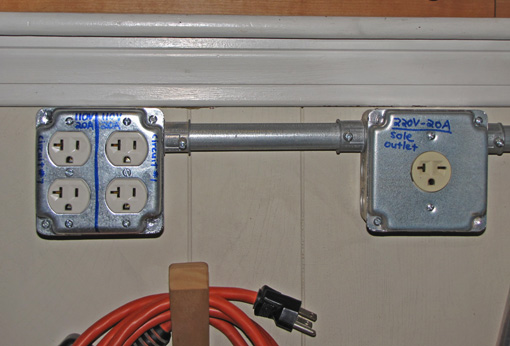
The pre-existing wimpy household 110V-15A wiring takes care of shop lighting and a few other small items such as a battery charger. Then there is a 220V-20A line with a single receptacle. This runs the bandsaw, table saw, and jointer-planer; one machine at a time, of course, because there’s only one guy in the shop. A 220V-15A line would not reliably handle a surge from the jointer-planer rated at 14A or the cabinet saw at 13A. There are also two 110V-20A lines, each with a pair of receptacles. Two lines are necessary to run the DW735 at 15A along with the dust collector at 16A. This also accommodates any portable power tool that I own along with the Fein shop vac.

It pays to plan carefully for the shop you have now and for the shop you aspire to. I think I’ll never need more juice than this in my one-man small shop.

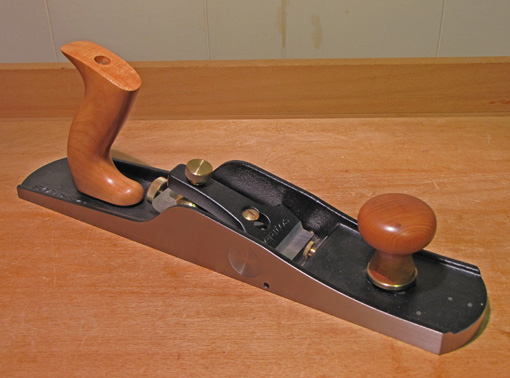
A woodworker planning to make a coopered door inquires about options in planes with the sole and blade convex across their widths. The radius of the blade needs to be just a bit smaller than the curve it planes. Calculating an example, a 14″ wide door with a curve depth of 2″ has a radius of 13.25″. A 1-1/2″ wide plane blade of this radius will have a curve depth of 0.02″. Taking into account the effect of the blade bedded at 45 degrees (formula here), the blade must be cambered .03″, or about 1/32″. A tiny bit more depth than that will keep the outer corners of the blade clear of the wood and enhance control.

For this, my solution is to take any small wooden plane and camber the blade, and shape the sole to match it. Test and adjust. One nice option might be to get a Krenov style plane kit from Ron Hock and alter it accordingly. A Japanese convex sole plane is a more expensive option that is not tailored to the specific task, and is likely to be too curved for it.

I was a fan of Bartley’s gel varnish, which is no longer available as far as I know. A few questions came in regarding alternatives. Here are three:

A reader asked about my preferences in handsaws for long rips. My preference is the bandsaw, the “hand tool with a motor.” In most cases, I see no particular virtue in sweating out a long rip by hand, but the Disston D-7 is my weapon of choice if I really want to commune with the wood.

Speaking of communing with wood, I’ll hang out with Claro walnut any day. A reader wonders what woods might make a good combination with Claro. Of course, this is personal preference, but consider pear. The pink blush of pear seems to bring out the red hues in Claro, and its fine, delicate texture contrasts with the moderately open-grain nature of Claro. Unity and variety, right Mr Heath?

One combination that might seem promising but falls flat to my eye, is walnut and cherry. Maple and walnut usually don’t seem to work together. Claro and zebrawood look cool together, and ash also has potential with Claro. Just opinions.

Email questions (see the About page) and I’ll try to answer as time permits. Thanks, and happy woodworking.
Category: Tools and Shop  | 2 Comments
Author:
• Tuesday, March 20th, 2012

Here are the other rasps that have been useful in my work. There are, of course, many more specialty rasps available than discussed here. Hopefully, you will have the opportunity to use high quality rasps that are suited for your work.

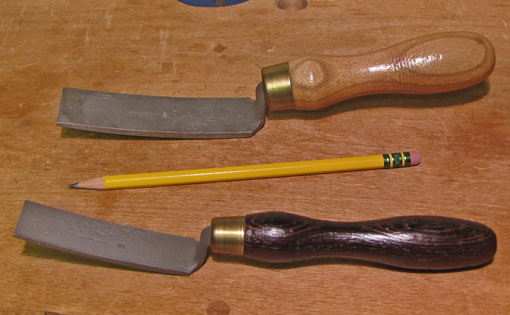
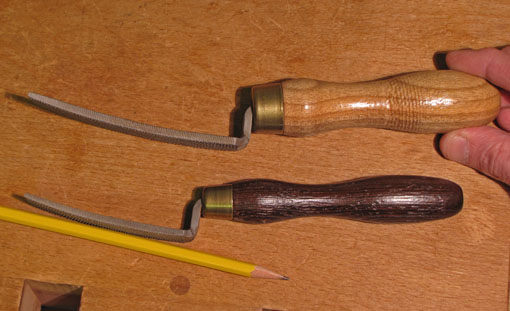
For the enjoyable work of shaping table legs, the Auriou curved “ironing” rasps have been very helpful. Pictured are the larger #8 grain, 1-1/8″ wide, and the #10 grain, 3/4″ wide. (I do not see the #8 grain available now, but there is a #9.) This type of rasp has a shallow curve along its length, useful for the gradual concave curves found in legs and other work. These smooth-cutting tools give excellent feedback to the hand when fairing curves.

Half-round rasps can be used to fair these curves but there are some disadvantages. As the convex face of the rasp is angled to the length of the leg, the contact profile is asymmetrical and often becomes confusing to feel. Also, there is less contact length, somewhat like a short-soled plane, and this makes it harder to feel the lumps and bumps that must be removed to fair the curve. There is also more tendency to tear the wood fibers. Do not be tempted to hold the rasp almost parallel perpendicular to the length of the leg because the teeth will slice the wood like tiny knives, you will not be able to control the rasp well, and deep scratches will be created; not how a rasp should cut.

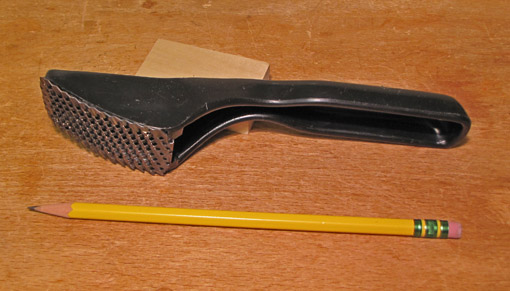
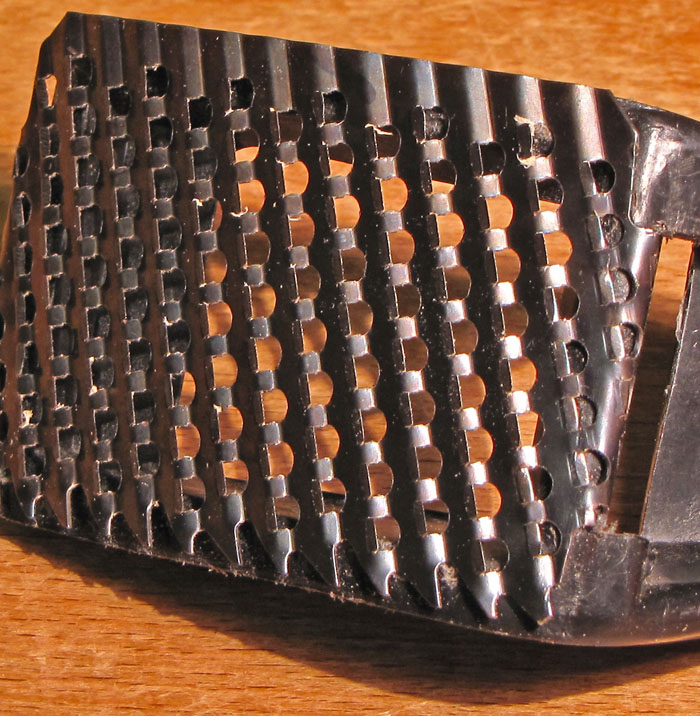
Now, let’s say you’re at the bandsaw and both your mind and the cut wander, hopefully on the safe side of the line, and you end up with a lump on your otherwise nice leg. Hack it down with this beast, the Surform shaver. Don’t expect a lot of control or a uniform surface, but it is cheap and works quickly.

Click the thumbnail below to enlarge.

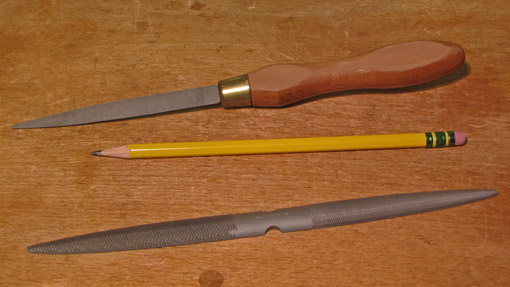
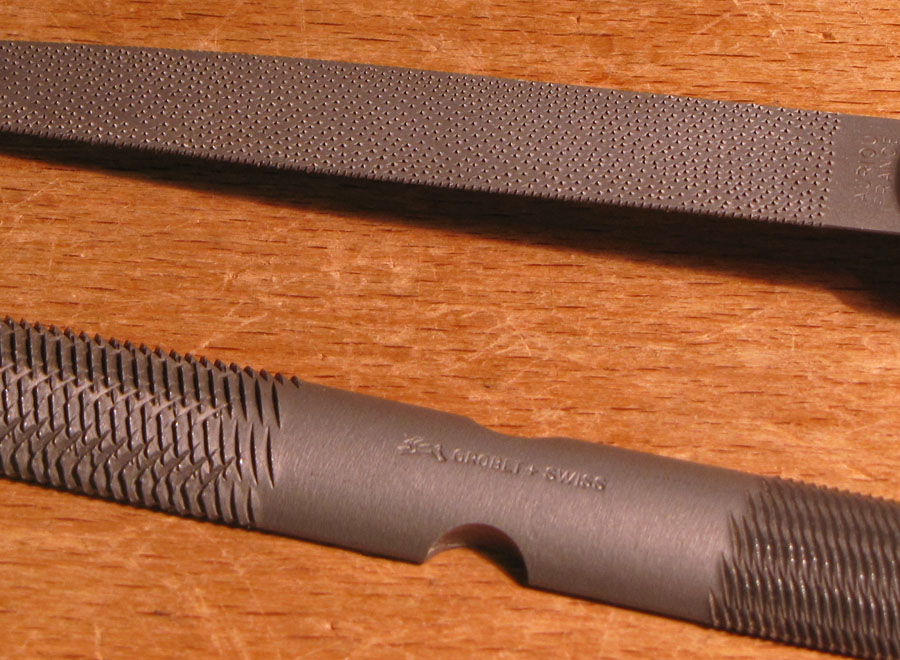
Returning to refined tools, for detail work, the Auriou #14 grain modeler’s rasp can be a lifesaver. It is thin and can be exquisitely controlled. It leaves only a very shallow scratch pattern, but can be made to remove wood remarkably fast for its size and grain.

Similarly useful, though a bit less smooth-working, is the Grobet detail file. While not a true rasp, its double-cut file pattern makes it function similar to a rasp. It is also versatile – four faces, flat and convex, each in coarse and fine.

Click the thumbnail below to enlarge.

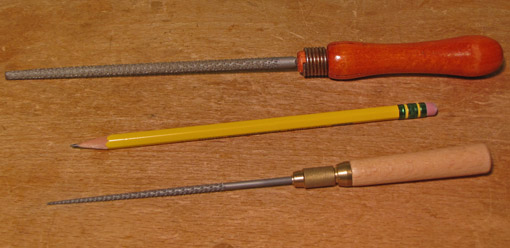
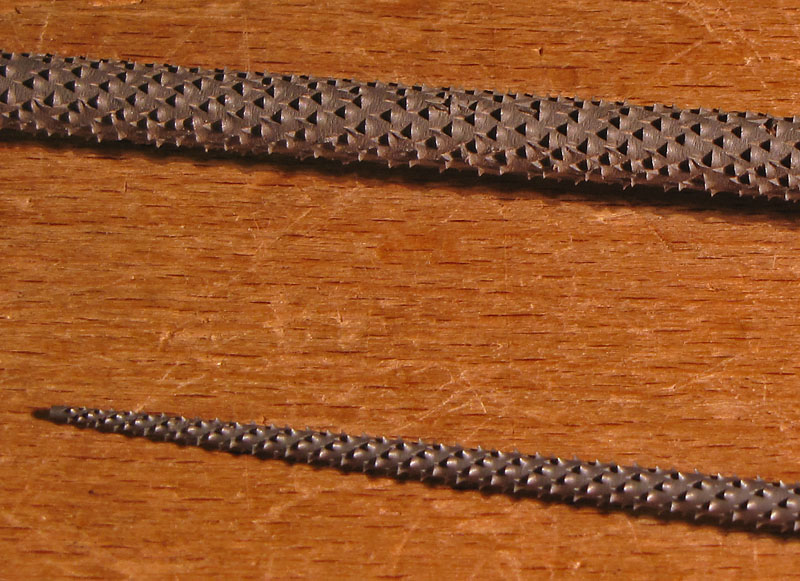
The larger round rasp is an inexpensive model from Lee ValleyThe round needle rasp, made by Corradi, is helpful for various detail work such as enlarging holes. The handle, also from Corradi, has a chuck which allows the rasp to be removed.

Click the thumbnail below to enlarge.

This wraps up the rasp series. I hope it has been helpful. A final thought: it is easy to underestimate the value of a quality rasp. They are not pretty tools, but they can make a big difference in your work.

Author:
• Monday, February 27th, 2012

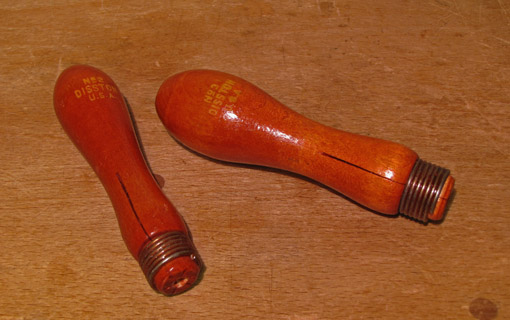
In the two previous posts, note the orange-colored handles on the Nicholson, Corradi, and Iwasaki tools. These are labeled “Disston” but, as far as I can tell, are no longer manufactured. I last bought some at least several years ago, I’ve forgotten from where, and have about eight in use and a few spares. Disston called them “Stronghold” handles as seen in this ad from 1930. They came in five sizes, from #1, the smallest, through #4, and the long, thin #0 for use with taper files for saw sharpening. The #3 is good for a 10″ rasp or file.

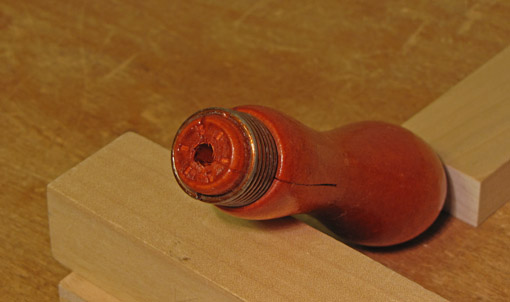
There are three relief slits at the front of the handle which is surrounded by a steel spring ferrule. This construction grips the tang of the rasp well, prevents extension of the built-in slits, and makes the handle reusable because there is some flexibility to the bore. Best of all, these handles feel just right in my hand.

I wonder if one of the hand tool manufacturers such as Lie-Nielsen or Lee Valley would be interested in making these handles if patent issues could be cleared. By the way, I do not have the Disston handles on my Auriou rasps only because I am unable to remove the less comfortable original handles despite lots of pounding.

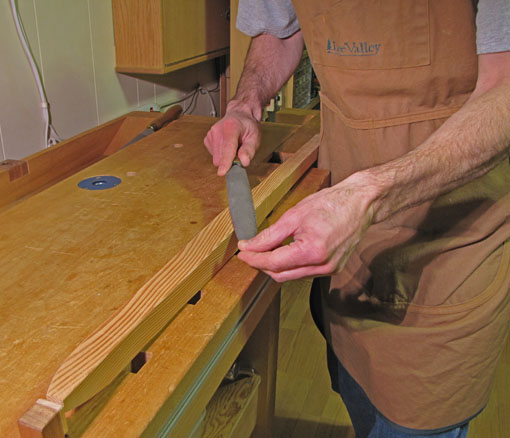
Rasps are used more effectively if one adopts the attitude that this truly is a tool to be used with sensitivity. The rear hand (on the handle) supplies power and direction while the forward hand aids control with a light hold. Push to cut, disengage with a slight lift, retract, and repeat. The rasp is angled to the direction of push (remember the teeth are in diagonal rows), but avoid a pronounced sideways motion which will make the teeth slice into the wood across their width, causing the tool to grab and create deep scratches in the wood.

Adjust your push and pressure to the grade of the selected rasp which is based on the stage of the shaping process. Flip freely from the flat side of the rasp to the convex side depending on the contour of the work. As you get closer to finishing, lighten your touch. Use the weight and stiffness of the tool to sense lump and bump irregularities as you fair the curves of the wood. As with all woodworking, good adjustable lighting helps a lot.

For purchasing 10″ half-round rasps for fine furniture making, the subject of these posts, here are some suggestions. You can try out tools prior to making your choices at shows, some stores, Lie-Nielsen Hand Tool Events, woodworking schools, or your friends’ shops.

  • Low budget: Shinto + one medium lower cost hand-cut or maybe a Nicholson
  • Middle ground: Shinto + one hand-cut such as an Auriou #9 or #11
  • Better still: Shinto + #9 Auriou + #13 Auriou, and use a medium/coarse lower cost rasp that you may have acquired earlier for rougher or less critical work
Next: more rasps
Author:
• Saturday, February 25th, 2012

Moving up the rasp food chain to the hand-cut variety reveals the true capabilities of rasps. These have teeth that are cut (“stitched”) into a polished steel blank by a skilled craftsman using a metal pick and a hammer. The teeth are cut in diagonal rows but the handmade process introduces an important bit of randomness in their placement which creates a tool with control and smoothness in use that is unmatched by machine-made rasps.

It is the feel on the wood and the feedback through the woodworker’s hand which makes these rasps so effective. The teeth cover the surface across the entire width, typically at least 1-1/4″ in a 10″ long model, helping to give a direct sense of where the tool is cutting. Because these tools are used for shaping, their superb sensitivity in the hand is paramount.

There is an increasing number of hand-cut rasps available but I will comment only the Auriou brand which I have used for several years. I use the 10″ #9 and #13, a combination which has been marvelously effective in shaping legs, one of my favorite things to do in the shop. They’re not cheap but have proven well worth the investment. Here are two sources: Lie-Nielsen and TFWW. Here is a close-up of the #9 and #13 teeth. Click to enlarge.

It pays to store rasps so they don’t bang against each other, and keep them clean with the method described here.

Here is a list, not necessarily exhaustive, of other hand cut rasps available. Also, here is a suggestion to Popular Woodworking, Fine Woodworking, and the other woodworking magazines: this would be a good topic review, especially since there is a considerable range of prices. In the meantime, reader comments are welcome.

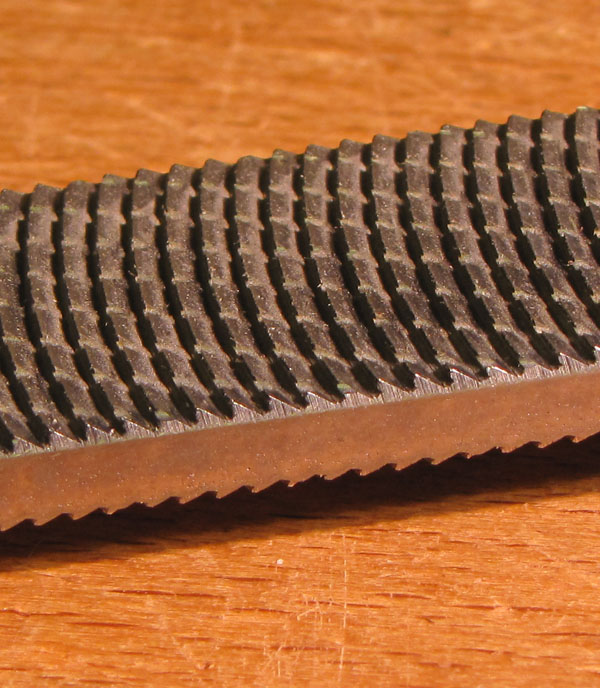
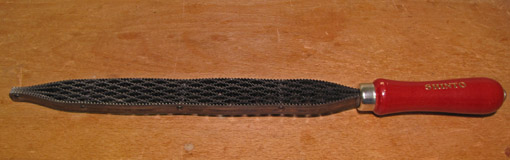
Another tool that is not a conventional rasp but deserves mention in this discussion is the Iwasaki float (“rasp” in at least one catalog) which is effective for shaping. I like my 8″ x 3/4″ “fine” flat Iwasaki. It is essentially a very sharp float with discontinuous arc-shaped teeth, which make the cutting action smoother. When I’ve tried conventional float files on repeated occasions, I found them grabby, though admittedly this was probably due to my inexperience. Nonetheless, the Iwasaki felt good right away.

The Iwasaki is useful in the late stages of shaping to clean up surfaces, and it can even be used to take a bit off tenon cheeks with good control. They are also available in convex profiles. Here is a close up, click to enlarge.

Rasps seem to be looked down upon by some fine woodworkers as less sophisticated than edge tools for shaping. I disagree. I own and use spokeshaves, specialty planes, and gouges. All of these tools have a role in shaping. An excellent quality rasp allows a skilled craftsman to execute just as much control and sensitivity as any of the edge tools. They work!

Next: Disston handles, some technique, and suggested rasp sets to own.

Category: Tools and Shop  | Tags:  | Comments off
Author:
• Sunday, February 19th, 2012

Woodworkers are fortunate now to have many more choices in quality rasps than were available in the recent past. Here we will look primarily at the workhorse configuration found in most furniture makers’ shops, a 10-inch half-round (one flat face and convex across the width of the other) 7/8 to 1-1/4 inches wide.

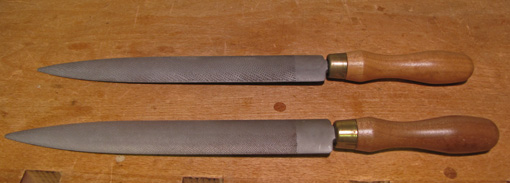
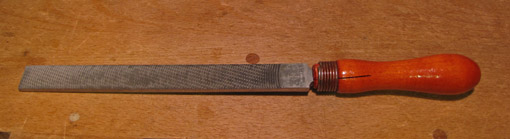
First, let’s dispense with rasps which have their teeth cut by machine in neat rows, sometimes referred to as “wood rasps.” These low-cost hackers should be considered DIY tools unsuited for fine furniture making. The problem is the uniform rows cause too many teeth to catch the wood at the same time and depth, sink in, then come away with an abrupt tearing of the wood. Though this effect can be reduced by angling the rasp and adjusting the stroke, a better solution is to get a better rasp. As an analogy, imagine if raindrops hit you in tight groups of eight, instead of the random scattering of real rain. You get just as wet in both cases, but you would feel intermittent strong impacts in the first case (like uniform rows of teeth), instead of the steady smooth shower of real rain (like quality rasps with irregularly distributed teeth).

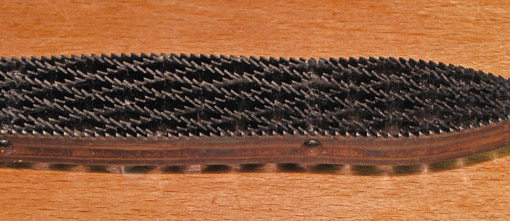
Probably the most bang for the buck (about 25 of ’em) of any shaping tool in the shop is an unusually constructed rasp, the Shinto “saw rasp.” These are made from hard hacksaw-like blades melded together in a pattern that presents irregular phalanxes of teeth to the wood. Both sides are flat, one coarse, one medium. I prefer the model without the auxiliary handle which handles much like a regular rasp. It is a fairly rough tool, but the cutting action is surprisingly controlled. There is very little clogging and the tool lasts seemingly forever. I use mine early in the shaping process, and it is a great tool for mockups. This is also a way to save your best rasps from unnecessary wear. I wish the company made a version with the medium cut convex along the length and/or width.

Now let’s look at two brands of machine-made rasps with irregular tooth distribution, a key factor in producing a controlled smooth cut.

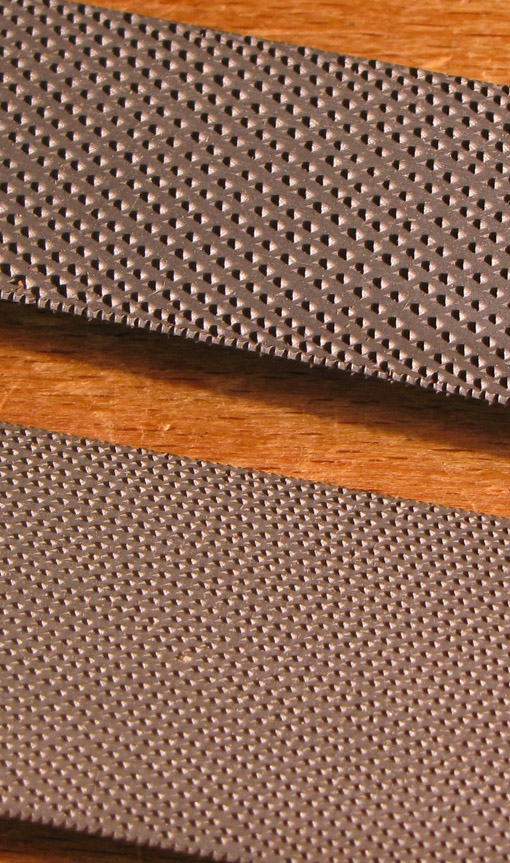
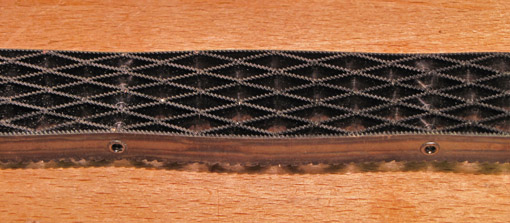
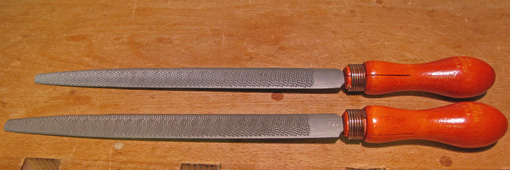
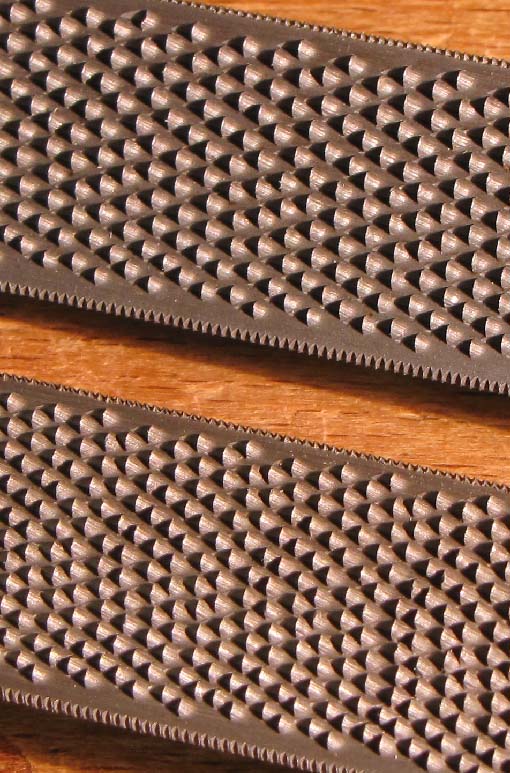
The Nicholson #49, and the slightly finer #50 have been old standbys, and, for a long time, about the only alternative to row-toothed rasps. The current crop, according to what I read, is made in Brazil and the quality has gone down. I still use my old USA-made pair and though they are good rasps, they are not what I reach for first. They are barely 7/8″ wide and teeth do not cover the full width. I prefer a rasp 1 1/4″ wide for general shaping. Though surpassed by better options, especially hand-cut rasps, these still might meet your needs at a low price. I don’t fine much difference in action between the #49 and the #50, so you could do well with just one of them. A close-up of the teeth my #49 and #50 (not the current production), click to enlarge:

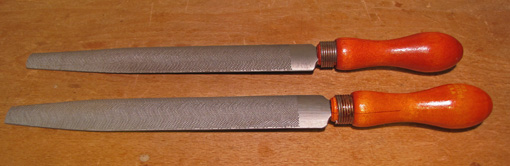
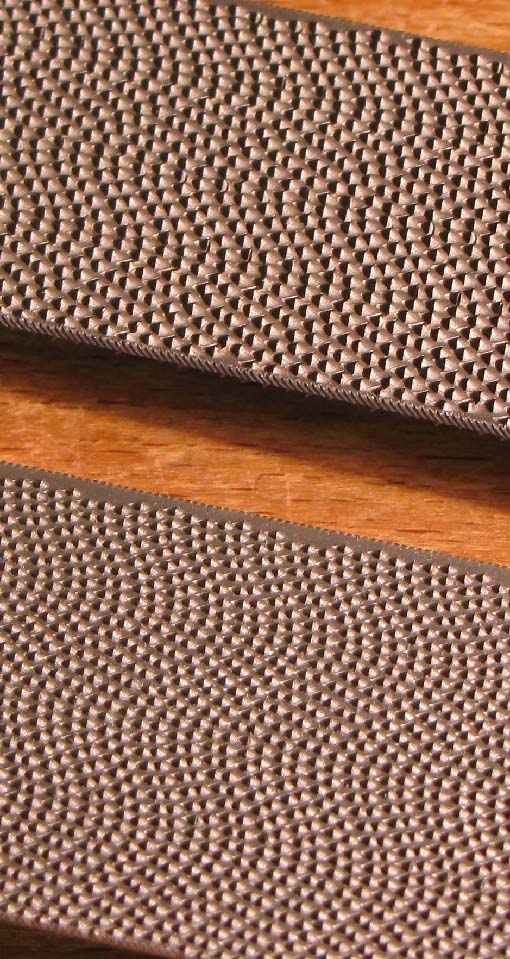
Corradi “Gold” rasps are lesser known but excellent tools which are different in character from any others I know of. The machine cut teeth are densely packed in a wavy pattern which effectively presents the teeth randomly to the wood, giving a very controlled steady cut that feels almost like coarse sandpaper on a stick. My 10″ x 1-1/4″ #8 and finer #10 leave the least scratches of any rasps I’ve ever used. Not particularly aggressive, they come into play in the later stages of shaping. They tend to clog relatively quickly but clear easily. The Corradis have earned a solid role in my work but, as a matter of personal preference, do not have the special feel and feedback of the top-quality handcut rasps. A close-up of the teeth of the Corradi #8 and #10, click to enlarge:

Coming up: handcut rasps, handles, some technique, and more.

Author:
• Saturday, December 31st, 2011

This installment includes questions from readers about the Shelix cutterhead, choosing a plane for shooting, and building a set of tools and skills. Also, several readers have noticed and asked about the tool cabinet in my shop.

I’ve been looking at the Byrd Shelix and can’t decide if I should get it for my 8″ jointer or my DW735 13″ planer. I can’t afford it for both.

The Shelix for the planer is the better option for almost all shops. Here’s why. The main purpose of the jointer is to produce a flat surface and an edge square to it. It does not really need to produce very good surface quality on the face of the board. The jointed face, even if it has tearout and missed areas, will register on the planer bed as the Shelix makes opposite face flat and parallel with excellent surface quality. Once that is done, the board is flipped over and the jointed face is cleaned up with the Shelix.

Tearout is rarely a significant problem when jointing the edge of the board. Even if there are some defects, they should disappear when the edge is handplaned, such as for an edge joint. Jointer defects can also be ripped away on the table saw after you have ripped the second edge parallel.

A segmented cutterhead is not a bad idea for a jointer, but the point is that it is far more valuable on a thickness planer.

By the way, hand planing to flatten the first face of a board too wide for your jointer is not so hard once it is realized that you do not need a perfect surface. You just need a hit-or-miss surface, however ugly, that registers on the planer bed without rocking. Then do the flip procedure as described above.

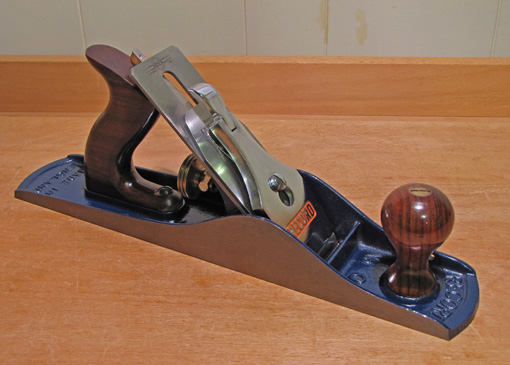
I recently bought Tico’s shooting board (the Super Chute 2.0). I didn’t want to buy a dedicated plane for shooting and thought a low-angle #5 would be a good choice. I also have a #4, #7, and a block plane.

A LA #5 would work very well and I think would be the best choice of the planes you have. For a plane for shooting, you want a lot of concentrated mass and a thick bevel-up blade which is supported close to its cutting edge. A #7 BU plane has more mass but may get a bit awkward on a shooting board of that size. A 6″ block plane is too small and light. Even the #4 is too light.

A dedicated heavy miter plane is the best choice if you can afford it, such as the Lie-Nielsen #9, which I use with the “hot dog” handle, or the new beast #51. However, even a bevel-down jack or jointer can be used successfully. Most important, use a very sharp blade. Add shooting to your repertoire and watch your capabilities grow.

A woodworker building his set of tools and skills asks: I’d like to add a new tool to my small collection of chisels, saw, marking gauge, and squares. You suggest buying a jack plane first but I already own a #5 and a small power thickness planer. Should I buy a second plane or a pair of rip and crosscut saws. Also, can you recommend a book for learning the basics of woodworking?

Because the jack plane is so versatile, I suggest that you not buy another plane for your next tool. More planes can come later. Instead, you would probably benefit most from buying saws for joinery. If your next project is a table, using mortise and tenon joinery, get a ripcut tenon saw for the cheeks and a crosscut carcase saw for the shoulders. If your next project is a box, get a ripcut dovetail saw to cut the dovetails and a coping saw to remove most of the waste.
Of course, you will need saws to prepare the stock. You will also need gauges, chisels, and so forth. Do not try to accumulate all the tools at once. It is better to choose a type of project that you would like to build now – stick and board construction such as tables, or case construction such as boxes or chests – and get the tools for that. In time, you will acquire more tools. Buy the best you can afford. It can be very frustrating to outgrow cheaper tools as your skills improve. It is much better to have fewer excellent tools than lots of cheap tools.

Start with manageable projects. A small, simply designed project that is well executed will be more satisfying and more instructive than getting overwhelmed with a project that gets out of control.

I suggest Peter Korn’s book, Woodworking Basics, as a very good place to start.

Regarding my tool cabinet, I will soon post about that. I’ve been using it for 25 years, and, though there are a few things about the dimensions that I would make different, the basic design has served me well.

Dear readers, I thank you for reading and for your questions. May 2012 bring you many happy hours in the shop!

Rob

Category: Tools and Shop  | 4 Comments
Author:
• Sunday, December 11th, 2011

A key question for any woodworker acquiring a basic set of tools is which handplane to buy first. As with all tool questions, the answer depends on the type of work you will do and your available money. Furthermore, these issues always involve a large dose of opinion because there are multiple ways to get jobs done in woodworking. 
For general furniture making, I suggest first get a jack plane. If you have a lot of money and can make a strong commitment to woodworking, go ahead and get a top quality set of these six planes: smoothing, jack, jointer, block, shoulder, and miter. For such a set of Lie-Nielsens, the cost would approach $2000 and, though surely worth it for an avid woodworker, is hardly a likely leap for a novice. Yet, you must start somewhere, and an incremental acquisition of tools, with adjustments based on the work you decide to do, is a reasonable path.

A jack plane is an excellent tool for stock preparation and can perform well, though admittedly not ideal, for smoothing, jointing, and shooting. As an only plane, a smoother would be deficient in truing work, and it would be very awkward to use a jointer for finish smoothing. Later, when you get the full set of planes, the jack will still be very useful. I originally used my Record jack for all those tasks and gradually got more planes. With a full complement of planes, I still use it more than any of the others and I also have a bevel-up jack.

The options are: buy a new Lie-Nielsen or other high quality plane, fix up a high quality vintage plane, fix up a mediocre new or old plane, or make your own wooden plane. With the exception of the first option or two, it is best to get a good aftermarket blade such as a Hock. The edge durability of A2 steel makes it a good choice for a jack. Keep in mind that the potential of a fixer upper will be limited by its inherent qualities such as the frog design, weight of the casting, and the adjustment mechanisms. 

Bevel-down and bevel-up both work. For either, it is helpful to have one or two extra blades sharpened to different angles and cambers to accommodate different work. You can shoot with a BD plane (I did for years) though for this a BU design has the advantage of a heavy blade that is supported very close to its cutting edge. A BU plane makes it easy to change to a blade sharpened to a higher angle for figured woods, but a back bevel can similarly be used on a spare blade for a BD plane. I find BU blades harder to sharpen, primarily because of the wear created in use on the flat side of the blade. To choose for an only plane, I’d go with the BD, but this is my bias. The bigger issues are quality, tool preparation, and skill.

Please don’t buy a block plane as your first plane, as is often recommended! While useful, it is far more limited than the jack. It is a one-handed tool used mostly for chamfering and small trimming work that can often be done with a sanding block. You cannot prepare stock with it, true surfaces and edges, or use it as a smoother. Step up to the big leagues right from the start and get the jack.

Even woodworkers who do almost all machine work will benefit from a jack plane. For most hand-machine blended woodworking, you could do quite well with a jack plane to joint the faces and edges of boards and a portable thickness planer to get the brute work done. Add saws, chisels, marking tools, clamps, sharpening equipment, and, of course, a workbench and you’re in business. Get a bandsaw soon.

Go make something – anything – and enjoy it!

Category: Tools and Shop  | 4 Comments
Author:
• Monday, November 21st, 2011

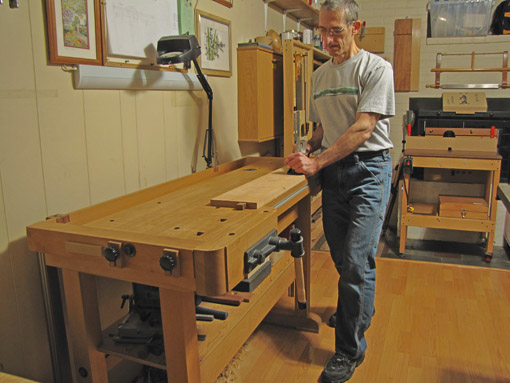
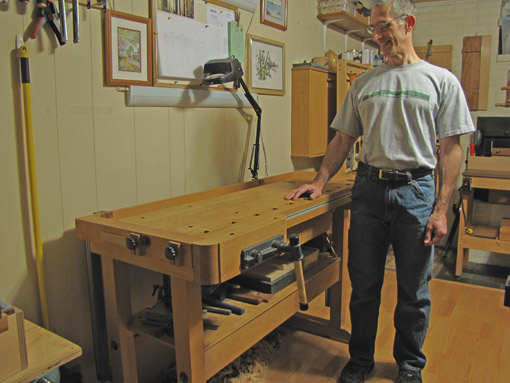
Here is a practical way to choose the height of the workbench that you are planning to buy or build: First, consider the tasks you will commonly perform at the bench. One height will not be ideal for all of them. So, prioritize them, and then try out heights for the major tasks.

I think this method is better than a formula. The most commonly quoted of these states that the top of the workbench should be at the level of your palm when you stand with your arm straight down with your hand extended forward, or simply at the level of your wrist. That might work for you but it might not. I know it does not work for me.

I dissuade you from using a simple formula because this is a personal matter like many aspects of craft. It is not only your height and arm length, but also your back, neck, eyes, posture, and style of work that come into play. The best way to integrate all these factors is to simply try out different heights. Here’s how.

First consider your tasks. As an example, here is my list.

Very common jobs, at which I often spend a long time: planing, sawing dovetails and tenons (sometimes using an auxiliary vise), chopping joinery (often while seated), shooting, scraping, sanding, and finishing.

Shorter duration or less frequent tasks: marking out, paring, sawing with the bench hook, and assembly.

Machine work at the bench: mortising with the router, Domino and biscuit joinery, and using a benchtop drill press and portable electric drill.

Maybe you do lots of carving or inlay, maybe you do all your joinery with machine jigs and the bench is mostly for fitting and sanding, or maybe you prepare all of your stock by hand, and so forth. Remember too, that workbenches are not saw horses; ripping and crosscutting stock to size with handsaws require much lower support.

The next step is to use a sturdy table, Workmate, or a friend’s workbench along with some clamps, and stack/remove 3/4″ or ½” plywood or MDF on it to create various heights to try out the tasks on your list. Pay attention to:

  • your posture – neck, shoulders, back, core, knees
  • reach
  • range of eyesight
  • how you tire
  • any physical limitations you may have.

Find what feels right for you. Your most common and long duration tasks should govern your final choice of height, along with some accounting for the other tasks.

If you are getting a new bench, you get to choose, of course. However, you can easily raise an existing bench by attaching blocks at the bottom. While lowering a bench is a bigger job, it can be done because you’re a woodworker.

There are other approaches. Adjustable height benches and plans to make your own are available which could be used as a primary or secondary bench. Japanese woodworkers do much of their work on the floor and on an angled heavy beam.

In summary, I suggest forget the formulas and trust yourself. You will, after all, be spending a lot of hopefully happy hours at the bench.

This is what works for me, but who cares, find what works for you!

Category: Tools and Shop  | 2 Comments