Archive for the Category ◊ Techniques ◊

Author:
• Friday, January 09th, 2009

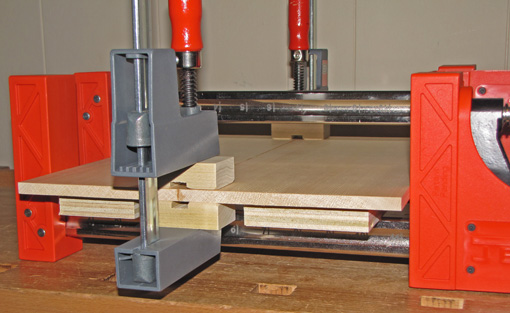
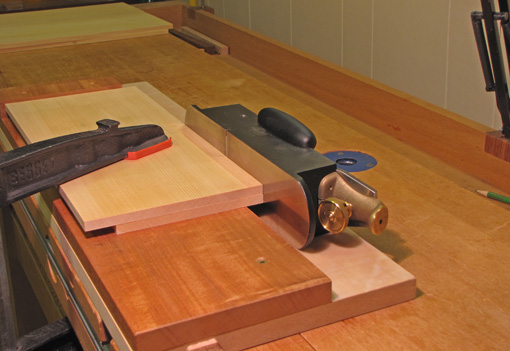
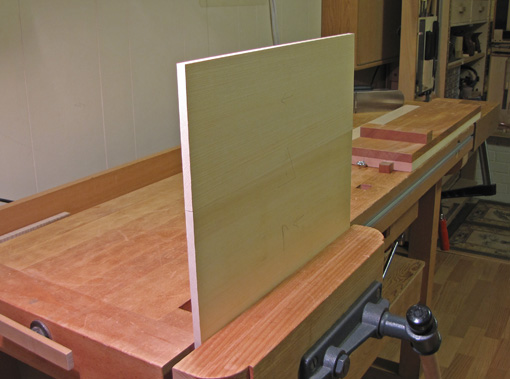
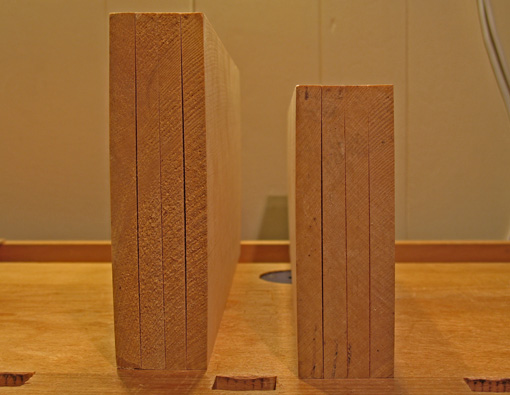
These boards, about 7 inches and 5 ½ inches wide, were originally a bit over 2 inches thick and were resawn into four slices. I had monitored the moisture content of the original boards over a few months in the shop and was confident they had equilibrated to the ambient humidity. Immediately after resawing, the inner slices measured the same moisture content as the outer slices, proving there was no moisture gradient through the thickness.

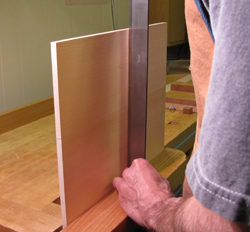
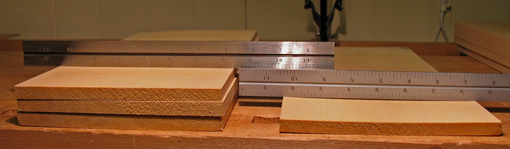
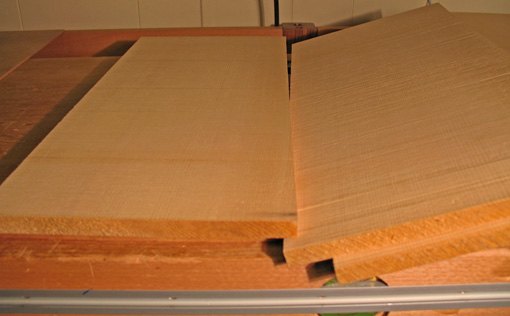
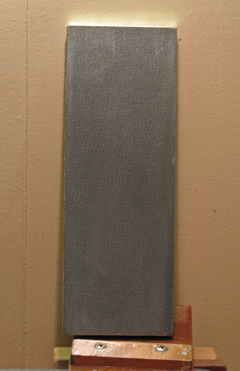
The photos above show the slices immediately after resawing, set up in their original positions. Note the inner boards are flat, but the outer boards are mildly cupped, concave on their inner faces. This immediate distortion is due to internal stresses in the wood, not moisture changes.

I could have predicted this by using the method discussed in a previous post on this blog. Of course, I did not follow my own advice. Notice the outer right board in the wider set. I sawed it too close to the desired finished thickness and now I will lose some thickness after flattening away the distortion. Had I properly anticipated the distortion with the prong sample method, I would have made the outer slice thicker to compensate. Having been reminded of my lesson, I did this when resawing the narrower board.

The steel rules lying across the slices of the wider board show the inner slice is flat while the outer slice has about a 3/64 inch cup. That’s not so bad, but the total loss of thickness is double that amount after both faces are flattened. A moisture gradient through the thickness of the original board, if it had been present, could have exacerbated the problem.

This is yet another reminder (note to self) to understand and watch the wood. That’s always good advice.

Category: Techniques  | 2 Comments
Author:
• Tuesday, December 09th, 2008

For several months I have been using an Atoma 1200 diamond stone to improve the action of the finest Shapton stones when I want a really excellent edge.

For flattening Shapton stones, the Shapton Diamond Lapping Plate works wonderfully fast and well. The grit size is listed as 54/45 micron, approximately equivalent to P280/320 sandpaper. It is manufactured to a flatness tolerance of +/- 3 microns, which is about one ten-thousandth of an inch!

However, to go beyond the task of flattening the stone, I wanted to improve the cutting qualities of the stone’s surface and the slurry. I turned to the expert advice of So Yamashita who recommended the Atoma 1200. This is used essentially as a nagura substitute. (The particles of a nagura are coarser than those of the finest Shaptons.) The Atoma has an extremely even spread of diamond particles on its surface which, as they rake particles off the Shapton, crush them into smaller pieces creating an ultra fine paste as well as finely conditioning the Shapton’s sharpening surface. It does this specific task better than the coarser Shapton Lapping Plate. This also gives the stone surface a nice feel under the blade which improves my sense of the blade’s contact on the stone.

So further suggests, for the very finest edge, to rinse the slurry and polish the edge with almost no water. A slurry can slightly round the edge which would work better for a tougher edge for coarser planing.

So is outstandingly knowledgeable in the field of Japanese woodworking tools, especially sharpening stones. I do hope I am presenting his explanations accurately; any errors are mine.

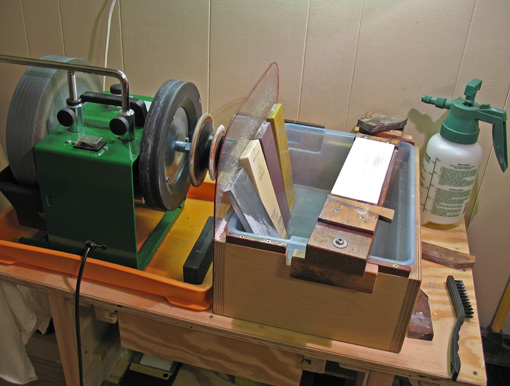
I can certainly say that this system is giving me very good results. The Atoma diamond stones are available from Japan-tool and, I believe, from Hida Tool. I have no financial interest in the sale of these; my suggestions are for the benefit of fellow woodworkers. The sharpening station set up that I use, in the photo above, is detailed in the October 2007 issue of Popular Woodworking magazine.

Category: Techniques  | Tags:  | Comments off
Author:
• Friday, November 07th, 2008

If I have a nice board and want a successful resaw I need all my ducks in a row: a good bandsaw with sufficient power, an appropriate blade that is sharp, clean, and properly tensioned, an adequately high fence corrected for blade drift if necessary, good dust collection, and a safe plan to feed and support the board all the way through the cut. The board needs at least one flat face and a straight edge square to the face.

Even with all the mechanical preparations it’s necessary to consider the properties of the wood to avoid disappointment. When I bring new wood into the shop I check its moisture content with a pinless meter and write the date and MC% on the board. I stack and sticker the boards and monitor the MC over the next few days to few months, noting when it seems to level off, accounting for the humidity in the shop. For thick stock, if I can crosscut away from the ends of the board, I like to check for any moisture gradient across the thickness of the board. Ideally, I want a board that has equilibrated to the shop air with uniform MC through the full thickness.

There is one more very important issue. Dried wood can have internal stresses that manifest immediately after resawing. Very often, in resawing a board down the middle the two pieces produced promptly cup toward each other; the sawn faces both become concave across their widths. This immediate change is not due to drying or moisture issues, although those still might later create gradual movement of the boards.

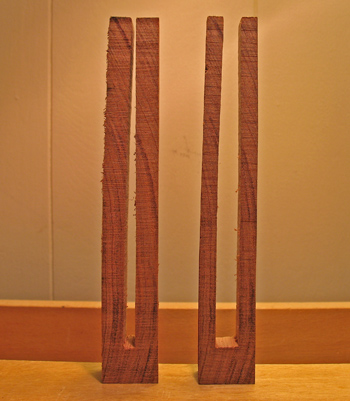
To detect stresses in a board I take a short end cut, preferably away from either original end of the board where end checks may be present, saw out a center section and observe the remaining prongs of wood. In the sample above, the inward bow, especially of the left prong, shows just a slight casehardening effect. The sample on the right, with more of the core removed, shows a bit less bowing. (The moisture content is a uniform 6%.) Resawing this board would probably give good results.

Severe bowing of the prongs would predict markedly cupped boards from the resaw. Such boards would lose much of their thickness after flattening. I would use a fence with no outfeed length (beyond the blade) since the cupped surface coming off the blade would not register properly. Better to find another board to resaw.

A thought on design: in general, I’m not fond of perfectly bookmatched pieces juxtaposed in furniture. There’s something too contrived about that, to my eye. I like harmonious unity with a dose of organic variety better than mirror repetition.

As always, happy woodworking.

Category: Techniques  | 2 Comments
Author:
• Wednesday, November 05th, 2008

Resawing is certainly one of those gateway skills that allows the woodworker to utilize wood more artfully and efficiently. It’s not hard to do. Well, let me qualify that.

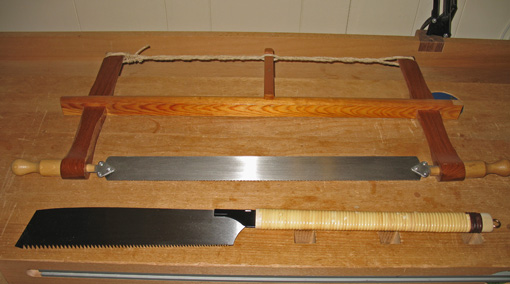
I acquired my Tage Frid style Danish bow saw over 25 years ago and I’ve jointed, set, and filed the teeth over the years so the saw cuts to my liking. Though it is a versatile tool, I currently do not use it very much. It performs well for resawing smaller boards as long as I’m patient and don’t mind some sweat. The 12 inch Japanese rip saw, with fearsome looking teeth, especially at the toe end, also does a nice job on smaller boards. My previous small Inca bandsaw also served well but was limited by its 6 inch cutting height and lightweight power. None of these tools made me eager to resaw.

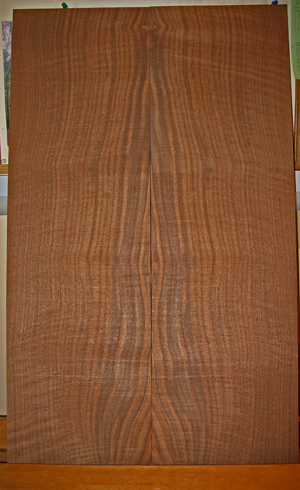
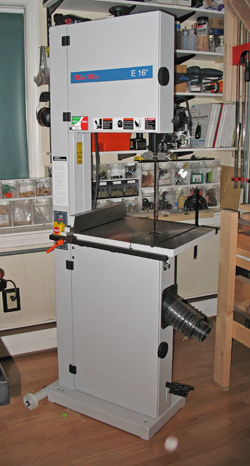
Since I upgraded to the Minimax E16 with a 12″ cutting height and 2.4 HP in the tank, it is so easy to resaw that I find excuses to do it. The 10″ wide (each piece, 20″ total), 34″ long curly western walnut in the photo is straight from the saw and will require little surface clean up. I use a 3/4″ x 0.25″ VPC silicon steel Timberwolf blade from Suffolk Machinery. VPC means “variable positive claw” which is their term for modified hook teeth in a variable pitch pattern, 2-3 teeth/inch. The kerf is about 3/64″. A carbide tip blade is on my wish list but the VPC is darn good at a small fraction of the cost. The E16, lighter and less expensive than the MM16, works into my small shop nicely and so far I have not had any problems with its power.

So there’s my resawing history and current set up. More to come on this topic.

Category: Techniques  | 2 Comments
Author:
• Tuesday, October 28th, 2008

Sharpening is, of course, a huge topic in woodworking where it should never be forgotten that there are many effective ways to achieve excellent results. As such, I will not stir up the debate as to whether one should use manufactured honing guides but simply state that, with rare exceptions, I do not.

For preparing a new edge, after flattening the back of a chisel or plane blade, I grind a primary bevel on the Tormek machine using one of Tormek’s handy jigs. I use the resultant concave bevel to feel the contact angle on the stone’s surface as I clean up, but still preserve, the grind. I use Shapton stones.

I refer you to Joel Moskowitz’ excellent discussion of sharpening, which, as you would expect from Joel, includes some interesting historical information. I almost always use a small secondary bevel on my tools. Joel discusses microbevels and here is where I will add my approach.

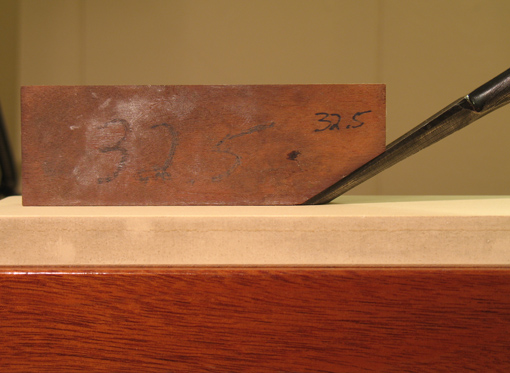
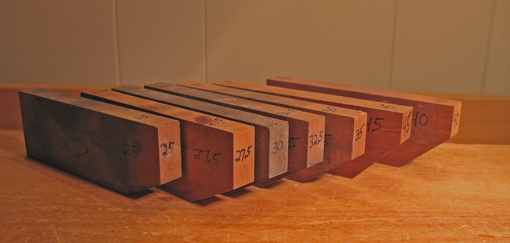
Let’s say I grind a chisel at 27 degrees, and use a 32 degree secondary bevel. The chisel is held freehand, yet consistently, against the stone at the secondary angle. I “set” this angle with a simple block of wood as shown above. I hold the block on the stone, slide in the chisel, lock one hand, remove the block, bring the other hand on the tool, and hone. I can precisely return to this angle as needed after flipping the tool and backing off on a finishing stone. Usually my hands remember the angle after a flip or two, but I can always return to the block to remind my hands.

When I resharpen the tool I hone just the small secondary bevel, sometimes first on a 5000 before going to my finest stone. Here’s the important point: I can reproduce the secondary bevel angle very easily with the block guide, a day later or a month later. I’m honing a very small area of metal that meets the stone precisely. Depending on the use of the tool, the secondary bevel lasts for several resharpenings before I regrind on the Tormek. I am careful to rinse the blocks to avoid contaminating my finest stones.

The blocks, about 4 ½” x 1 ½” x ½” are easy to make. They are also useful for creating a primary bevel using coarse stones for certain tools that I don’t grind on the Tormek. Most of these blocks have seen many years of use. Very simple, very effectivethat’s the way I like things.

Category: Techniques  | Comments off
Author:
• Wednesday, September 17th, 2008


Here’s a seven-tenon version of the MWTM&T joint that is part of a casework project in progress in the shop. The wood hasn’t been varnished yet. I recently wrote an article for Popular Woodworking magazine detailing techniques for producing this joint. The article, using a small sample, explains step by step how to make the joint, with key differences from traditional teaching that make it easier to make, improve the appearance, and add to the long term stability of the construction.

The photo below shows the dry fit with the excess lengths of the tenons still projecting. The pinch rods were used to check the width of the case; going from front to back it widens just a hair to allow proper drawer fitting.

It is a moderately difficult joint to make but the work progresses predictably. Glue up for this piece was tricky but Bowclamp cauls were very helpful in getting a tight joint line along the full width of the boards. Sawing the tenons flush to reveal the finished joint is one of those great moments in woodworking!

Category: Techniques  | Comments off