Archive for the Category ◊ Product reviews ◊

Author:
• Thursday, January 15th, 2009

In general, I have nothing against oxygen; I use it on a regular basis. I just do not like its predilection to hook up with the iron in my tools. Like all tool folk, I hate rust. Hoping to prevent this unholy molecular union, I’ve tried many methods and products over the years. Here are the proven performers: three non-toxic, virtually problem-free products.

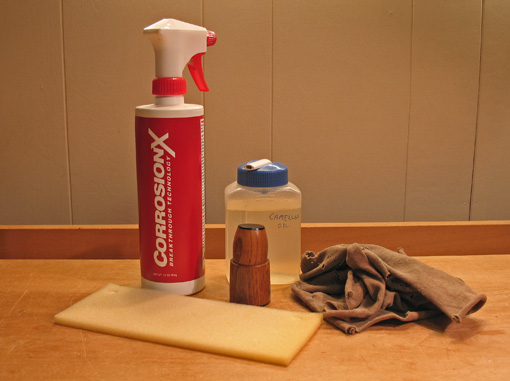
Camellia oil. This gets wiped onto all my hand edge tools and some steel measuring tools with either an oily rag or an oil rub, a wad of soaked felt in a wooden cup. This very light oil has a pleasant fragrance, and only a minimal film is required to prevent rust. I’ve never had any problems with the oil interfering with gluing or finishing since I use a quick cleaning wipe on edge tools before putting them to wood. Freshly sharpened tools get oiled promptly after the water is wiped off, but I make sure oil stays away from my Shapton stones. One 8 ounce bottle lasts a few years for me.

Corrosion X. I use this on cast iron machinery surfaces and for other power tool applications. I much prefer it to the several other products I’ve tried, including Boeshield and Top-Cote. I wipe it on and rub it in infrequently, when I think of it, perhaps every few months. The manufacturer claims Corrosion X is non-toxic, non-carcinogenic, nonflammable (in the pump spray form), has no silicon, and has only 8.6% VOC. I find it has only a mild odor.

Bull Frog Vapor Corrosion Inhibitor. This is a yellow foam pad, about 10 inches square, containing the non-toxic, odorless VCI chemical which settles on metal in an invisible layer only a few molecules thick. The pad is rated to protect 50 cubic feet of enclosed space. I cut it into several proportionate size pieces to protect the contents of various tool cabinets and boxes. This is cheaper than buying smaller strips. It lasts at least one year and works well without a hint of problems.

Here in the Northeast US summers can get very humid. An electric dehumidifier in the shop keeps humidity moderated for the sake of my tools as well as the wood.

This multi-pronged approach has kept rust at bay in my shop. I hope it helps in yours. Go Rust Busters!
Author:
• Tuesday, December 23rd, 2008

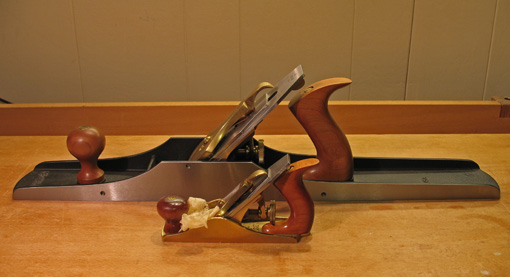
It is easy to see how the #1 bench plane might not be taken seriously as a real working tool. With a 5 ½” sole and 1 3/16″ width blade, here sitting beside the 8 pound, 22″ #7 jointer, it may be regarded as merely a nifty miniature suitable for collectors. However, I don’t collect tools, I only want gamers on my tool roster, and the #1 is fit and ready to play.

The blade is bevel down, with a cap iron, on a 45 degree frog which is adjustable to control the mouth width. There is the usual blade depth adjuster nut, while lateral adjustments are easily done by tapping with a small hammer. I use a two-handed grip as with a larger bench plane, but with only the left thumb and first one or two fingers on the front knob and the right thumb and two or three fingers gently holding the tote.

I find the #1 is useful for many tasks. The obvious one is planing small pieces where a full size plane would obscure any view of the work and tend to tip at the start and finish of the cut. It is handy to use on assembled projects where I need a light, maneuverable plane, such as in trimming joinery or truing a table top bearing part.

When I want my hands very close to the cutting edge for a sensitive feel of the blade on the wood, the #1 gives me the control I need. For example, it works well planing around the joint line at the junction of a rail and stile in a small frame. The #1 can also fix small defects in surface finish planing where a larger plane would bridge the area.

It is true that a block plane could do much of this. However, I keep the #1 tuned like a bench plane, with a slight camber in the blade, and the plane lends itself to a two-handed grip, so it feels more natural and controlled to use the #1 for these tasks. Note that because there is not much momentum behind the cutting edge, the blade must be kept very sharp.

This is certainly not among the first few planes to buy and it is a role player, but it’s not a bench warmer and it has definitely earned its place on the team.

I will continue to laud some of my favorite tools on this blog, particularly if I think they are not well known or just really cool.

Category: Product reviews, Tools and Shop  | Comments off