Archive for the Category ◊ Ideas ◊

Author:
• Monday, June 18th, 2012

It is not easy to make fine things from wood. Woodworking is a succession of mostly subtractive steps which requires careful planning. The critical differences between success and failure in most woodworking processes are subtle, often difficult to reliably articulate, and regrettably seem to require a bit of failure prior to the success.

Human nature creates a tendency to imagine an easy path to success, and, further, to seek this illusory path against all odds. Now certainly, woodworking can be taught and learned with reasonable diligence and, along the way, plenty of fun. Today, there is an abundance of excellent learning tools which admirably remove the unnecessary mystery from woodworking. Unfortunately, the woodworking student – and that means all of us – can be easily distracted by the allure of magic.

Magic is everywhere in the world of woodworking. Catalogs tout machine jigs, especially for the router, that guarantee “perfect” results “every time”, hinting that no real skill is required. Sharpening and finishing, perhaps because they harbor perceived mysteries, are particularly prone to the din of hype. Gurus demonstrate astonishingly fast technique making parts that are conveniently abstracted from the constraints of a real project.

Sure, there are places for time-savers, innovative devices, and instructive demonstrations. The point here is that the hype can lure you to squander your efforts seeking answers in the wrong places while neglecting the acquisition of true craftsmanship. Though the noble task is slower than we might like, and sometimes disappointing, it is ultimately joyful.

Consider this: the only magic tools are the ones attached to the ends of your arms, and they only do what your brain tells them to do. I suggest being cautious about where you invest your time and energy in developing your woodworking craftsmanship. You very likely have an intuitive sense of true skill and quality, especially if you have developed it in other fields. Follow that, not the hype.

That’s the way to happy woodworking.

Category: Ideas  | 3 Comments
Author:
• Sunday, February 12th, 2012

The machine’s 7 1/2-inch blade, powered by a motor claimed to develop one horsepower, could cut 1 5/8″ thick wood on a table 14 inches deep. Its shipping weight was all of 31 pounds. Sears was selling it for $70 in 1970, and though now it hardly seems an enviable tool, back then I wanted it.

While returning home from competing in high school indoor track meets in New York City during the winter months, I would get off the public bus and browse the tool department at the local Sears store as I waited for a ride to complete the trip. I studied that little saw and imagined exactly how I could use it to make things from wood that would exceed my basement output at the time. I had been carrying in my head a scene from a few years earlier when I saw a man, a real woodworker, cut parts for a box I was making. He used a cabinet saw to do this more easily and precisely than I could ever hope to by hand. Much later, in recollection, I could identify his machine as a Unisaw.

Oddly, having now found, through the wonder of the internet, a picture of that little saw in a pdf of the 1969 Sears catalog, I clearly feel a glimmer of that long ago desire. (Page 26 of the catalog, bottom right corner.) I never bought the saw. But I kept making things from wood, and it’s OK now, life worked itself out and I’ve got a very nice top-of-the-line cabinet saw along with lots of other tools. The love, and that’s just what it is, love, endured and evolved.

It must be about push and pull. The way life is, we spend so much of our time and energy pushing ourselves to do the things that must be done. No complaints, and all that. There are, though, a few special things that call to us. These pull us and don’t let go, not for a long time, maybe never.

Heed that pull. Follow, if you can. It’s your soul calling – and it’s important.

Happy woodworking.

Category: Ideas  | 3 Comments
Author:
• Thursday, December 22nd, 2011

Steve Jobs understood, and was able to bring to fruition, not merely the intersection of technology and design, but that they are inseparable aspects of a desirable product. High tech devices are, after all, valuable only if humans can interact with them, and it is via design that we do so. The inviting look and feel of Apple products draw us to them. So often, while we see other brands in the store, we readily sense that we want an Apple – leaving aside whether we can afford it.

Jobs recounted that a course in calligraphy that he took years before he began designing computers was a great influence in developing his appreciation for the importance of nuance and subtlety in comprising an overall style and look. In that art, the smallest details of spacing and line weight, for example, matter decisively in creating the whole image.

Phones, laptops, and other electronic devices are all basically the same shape, but the details of an Apple product add up to produce an unmistakable attractiveness. When you know the underlying functional quality is also there, the product is a real winner.

So what does this have to do with woodworking? Well, looking at a Maloof chair or a Krenov cabinet, I think the question is answered. These masters made things that invite our interaction, are the ultimate in refinement of style, conveyed largely with judicious details, and, of course, embody honest quality. When seeing their work, all this adds up to evoke that wonderful “ahhh.” It is the masterful execution of inspired intent. So intimately human, so wonderfully functional, the piece calls to us, and we reach out to it.

This is what we strive for as we take our best shot at making fine things. In Krenov’s words, a “quiet joy.” 

[About the photo: The apple depicted in this post has absolutely nothing to do with the text. The author, a non-attorney, has better things to do than research the legal intricacies of product and personal publicity rights, and also does not want to tread near copyright infringement. Thus, no photographs are shown of products or persons that might relate to the text. While the author does enjoy eating apples, he did not wish to take a bite out of this one prior to publication. Aha ha ha ha.]
Category: Ideas  | Comments off
Author:
• Tuesday, November 29th, 2011

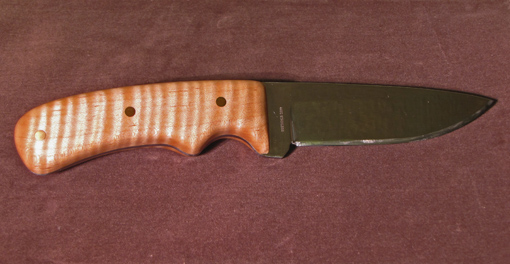
I was browsing in a Woodcraft store a while ago and saw some blank knife blades to which only a wooden handle needed to be attached to produce a nice knife. I am not a knife maker but I certainly like tools, including knives, and figured this would be an easy diversion for me, an experienced woodworker, while more profound projects ruminated in my head. Ha! Yeah, right.

I bought two. I was thinking vaguely, without fully admitting to myself, that one was to screw up and learn on, while the second had a shot at turning out OK. Really, it was not a difficult project, but even such a seemingly straightforward job as this harbored glitches that, lacking specific experience, I was unlikely to anticipate.

How was I to know that the quick-set epoxy would make an ugly thick glue line, or that blending the handle near the heel of the blade would be tricky? Even though I’ve handled knives for many years, decisions for the figure, weight, thickness, and contours of the handle were confusing. I also was not accustomed to seeing sparks fly off the drum sander along with the usual wood dust.

In short, after irretrievably messing up my first attempt, the next try resulted in a decent handle. The process still felt awkward, and I know there is plenty of room for improvement.

So, while not wholly unfamiliar, this was new territory for me. The experience reminded me how damn difficult it is to make things, especially to make them come out the way you really want them to come out. It’s not quick, easy, or perfect every time.

To students of woodworking, and that means all of us, I suggest we ignore the popular trend of hawking this or that technique as easy-peasy, quick as a flash, or (ugh) “perfect every time.” Woodworking is none of those. Sure, you and I can and will learn new skills and do excellent work, but it’s really not easy.

So, ignore the hype and keep making sawdust. Happy woodworking!

Category: Ideas  | 4 Comments
Author:
• Friday, November 11th, 2011

Isn’t learning wonderful? You acquire new things that become part of you, you can do it all you want, it’s good for you, and you don’t ever have to stop. It does, however, require humility in that it must start with the admission of the enormity of what you do not know. Thus, I am a permanent student of woodworking. The learning I like best is the kind that I can put into action in the shop.

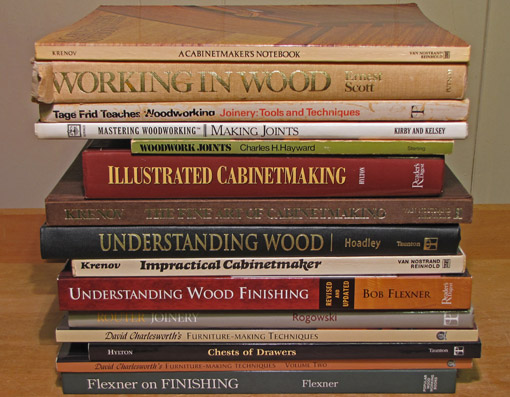
When asked, I say that I am a self-taught woodworker, true in the usual sense. In reality, I have had countless teachers, almost all from afar. I would like to share with you the woodworking teachers from whom I have learned the most.

James Krenov has to head the list. His writings and work catalyzed my intuition that making high quality things in wood, with a personal touch, is powerfully meaningful. Further, his level of technical refinement continues to set a standard.

Ernest Scott’s Working in Wood, published in 1980 and, as far as I know, long out of print, was an encyclopedic challenge to absorb, especially for learning joinery. I would literally blow the sawdust off the pages as I turned them and practiced making joints. Tage Frid had a legendary breadth of practical woodworking knowledge. His Taunton Press books and articles remain directly usable at the bench. Ian Kirby offers clearly reasoned explanations of techniques that advanced my understanding and helped develop my habit of thinking through woodworking processes instead of accepting them by rote.

There are many more. To learn about wood, I turn to Bruce Hoadley (Understanding Wood), and the wonderful Fine Woodworking articles on different species authored by Jon Arno. Bob Flexner’s lucid demystifying of finishing in his books, and articles in Popular Woodworking, is some of the best explanatory writing I’ve read on any topic. I still refer to Charles Hayward’s Woodwork Joints, copyright 1975, to sort out joinery. David Charlesworth’s incisive understanding of technique is top of the line.

For furniture construction, I often look to the writings of the following woodworkers in numerous sources. Bill Hylton must have taken five lifetimes to learn his range of ability. Chris Becksvoort gives reliable advice borne of long experience. I keep rereading Will Neptune’s articles, there is so much in every paragraph. I’ve always enjoyed Gary Rogowski’s enabling way of teaching several different ways to accomplish a job.

Still, there are so many more. Without a doubt, every devoted woodworker has his favorite teachers and sources. The explosion of woodworking information on the internet adds immeasurably to our learning opportunities. To all of the above and the many more unmentioned, thank you.

Category: Ideas  | 2 Comments
Author:
• Thursday, August 25th, 2011

I usually approach the completion of a project with hesitancy because I know that, for better or for worse, this is as good as the thing is going to be. I no longer can do anything to improve it, except for marketing, and must accept it. Competing with this is the sense of wanting to get the damn thing out of the shop because I’ve already put enough sweat into it.

Another, more important, very distinct, feeling comes over me. Readers, maybe you can relate. I have a sense of separation from the piece. It is now out of my hands and has a life of its own without any further influence from me. It feels almost as if someone else might have made it.

Well, isn’t that the point of creativity, to make something that stands on its own and is appreciated for what it is apart from its maker? Yes, attention is rightfully now on the object, not its maker. People will, to varying degrees, like or dislike the object. The object is not you, so don’t take the praises or winces too personally. Even though you made it, in this sense it’s not yours anymore and doesn’t need you. Hopefully, it will even outlive you.

This view is in contrast to that of the painted, pierced chic “arteests” of today who seem to prefer that everyone dwell on them more than on what they have made. I believe that we as artists (artisans, craftsmen, woodworkers, whatever you prefer) should be humbled by the degree of mystery that lies in making things.

Yes, this work is personal, but consider the words of James Krenov, “. . . the worth of such things is their whole content . . . [to be] seen – and lived with, in a coming together of sense and observation that will bring quiet joy long after the maker is forgotten.”

It is good to build good things.

Category: Ideas  | 2 Comments
Author:
• Tuesday, August 16th, 2011

These thoughts started to gel as I was browsing a craft exhibit of many wonderful pieces. There were also a few that didn’t quite measure up, at least in one man’s opinion. I wondered what, apart from preferences in style, had formed my view of an object as a creative success or as falling short.

Further, I supposed these considerations could help me with my work. “I work wood, therefore I am??”

At the core of creativity is the development of a powerful, compelling, rich idea. By “idea,” I mean more than a whim or an attractive notion. I mean a driving, guiding force with enough energy to result in a creation. I like the word “concept” for this. Without it, a creative effort really doesn’t stand a chance.

When designing a new piece, I wonder why would anyone, including me or a client, really care about this. One way out is to make ostentatious nonsense or to be different for its own sake. No, I want to make refined work that elicits the “quiet joy” of which Krenov wrote.

Moving ahead, a clear concept produces economy of intent and execution. The artist/craftsman grasps the essence of what he desires to create, and thus driven, marshals the skills and focus to make it be. To get the job done, the intent must coordinate with workmanship and this must be conscientiously sustained throughout the construction process. In other words, consistency of intent should engender consistency in workmanship so that one reflects the other.

OK, nice lines on paper that I’ve got here but I better be able to pull this off. I must have the skill and mental focus to carry this through because no one puts up scale drawings in the living room.

The result of all of this, we hope, is harmony of all the aspects of the piece – form, wood, color, details, and so forth. This is pleasingly evident when viewing the piece. It is so readily evident that it will likely make the viewer blissfully unaware of the sweat it took to get to the final product.

By contrast, inconsistency and disharmony are readily evident. Think brown shoes with a tuxedo (inconsistent intent) or a suit that would look great except for an awkward fit that can’t be ignored (inconsistent workmanship).

I better be clear about where I’m going with this because I’m going to invest a lot of work in it. More than hope that it will “come out good,” I’ve got to think and believe that it will.

More than merely theoretical meanderings, this is the stuff that makes a piece produce that good “Ahhh” feeling. It is a formidable job to have a good idea, recognize and develop it, then sustain it as you execute it with consistent workmanship. I am grateful to be able to make things in wood, it is fun, and at times exhilarating, but I do think it is truly difficult to do well.

Stay with it, you can do it. “Unity and variety,” as Maestro Heath used to say.

Category: Ideas  | 6 Comments
Author:
• Tuesday, May 31st, 2011

Here is a two-part answer. Some reasons are clear to any woodworker, starting with the pleasure of working with a wonderfully beautiful and diverse material – wood. Craftsmen have a strong urge to simply make things, and, for some, there is the creative joy of producing original designs. There is also the primal appeal of skillfully working with one’s hands. Each woodworker has his own reasons.

However, I think for many of us, amateur and professional, there are satisfactions derived from woodworking which are especially meaningful because they are notably lacking in much of the modern world of work. Here I submit three such satisfactions. Can you relate?

1) Woodworking produces a product that you and others can see. Moreover, you can use and share it for a long, long time in the comfort of home.

2) A woodworker is responsible for, and controls, the process and the outcome. The limitations come from your skills and resources, not from “corporate.” Control and responsibility seem to be frustratingly unlinked in many occupations.

3) There’s no BS in woodworking: If you do good work, the result is a good product. If you do poor work, you and others will see it plainly. What you put in is what you get out; there are no “moral hazards.” Politicians probably should stay out of the shop, or at least leave it at the door.

Step into the shop, my fellow woodworkers, and enjoy the sawdust. If you’re reading this and considering getting started in the craft, consider the above.

Happy woodworking.

Category: Ideas  | 5 Comments