Archive for the Category ◊ Ideas ◊

Author:
• Sunday, September 27th, 2020
woodworking insights

Disclaimer: Or what they do tell you but you might not notice.

Learning in any field takes place on at least two levels. First, there are the overt knowledge and skills that necessarily dominate the instructional material and the student’s efforts. Yet, there are always the unwritten, perhaps even unsaid, insights without which we never feel truly in command of the field. This is “Oh, now I get the idea . . .” — on the road to mastery. 

With all due respect for the many wonderful woodworking teachers out there, it is difficult to transmit these key points in the environment of most formal instruction, especially written. In fact, these essentials may more often be “discovered” by the student in the quiet reflections of “putting it all together.”

These are the sorts of things that despite all your training, you realize six months into the job. Or that the instructor casually mentions in conversation after class when he sees what an eager student you are. Or that dawn on you during a long nighttime drive back home. These are synthesis ideas.

There is a simple continuing theme of this weblog: I greatly enjoy woodworking and find it meaningful. I want to help you do the same, particularly by discussing matters from a viewpoint that is typically neglected in most woodworking publications. With that in mind, I offer this series of posts to present what I think are pivotal nuggets in the various aspects of woodworking. I hope they help you leap ahead to better woodworking or at least reinforce your woodworking mindset. 

Hey, I’m not so foolish as to think I know it all, so please do comment to share your insights on each of the topics as we go through them. The first topic will be, of course, wood. 
Author:
• Friday, June 26th, 2020
woodworking dust collection

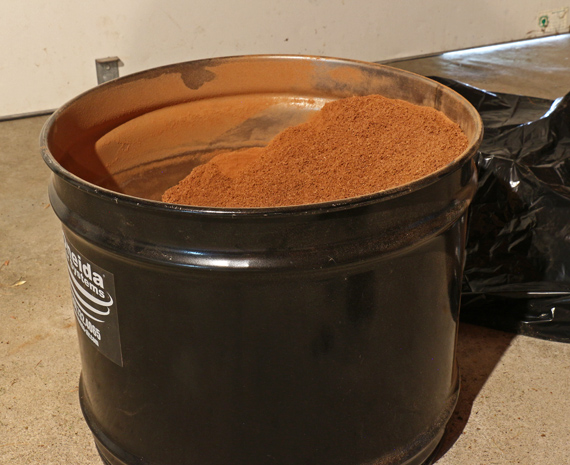
For the 500th post since the inception of this weblog in 2008, I would like to present the Grand Unified Theory of Woodworking. Concocted while emptying my dust collector, this offers deep insight to woodworkers and non-woodworkers alike as to what really goes on in the shop. 

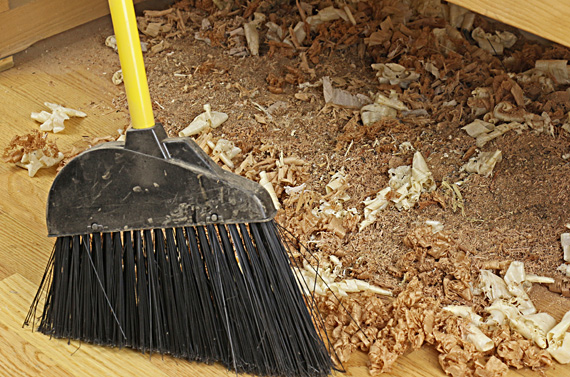
And so: You start with a tree. Then, to produce a masterpiece you merely remove the exactly correct tiny pieces of wood (as shown in the dustbin pictured above) while retaining the exactly correct wood in the workpieces, which you then simply join together. Done. 

I present this ridiculous notion only to make a couple of points, which are hardly original but bear repeating.

The people who see and use what we make almost never understand the effort, time, skill, and expense required to make high-end woodwork. Perhaps this is only due to the nature of the craft – wood seems so accessible to work. More likely, it is partly or even largely the fault of woodworkers (like me). Most of the things we use in our modern world are made in huge numbers by computer-controlled machinery. In some cases, the consumer’s hands may be the first to ever hold the product. I think woodworkers should affably convey an understanding of what goes into our work to those who encounter it. 

Second, we woodworkers are similarly apt to forget that making excellent stuff is really difficult. Not to be whiny, but it is healthy to acknowledge that we are always dealing with some degree of workmanship of risk from which even the gadgetry of modern woodworking does not shield us. As a mostly subtractive process, woodworking can be unforgiving (again, see dustbin). For me at least, I have to remember to go easy on myself, trust my hard-won capabilities, and be always open to improving my skills.

It’s simple, really.

Category: Ideas  | 10 Comments
Author:
• Saturday, February 29th, 2020
woodworking thoughts

A good craftsperson never stops learning, so I have the habit of taking stock after completing a project to see what it has taught me. Often it is just a matter of reinforcing or reminding myself of things I already know – or “should know by now.” Here are some views from the caboose after a recent project.

1. It is so important to develop a solid design concept that you can trust throughout the tribulations and vicissitudes of building a project. Woodworking is not easy to do well, so you need the power of that concept to sustain your energy and optimism.

2. Make sure the design is good. You may need to redesign. Often, your early, unexamined assumptions are the most likely candidates to need refinement. Do not obsess, but do get it right.

3. 3M sandpaper products – regular sheets, flexible sheets, and random orbit discs – are flat out superior, and I see no point in using anything else. I can feel this stuff bite the wood like no other brand of abrasive that I have tried. Sandpaper is a tool.

4. Live edge wood furniture remains extremely popular, and I appreciate its appeal. But for now, I’m tired of it. I also have low regard for tables that consist of nothing more than a non-descript base under a slab.

5. Every effort in accurate, thoughtful stock preparation will likely be rewarded downstream in the building process.

6. Stock thickness disappears startlingly fast. Cupping, defects, and especially the dreaded twist, conspire to seemingly evaporate thickness. We are less likely to need a magical Board Stretcher than a Thickness Inflator.

7. Fiddly things drain energy and wear you down. These are things like altering hardware, fixing defects in wood, and finishing quirks. Plan to avoid them and find a better way.

8. The few minutes after making a mistake is the riskiest time for making a bigger mistake, maybe even the Big Mistake. Take a break, step back, and think. 

9. I think it is true: if I were to make this again, I could do it in less than half the time.

10. Krenov was right: “Worry less, concentrate more, and above all, relax.”

Best wishes to you with your projects, and I hope you never stop discovering.

Category: Ideas  | 14 Comments
Author:
• Wednesday, August 28th, 2019

There has to be a certain level of energy to carry you through a project. You need a good spark to start things off and enough fire to make it through the inevitable difficulties that come along. 

Where do you get this energy to build? Well, there may be secondary motivators – maybe you need to get it built for the money, to fulfill a promise, or you just need the item for its practical use.

At best however, “love and need are one” and sheer creative joy is driving you to build. Maybe it’s the design, and you feel you’re onto to something powerful. Maybe you’re eager for the challenge of a new or refined technique. Maybe the wood itself is so compelling that you can’t wait to build with it. 

In any case, you have a real problem if the fire is not truly there: if you sense the design is only so-so, or the materials are not compelling, and building will be grunt work that you don’t strongly care about. And you lack even secondary motivators. 

Well, in that case, I think it’s best to do something else! 

Make a decision. There’s no point in kidding yourself by further pursuing a project without The Energy. Try a different project. You’ll think of something. It might be better to just buy that bookcase that you were going to build, and instead build a table that you’re excited about. 

I’ve been down this road more times than I care to admit. I’ve found it best to be honest and tough with myself even if that means junking a project in which I’ve already invested considerable hours. Drawings get torn up and wood gets sacrificed. 

If the energy is not in you, it won’t be there in the final piece, and you’ll know it for always. And those who see and use the piece will know it too.

Category: Ideas  | 8 Comments
Author:
• Saturday, June 29th, 2019
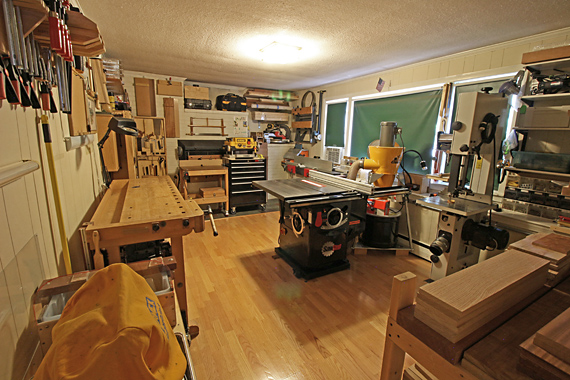
my woodshop

A violin maker in Los Angeles, Hans Benning, relates a story from many years back when a man came to his shop seeking repairs on his violin. The violinist wanted Hans to come to his house to work on the instrument but Hans declined, explaining that all his tools and fixtures were there in his shop. The work could not be done properly on a kitchen table. After looking around the shop a bit, the man left.

Now this was no ordinary violinist who had come to Hans’ shop. It was Jascha Heifetz, one of the greatest ever, and his violin, an 18th century Guarneri del Gesù, was no ordinary violin. That’s right, Hans turned down work from the great Heifetz! The craftsman would not lower his standards.

A few days later, Heifetz returned, this time with the violin, and agreed to have the work done by Hans in his shop. This was the start of their 15-year working and personal relationship of great mutual respect. Some time later, Heifetz acknowledged to Hans that he appreciated Hans’ refusal to compromise his standards as a craftsman at their first meeting. 

Picture that. The most discriminating imaginable client, famous and at the pinnacle of his art, seeks your services as a craftsman on work of the highest caliber, and you say, “Nope, sorry, I don’t work that way.” But later he returns, seeing it your way, and the work commences. Wow.

So, here’s a thought. What if, instead of Jascha Heifetz, it is you who walk into your own shop. You have a conversation with Yourself, and walk away. Reconsidering, you decide to return and accept the conditions – and the work commences. 

It’s in your hands now.

Category: Ideas  | 3 Comments
Author:
• Friday, April 05th, 2019
woodworking thoughts

We want to build. We want to work at a pace and get things done

The key to working at a craft the way we should work – where the job is done well and we are well – is to coordinate the pace of four factors. Let’s consider what’s really going on when we work.

The hands must work with clear intent, guided by skill embedded into muscle memory. For most good craftspeople, this is usually not a limiting factor. Rather, the hands that can easily run ahead of the other factors, which leads to awkwardness and fumbling. We all know what happens when the hands rush ahead of the brain. You neatly saw on the wrong side of the line or cut yourself with a chisel that you’ve picked up a thousand times.  

The mind must focus unwaveringly on the specific task at hand, yet maintain cognizance of its place in the overall mission. The mind, of course, governs all and so is the master pace setter. Try to outrun it, and trouble comes: “How did that happen?” – a surprise mistake that really isn’t surprising. Skill of mind is the greatest skill. 

Each of our tools must be put to work within the range of its intended purpose, not forced beyond it. So, maybe you should chop that waste in two passes, not one. And the tablesaw has only so much horsepower. Push a tool beyond its limits and you’ll both pay the price. For a craftsperson, knowing your tools is almost like knowing yourself. 

The body must be respected with regard to energy limitations and fatigue. It is not a machine. Usually, posture is the first thing to break down. When core stability breaks down, the fine motor tasks performed by the hands will suffer. If your work is becoming less accurate as a session in the shop proceeds, consider that core/posture fatigue may be the cause. 

When these four factors are exerting synchronously, you are happily at ease and do good work. This is peaceful productivity and efficiency – the way we should work, and the way things best get done

Sadly, many, maybe most of us, are pushed in our pay-the-bills jobs with little regard for the truths of human work, driven by the fantasies of those who do not actually do the work but instead tell others how to work. (Anyone remember Lucy in the chocolate candy factory?) Appreciation of the work dissipates. We become detached from it, and from ourselves.

Happily being human almost always includes integrating our various faculties, being cautious not to neglect parts of our true nature.  Hopefully, we can work well in the woodshop as we produce, and do so with joy. Work is best when we pace it this way. And it is the way we live best

Category: Ideas  | 4 Comments
Author:
• Saturday, February 02nd, 2019
The Krenov Archive

Now, as I work on a new design, there are matters of wood, style, proportion, and details. There are plenty of technical problems to solve. My mind swirls at times with all the issues and all the possibilities.

I find myself asking if this piece is really worth it. Worth what? Is any piece worth it? Is the essential idea, the concept, growing? Is it bringing forth the energy that the project will require?

All of this is part of the joy of creating. I love it, but it can get out of hand in many ways. Tension comes about, some of which is good in that it generates energy. But some can be damaging, and that will ultimately reflect in my mentality when building the piece and in the finished product.

And there is Krenov, again, with the advice I need. In his book With Wakened Hands, he counsels, “Worry less, concentrate more, and above all relax.” Krenov’s work elicits in me an energetic but peaceful response – the “quiet joy” – and so does his advice.

Now back to work.

Category: Ideas  | One Comment
Author:
• Sunday, November 18th, 2018

marking out

Elsewhere in this blog, I’ve contended that woodworking isn’t quick, easy, or perfect every time, and false promises of such delights by some tool advertising and sources of instruction can discourage those learning the craft, who eventually encounter the truth but wonder if the difficulties are their fault. Moreover, perfection is an illusory pursuit that can lead to discouragement and loss of nerve, and is better replaced by a knowledgeable pursuit of excellence.

Yet, I think most anyone with strong dedication, good tools, proper instruction, and decent manual dexterity can develop the individual skills needed for excellent woodworking.

So, what makes woodworking difficult? Why is it pretty hard to learn how to make a project turn out the way you hope? What is the missing link that takes you from learning how to cut a mortise and tenon joint to being able to confidently make a table? In other words, what is the most essential thing to learn in woodworking?

I think it is this: putting it all together. This means being cognizant of the context of each step of the process, so that as steel meets wood, you understand what you’re really doing and why. You must appreciate how the skill being executed at the moment fits into the whole construction. That appreciation informs your approach to the task at hand.

For example, when you flatten the stock for casework, you are aware of why it needs to be flat, the range of flatness tolerance required, and the consequences of sloppiness outside of tolerance. You know when to bear down for high precision but also when punctiliousness is, at best, a waste of energy. So, you have a different mentality when preparing stock for drawer sides compared to drawer bottoms.

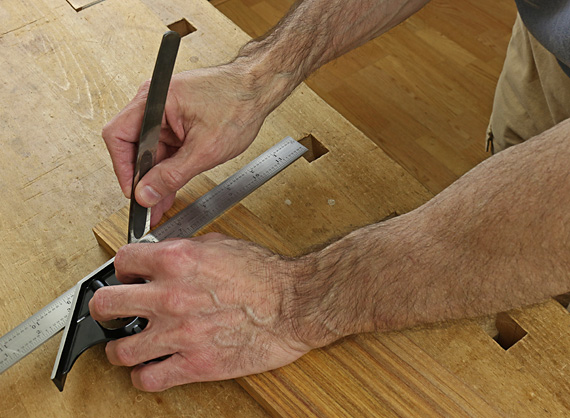
Here are more examples. You sense how to make that mortise and tenon joint accurate not just for itself but also for how it will contribute to the accuracy of the whole table coming together. You have this sense even when you are marking out (photo above). In the design process, you appreciate how individual elements have to coordinate into an aesthetic whole that you are also capable of building.

And you understand how “perfect every time” is silly.

Of course, you cannot have all the steps of a project top of mind at once. However, with experience (and for most of us, that means sometimes dealing with failure) you learn to absorb the big picture. It shapes a correct mental approach that you carry with you. With this awareness, your work becomes natural and flowing. The cognizant mentality is not at all burdensome but rather is energizing because you know how to value each step in the journey.

Good musicians know this. Playing notes, even if technically excellent, is one thing; making music quite another. The impact, presence, and style of the whole piece inform the treatment of each passage. I suppose being good at anything is like this, but with woodworking it is right there in front of us.

And finally, another thought for another day: how does making something in wood fit into everything else? (And for me, it must.)

Category: Ideas  | 7 Comments