Archive for the Category ◊ Ideas ◊

Author:
• Monday, December 15th, 2008

The late Tage Frid wrote, in his 1979 book Tage Frid Teaches Woodworking, “I don’t care how it is made – he [the craftsman] can make it with his teeth or a machine – it is still the final product that counts.”

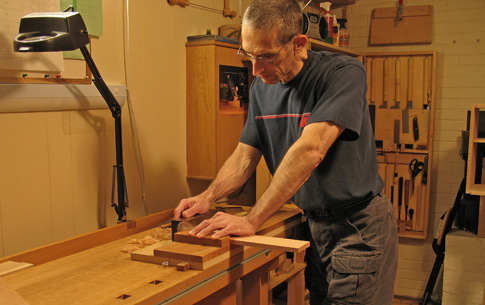
Sure, tools and methodology are essentially means to an end. However, the way we accomplish things and the nature of our work life are important too. This is particularly true for the avocational woodworker who is under less production pressure than a full-time professional and thus has the luxury of choice as to how he feels while he is working. In general, I feel better when I’m using my hand tools than when I’m using my power tools, and so there’s one point in favor of hand tools. I also feel good when I see steady progress through the stock preparation phase of a project along with the repeatable precision of machine work, and so score a couple for electricity.
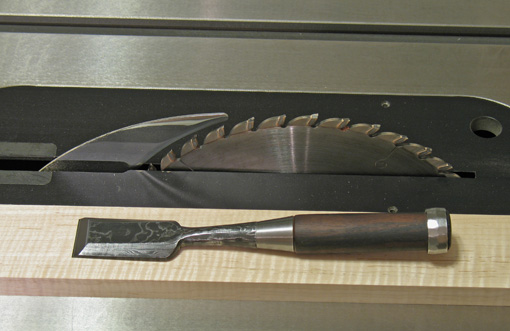
Yet, there’s more to this issue. Hand tool woodworking is a mentality, an approach, almost a philosophy. It does not mean the absence of power machinery. Rather, I believe the hand tool woodworker is one who recognizes that he can impart degrees of quality and personalization to his work with hand tools that are unlikely or impossible with machinery. This applies to two aspects of woodworking.

The first is methodology. The hand tool worker thinks and plans work differently than those ruled by machines. Processes are incremental. For example, relying only on the table saw to crosscut a drawer front is not likely to produce as excellent a fit as shooting with a hand plane, where fitting can be done in increments of just a couple thousandths of an inch. This level of control builds a relaxed confidence.
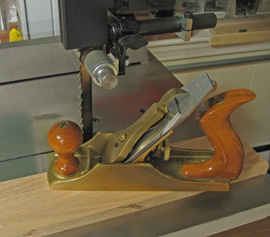
Hand tools also allow for error compensation and avoid error build up. For example, in making tenons on the table saw, a machine woodworker is likely to measure stock thickness and assume a sort of perfection, even though the slightest inconsistency in stock thickness can create poor fitting tenons. A hand tool woodworker would work from one reference face of the stock, cancelling small imperfections in stock thickness. If he did use the table saw to make the tenons, he would adjust the machine with a one-sided tolerance, mindful that he can later remove a shaving or two with a plane if necessary to produce an ideal fit. Machines, yes, but on your own terms.

The second aspect of hand tool work has to do with the aesthetics it engenders. Interesting joinery, resplendent surfaces, subtly treated edges, and satisfying contours are some of the distinguishing personalized features we are at ease producing with hand tools. One may use a bandsaw to do most of the work of creating a pleasing contour on a table leg, but a spokeshave and rasps will refine it to a quality that a power sander alone is not likely to achieve. Maybe a round-over router bit gets an edge close to what you want, but a plane gradually alters the mathematically produced edge to something that is less readily definable, but is just what you want. The vision, the work, and the product are personal.

It’s nice to drive to the mountains and even drive through the mountains, but it’s not as nice as hiking them. Power tools drive you there, but hand tools walk you through.


Category: Ideas  | 10 Comments
Author:
• Tuesday, December 09th, 2008

It was a pleasure meeting the many woodworkers who attended the Lie-Nielsen Hand Tool Event in Massachusetts this past weekend. I hope my demonstrations and advice were useful. It was exciting to be surrounded by the wealth of expertise available from my fellow demonstrators so I was able to pick up some good tips as well. There’s some photos here which capture the flavor of the days.

It was fun to encounter so many friendly woodworkers enjoying what they do and sharing their interest. And not one person asked for a bailout! Simple joys, the best kind.

Category: Ideas  | 2 Comments
Author:
• Saturday, October 11th, 2008


Trees, equipment, and a plan. That sounds a lot like woodworking but also applies to hiking in New Hampshire’s White Mountains, seen here. One of the great satisfactions of woodworking is the clear linkage through planning, tools, technique, and very evident results. The woodworker knows and controls what he does and takes responsibility for the outcome, which lies in plain view. A virtuous universe.

The shop, and the mountains, are good places to be.

Category: Ideas  | Comments off
Author:
• Friday, September 12th, 2008


You’ve heard it in ads, seen it on magazine covers, and on TV.

Perfect dovetails, every time.

This square is dead accurate.

The plane comes with a dead flat sole.

Perfect edges in two minutes of sharpening.

Stop it. Nothing is perfect. Not my work, not yours. The joinery in the photo is not perfect, trust me.

Let’s eliminate sloppy, low quality work from this discussion. I’m referring to high quality work done by very skilled woodworkers, top quality tools, and so forth.

As an example, consider the sole of your expensive new plane. Is it really perfect? Flat to within what, 0.002″? .001 “? Everywhere? 0.0005”? Doubt it. But what’s really important? A skilled woodworker knows that there should be, for example, no hollow just in front of the mouth. If there is light blocking contact there, as well as at the toe, heel, and just behind the mouth, it won’t matter if there is a bit of hollow in the middle of the front or rear sections of the sole. The wooden soles of Japanese planes are intentionally nuanced in this way.

How about cutting the tails in making dovetails? Is the saw held perfectly square to the width of the board? Within what tolerance? A skilled sawyer attempts to directly split the layout line on the waste side, cutting at 90 degrees, but nevertheless knows on which side is the mountain and which the cliff. You are aware of a one-sided tolerance – if slight error is to occur, try to confine it to where it could be trimmed, or perhaps yield to the slight compressibility of wood, or at least won’t be noticeable in the finished work.

The point is that a good craftsman gets beyond naive notions of absolute perfection of process or outcome and instead understands how to manage tolerances. He knows what is – and is not – critical to produce superb quality and apportions his energy accordingly. Likewise, a new woodworker should not be intimidated by the illusory goal of perfection. Nor should the novice be seduced by the claims of machine manufacturers that promise perfect joints or perfect anything.

I hope for an educated, perceptive excellence in my work. Understanding is better than hype.

Category: Ideas  | One Comment
Author:
• Wednesday, September 10th, 2008

In this blog, I invite you to stop by my shop, look over my shoulder, hear what’s on my mind, and, of course, offer your comments.

Working alongside another woodworker, you can observe his habits, and acquire useful skills by absorption as much as by explicit instruction. Over time, the craftsman shares his thinking, along with the meaning of his work.

For so many of us, woodworking is done mostly in isolation. Though today there is an abundance of formal learning materials, I believe we small-shop woodworkers have much to gain from visiting each other’s shops, albeit in the virtual world.

Welcome to my shop.

Category: Ideas  | 2 Comments