Established in September 2008, this site contains 260,000 words of original content (through December, 2025), not including comments, and 1406 original photographs.
Here you will find plenty of serious woodworking instruction, information on tools, shop setup, and wood, along with musings about the craft. All for you to enjoy for free.
Heartwood is one of the longest running woodworking weblogs on the internet with, conservatively, 6 million visits and 20 million page views (actual human visits, not bots, crawlers, etc.).
I am always delighted to hear from fellow enthusiasts and anyone exploring fine woodworking.
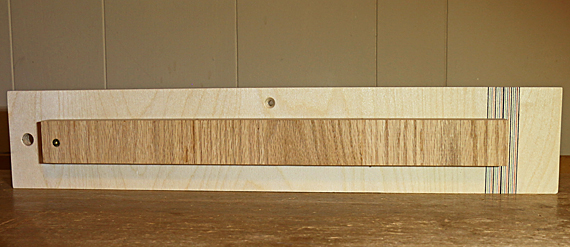
Wood moves. We all know that. This simple gadget makes the hygroscopic movement of wood readily apparent. It reminds me of what is going on with the wood in my shop, and it’s fun to observe.
The device is simply an offcut from a glued-up flatsawn red oak panel. The strip is mounted on a piece of plywood, which, of course, will not undergo hygroscopic change in its length. The oak is secured with a screw near one end, while a scale on the plywood with 1/16″ gradations straddles the free end. The strip is freely supported by a tiny brad about two-thirds the length from the fixed end in case the unit is hung horizontally, but I usually hang it vertically on a nail.
At 8.6% movement across the grain (green to oven dry), tangential to the annual rings, red oak is in the midrange among wood species. The 15″ length of the strip plus the abundance of end grain exposure produce substantial and relatively rapid dimensional change.
A change in relative humidity (RH) from 35% to 85% (at 70°) is calculated to produce about a 1/2″ change in the length of this strip. I try to keep my shop between 40% – 60% RH year round but even this range will produce about 5/32″ of movement. It is interesting to see what happens when I place the device in another room in the house for a day or two, especially during seasonal extremes.
This type of device can be upgraded by attaching an indicator needle to the end of the strip via pivots that convert its linear movement to an arc movement of the tip of the needle. That’s more bother than I want, and the movement of the strip itself is enough to be easily observed directly without conversion.
I consider the regular humidity meter on the wall to be essential shop equipment but this gadget is a nifty way to stay directly aware of wood movement.
In a 2011 post, I argued for an empirical approach to determining your best workbench height instead of relying on any formula. The many variables in body characteristics, woodworking styles, and tools necessitate practical testing.
Consider the tasks you do at the bench, such as planing, sawing, and chiseling, and the portion of time and effort you are likely to devote to each category. Then find a workbench, Workmate, or a sturdy table to try the work at different heights created by clamping layers of boards or plywood to the table. Find what feels best all-around.
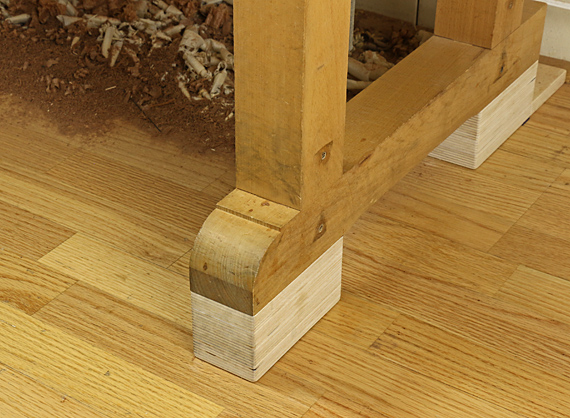
Maybe your ideal bench height will change over time as mine has. Recently, after assessing how I was working, and then testing just as I recommend to others, I raised my bench almost two inches to 37″. I feel more comfortable overall, particularly being able to stay closer to a neutral head posture. I can reduce the bend in my neck, which reduces stress on the lower cervical vertebral joints.
On the other hand, I can feel that the higher bench height transfers more of the work of certain tasks such as heavy planing to my upper back and arms. Fortunately, I’ve maintained good upper body strength, especially in the upper back and shoulders, so I don’t seem to miss the reduced drive from the ground. In fact, firming my upper back as I work actually further removes stress from my neck.
I used long #14 screws to attach a glued stack of Baltic Birch plywood to the base of the bench, replacing the previous riser blocks. 3M Safety-Walk slip resistant tape applied to the bottom along with filler blocks between the bench and the back wall do a great job of keeping the bench stable in all directions.
“Assess your stress” and work habits to make your shop time more efficient and pleasant.
The process I used to construct these markers ensured their accuracy.
I used bubinga but many dense, fine-grained hardwoods such as hard maple would do fine. Start with a 1 3/8″-thick, flat board without internal stresses, at least 12″ long and 5″ wide for safety, with a straight, squared long grain edge.
Using appropriate safety precautions, make a 1″ x 1″ rabbet on the long grain edge. I used many shallow passes with a 1″ diameter straight bit on the router table, finishing with a light pass over the entirety of the inside surface.
On the table saw, rip away a 1 1/2″ strip containing the rabbet.
For safety and accuracy, short pieces – the markers themselves – will be cut on the table saw from this long work piece.
Two principles guide the process. We want to work with the rabbet always facing the blade to eliminate even the minor tear out that can occur at the trailing edge of a cross cut. This keeps the inside edges of the marker crisp. This also keeps the work piece stable against the fence.
We also do not want to reset the miter gauge in case there is even the slightest inconsistency from the right side to the left side settings.
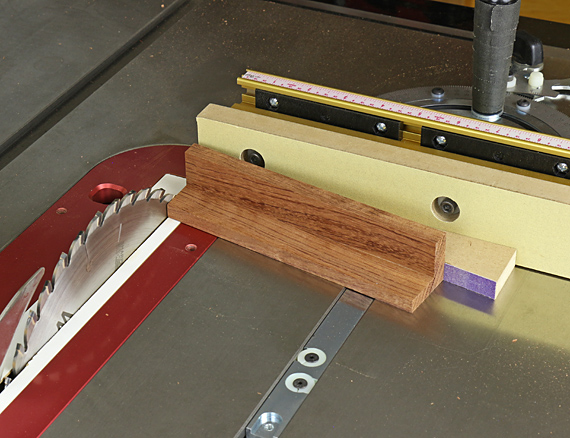
So, prepare by making a wedge. Use the miter gauge to cross cut a squared edge on a piece of scrap or MDF. Then set the miter gauge at the desired dovetail angle and cut off a narrow wedge. Glue sandpaper to the angled edge, and to the straight edge if you don’t have sandpaper on your miter gauge fence.
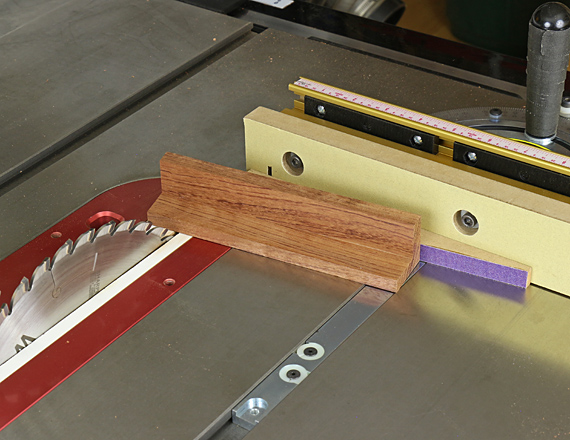
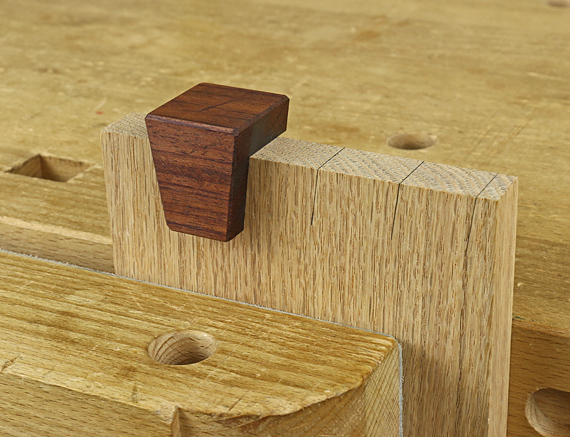
Use the wedge against the miter gauge fence, set at 90°, to cross cut the end of the work piece held against the wedge. This creates one side of the marker (as in the photo at top). Then, flip the wedge end for end, and cross cut to produce the finished marker about 1 1/4″ wide (as below).
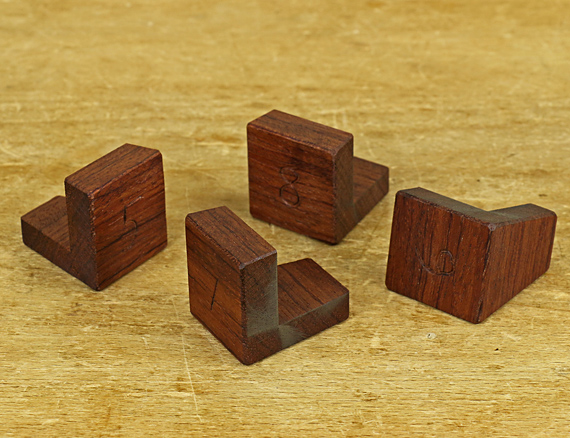
Check the marker with a square and bevel gauge. Both sides should be the same. Chamfer the non-working edges on the outside. Label it with the dovetail slope – I carved the numbers. The oil (non-film) finish has worked well over the years.
Make dovetail layout easier and speedier with these shop-made markers. I have been using them in my shop for many years.
Unlike most commercially produced markers, they allow you to pencil the entire length of the line on the end grain and face grain with one positioning. This produces an accurate alignment of those two lines, which in turn helps you saw accurately. They work for tails-first woodworkers as well as pins-first iconoclasts.
The outside dimensions are 1 1/2″ tall, 1 3/8″ deep, and about 1 1/4″ wide. There is 1″ of length on the inside of each arm of the marker, which will accommodate almost all dovetailing for most woodworkers.
They are easy to make in a variety of dedicated dovetail slopes. No more setting a sliding bevel.
You can also use them to square the pin layout on the end grain (that you transferred from the tails) down the side of the pin board with a pencil to help guide your saw.
Note that there is no “relief” at the inside corner of this marker. All the working edges are crisp. A relief at the inside corner, though present in many, if not most, commercial markers, is unnecessary and misguided. Come on, who has “saw whiskers” on the pieces they are about to dovetail? The relief causes a break in the pencil line at the corner of the work piece, thereby disturbing an important visual link for guiding the saw.
The construction method makes these markers as accurate as anything you can buy. And, of course, the cost to make them is negligible.
I detailed their construction in an article in Popular Woodworking magazine, November 2009, issue #179, but now I will present show the simple process here on the Heartwood blog in the next post.
In writings from the 1970s and 80s, Charles Hayward, Ernest Scott and others discuss using shallow saw kerfs to mark the tail layout onto the endgrain of the pin board. The idea is to drag the saw through the tail kerfs, which act as guides. There is no instruction to laterally displace the tail board to compensate for the width of the kerf, and so the intention is to saw to one side of the mark.
I find it difficult to start the cut by following such a mark. Moreover, if the start of the cut is imperfect, it is too easy to become disoriented by the hacked up endgrain surface. I do not like or use this method.
A better method is to use shallow kerfs to guide the placement and engage the saw as you start to saw the pins. Of course, you must laterally displace the pin board to compensate for the kerf thickness. Otherwise, the sockets will be too wide by the amount of two kerf widths.
I do not know who first came up with this method. I first saw it on Kevin Drake’s website. More recently, dovetail master Rob Cosman, who mentions that he learned it from The Encyclopedia of Furniture Making by Ernest Joyce, has taught it. I suspect that like most woodworking methods, it has been around longer than we realize.
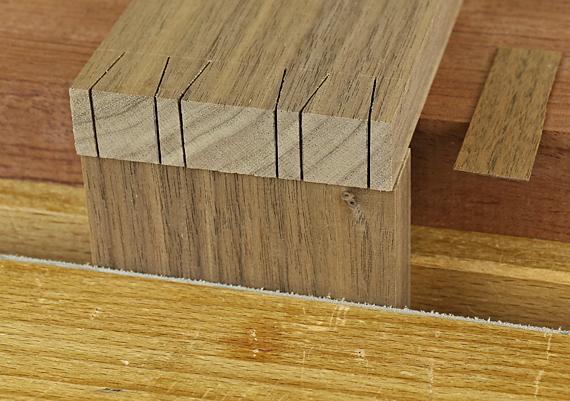
In the demonstration photo above, the tail board is shifted one kerf width to the left to prepare for making marks through the kerfs on the right side of the tails. This puts the kerf marks in the waste wood of the sockets on the pin board.
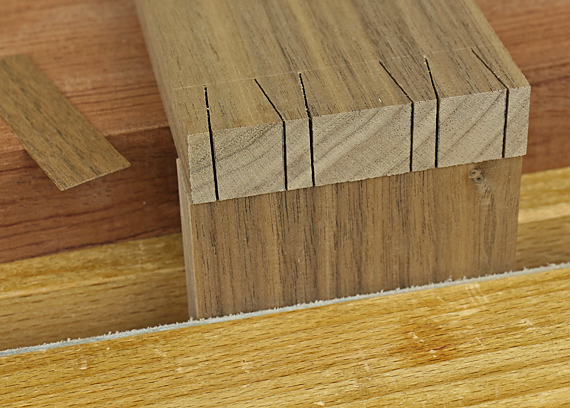
Below, the tail board is shifted to the right for making the marks through the kerfs on the left side of the tails.
To gauge the shift, I used a shim that is a tight fit in a kerf made by my dovetail saw. You can regulate the tightness of the joint and/or allow for a margin for error by adjusting the thickness of the shim. Making a slightly thicker shim (say .002″ or a piece of Scotch tape) will make the sockets slightly undersized. This may be good for softer, more compressible woods.
Make the kerf marks before sawing or chopping out the waste between the tails. This gives you a tighter guide. Note that you have to saw the tails square or at least to a one-sided tolerance.
You will need a specialized tool to make the kerf marks. With a Western saw, it is impossible to make them on the push stroke, and slow going on the pull stroke unless the wood is quite soft. Japanese saws do not work well for this because the teeth do not extend to the toe of the blade.
Kevin Drake’s system uses a hawk bill scraper, which acts as a saw with a single big tooth, while Rob Cosman sells a nifty marking tool that is essentially a tiny pull-stroke saw with the same kerf width as his dovetail saw. Note that Drake’s system uses a special dovetail saw with no teeth at all at the toe to aid in registering the saw in the kerf mark.
Unlike when using a scriber or knife, it is easy to inadvertently shift the tail board when making these pronounced marks in the pin board endgrain. A dovetail alignment board of the sort used by David Barron is one way to minimize this. This tool is a great aid to dovetailing no matter the transfer method you use.
Another method, is to make a very shallow rabbet (1/32″ is enough) on the inside face of the tail board. This gives a dead-on, steady alignment of the tail board against the pin board. I really like this trick for dovetailing in general and use it especially for wider boards. I recall first learning it from an article by Rob Cosman in Popular Woodworking (April 2006), where he notes that he learned it from Ian Kirby.
Remember, any method of marking out the pin board goes better if you are working on cleanly sliced endgrain, at least from the table saw or, better, from the shooting board.
So, there you have it: three posts on the critical step of transferring the tail layout to the pin board. I suggest experiment and choose what works for you! My go-to method is still the scriber. I cut my first dovetails 40 years ago but I still like to explore and refine different methods. I’ve only experimented with the kerf mark method, but I may adopt it for some circumstances. I like having options as various woods and constructions favor different methods.
Continuing the topic of transferring the layout of the sawn tails to the endgrain of the pin board, the purpose of these posts is not to argue for the superiority of any one method but rather to array the options to help you choose what works best for you and the specific project at hand. I vary my method depending on the species of wood, the type of dovetail (e.g. through or half-blind), and the thickness of the wood.
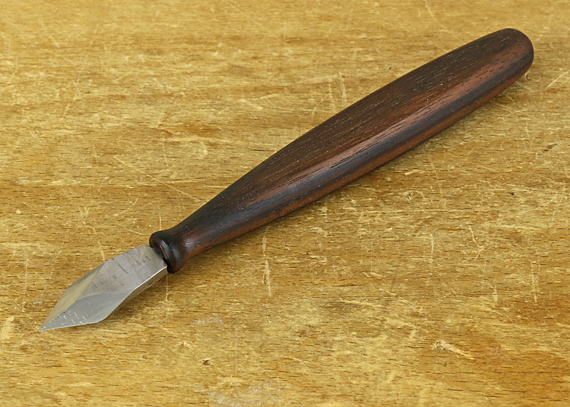
V-point knives seem to be popular for this task, especially thin models that can slip in between narrowly spaced tails, such as the beauty made by Blue Spruce. Without a doubt, many highly skilled woodworkers produce excellent results with these tools, but I find it difficult to see the knife line.
I do not mean that it is difficult to see the fine knife line at first, but when I start sawing across the endgrain, I cannot visually keep track of that skinny line to confidently split it with the saw. Chalking the endgrain is not much help. The scriber makes a V-groove that I can track and split better while sawing, and furthermore allows me to better see how I’ve done afterwards. I also find that a V-knife sometimes catches the side grain of the tail, slicing off a hair of it and slightly dislocating the layout line, albeit in the safe direction.
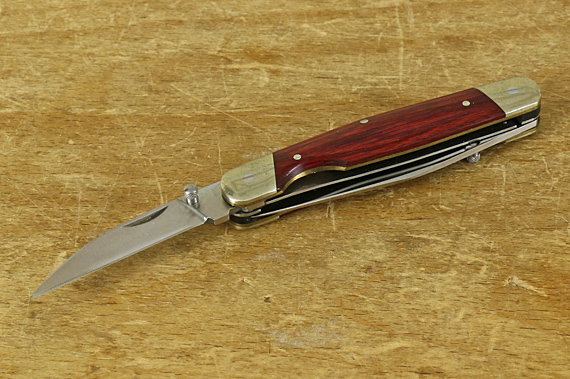
Ian Kirby, one of my all-time favorite woodworking teachers, has favored a pocket knife for this task. This is not my preference but again, it is another option to consider. The sheepfoot in your three-blade stockman or a Wharncliffe blade like in this lovely Kershaw would be good choices for this because it is easy to reach the tip all the way out to the base of the tail.
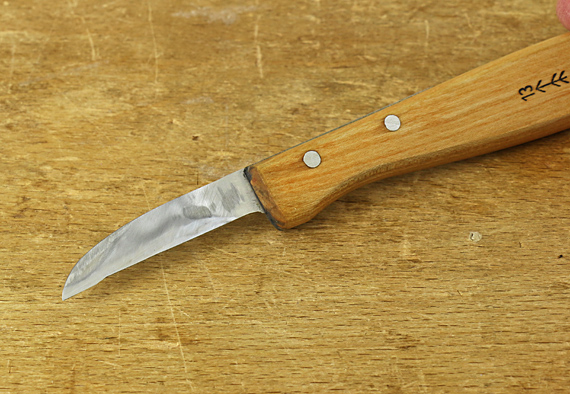
One knife that I sometimes use is my modification of a Pfeil #13chip carving knife. I removed the edge and a bit of the width from all but the first 1/4″ of the blade. I also ground the sides to a nearly flat single bevel. (The Pfeil #3 knife would probably also work.) I find this modified tool very easily reaches to the base of the tail and follows the wall of the tail with very little tendency to slice into it. So, I like it better than a V knife but I still usually have the dilemma of following a pretty fine knife line.
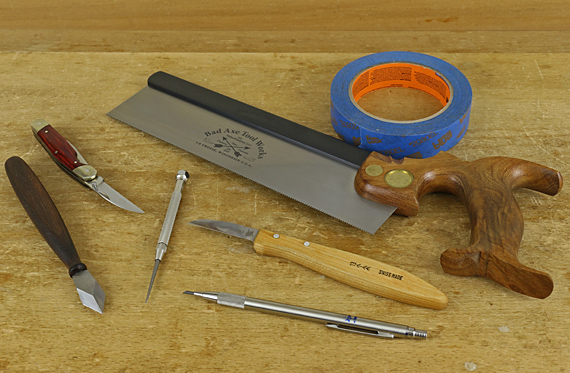
What about the roll of blue tape in the photo in the previous post? Mike Pekovich, Creative Director of Fine Woodworking magazine, and a very skilled and thoughtful craftsman, covers the endgrain of the pin board with blue tape. (FW #240) He then knifes the tail outlines into the tape, removes the tape over the waste wood, and saws just adjacent to the remaining pieces of tape, which represent the pins. Clever!
I experimented with Mike’s method. It surely has merit, and some will love it, but I am not comfortable with it. The pieces of remaining tape can move, especially if you knick them while engaging the saw, and when they do move, I’m lost. I also do not feel comfortable with a piece of tape determining the registration of the saw. But give it a try, you might like it.
A critical step in hand-cut dovetailing is accurately marking out the second piece – usually the pin board – from the completed first piece – usually the tailboard.
Sure, to make a good dovetail joint, you have to be able to reliably saw to a line and chisel to a line. You also have to understand the mechanics of the joint to appreciate how to tweak the contact surfaces and where you have a bit of tolerance and where you don’t. But if the transfer step is inaccurate, it’s all a losing battle.
So, let’s look at several options.
Keep in mind that all of this depends on several variables including pin width, the texture of the wood, and your personal eyesight, lighting, type of saw, and technique. An effective marking out in cherry using a ripcut dozuki may be difficult in red oak using a Western backsaw.
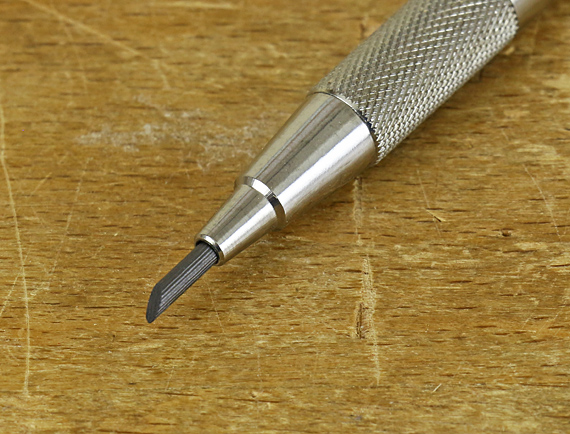
A plain old pencil seems too crude for the precision required in dovetailing and yet it can work well for some. All of the pencil mark is in the keeper wood, so you have to saw to one side of it without touching it at all. A very clean, consistent line gives the best chance for success. A 2mm drafting lead sharpened on 320-grit sandpaper to a chisel point (above) can produce an almost knife-quality line, especially with 2H lead on a diffuse-porous wood like cherry. That said, a pencil is not my preference.
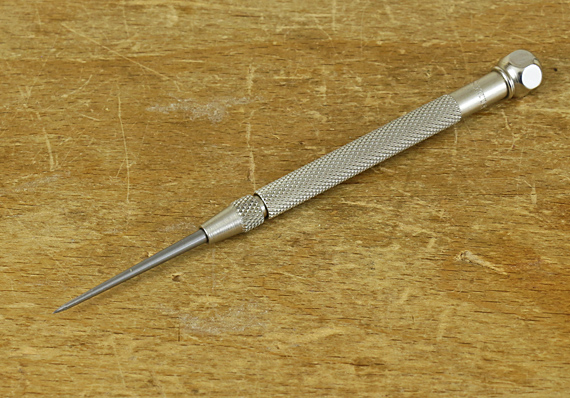
I’ve used a scriber more than anything else for this job, perhaps because that is what I used long ago while learning (first learning, that is). I prefer the type of point on the Starrett scriber (above), which ends in a small, straight conical taper. Unlike a gradual curved taper, I can clearly tell when the scriber is or is not up against the wall of the tail wood.
Used properly, the scriber point hugs the wall of the tail wood as it bites into the endgrain of the pin board, without any chance of it cutting into the side grain of the tail as a knife might. Thus, the bottom of the tiny V groove created by the scribe point is exactly under the tail wood wall.
This works best if the sawn (and possibly pared) surface of the tail is straight and clean. Otherwise, the scribed line will be not straight and therefore probably confusing to follow with the saw.
I have found the scriber effective in ring porous woods like red oak as well as fine, diffuse-porous woods like pear. The downside is the scribed line is not quite as clean and fine as a knife line.
Next: a look at different marking knives and more.
By the way, go here for my free 42-page Dovetail Instruction Guide that I wrote several years ago for Craftsy. It really gets down to the sawdust and shavings to lead you to success.
A good craftsperson never stops learning, so I have the habit of taking stock after completing a project to see what it has taught me. Often it is just a matter of reinforcing or reminding myself of things I already know – or “should know by now.” Here are some views from the caboose after a recent project.
1. It is so important to develop a solid design concept that you can trust throughout the tribulations and vicissitudes of building a project. Woodworking is not easy to do well, so you need the power of that concept to sustain your energy and optimism.
2. Make sure the design is good. You may need to redesign. Often, your early, unexamined assumptions are the most likely candidates to need refinement. Do not obsess, but do get it right.
3. 3M sandpaper products – regular sheets, flexible sheets, and random orbit discs – are flat out superior, and I see no point in using anything else. I can feel this stuff bite the wood like no other brand of abrasive that I have tried. Sandpaper is a tool.
4. Live edge wood furniture remains extremely popular, and I appreciate its appeal. But for now, I’m tired of it. I also have low regard for tables that consist of nothing more than a non-descript base under a slab.
5. Every effort in accurate, thoughtful stock preparation will likely be rewarded downstream in the building process.
6. Stock thickness disappears startlingly fast. Cupping, defects, and especially the dreaded twist, conspire to seemingly evaporate thickness. We are less likely to need a magical Board Stretcher than a Thickness Inflator.
7. Fiddly things drain energy and wear you down. These are things like altering hardware, fixing defects in wood, and finishing quirks. Plan to avoid them and find a better way.
8. The few minutes after making a mistake is the riskiest time for making a bigger mistake, maybe even the Big Mistake. Take a break, step back, and think.
9. I think it is true: if I were to make this again, I could do it in less than half the time.
10. Krenov was right: “Worry less, concentrate more, and above all, relax.”
Best wishes to you with your projects, and I hope you never stop discovering.