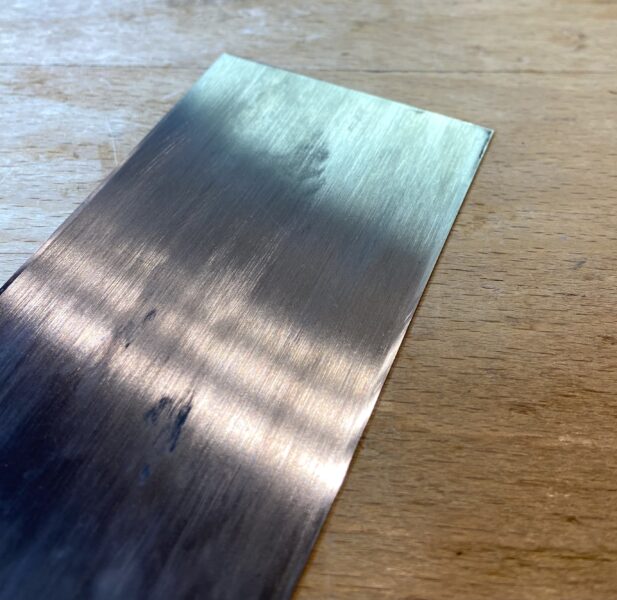
Now let us consider tuning up the hand scraper. Despite what you may have heard, read, or viewed, this is not a difficult task. What makes some demonstrations and discussions confusing is not presenting a simple understanding of exactly what you need to do with the scraper steel. Most demos do not clearly state what the actual task is for each step.
In the next post I will show and discuss the actual tasks being done. In this post, I will state what is done to the scraper metal at each stage.
First, the sides and the skinny edge must be made flat and smooth. You do this because the steel is not manufactured smooth enough. That is ok. They should also be approximately square to each other. The surfaces should be honed to at least 1000 stone grit. Better is about 4000, even more.
Second, compression should be applied to the side faces, just near the edges. Push hard on the steel repeatedly.
Third, the edge itself should be burnished at an angle – to create the hook which is used to cut wood – scraping.
That’s it. Done. There are variations and alternatives to achieve each step. These steps are not fully repeated for every sharpening. Every three or so sharpenings, however, require going back to some of the earlier steps.
Coming up, I will show how I do it. There are other equally good methods and helper jigs to achieve the same principles.
When you see – and understand – what is going on, you can alter the methods and probably come up with some of your own.
