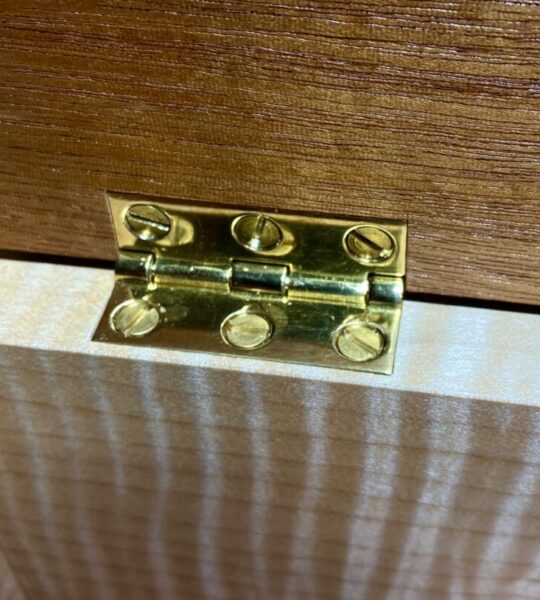
If you are going to put a lot of work into making a nice wooden small box, you might as well use fine quality hinges and possibly other products.
So, let us go through options of hinges, lid stays, and locks. I will make recommendations. I will hold off discussion of feet, nobs, and latches.
Most woodworkers make a box, sooner or later. So here we go . . .
Hinges
You can use regular style hinges, widely available in good quality, that allow you to open the box lid 180°. Since you usually want to stop the opening range at just over 90°, you would need to install a stay mechanism. I will get to that later.
I prefer to use a hinge pair that will itself stop the lid from opening further at slightly greater than 90°. The two best available options are from England. smartButt hinges have clever, elegant round knuckles that stop the opening at 93°. (See the photos at the top of this article and just below this paragraph.) (By the way, there are some shadow images in the top photo; not an imperfect fit!)
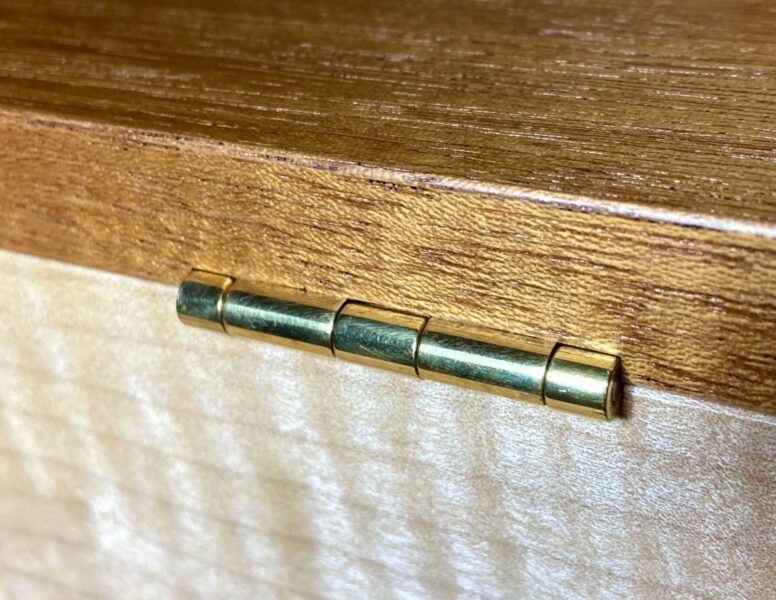
The other great option is smartHinges. (See the photo just below this paragraph.) These go on the side pieces of the lid and body of the box. These also stop the lid opening at 93°. You can easily and entirely use a router table to fit them. Note that the wood grains in the tops of the sides of the lid and the frame sides should go front to back. This is to avoid tiny short grain at the outer edges of the hinges.
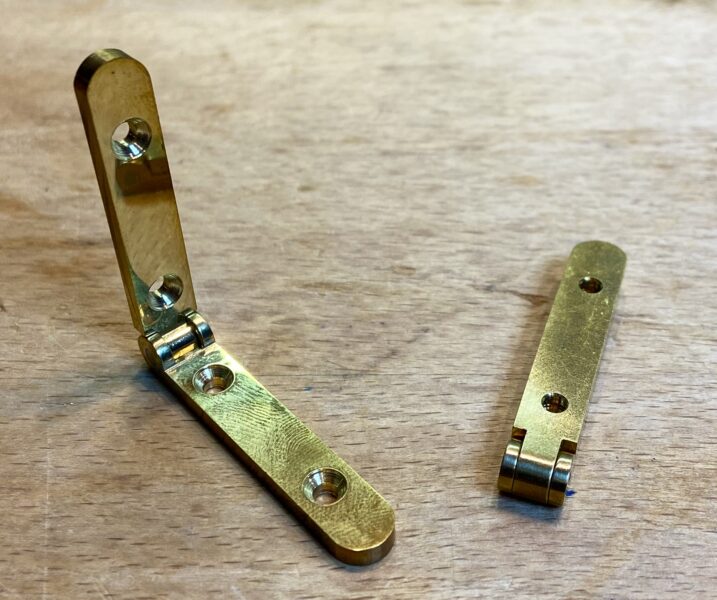
The two excellent types of hinges are available from the great box maker Andrew Crawford at smartboxmaker.com.
Also nice, but without the same elegance of Crawford’s hinges, are stop hinges (photo just below) and side rail hinges from Brusso (brusso.com).
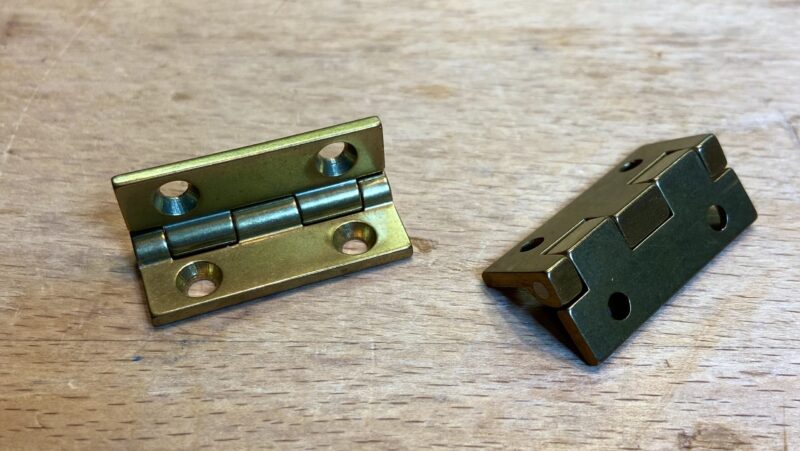
Brusso also sells quadrant hinges. I have an example of this type (not Brusso’s) in the photo just below. These also control the lid opening but I think are harder to install than the options mentioned above.
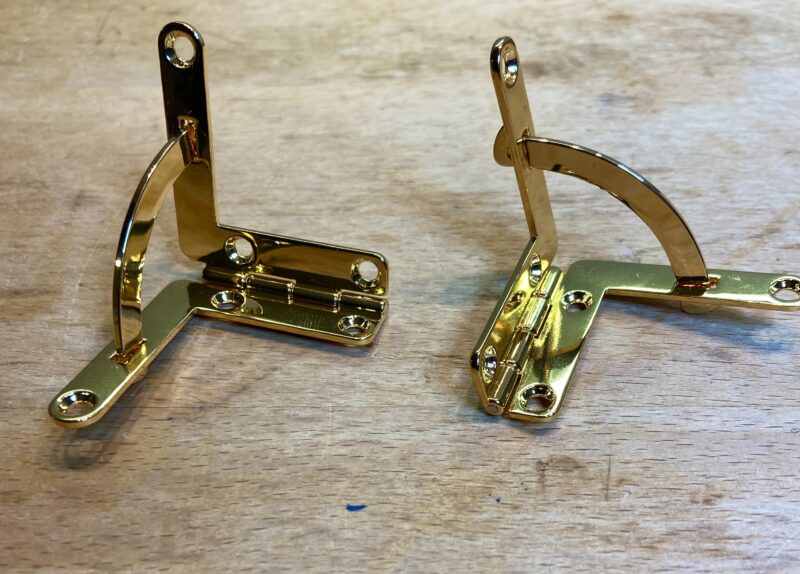
Separate lid stays on the side
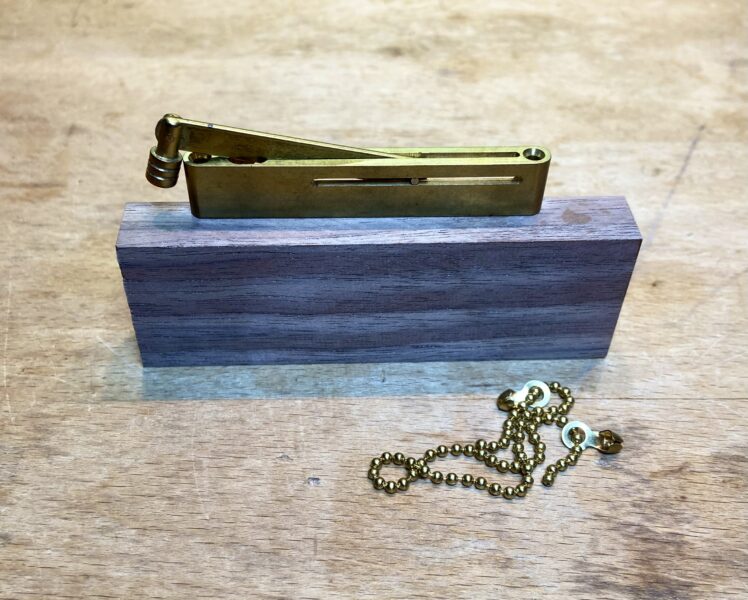
Ok, if you nevertheless use hinges that do not themselves fix the lid open, you will probably need a lid stay on the side. There are numerous choices but I think Brusso’s lid stay is your best option.
You can also use a string made of metal beads, cloth fiber, etc. This is a bit floppy and not my choice.
(Photo just below.)
Locks
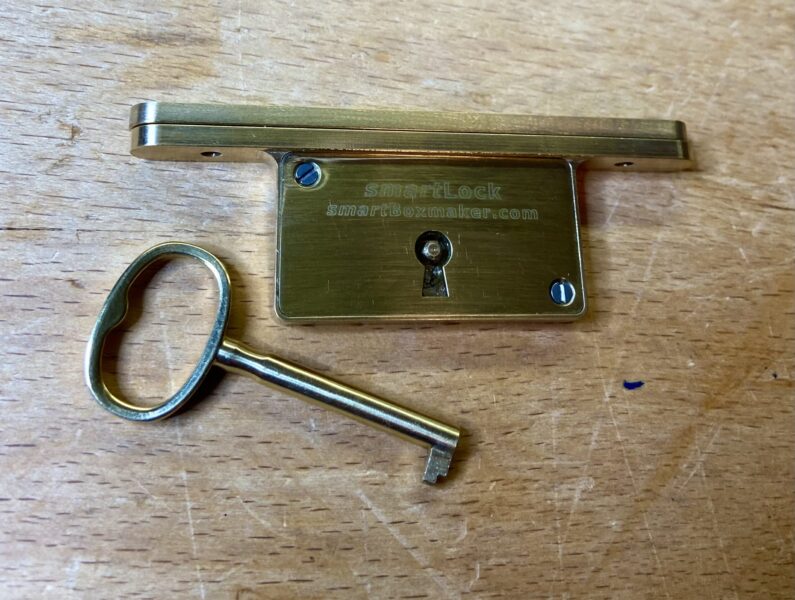
This is not strong security in your wooden box but is a nice image you might like. Again, I recommend the fine smartLock. Lee Valley has a good variety though less exquisite. (Photos below.) Don’t loose the key!
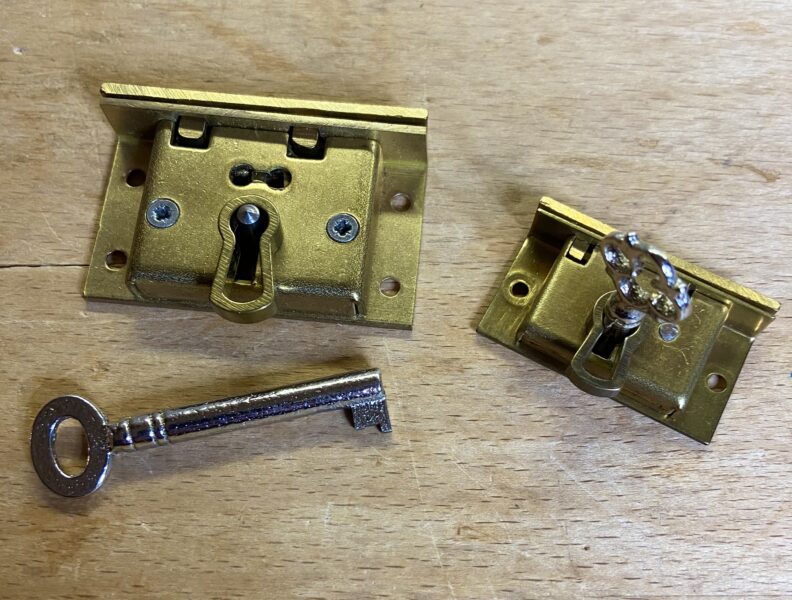
Brusso has a nice button latch for the box front, though not a lock.
So there is a quick summary of box parts that you can install. You are going to go through careful, detailed work that you want to make really nice, so install excellent parts to refine your work.
Enjoy!

Thanks for this post. It’s a very nice summary. Another company that I’ve bought a lot of hinges (and shaker knobs) from is Horton Brasses. Excellent quality and costs less than Brusso.
Hi Joe,
Thanks.
I agree, Horton is very good. However, they do not sell, as far as I can find, the special types of hinges for boxes that I discussed.
Rob
These are the ones I used from Horton Brasses and they are called a stop hinge. They don’t have a lot of options but this size works well for smaller boxes. I used them to make a tea box. Links below for the hinges and one of my blog postings. If I hadn’t used them I’m not sure I would have found them on Horton Brasses website. Their search feature isn’t very good.
https://www.horton-brasses.com/shop/horton-brasses/hinges/clock-box-hinges/4-8-stop-hinges/
https://joeswoodworkingjourney.blogspot.com/2022/03/tea-bag-box-part-3-sawing-open-carcass.html
Got it, Joe. Thanks!
Now I see what you point out from Horton, along with the larger sizes of that type that are available.
I will say that I don’t think they are as nice as SmartHinge or Brusso.
Rob
Hi Rob,
I haven’t used Brusso as typically too expensive but they do have top notch products for sure. Haven’t used SmartHinge or seen them. Will have to keep an eye out for them.
Sincerely,
Joe
Yea, Joe, the quality is well above what Horton has. SmartBoxMaker.com is tops. And Brusso is also good.
Enjoy building!
Thank you, Rob, for featuring my smartWare here!
Interesting to see this conversation about Horton Brasses. The hinges you mention, Joe, and I’ve seen on your blog, look like the stop relies on a square knuckle. But it’s impossible to tell from the one image provided on the HB site, and to my mind it’s a very important detail! I have always considered a square knuckle to be an unsatisfactory solution, which is why I developed my smartHinge [side rail] and and smartButt [stop butt] hinges, both of which Rob has highlighted above. These both rely on an internal stop contained within, crucially, a round knuckle. I believe this to be a superior solution, albeit that they are not mass produced and therefore more expensive.
Ok, readers, now you have heard it directly from the master.
I, too, will be clear: the smartHinge and smartButt hinges are the best available box hinges. I suggest that you bring your box work up to that level.
I can vouch for Andrew Crawford’s SmartHinge design.
Although I haven’t made many boxes these days as I’m busy with other projects I do love using his hinges and in the past was a bit concerned for a while back when I couldn’t get any. Good to see them available again now as he has found a reliable manufacturer who can make them to the finest tolerances needed for a great performing hinge.
I love how with his hinges we have the option to cut the ends off square which makes them easier to fit with hand tools instead of having to set up a router and fuss around trying to match the exact diameter of the bit, depth of cut etc.
I also prefer the more traditional square end look as the rounded ends seem to look too modern for me. Setting up the router table is great if you’re doing a few but if you’re just making one box and pretty skilled with hand tools then doing this by hand is more pleasurable in my opinion.
Andrew designed the holes on his to be set back a bit further from the end allowing them to be cut off square. Other makers don’t do this.
Thanks for the comment, Andrew W., and the helpful details.