Archive for the Category ◊ Jigs and Fixtures ◊

Author:
• Thursday, April 09th, 2026

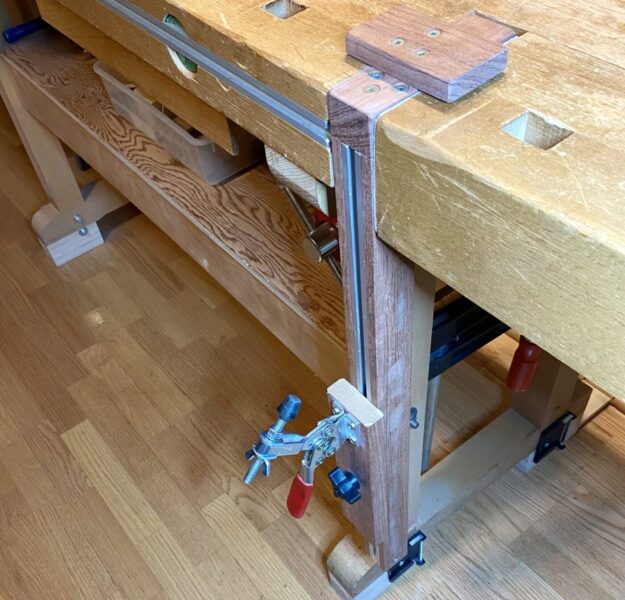
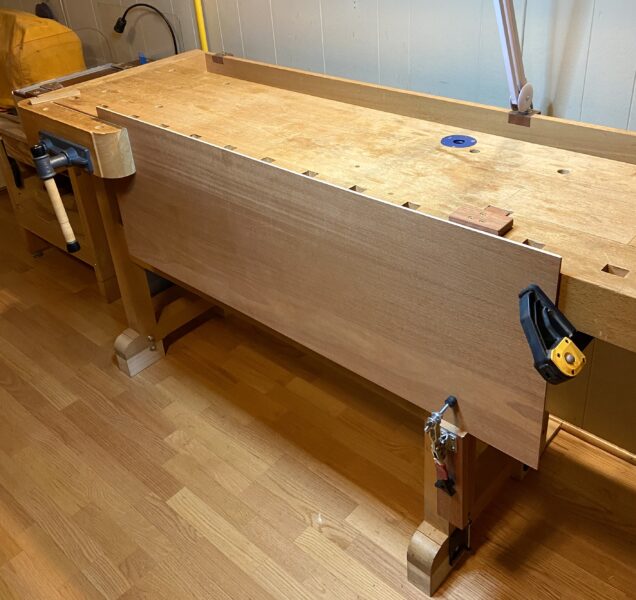
Let us continue with the previous post. If the wide piece of wood being held in the front vice is also fairly long, we need a second system that grips the right side of it. Otherwise, it will tend to slip down due to weight, especially pressure from planing the edge straight and square with a #5 or #7.

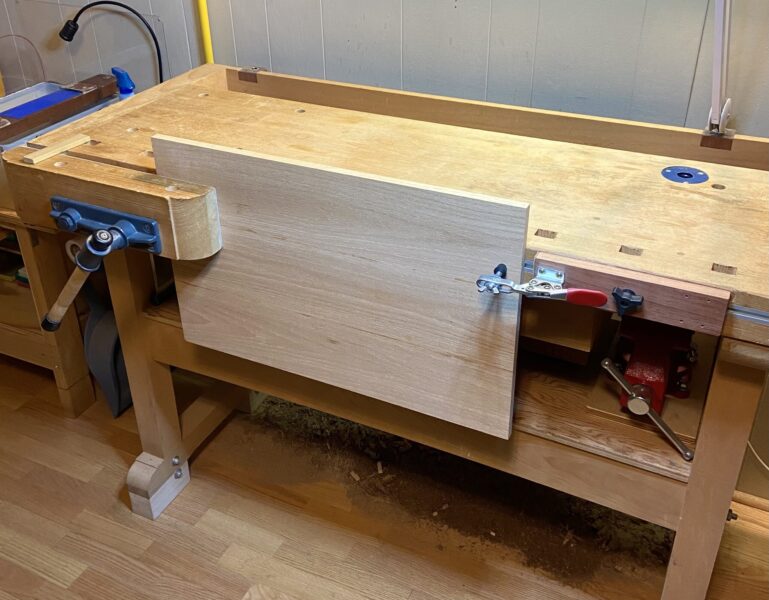
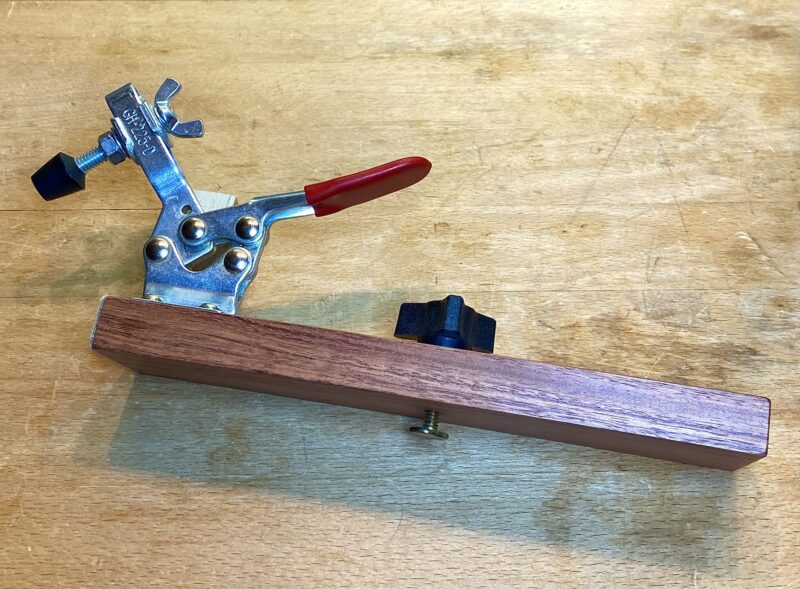
The photo above shows the system in action. 

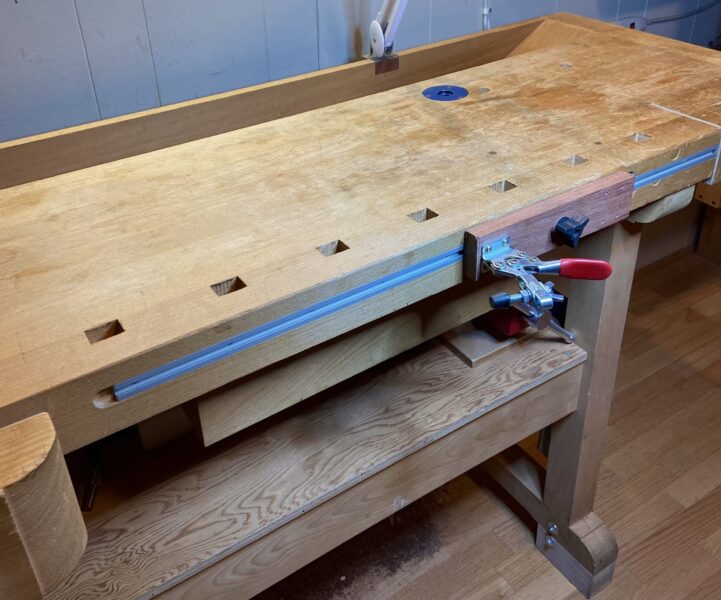
There is an aluminum T-track (“T-slot track”) (3/4” wide x 3/8” deep) screwed into a slot in the bench top made with a router bit. A small space on the left side of the slot allows you to easily enter the clamping device. The slot is not extended into the opening for the right-sided bench vice. The T-track never interferes with any other use of the workbench.

The workpiece is held with a quick-release toggle clamp with an anti-slip tip. It is attached with four screws on a sturdy piece of hardwood 3/4” x 10” x 2 1/4”. The toggle clamp is screwed in near the end of the wood piece.

This toggle clamp is GH-225-D. This holds the work I use.

A 1/4 x 20 x 1 1/2” T-track bolt is at the mid-point of the wood piece. It tightens with a three-branch star knob.

To use it:

Attach the toggle clamp device in approximate position on the T-track. Set the workpiece in the bench vise, using the compensating thickness piece on the left side of the vise (see the previous post), and tighten.  Then set the final position for the toggle clamp and tighten the T-track bolt. 

Then adjust the height of the toggle clamp based on the tightness to the workpiece, set it, and tighten it.  

This system allows adequate pressure to hold the right side of the workpiece. You can work well.

What about larger pieces and needing even more support on the right side of the workpiece? Coming up on the next post!

Author:
• Friday, April 03rd, 2026

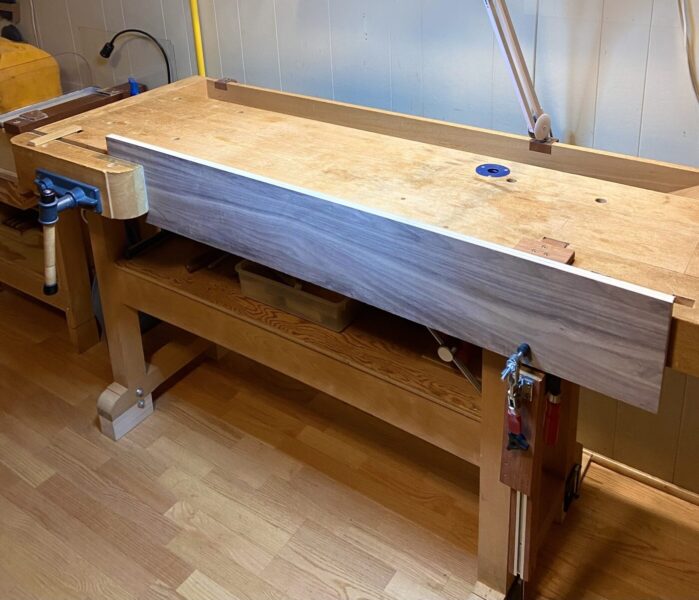
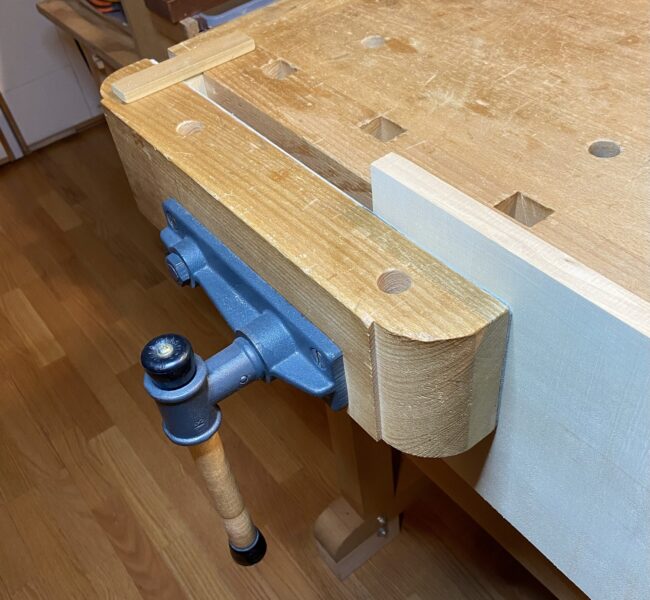
Let’s say you want to hold a wide piece of wood in a classic front vice of the workbench. You probably do not want to grip it in the middle area of the vice because it must be held above the lead screw and guide rod. 

You can grip the wood by the part of the jaw that is fully to the right of the screw and rod. This allows the wood to be lowered to where you want it. It will be held at a much better working height for planing and other tasks. (Exactly what is done with the right end of the wood itself will be discussed in a latter post.)                           

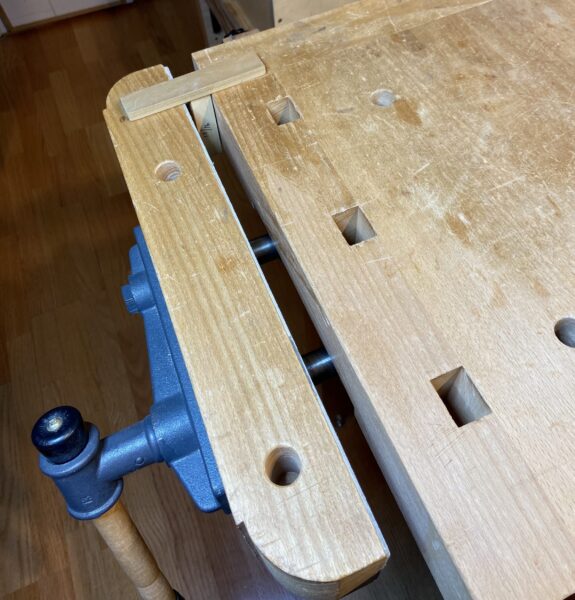
But the problem now comes when the vice is tightened. The empty left side of the moveable vice jaw can curve toward the bench top. This especially happens when strongly gripping thick pieces of wood. When the vise is turned tighter, it actually reduces the area of the pressure contact against the workpiece. (All of this varies with differently constructed vice designs in different benches.) 

Solution? Yes. Easy!

You just put an approximately matching thickness piece of wood in the left side of the jaw. This distributes the tightening pressure against the bench from the right and left ends of the vice. The vice stays aligned and, most importantly, the work wood is gripped more securely and evenly.  

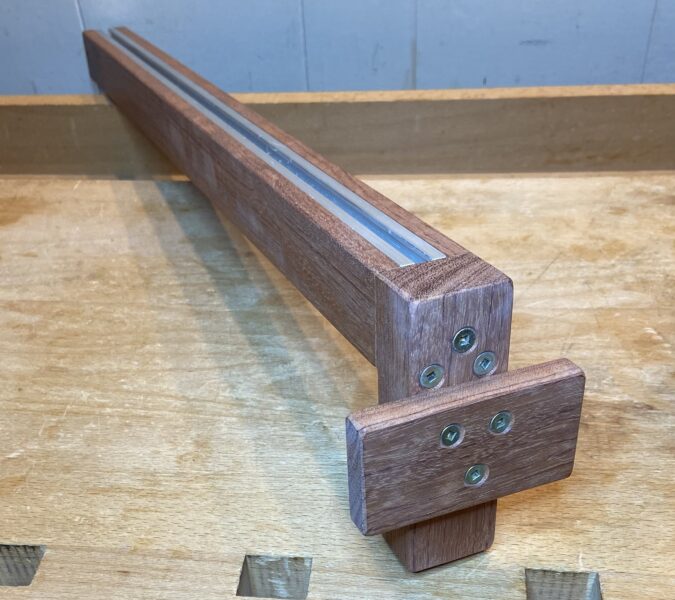
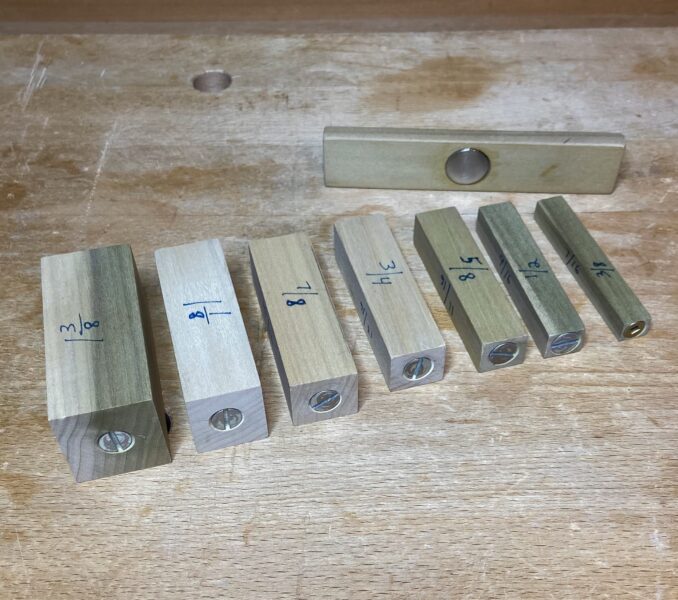
You do not have to hold the matching piece there when tightening the vice. A wide cross piece grips it with a magnet and keeps it there. (See photo above.) So you place it, let it go, and then place in the work piece on the right side of the vice at whatever height you want. 

I have a small collection of gripper pieces, from 3/8” through 1” in 1/16” intervals, and 1 1/8” through 1 3/8” in 1/8” intervals. That is 14 sizes that covers thicknesses within 1/32” of most work pieces. Close enough to work.

They are 3” long with a flat head screw in one end to grip the holder top piece. The holder is 5” x 1” x 3/8” with a 3/4” diameter magnet at the center. The grippers get stored in the bench drawer, and the holder gets stored at the head of a flat screw leveled into the side of workbench. 

This is very easy to make and use. It really improves the performance of the bench vise.

But what do you do with the right side of that long workpiece which has its left side securely in the front vice? 

Answers in the next two posts coming up! 

Author:
• Tuesday, March 31st, 2026

We often use the outer edges of the top of our workbench to restrict any movement of a piece of wood being worked on. Let’s go through some handy, practical methods to keep the wood in place. These can all be easily made by you with minimal cost.

The first one is very simple. Sometimes we have a board, thick or thin, that we do not want to clamp down. We just want to stop it from sliding in one direction – for most people, to the left.

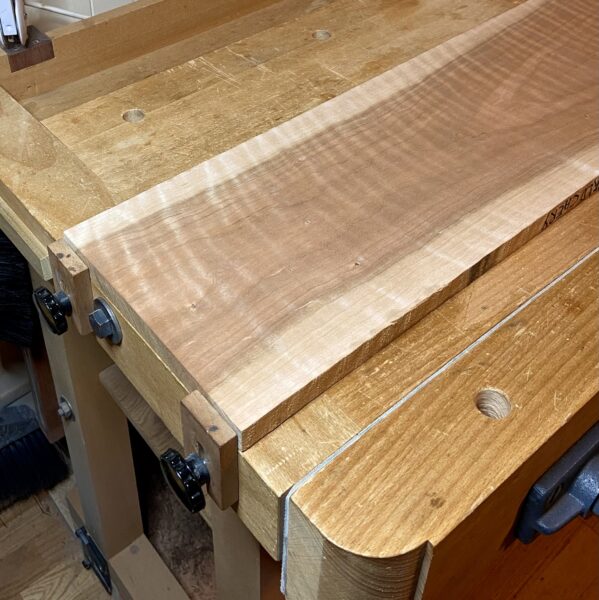
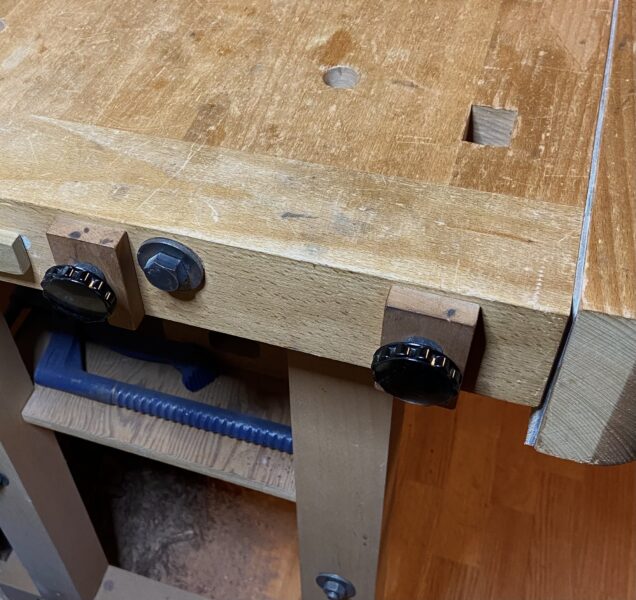
On the left side of my bench, I have two small blockers that can be quickly and easily raised for this purpose. The photo above shows an example of a piece of beautiful cherry in place. The blockers never get in the way when not in use. They have been part of my bench for a long time.

Here is how I made them: 

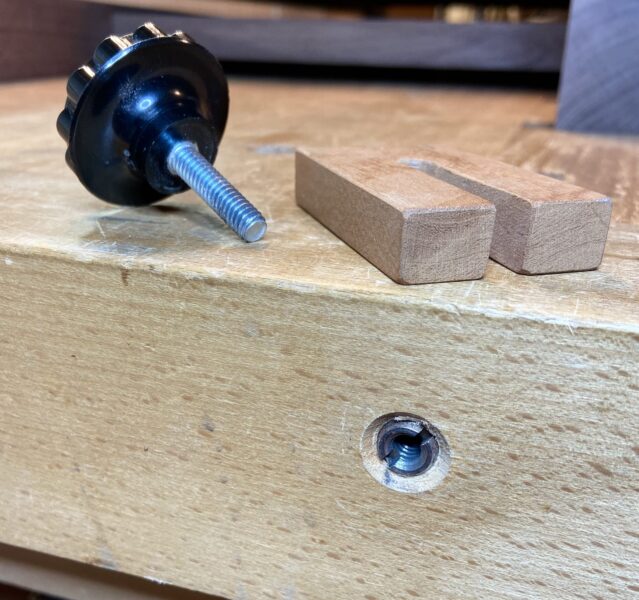
The hardwood pieces are 1/2” thick x 2 1/2” long x 1 1/2” wide. They have a 1/4” wide slot, about 1 3/4” long from the bottom. The main, visible screws have large handles, 1 1/2” in diameter (“star knob heads”), to make them very easy to use. They are 1/4” – 20, 1” long. These are very easy to loosen and tighten.

Those handled screws go into slotted set screws. The set screws sit very firmly in their drilled and slightly taped holes. These are centered about 1” from the top surface of the bench and about 6 1/2” apart. 

We’re all done. This little rig can be used for lots of tasks. 

Another nifty tool is coming up in the part 2 post.

Author:
• Wednesday, November 05th, 2025

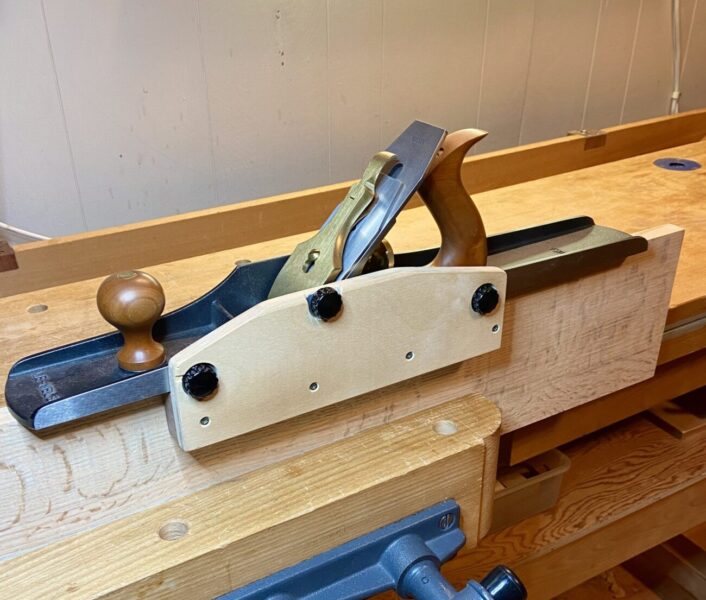
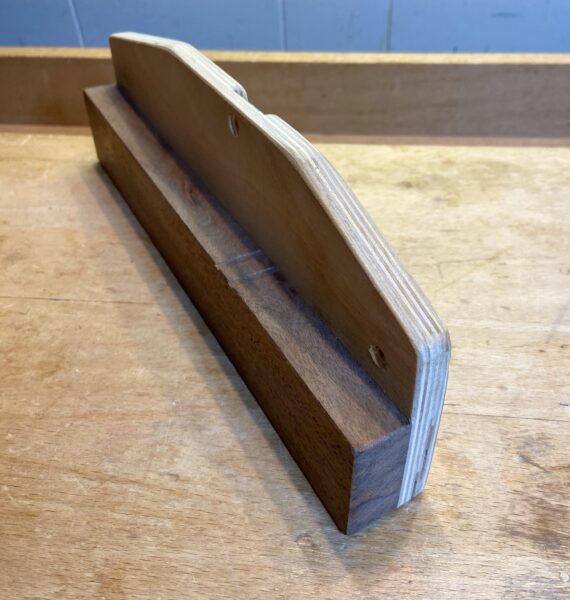
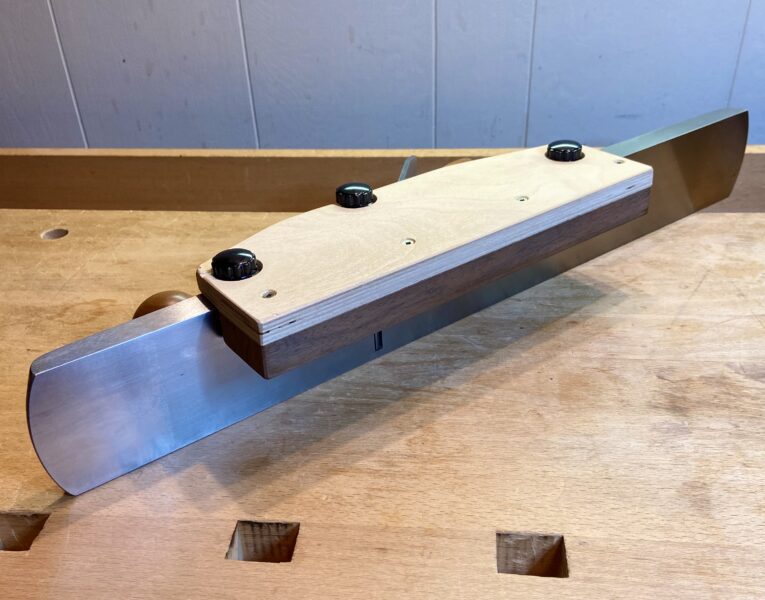
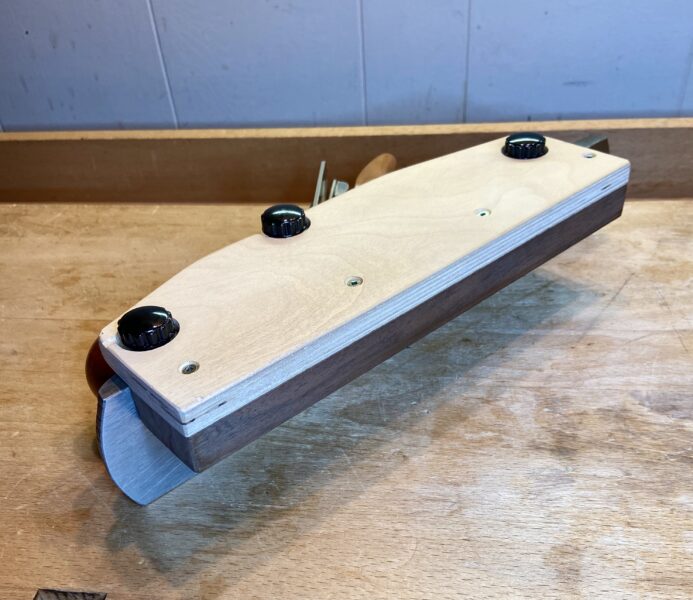
Here is the shop-made fence that I have been using since well before the current manufactured versions became available. It works very well for planing a board to a straight, 90° edge. Here is how to make it.

Start with settled dry wood. I used quarter-sawn walnut with a straight, even grain. It is 11” long, 1 3/4” wide, and 3/4” thick. 

This 3/4” thickness of the guide will center the plane blade of a 2 3/8” wide (14” long) jack plane on a workpiece 7/8” thick. For a 2 3/4” wide (22” long) jointer, the blade is centered on a 1 1/4” workpiece. A better compromised wood thickness for the guide would be about 7/8”. That would center the blade on 5/8” work with the jack, and 1” work with the jointer.

However, the guide wood thickness does not need to be precise. Here is what is important: The jack or jointer blade edge should be correctly exposed in its width. The edge of these blades should be sharpened to extend very slightly more in the center than at the sides. Thus, set up the blade exposure so the cutting edge is very slightly more at the center of the workpiece width, and less at the sides of the workpiece width.

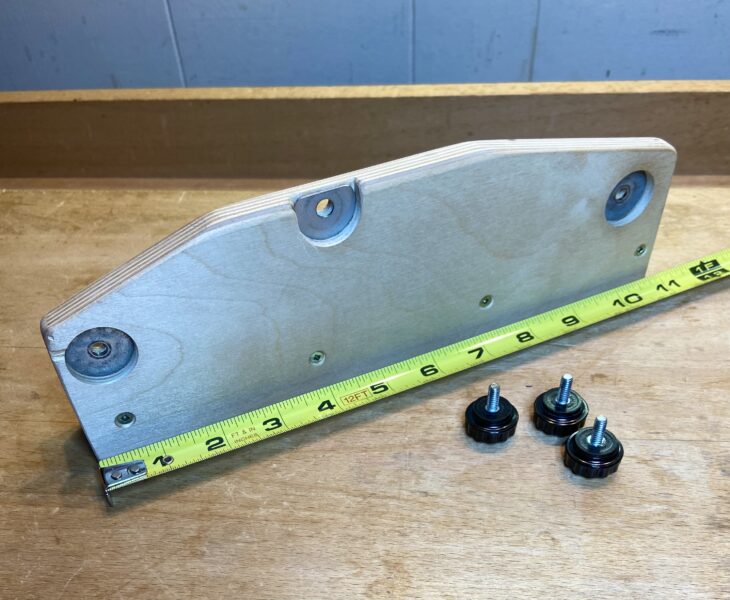
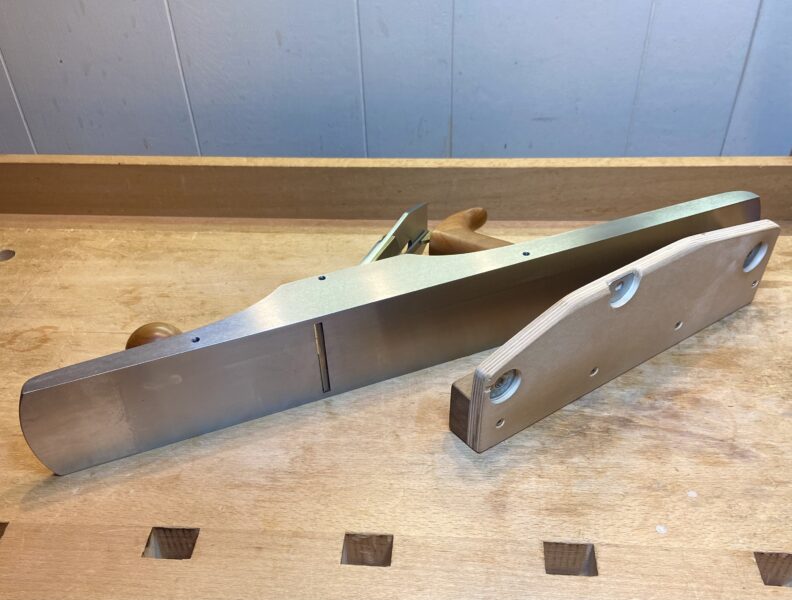
Ok, back to making the guide. See the photos. I used a piece of flat, high-quality, 11-layer, 1/2” thick plywood to attach to the guide wood with four screws. It is 3 3/4” wide, angled at the top edge. There are three 1” wide, 3/16” deep holes at the top to accommodate steel washers, glued in. Corresponding #10-24 1/2” thumb screws pass through the holes and screw into 10-24 drilled and taped holes in the plane wall. 

It takes careful but not difficult work to set up this attachment system. It does no damage to the plane wall if set up properly. 

There are a couple of very shallow, 1/8” wide slots in the top of the guide wood to accommodate the exposed cutting edge in the jack and jointer. 

Additional note: With the new fence screwed onto the plane, check for square between the fence and the bottom of the plane. Carefully plane/scrape the outer face of the guide wood to get it perfectly square to the plane bottom.

To make accurate plane cuts with the guide, it is all about using your hands, shoulders, and body weight. (Assuming you sharpened the blade nicely!) The right hand pushes the plane with the index finger usually extended. The left hand lays over the side of the guide with the thumb at the top and the four other fingers and palm heel keeping it snug against the wood work. 

At the start of the cut, the left hand thumb and palm heel can apply some pressure to the front of the plane. Then, in the long middle range of the cut, both hands keep light pressure over the whole plane. Finally, the heal of the right hand presses down at the curved lower part of the plane handle at the last part of the cut.  

Well, I made this guide tool years before there were factory-made metal guide fences available. If you prefer, check out the several different plane fences made by Veritas: Jointer Fence, Bevel-up Jointer Fence, Technical Fence, Universal Variable Angle Plane Fence, Variable Angle Fence for Veritas Bench Planes, and Variable Angle Fence for Veritas Rabbit Planes. That is certainly more versatility than the basic guide that I show you here, but I still use mine after 40 years for 95% of my edge planing. 

Now you have options. I do suggest to avoid doing the precise planing task without a guide. 

Enjoy the work!

Author:
• Monday, October 20th, 2025

Here is one more thing to add to a manufactured device for sharpening. The previous post explains the issue: for sharpening plane irons that have a slightly curved edge, which is most of them, a subtle curve needs to be added to the roller. (This does not apply to nearly all chisels.)

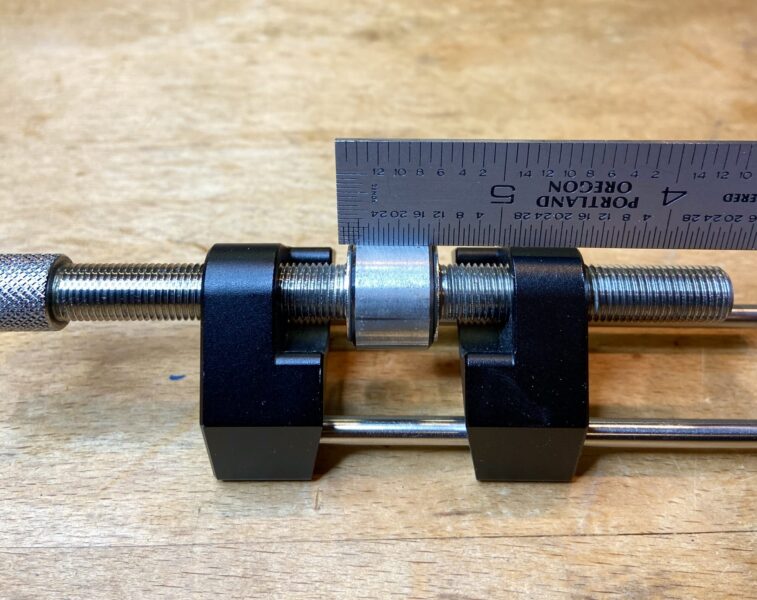
I have two Woodcraft rollers. One is used as is – for sharpening straight edges. (Photo is below.) The other roller is very slightly curved across its width. (Carefully note the photo above.) It was not manufactured that way but was easily done in the shop.

The roller itself is 1/2” wide. Working out the math and using it in practice, reveals that the roller needs to be ground just about .003” on each 1/4” half of the wheel. In other words, from zero at the center point to a maximum curve of .003” shorter at each far side edge. 

An electric motor-rotating wheel can do this. Be careful and keep fingers away from the wheel! (The safety decision is solely up to you.)

Note that you are making a curved angle on each side, not a straight-edge angle. It is easy to do.

This adds a comfortably controllable ability for angling the plane edge on the flat stone. This is far better than trying to alternately angle onto just the outside corners of a regular flat wheel guide. 

This subtly angled wheel will work for almost all of the plane blades. As I have mentioned in the previous post: nearly all manufacturers neglect this important factor. They could simply supply two replaceable wheels or two frame-wheel combinations. (Again, Lee Valley/Veritas is the only manufacturer that I know of that builds in the curvature in one of their wheels. I do not care for their expensive system but I do suggest taking a look online for your choice.)

With all of this said now, I will still say that I do the vast majority of sharpening by the total hand-holding method discussed three posts ago. But now you have options!

Sharpening is a must for good woodworking but not hard to do with the right equipment and skills!

Author:
• Monday, October 06th, 2025

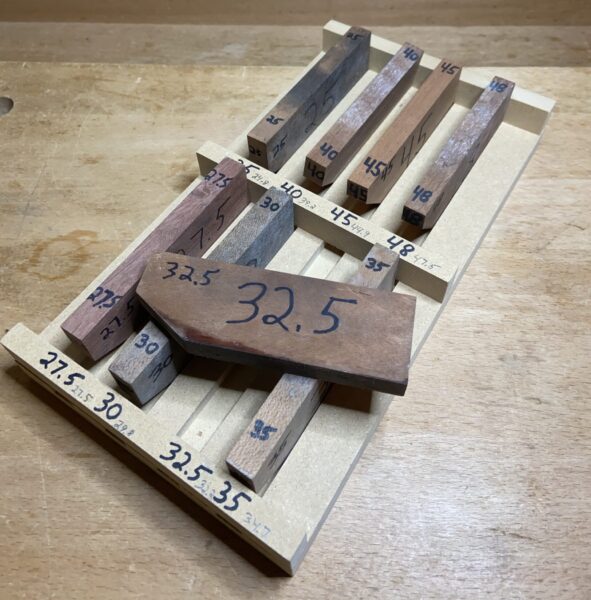
Here are the angle gauges that I use for the method discussed in the previous post. 

The size for all is about 4 1/2” long, 1 1/2” wide, and 1/2” thick  and made from cherry or African mahogany. They about 10 to 20 years old. 

The sharpening angle goes back about 1” for all the angle gauge sizes. Therefore, its height varies based on the angle. Height is about 1/2” for the 25° gauge but 1 3/32” for the 48° gauge. 

Overall, these give working consistency except for the angle itself.

These are easiest to make with the table saw using straight, square, level wood. Please work cautiously! You make the method but work from long pieces so your hands are nowhere near the blade and pushing path. Make no chance of slipping on the angle holding setup. 

I have a spaced holder for them to stay neat and handy. As mentioned in the previous post, I do not suggest going by my nerdy 1/2° amounts for 27 1/2 and 32 1/2. It does not matter. 27° and 32° would be just fine, or whatever else you might prefer. 

Looking at the photo carefully, you can note that I measured the actual angle in each gauge. It is off a bit. That does not matter. I am using the same gauges each time sharpening. 

They will last a very long time.

Next post: to discuss an angle holding gauge which I do use, though as I mentioned in the previous post, just a minority of the time.

Author:
• Sunday, August 10th, 2025

These wooden dogs grip a work piece using the rectangular openings in your bench top. They are easy to make and better than anything you can buy. I only use the steel ones that came with my bench over 40 years ago for very tall pieces of wood.

For the frame, use moderately dense wood, 6″ long. The side width is just under 7/8″ to fit in the width of the 7/8″ hole in the bench top. The front-to-back width is 13/16″ which works well in my bench. The corresponding hole dimension in my bench is 15/16″ in its full linear width, and 7/32″ greater in the upper 1 1/4″ of hight.

Alter the dimensional figures for the dog construction to similarly conform to the criteria of your bench.

Now plane the bottom 2 1/2″ to taper to about 5/8″ at the bottom edge. To that now-angled surface, screw in a 1/8″ strip (see the photos just above and below) of fairly flexible wood that is 1/8″ thick and 5″ long.

Now glue a piece of fairly soft wood, such as pine, 1/4″ thick and 15/16″ long, to the top portion of the frame, as you see in the photos. This serves as the contact to the work piece. Also, the sideways hole in the dog frame allows you to hang it up near your workbench, if you want.

These dogs will stand securely up to about 1 3/4″ above the bench surface. This covers 95%+ of the needs.

Make a pair, finish them if you want, and you’re done! Eventually, you probably will need to replace the 1/4″ heads. Cut the original off, chisel the service clear, and glue on a new one.

The dimensions quoted herein are based on the dimensions of my workbench as described. If necessary, adjust your building dimensions using the same principles to make the dogs fit your bench.

Wood will not get dented by these dogs, and they grip securely. You can easily adjust the hight of the dogs to avoid bumping them with the plane of other tools.

These dogs work. 

Author:
• Sunday, May 29th, 2022

sandpaper cutter

I made this handy sandpaper cutter many years ago but have not until now fully described it here. This post lays out the details if you would like to build your own. I make no claims to originality for this but I have not seen one incorporating all of these features.

By the way, cutting sandpaper with a scissors will quickly destroy the blades, and creasing and tearing sandpaper is slow and awkward especially in coarse grits.

The base is 3/4″ plywood, 13 1/2″ x 6 5/8″. The cutter is a 12″ 14-tpi hacksaw blade. Use a pliers and metal vise to make a small L-shaped kink along the length just inside each end hole to give the blade a slight lift that will make it easier to slip the sandpaper underneath.

Secure it with pan head screws parallel to the edge of the base, then carefully make marks to indicate the location of the teeth. Remove the blade. Draw a line at the marks. It too should be parallel to the edge of the base. 

sandpaper cutter detail

Use cyanoacrylate glue to attach a 1/4″ plywood handle to the hacksaw blade. This makes it much easier to give the blade teeth good purchase on the sandpaper, which gives a straighter, faster, and cleaner cut. 

sandpaper cutter measurer

Use the table saw (alternatively, a router or hand tools) to make 1/8″ grooves, 5/16″ deep, at strategic locations, to house a snug fitting 11/16″-wide slat. [Tip: rip the slat from the edge of a board. On most boards, this will produce a slight bow in the cutoff, which will help it stay in the grooves without being an overly tight fit in thickness.] 

The key measurements are from the teeth of the cutter to the near edge of the grooves/wall of the slat. Below are the dimensions I use, based on standard 11″ x 9″ sandpaper sheets. I drew little visual aids on the base. 

5 1/2″ = half of the length

4 1/2″ = half of the width

3 2/3″ = 1/3 of the length – This produces strips for the cork blocks that I use. 

2 3/4″ = 1/4 of the length – This produces strips for Preppin’ Weapon sanding blocks. 

The line (no groove because there is no room) at 3″ is for my Singely sanding drum. The line for 2 1/2″ strips is for some of my shopmade cork sanding blocks and is the same as PSA sandpaper rolls.  

sandpaper sizing

Reattach the cutter. I added an eye hook for hanging and a larger hook to easily grab the jig from its storage location low down on the wall near my bench. 

To use this nifty jig, slide the sanding sheet, grit side down, under the cutter and against the slat, which is placed in the desired groove. [For the infrequently used dimensions marked with a line only, just bring the edge of the sheet to the line.] Hold the blade down using the handle as shown, and tear. The job goes very quickly.

sandpaper cutter in use

This is an easy jig to make and I think you’ll enjoy the ease with which it handles an otherwise annoying job.

Category: Jigs and Fixtures  | Comments off