Archive for the Category ◊ Techniques ◊

Author:
• Saturday, February 07th, 2026

Consider the strength of the end to side-edge joinery which we have put into three categories: mortise pair and free tenon, Domino, and dowel. 

When did you see a properly made joint fall? I never have in my work. The dowel joint gets the most criticism regarding strength. Let’s discuss that.

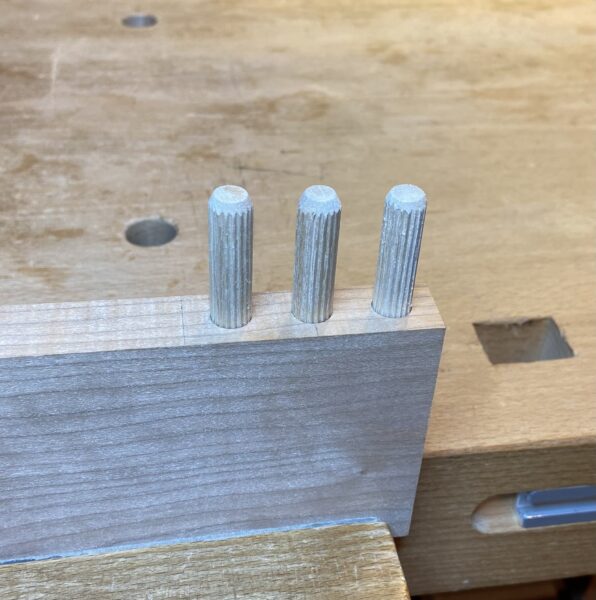
As an example, consider a 2 3/8” dowel joint with three 3/8” dowels that are set 3/8” apart and 1/4” from the edges. (As above photo.) We only need to examine the cross grain part of the joint. The other half – dowel grain entirely inline with the wood grain – will really not break for practical reason. 

Based on the number of dowels and their diameters, the total glue width is 3.5”. As a mortise joint, we are gluing 3.9” width. This assumes not applying glue to flat or curved outer tenon edges to allow space for a bit of seasonal movement. Nor would the bond grip well there. We also assume the depth of the joint is the same for dowel and mortise. 

Also, note that some of the dowel side area, though entirely glued, does not grip as well since it is attached to opposite grain direction. It is hard to say at what stage of the circle this changes for better.

So, the dowels use a little less glue joint area than mortise joints, but not much. Working out a similar example using 1/2” dowels in a 2 1/2” wide joint, gives 4.7” of glue width. The mortise joint has less at 4” of width. 

By the way, wedged tenons – either at the central end or on the sawn and angled wide sides – have a distinct strength advantage. For that we have to award the strength contest to mortise and tenon.  

Basically, to compare mortise and tenon joints with properly made dowel joints is a close call for strength in my opinion. 

The best joint strength contests that I have seen online are done by the DowelMax. They look careful and legitimate. Dowel joints win. Dominos come in third place.  

All of this is not a science project. I simply am saying that joint strength is not a good reason to oppose dowel joinery. Again, it must be properly done, like all joinery. 

Let’s give the appropriate, but commonly opposed credit to dowel joinery: strength. It also is convenient, fast, and cost efficient for good tools. Pieces that I have made months ago as well as decades ago with plenty of dowel joinery have never failed!

Once again, I list the three main joints I use and recommend for woodworking: Pair of mortises with free tenon, Domino, Dowels. 

But which of the three have I now come to choose most of the time? The answer is coming but anyway, my choice may not be your best choice. 

Having a realistic practical choice is what matters for each woodworker. Hopefully this series helps you choose. 

More to come.
Category: Techniques  | 10 Comments
Author:
• Wednesday, January 28th, 2026

Dowel joinery. It takes little equipment. Even beginners can do it with care. Yet among many woodworkers, it just does not get the states it deserves. Let’s consider.

I learned the principle and technique mainly from pages 130 – 140 of The Fine Art of Cabinet Making, by James Krenov, published in 1977 and read by me just several years later. I had Tage Frid’s book Tage Frid Teaches Woodworking first and thought that explained dowel joinery. Despite lots of other great instruction by Frid, the dowel procedures were no match to Krenov’s book.  

I highly recommend reading the late, great Krenov’s work in that book, and his other four books. I will discuss that in upcoming posts. 

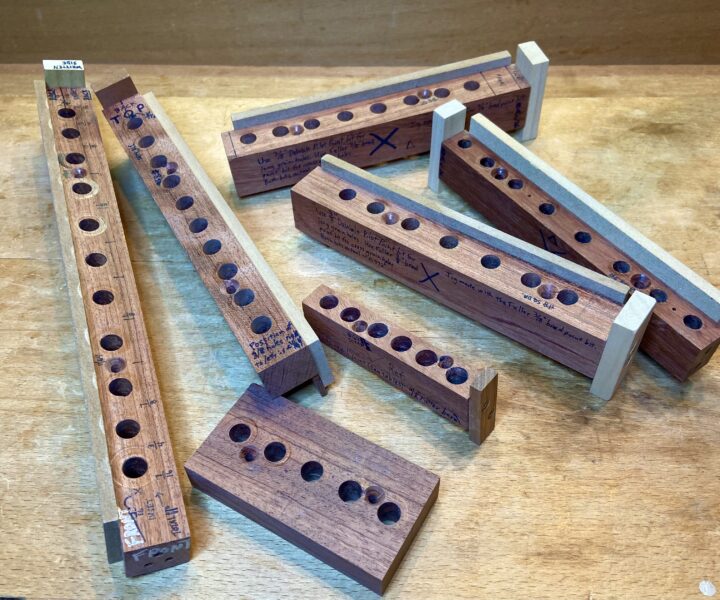
In the photo below, see the collection of remaining jigs for doweling that are directly based on Krenov’s writing. I used these for many years. They worked well. Now I usually use factory made jigs that make the job easier and faster.

There are two main issues with dowel joinery. First, as with almost all joinery, is strength. Bottom line: Yes, made well, they are plenty strong, including compared with mortise and tenon, and with Domino. The best strength assessment based on mechanical destruction that I have seen online is done by the DowelMax man. Find it at dowelmax.com

The second big issue is accuracy. Drilling the holes is easy but the sets of holes on the boards being joined must be placed correctly. In other words, the two groups of holes must align together exactly to allow the boards to join exactly where you want them. Unlike tenons and Dominos, you cannot slice away bits of dowels to allow the boards to shift. Well, you actually can do this a little with dowels but strength is reduced quickly.

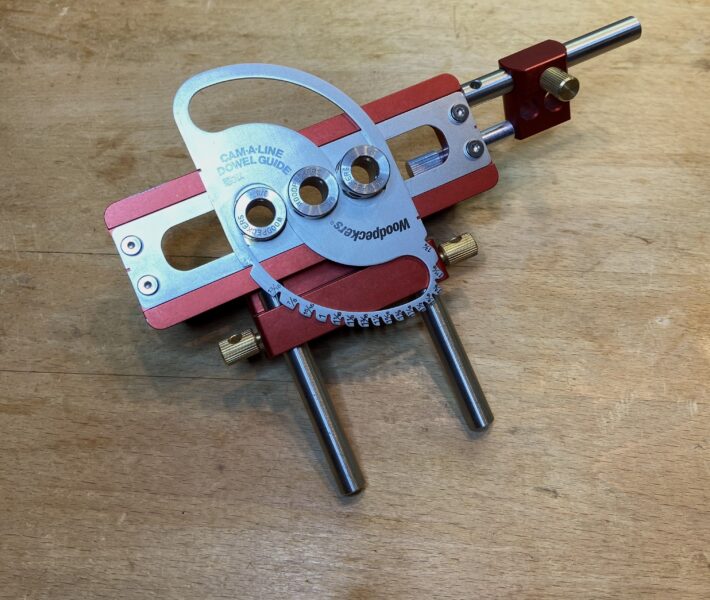
I like the JessEm jig (above) – very straight forward – and the Woodpeckers jig (below) – allows more dowel placement variation and length alignment. DowelMax jigs look great and have some nice placement and angle options. I have not used them but they have great reviews.

So, now we have covered three winning joinery systems which are convenient, strong, and make great woodworking: 

Pair of mortises with free tenon

Domino

Dowel joinery 

Upcoming: More dowel joint strength discussion, angled joints, biscuits, and screws. They all belong in the shop.

Category: Techniques  | Leave a Comment
Author:
• Tuesday, January 20th, 2026

Before we get to dowel joinery and angled joinery, let’s briefly cover some more options for joining with a pair of mortises and a loose tenon.

I mentioned the Multi-Router. It has been around for a long time and now done by Woodpecker. Then there is the PantoRouter, designed by a very clever engineer prolifically online. I have not used either of these. Their prices are large but they probably are great. 

Another remarkable tool is the Leigh FMT. (Photo above.) This makes actual mortise AND tenons. It has precise adjustments for both parts, and a fairly wide range of joint sizes. (Why, I do not know, but I have one, having bought it just days before meeting up with a major brain hemorrhage. See the July 7, 2005 post.) 

I see little point in using the tool to make tenons because, as I have said, I see little point in directly making tenons on a half of the joint. (Free tenons are the way to work with rare exceptions.) And because there is some fairly tedious adjustment to make the tenon match the easy-to-make mortise, it will 99% just be a mortise maker for me to use once in a while. It is very good at angled joints, including mortise + mortise with a free tenon.

I have never used a Rockler Bead Lock. It makes a row of linked mortises, into which loose tenons are inserted. From seeing some demos online and trying to understand how it functions, it is not something that will join my shop.

The Kreg Mortise Mate uses a powered drill bit like a router bit. It makes mortises that are similar to Domino but not as good. Apparently, it is related to a JessEs system. Again, though I have not used one, I am not impressed with the performances that I have seen online, nor with the overall logic of the system. 

Ok, it is now time to bring in the dowel joint – coming in the next post – and after that, I’ll cover the angled joint. The dowel joint has been fighting for a reputation for many decades. It is often highly underestimated! Even James Krenov was a wide user. Discussion coming up next!  

Category: Techniques  | Leave a Comment
Author:
• Friday, January 16th, 2026

Progressing in the discussion of mortise and tenon joinery, it is now time to bring in Domino. 

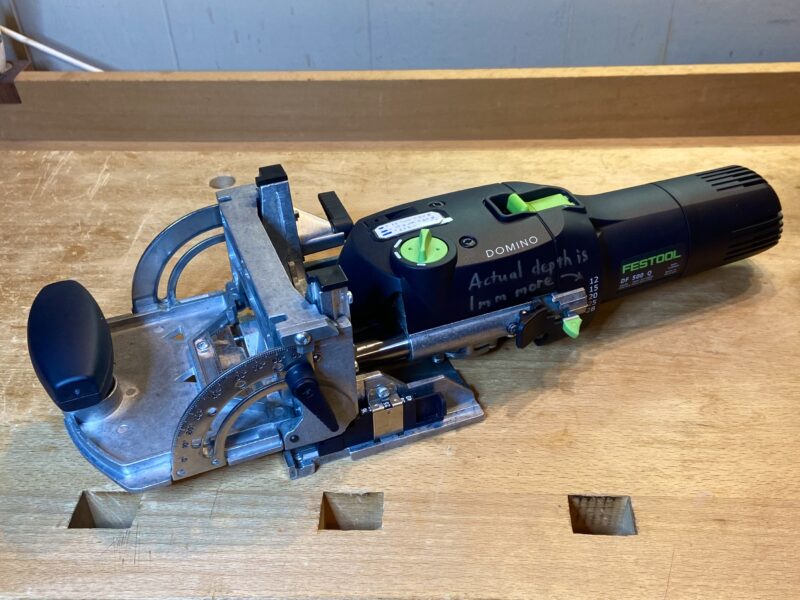
Put simply, it is a way to make a pair of matching mortises into which is placed a manufactured tenon. Properly set up, it gives fast, precise mortising and an accurately fitting tenon. We all know Domino.

I bought a new Domino 500 18 years ago. It can be seen from old posts that I had some difficulty with its accuracy. I had to build in some refinement to make it right. 

But why do I not use the fast, easy, clean Domino for everything where a mortise and tenon is needed?

There are three limitations: 

1) Limited tenon length. The largest single tenon with the Domino 500 is 50mm (2″ long and 8 or 10mm thick). There are plenty of places where I want the greater strength of a tenon joint that goes in further than one inch (50mm tenon).

2) I usually want wider tenons. I can use two or more Domino tenons and that will give the needed joint strength. Still, sometimes I want a single width tenon.

3) The Domino is expense. Currently, the 500 is now about $1350. Sure, it is really worth it, but it may be out of range for some folks.

The Domino 700, more expensive, has a capacity for much longer tenons (some longer than I think I would ever need). That will take care of your big constructions. It does not have the handy smallest versions taken care of by the 500.

For most woodworkers, the Domino 500 is probably the more versatile choice, but look at both if you are going to unload the cash. Bottom line: I still think it is worth it.

So now I have gone through two major suggestion categories:

1. Mortise Master. Low cost, reliable, good range of mortise sizes (and therefore, tenons). More work, dusty. Several alternatives are around.

2. Domino. High cost, reliable, good but limited range of mortises. Convenient work, great dust collection. 

Two other highly versatile machines, which I have no experience with, can also cover your mortise and tenon joinery (along with of other joints): the Woodpeckers Multi-Router and the PantoRouter. 

And here, I’m afraid that I have to say it: the 4000 year old mortise and tenon is largely history. It is rarely, if ever, needed. There are faster, easier, and strong options.

But what, there are two big categories left to discuss:

Dowel joinery

Angled joinery

We’ll get there, and more, in upcoming posts.

Category: Techniques  | Leave a Comment
Author:
• Friday, January 09th, 2026

Now let us briefly go through some machine options for the classic mortise and tenon. However, the discussion on this post is that we can move on to more practical construction.

For the mortice, the router takes over. The welcomed speed and accuracy make the whole job easier and more accurate. My changes of systems are discussed later.

To make tenons with machines, there are also many systems. A partial list: bandsaw, table saw setups, and supported router. Over the years, I moved to a routine: bandsaw for the tenon thickness and width, and table saw 90° pushes for the shoulders. I finished as needed with chisels to refinement the shoulders. Finally, small hand plane work refined the tenon thickness as needed.

Nowadays, with rare exceptions, I do not make “pre-attached” tenons anymore. Really, why bother? Just make two mortises. Then, easily make a free tenon that will neatly fit into both. (I will get to the issue of angled joints in an upcoming post.) 

Let’s get past the strength issue regarding this. The free tenon first goes into a mortise with the same grain direction. Properly fitted, that is every bit as strong as a traditional tenon.  

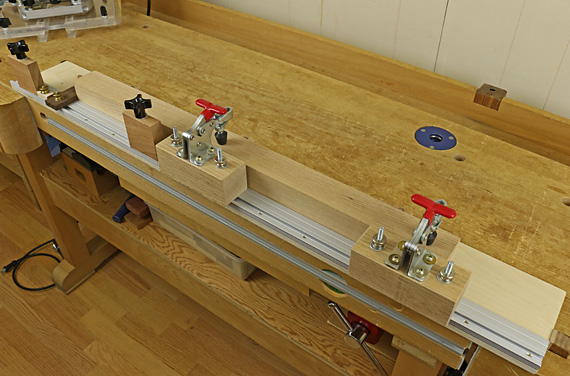
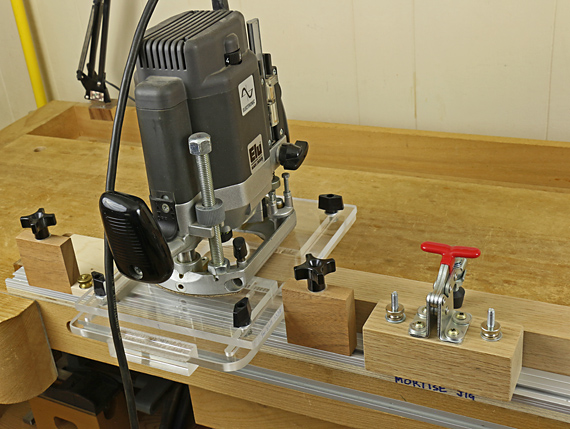
So, the router takes over the “double” mortise production but there must be excellent alignment and safety. Eventually, I shop-made a good jig that lasted several years. It was better than commercial guides that I previously used. Still, I wanted more convenience and versatility.

router mortise jig

router mortise jig

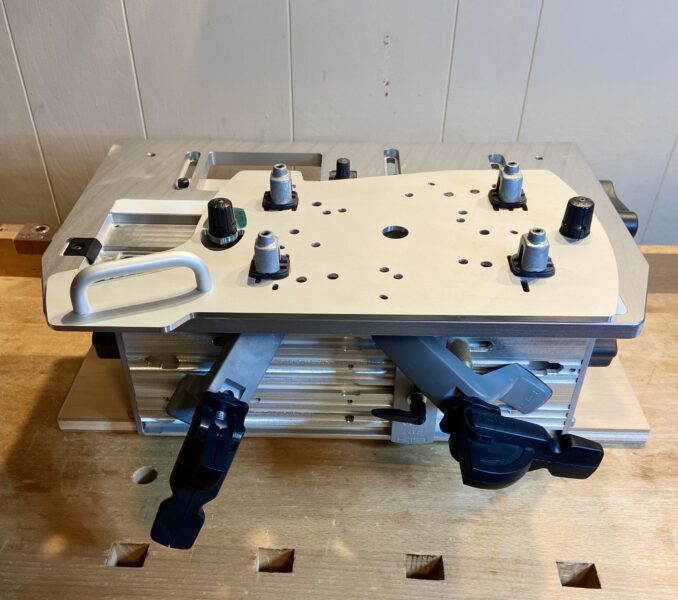
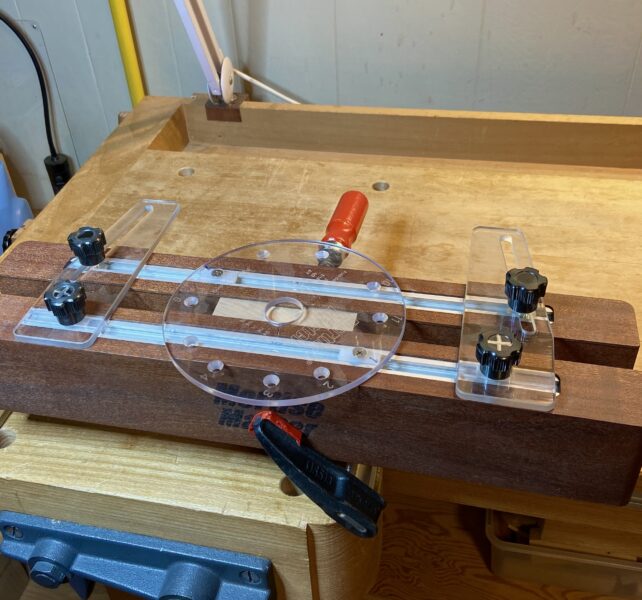
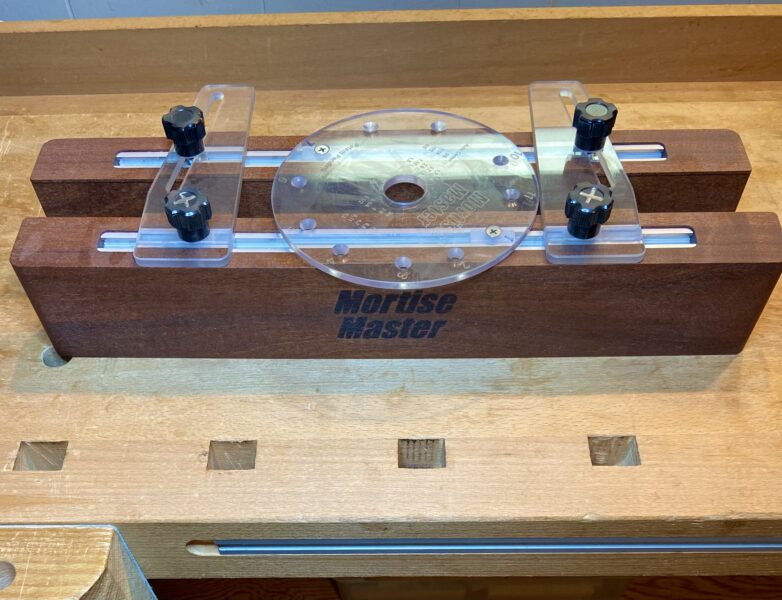
Enter the Mortise Master – the primary rig that I use for this purpose now. I wrote about this in an 8/3/25 post, having gotten it a few years before. (Photos: at the top of this page and below.) It is based on an intuitive setup system that gives consistent accuracy. Like most systems, dust collection is absent.

The tenon material is made with the thickness planer and table saw. Thickness is refined with quick hand plane work. I often round the edges with either a mini curved-blade plane or router table set up.

So, here is the point to which I have discussed so far: A pair of mortises done with a router set-up, and then a free tenon. But there are lots more options available to make end to side-edge joinery.  

More posts to come in this series. The goal: to help you organize and choose among the many options available to make these joints.

Category: Techniques  | Leave a Comment
Author:
• Wednesday, December 31st, 2025

The next few posts will cover a major woodworking task: how to join boards together from an end-grain edge to a side-grain long edge. As you are planing and designing a project, it helps to be aware of the many available options.

To make a project, we want to engage in effective, pleasant working tasks that are functional and beautiful. So let’s go through the many types of joints.    

We will start with the classic mortise and tenon. In the past, I used this in nearly every piece I made. The real beginnings were chisel-chopped mortises and hand-sawn tenons.

The joint has been around for 4000 years. Some excellent modern woodworkers use these methods regularly. I now almost never do, but let’s go through the basics of building the joint.

Here is a brief run-through of cutting the joint, mainly meant to keep it in perspective with the other types of joints to be discussed in the future posts.

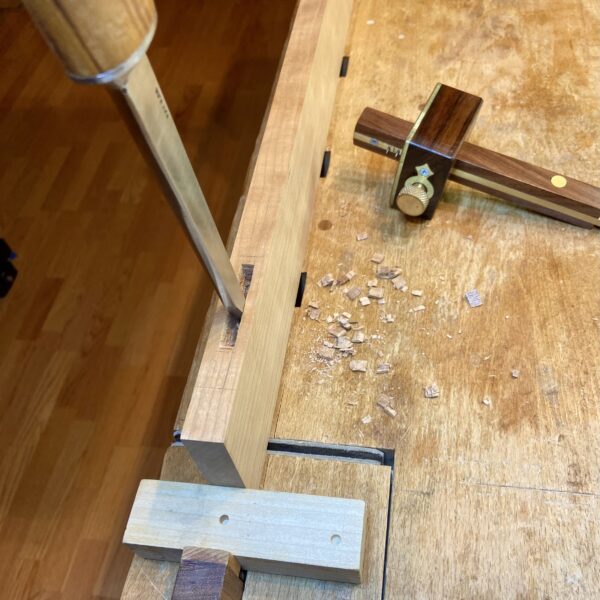
Mark 90° cross lines to lay out the mortise, leaving out 1/8” – 1/4” at the bottom. It usually is helpful to extend the top of the piece an inch or so past the tenon piece to prevent impact rupture when chopping. Mark the mortise width with a double-edge gauge based on the chisel width to be used. 

The tenon will not fully extend to the top of the piece. Plan a haunch at the top. For a 3” tenon, a 3/4” length for the haunch is about right. It only needs to be about 1/4” deep. 

Start chopping at least 1/8” from the edge of the mortise on both ends. A true mortise chisel really pays off. It all gets more difficult as the progress goes deeper. Chisel away the ends. Saw for the haunch and chisel out the depth. 

For the tenon, layout across the grain with a marking knife or fine pencil. For along the grain, layout with the double-edge marking gauge at the same set used to layout the mortise. Plan on the tenon being at least 1/16” shorter than the mortise depth.

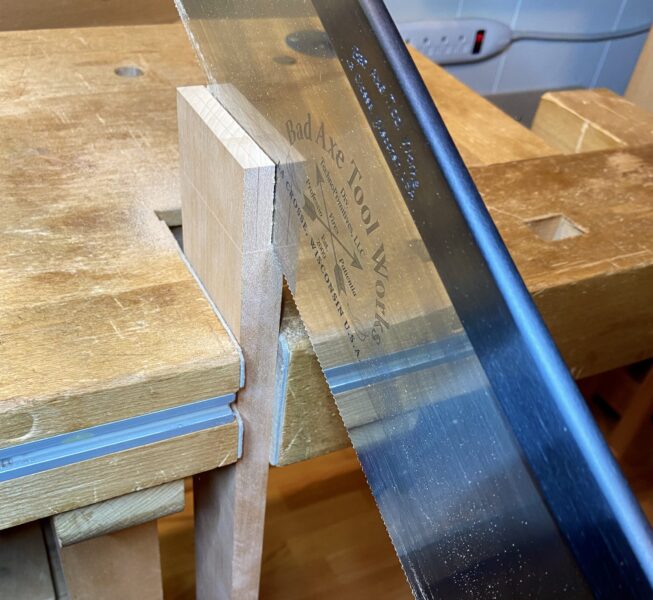
Saw across the top of the tenon, carefully following the layout. Then go down with an angled cut on each side toward the base layout. Finish the cut straight across to the baseline. 

To cut the crossgrain of the tendon, you can go to the final edge with the saw. I would be less risky and saw to within a 1/64” of the knifed line. Then I would slice to the edge with a chisel. 

Be generous with the tenon thickness. It is much easier to plane away a tiny bit than to saw it too narrow and have to build it back with glue-one pieces. Finally, saw away that extra horn length at the top of the mortice piece.

I know that some fine woodworkers like the hand cut mortise and tenon. Well, I did my time long ago and now would find it too much work, despite the reduced noise. 

I briefly went over the hands-on method to put it in perspective with the other available methods of end to side-edge joinery.

Lots more to come in upcoming posts. 

Category: Techniques  | 2 Comments
Author:
• Friday, December 05th, 2025

These are tools that will surely come in handy but like all tools, they have capabilities and limitations. So let’s get the hands on.

A variety is available. I have one with a flat face and one with a front-to-back curved face which is more useful. Blades are approximately 2” long. Other types are available, including those with a side-to-side curved blade. Those are especially useful for making roundish furniture or chair legs. 

I suggest to not think of them as small hand planes. Rather, they function more like super-controllable chisels or knifes that you move along as they respond to your cutting intentions. 

Cut narrow, not wide, slices. Specialized hand planes are for the wider cuts. Irregular grain can also be difficult. Maybe a hand scraper or plane scraper is a better choice for such work.  

For me at least, controlling the spokeshave is much easier pulling the blade rather than pushing it like a hand plane. With a bit of trial, find the right entrance of the cutting edge in the wood. Maybe practice on some extra wood first. 

Thus, maintain a good blade angle for progressive, repeatable cutting. It can, and usually will, change a bit as new areas or cuts are entered. Sometimes you have to sense the cut immediately at the start and then adjust a bit.

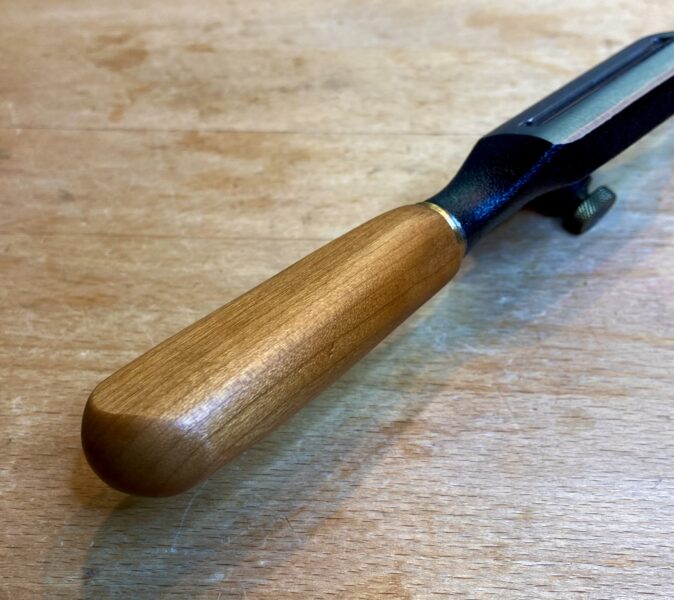
I do not think we are as capable of this task using a spokeshave that has round handles (in their cross-section) compared with the ones that I am showing in this post (or others similar to them). These handles have a nearly flat top and bottom.

With round handles, the hands can spread the thumbs and fingers around the handles and blade-holding section. With a flat-faced spokeshave, it is somewhat easier. However, these are just not secure grips. It is too easy for the tool to turn in the hands. And that ruins the blade edge contact with the wood!

However, the flat areas of the handles make the whole matter easier! You can grip the handles much better in the palm and fingers, and still extend fingers into the metal blade-holding area just as you want.

Veritas’ otherwise excellent spokeshaves are made with handles that are round in cross-section. Fortunately, they can be replaced, though precisely fitting new ones is a bit tricky. Inexpensive spokeshaves mostly have cupped gripping areas of fully metal handles. I doubt that is held as well as well-shaped wooden handles. The more flat, slightly curved, metal handles may work pretty well. 

https://www.rpwoodwork.com/blog/2013/01/14/replacement-handles-for-veritas-spokeshaves

Spokeshaves are certainly worth having for most woodworkers. Hopefully, the suggestions here are useful for techniques and tool setup. Your thoughts are welcome. 

Author:
• Monday, October 20th, 2025

Here is one more thing to add to a manufactured device for sharpening. The previous post explains the issue: for sharpening plane irons that have a slightly curved edge, which is most of them, a subtle curve needs to be added to the roller. (This does not apply to nearly all chisels.)

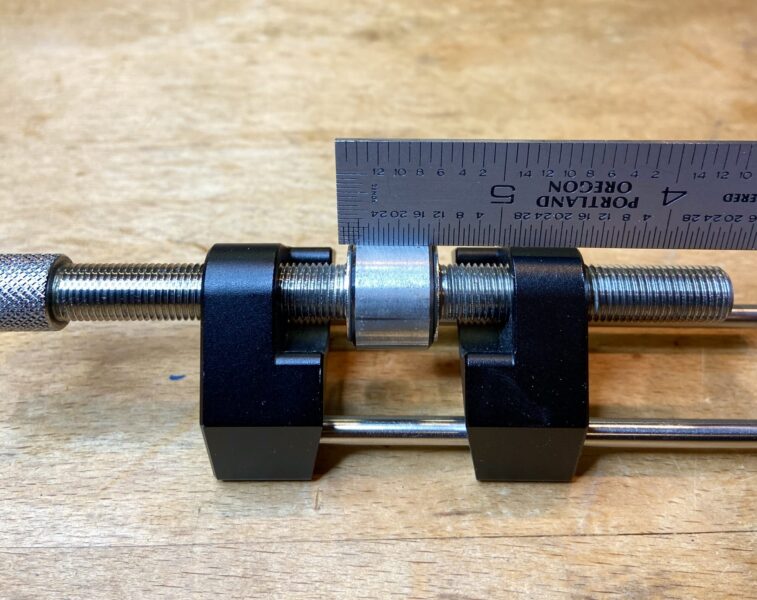
I have two Woodcraft rollers. One is used as is – for sharpening straight edges. (Photo is below.) The other roller is very slightly curved across its width. (Carefully note the photo above.) It was not manufactured that way but was easily done in the shop.

The roller itself is 1/2” wide. Working out the math and using it in practice, reveals that the roller needs to be ground just about .003” on each 1/4” half of the wheel. In other words, from zero at the center point to a maximum curve of .003” shorter at each far side edge. 

An electric motor-rotating wheel can do this. Be careful and keep fingers away from the wheel! (The safety decision is solely up to you.)

Note that you are making a curved angle on each side, not a straight-edge angle. It is easy to do.

This adds a comfortably controllable ability for angling the plane edge on the flat stone. This is far better than trying to alternately angle onto just the outside corners of a regular flat wheel guide. 

This subtly angled wheel will work for almost all of the plane blades. As I have mentioned in the previous post: nearly all manufacturers neglect this important factor. They could simply supply two replaceable wheels or two frame-wheel combinations. (Again, Lee Valley/Veritas is the only manufacturer that I know of that builds in the curvature in one of their wheels. I do not care for their expensive system but I do suggest taking a look online for your choice.)

With all of this said now, I will still say that I do the vast majority of sharpening by the total hand-holding method discussed three posts ago. But now you have options!

Sharpening is a must for good woodworking but not hard to do with the right equipment and skills!