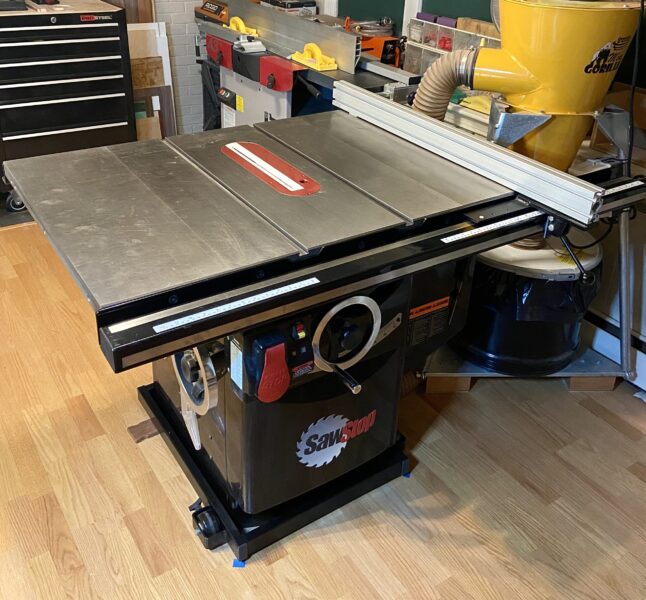
The third machine to buy as you are getting into woodworking and making a shop: the table saw.
Clean, accurate, straight cuts along the length of grain, as well as dead-on cross cuts are required for most projects. Angled cuts at 45°, or any angle, are common.
Hand cutting cannot match the speed and accuracy of the table saw. The band saw, miter saw, scroll saw, jig saw, track saw, and circular saw, even with all if their jigs and accessories cannot match the efficiency and convenience of the table saw.
There are, however, three big problems with table saws:
1. statistically, the most dangerous tool in the shop
2. expense
3. they generally take a lot of space for the machine and the work itself
Starting with the first issue, I want you to realize that it really is critical! This website is not the place to learn safety. Please learn from the excellent sources available in books and magazines, some classes, and some of the online videos.
An example is in Fine Woodworking #315, Jan/Feb 2025, page 32 – 37, by Roland Johnson, regarding kickbacks and more. I like some of Stumpy Nubs videos on YouTube. Search on your own for more.
As you can see from the photo, I have a SawStop. This can detect blade-to-skin contact, and then stop and drop the blade extremely quickly. I have never touched a running blade in the 21 years that I have owned it but I am glad the precaution is there. You can consider SawStop despite the extra price. Machine production, marketing, and legal restrictions may change, so keep track of the available options in SawStop and other brands.
In the photo here, I have intentionally left out the splitter, crosscut gauge, blade guard, kickback risk controls, and other safety devises and issues. That is your job to study.
———————
CAUTION: Electric woodworking power tools are extremely dangerous and can cause severe injury including amputation of fingers. Please do not even begin to use an electric woodworking tool without first learning safety from a highly reliable source, understanding, and using appropriate safety procedure.
This website is NOT the source for learning this important practice. The brief mentions on the topic are not nearly sufficient to keep you safe.
———————
Expense and space in the shop are issues for almost all of us.
The photo shows the table saw in its mode (unplugged, with the blade fully lowered) as a secondary “bench top” which I need for some veneer work and assembly work. So you can work around the size of the table saw by converting a good, strong, accurate top it in this way.
Perhaps you want to start off with a much less expensive compact saw (SawStop is an option). Consider that projects you want to do and the sizes and space of the boards involved.
By the way, I do not own or want a table saw dado blade.
So, a table saw gets spot #3 for the developing woodworker, in my opinion.
Number 4 coming up.

I gotta say, your list is different than mine. I have a lunchtop thicknesser (would buy again) bandsaw (would buy again), drill press (could live without), and mortiser (would not buy again) and called it quits in terms of tools. To each his own. I am enjoying the series though.
Joe, thank you again for your comments!
No doubt, there are lots of other good points of view among readers. My main goal is to motivate developing woodworkers to think about and plan the issue before taking out the cash and taking up the space.
I view a table saw as an optional machine in a woodworking shop. Yes it’s faster than a handsaw, but I can easily surpass the accuracy of a table saw with a handsaw and shooting plane. It just takes a bit more time to make the cuts. I got rid of my table saw a decade ago and never looked back. I would use a table saw if I were running a production shop or if I were mainly working with flat material like plywood.
I understand, Jason. Thanks. In the first post in this series, I wrote: “You do not absolutely need any machines/power tools.” This series is to guide the vast majority of developing woodworkers who want the convenience and speed of machinery.