Archive for ◊ April, 2026 ◊

Author:
• Wednesday, April 29th, 2026

The previous series of posts showed and explained four ways to secure wood at the workbench to facilitate work. And there are at least a dozen more ways. It should be convenient to set up, work on, and take down.  

This key factor has been important since the first time you ever worked on wood, even at an early age. Yet often it is neglected or done poorly.  

So, why is it so important and deserves so much attention?

We woodwork with our hands. With good hand tools or machines, the hands ultimately choose and control what happens to the wood. While they are guided by sight, sound, mind, and time, and supported by the rest of the body, the hands make the final actions. 

What usually happens in early learning of woodworking, the hands cannot do there job because the wood is not properly set in place and stable. I think that is the most common confusion when developing woodworking skills and   retaining them. 

In practical summary, I suggest taking the time and trouble to set up the wood well. I bet your hands will do the job as they lead the tools to success. 

Category: Ideas  | 2 Comments
Author:
• Wednesday, April 22nd, 2026

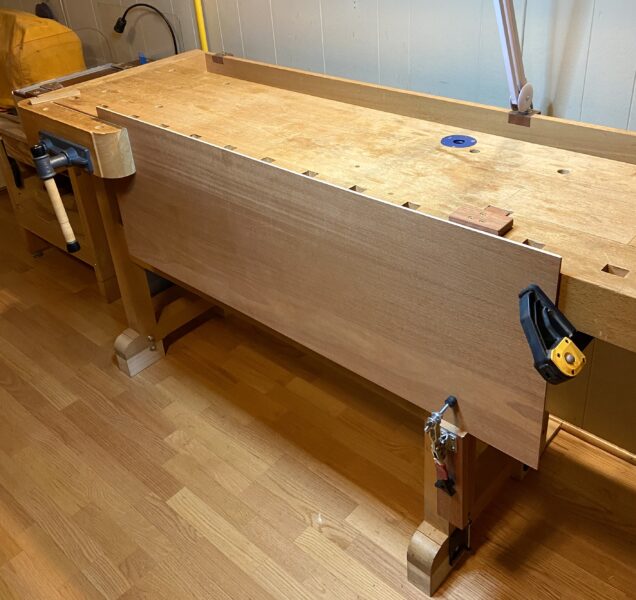
Continuing from the last two posts, let’s now look at gripping an even longer piece of wood by the front vice and extending it to the right, even fully across the length of the bench. We will use a griper easily installed into the tail vice.

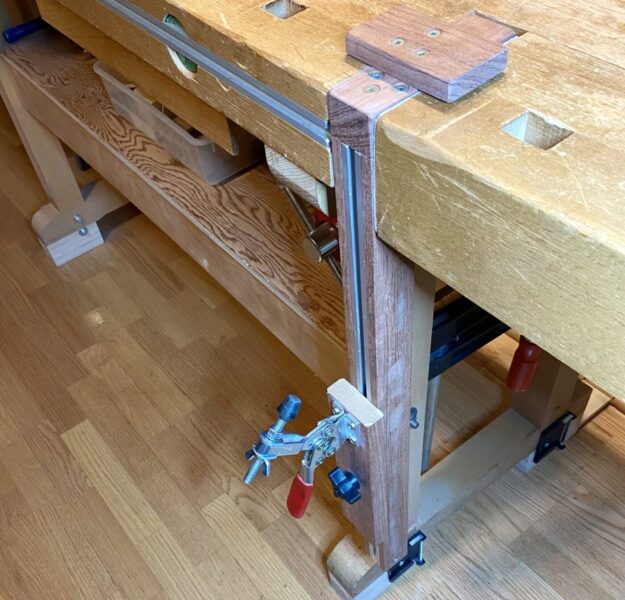
The tail vise will hold a T-track set into a piece of wood. This holds the same toggle clamp mechanism as is used in the T-track on the front of the bench itself. (See the previous post for that.) The photos above and below show the set up for this system.  

The next photo below shows a wider piece of long wood held by this system. The extra width requires an extra clamp on the upper area to prevent the top of the board from bending outward during some work. 

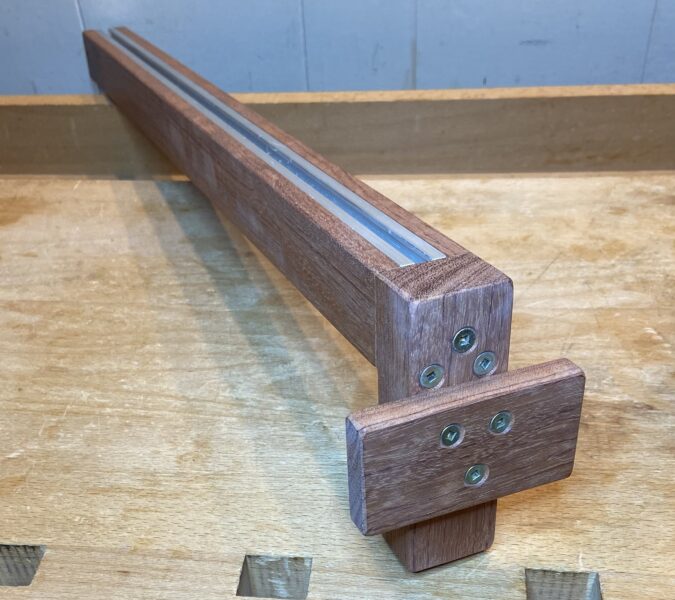
Now lets look at how to easily make the part. The photo below shows it.

I used a 24 1/2” x 1 1/2” x 1 1/2” piece of sturdy hardwood. An aluminum T-track, 3/4” wide x 3/8” deep, is screwed into a router-cut slot. 

Screwed in at the top of the post is a 1 1/2” wide x 1 1/8” thick hardwood that was made 4 11/16” long to neatly fit in the tail vise to make the surface with the T-track even with the front of the bench. 

Then another piece of wood, 3 1/2” x 1 3/4” x 1/2” is screwed on top. This top piece, along with the tail vise tightening, holds the T-track device securely.

So now we have covered four good systems (among the many more) that are used to hold wood so we can work well. Next, for a final “part 5” of this, I will go through the whole idea of wood being secured and why it is so important for working well.

Author:
• Thursday, April 09th, 2026

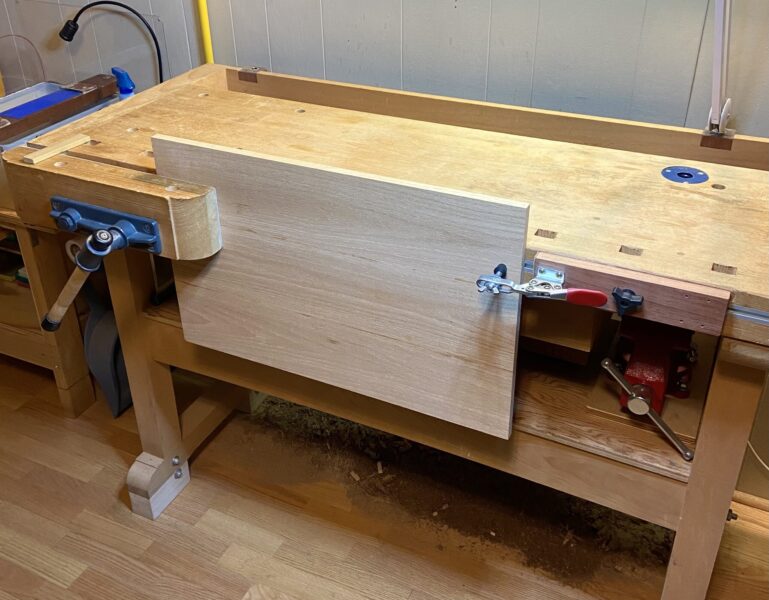
Let us continue with the previous post. If the wide piece of wood being held in the front vice is also fairly long, we need a second system that grips the right side of it. Otherwise, it will tend to slip down due to weight, especially pressure from planing the edge straight and square with a #5 or #7.

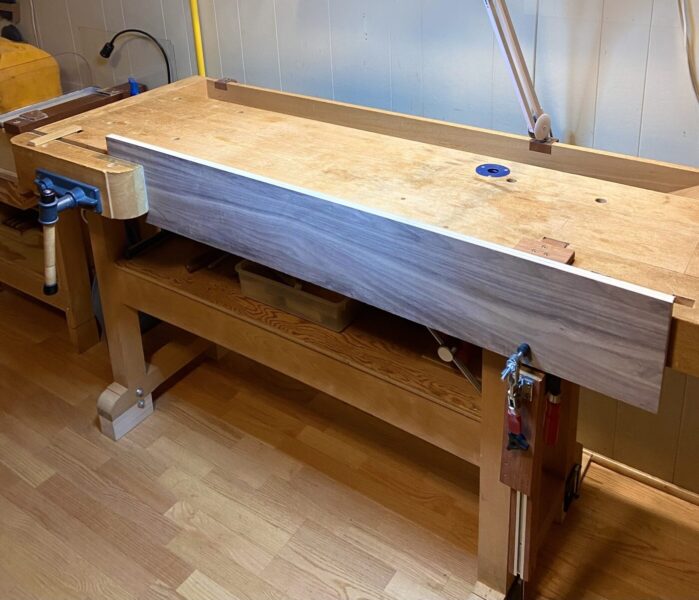
The photo above shows the system in action. 

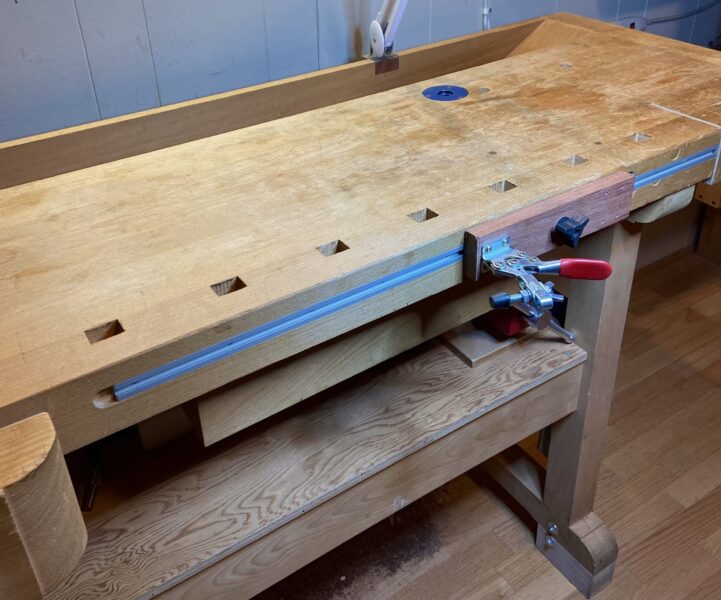
There is an aluminum T-track (“T-slot track”) (3/4” wide x 3/8” deep) screwed into a slot in the bench top made with a router bit. A small space on the left side of the slot allows you to easily enter the clamping device. The slot is not extended into the opening for the right-sided bench vice. The T-track never interferes with any other use of the workbench.

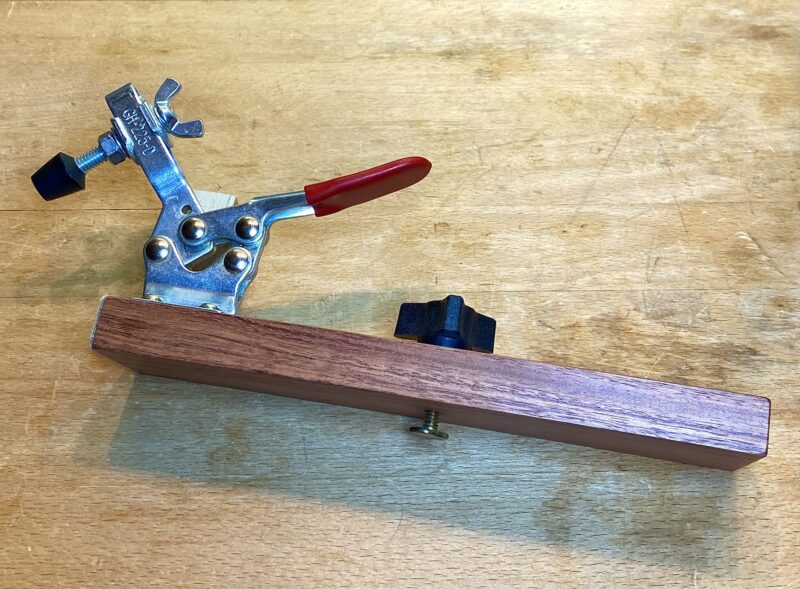
The workpiece is held with a quick-release toggle clamp with an anti-slip tip. It is attached with four screws on a sturdy piece of hardwood 3/4” x 10” x 2 1/4”. The toggle clamp is screwed in near the end of the wood piece.

This toggle clamp is GH-225-D. This holds the work I use.

A 1/4 x 20 x 1 1/2” T-track bolt is at the mid-point of the wood piece. It tightens with a three-branch star knob.

To use it:

Attach the toggle clamp device in approximate position on the T-track. Set the workpiece in the bench vise, using the compensating thickness piece on the left side of the vise (see the previous post), and tighten.  Then set the final position for the toggle clamp and tighten the T-track bolt. 

Then adjust the height of the toggle clamp based on the tightness to the workpiece, set it, and tighten it.  

This system allows adequate pressure to hold the right side of the workpiece. You can work well.

What about larger pieces and needing even more support on the right side of the workpiece? Coming up on the next post!

Author:
• Friday, April 03rd, 2026

Let’s say you want to hold a wide piece of wood in a classic front vice of the workbench. You probably do not want to grip it in the middle area of the vice because it must be held above the lead screw and guide rod. 

You can grip the wood by the part of the jaw that is fully to the right of the screw and rod. This allows the wood to be lowered to where you want it. It will be held at a much better working height for planing and other tasks. (Exactly what is done with the right end of the wood itself will be discussed in a latter post.)                           

But the problem now comes when the vice is tightened. The empty left side of the moveable vice jaw can curve toward the bench top. This especially happens when strongly gripping thick pieces of wood. When the vise is turned tighter, it actually reduces the area of the pressure contact against the workpiece. (All of this varies with differently constructed vice designs in different benches.) 

Solution? Yes. Easy!

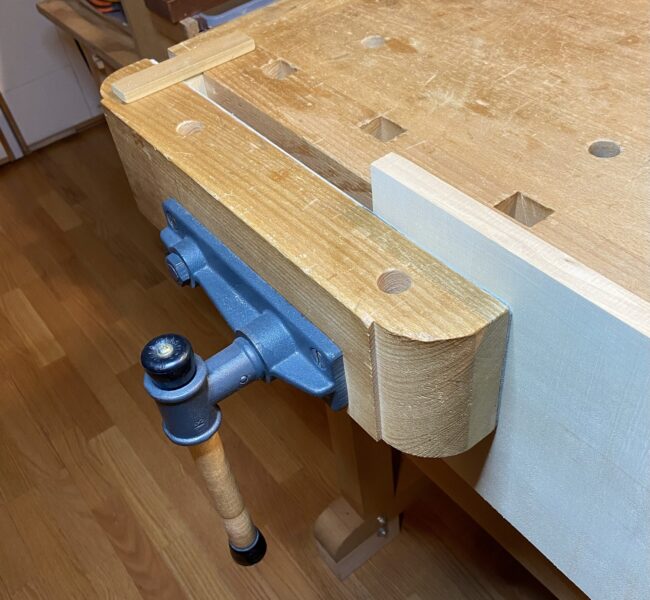
You just put an approximately matching thickness piece of wood in the left side of the jaw. This distributes the tightening pressure against the bench from the right and left ends of the vice. The vice stays aligned and, most importantly, the work wood is gripped more securely and evenly.  
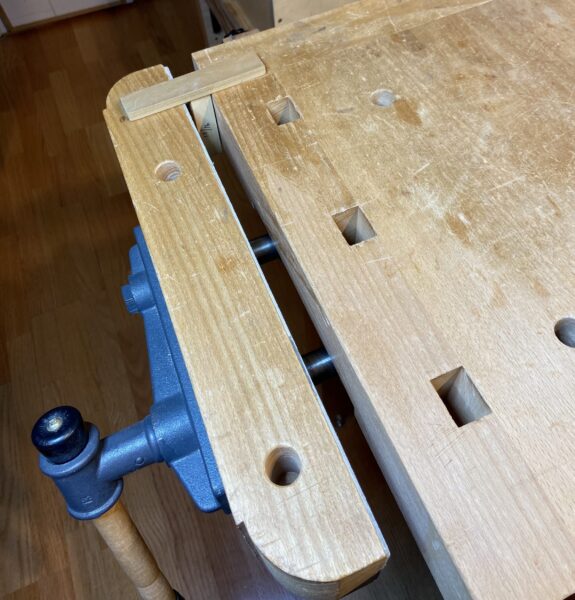
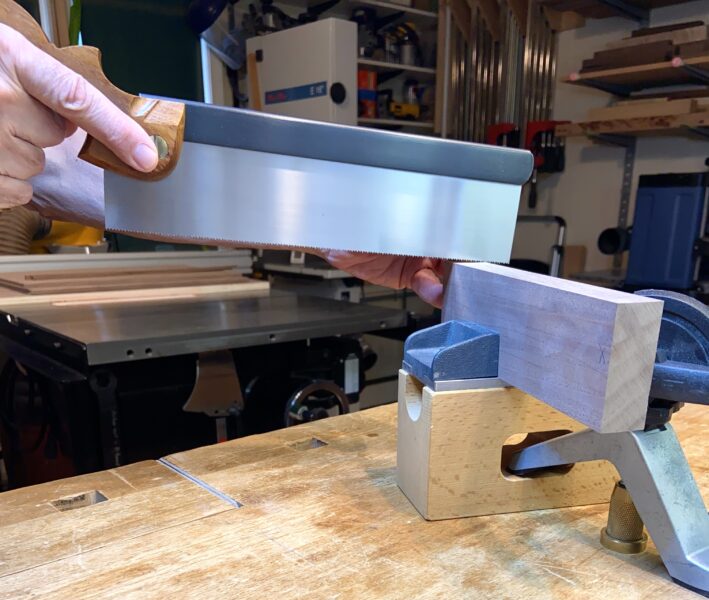
You do not have to hold the matching piece there when tightening the vice. A wide cross piece grips it with a magnet and keeps it there. (See photo above.) So you place it, let it go, and then place in the work piece on the right side of the vice at whatever height you want. 
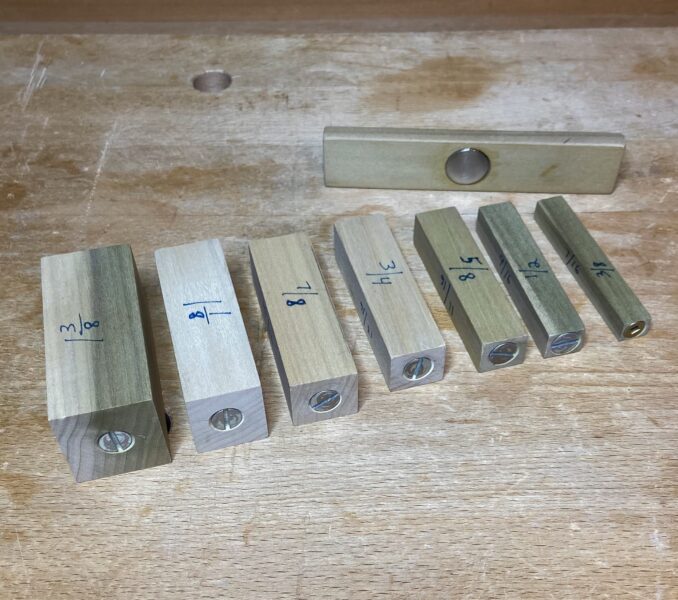
I have a small collection of gripper pieces, from 3/8” through 1” in 1/16” intervals, and 1 1/8” through 1 3/8” in 1/8” intervals. That is 14 sizes that covers thicknesses within 1/32” of most work pieces. Close enough to work.

They are 3” long with a flat head screw in one end to grip the holder top piece. The holder is 5” x 1” x 3/8” with a 3/4” diameter magnet at the center. The grippers get stored in the bench drawer, and the holder gets stored at the head of a flat screw leveled into the side of workbench. 

This is very easy to make and use. It really improves the performance of the bench vise.

But what do you do with the right side of that long workpiece which has its left side securely in the front vice? 

Answers in the next two posts coming up!