Archive for ◊ December, 2025 ◊

Author:
• Wednesday, December 31st, 2025

The next few posts will cover a major woodworking task: how to join boards together from an end-grain edge to a side-grain long edge. As you are planing and designing a project, it helps to be aware of the many available options.

To make a project, we want to engage in effective, pleasant working tasks that are functional and beautiful. So let’s go through the many types of joints.    

We will start with the classic mortise and tenon. In the past, I used this in nearly every piece I made. The real beginnings were chisel-chopped mortises and hand-sawn tenons.

The joint has been around for 4000 years. Some excellent modern woodworkers use these methods regularly. I now almost never do, but let’s go through the basics of building the joint.

Here is a brief run-through of cutting the joint, mainly meant to keep it in perspective with the other types of joints to be discussed in the future posts.

Mark 90° cross lines to lay out the mortise, leaving out 1/8” – 1/4” at the bottom. It usually is helpful to extend the top of the piece an inch or so past the tenon piece to prevent impact rupture when chopping. Mark the mortise width with a double-edge gauge based on the chisel width to be used. 

The tenon will not fully extend to the top of the piece. Plan a haunch at the top. For a 3” tenon, a 3/4” length for the haunch is about right. It only needs to be about 1/4” deep. 
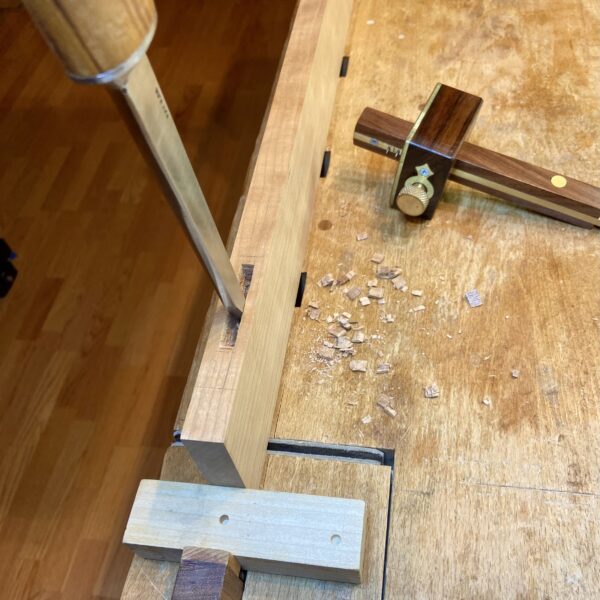
Start chopping at least 1/8” from the edge of the mortise on both ends. A true mortise chisel really pays off. It all gets more difficult as the progress goes deeper. Chisel away the ends. Saw for the haunch and chisel out the depth. 

For the tenon, layout across the grain with a marking knife or fine pencil. For along the grain, layout with the double-edge marking gauge at the same set used to layout the mortise. Plan on the tenon being at least 1/16” shorter than the mortise depth.

Saw across the top of the tenon, carefully following the layout. Then go down with an angled cut on each side toward the base layout. Finish the cut straight across to the baseline. 
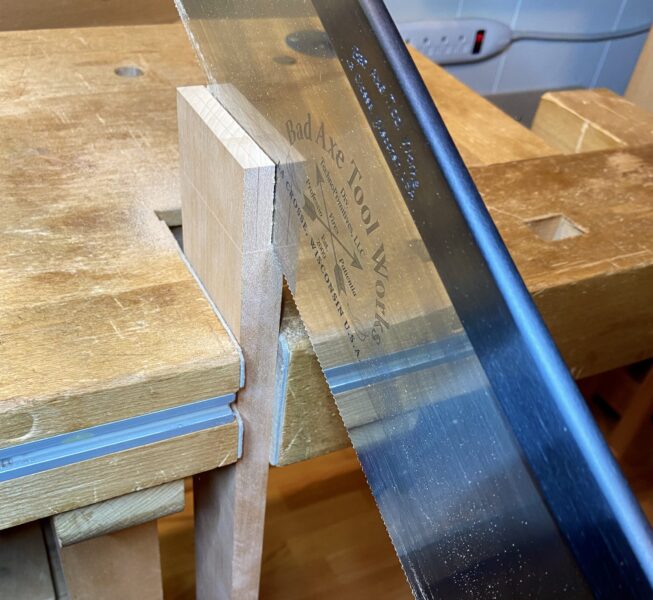
To cut the crossgrain of the tendon, you can go to the final edge with the saw. I would be less risky and saw to within a 1/64” of the knifed line. Then I would slice to the edge with a chisel. 

Be generous with the tenon thickness. It is much easier to plane away a tiny bit than to saw it too narrow and have to build it back with glue-one pieces. Finally, saw away that extra horn length at the top of the mortice piece.

I know that some fine woodworkers like the hand cut mortise and tenon. Well, I did my time long ago and now would find it too much work, despite the reduced noise. 

I briefly went over the hands-on method to put it in perspective with the other available methods of end to side-edge joinery.

Lots more to come in upcoming posts. 
Category: Techniques  | 2 Comments
Author:
• Friday, December 12th, 2025

There are very few! Yet I, and I think the readers themselves, appreciate what does come in. 

By the top trusted, popular, skillful blog-ranking companies documenting online, Heartwood is consistently ranked in the top 10 most popular woodworking blogs in the english/US language. It is between #6 – #9. That rates above some major woodworking magazines and tool dealers.  

It has been in function since 2008. Though there is a two-year entry gap before a half-year ago, it has run at the maximum content level in the past half year. The site now has 259,000 words, not including comments, and 1400 photos. That is like 3 or 4 books. All from one author, yours truly, and one small shop. 

The material is hands-on and mind-on useful, and, I hope, enjoyable for you to read.  There is no business or money at play here. Just the beloved woodworking – and woodworkers! 

And, I greatly appreciate the readership – and comments!

Online videos, as we all see, can quickly, amazingly produce thousands of comments. Some are just a few words, but it is communication and appreciation. Written blogs are, of course, different. Video seems to stimulate reply more than writing does. I get it. 

So, dear readers, I hope that some more of you will sometimes go to the clicker and pop in a comment. (I have to approve any comment. That keeps away the massive spam leaches.) Most importantly, your fellow readers will appreciate your thoughts and observations. Of course, I will too.

So, if you have something to say – and you probably do – maybe to put in another side of thought – whatever – I hope you will give it a go. 

Thank you, dear readers! 

Category: Ideas  | Leave a Comment
Author:
• Monday, December 08th, 2025

We all have squares in the shop. No, no, not nerds, but the 90° measuring tools needed for nearly every project. I will go through what I use in my shop. Not covered here are straightedges. Just squares. 

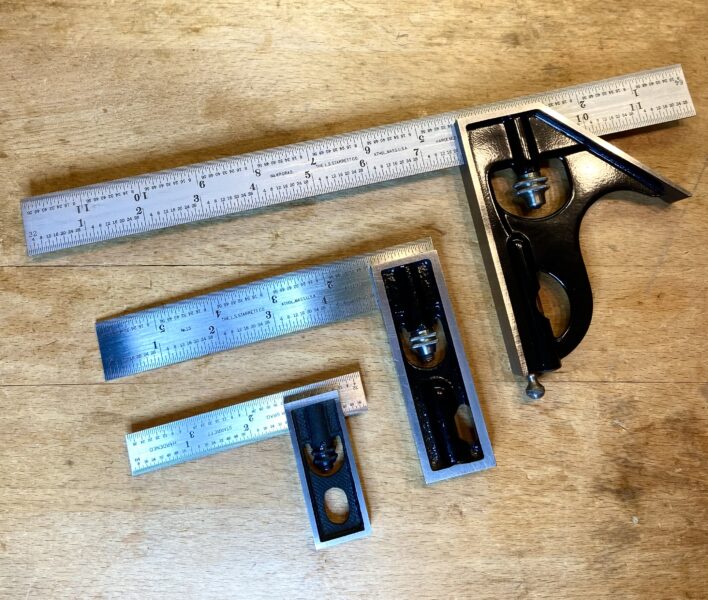
Let’s start with “combination” squares – the blade can be slid along most of its length. I have had Starrett squares for many years. There are other good brands (Woodpeckers has some useful choices) but in this type of tool, Starrett meets, by all I have seen or read, the top standard in documentable square accuracy: .0001” (1/10,000) per 6”. (Woodcraft has, for many years, incorrectly listed +/- .00001”, i.e. 1/100,000”.)

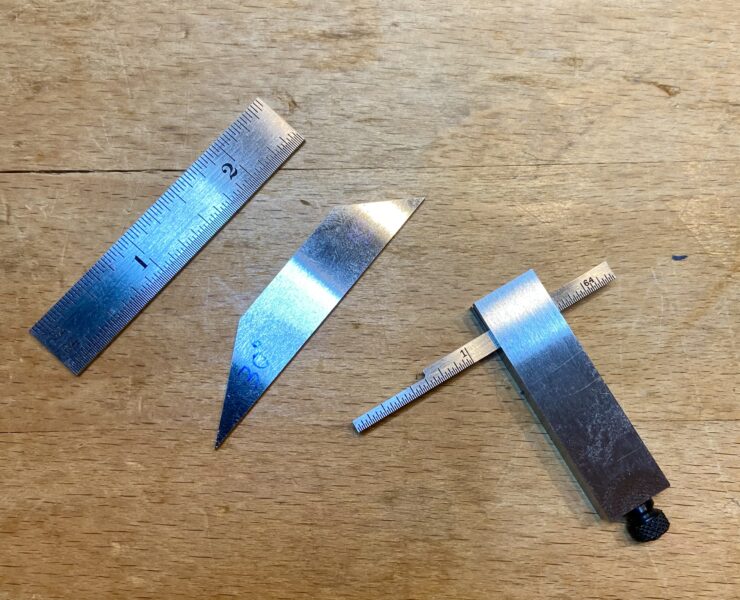
I have Starrett 12”, 6”, 4”, and 2 1/4”. I use them all. (The little one has regular, narrow, and angled blades.) To have only one, I would chose the 12”. The 4” or 6” would be the second choice. The 12” has a 45° angle in the frame, sure to come in handy. The angle slope bubble measure and the pointed scriber get almost no use from me but they do not get in the way. I use other, better tools for that. 

Starrett has a huge range of variety including flat or satin-chrome blades, smooth and mildly rough heads, plain straight or straight + angled handle heads, separate 45° head, and variable protractor head, inch and millimeter markings, etc. I suggest to shop around for price and choose what you need. This tool is worth it!

Do we need the 1/10,000 accuracy for everything? Of course not, but it always works in your favor. The best accuracy is valuable for some important things – like tuning machines. The excellent tool can do it all and lasts indefinitely. 

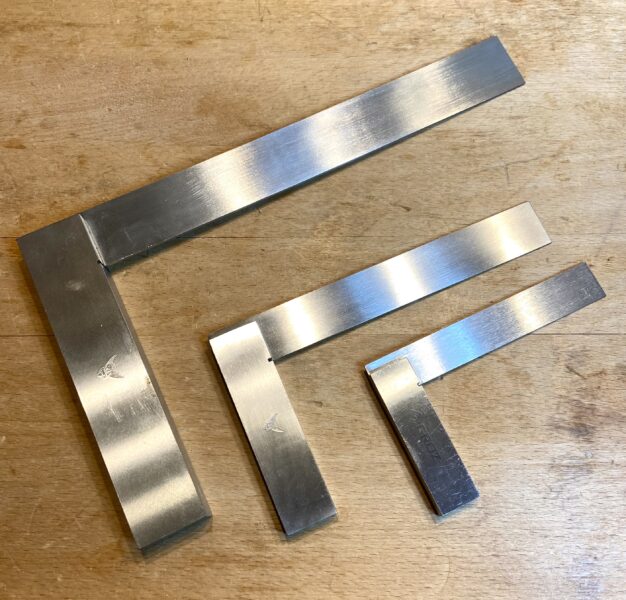
The other set of squares that I have are the solid machinist type. The very useful set of three is the 9”, 6”, and 4”. These are more convenient and faster to handle than the combination squares for stock preparation and some joinery. For this type of square, the highly accurate Starrett machinist squares are unnecessarily accurate and expensive.

For the 6” and 9”, I have PEC brand. Their standard is 6/10,000” (about half a thou) for 6”, which well meets the needs. They are well made and reasonably priced. Unlike some less expensive machinist squares, the edges are cut appropriately square-sharp enough without being rounded over.

For the 4” machinist square, I have a Groz. The inexpensive brand meets 28/10,000” for 6” (about 3 thou) which is not good enough. However, I lucked out with this one – it is well under 1 thou based on assessment with a Starrett. It gets lots of convenient use. 

There is one more square in the shop. I made it long ago for checking the square of dovetail parts. The very narrow square blade fits into small areas. I use this one or the little Starrett. Refer to this post:

https://www.rpwoodwork.com/blog/2015/12/31/narrow-square-for-checking-dovetails/

I keep all the squares clean, free of rust, and handled efficiently. Squares really move along the work. Get good ones. I hope this outline helps! 

Category: Tools and Shop  | 4 Comments
Author:
• Friday, December 05th, 2025

These are tools that will surely come in handy but like all tools, they have capabilities and limitations. So let’s get the hands on.

A variety is available. I have one with a flat face and one with a front-to-back curved face which is more useful. Blades are approximately 2” long. Other types are available, including those with a side-to-side curved blade. Those are especially useful for making roundish furniture or chair legs. 

I suggest to not think of them as small hand planes. Rather, they function more like super-controllable chisels or knifes that you move along as they respond to your cutting intentions. 

Cut narrow, not wide, slices. Specialized hand planes are for the wider cuts. Irregular grain can also be difficult. Maybe a hand scraper or plane scraper is a better choice for such work.  

For me at least, controlling the spokeshave is much easier pulling the blade rather than pushing it like a hand plane. With a bit of trial, find the right entrance of the cutting edge in the wood. Maybe practice on some extra wood first. 

Thus, maintain a good blade angle for progressive, repeatable cutting. It can, and usually will, change a bit as new areas or cuts are entered. Sometimes you have to sense the cut immediately at the start and then adjust a bit.

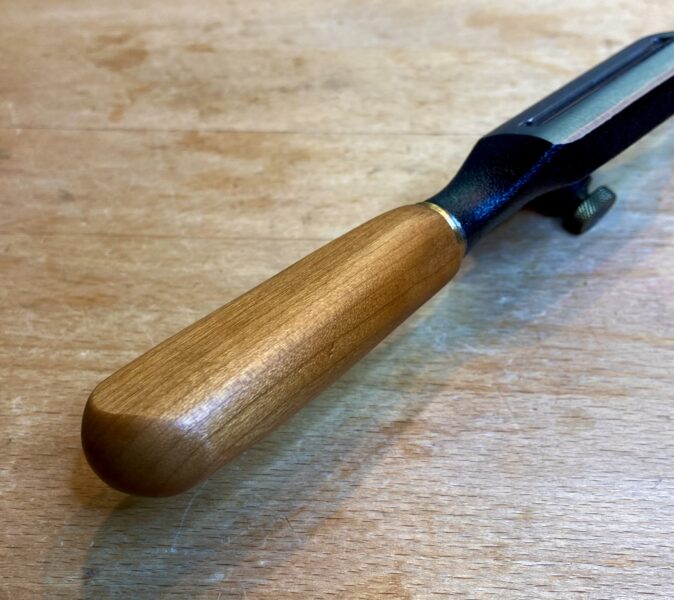
I do not think we are as capable of this task using a spokeshave that has round handles (in their cross-section) compared with the ones that I am showing in this post (or others similar to them). These handles have a nearly flat top and bottom.

With round handles, the hands can spread the thumbs and fingers around the handles and blade-holding section. With a flat-faced spokeshave, it is somewhat easier. However, these are just not secure grips. It is too easy for the tool to turn in the hands. And that ruins the blade edge contact with the wood!

However, the flat areas of the handles make the whole matter easier! You can grip the handles much better in the palm and fingers, and still extend fingers into the metal blade-holding area just as you want.

Veritas’ otherwise excellent spokeshaves are made with handles that are round in cross-section. Fortunately, they can be replaced, though precisely fitting new ones is a bit tricky. Inexpensive spokeshaves mostly have cupped gripping areas of fully metal handles. I doubt that is held as well as well-shaped wooden handles. The more flat, slightly curved, metal handles may work pretty well. 

https://www.rpwoodwork.com/blog/2013/01/14/replacement-handles-for-veritas-spokeshaves

Spokeshaves are certainly worth having for most woodworkers. Hopefully, the suggestions here are useful for techniques and tool setup. Your thoughts are welcome.