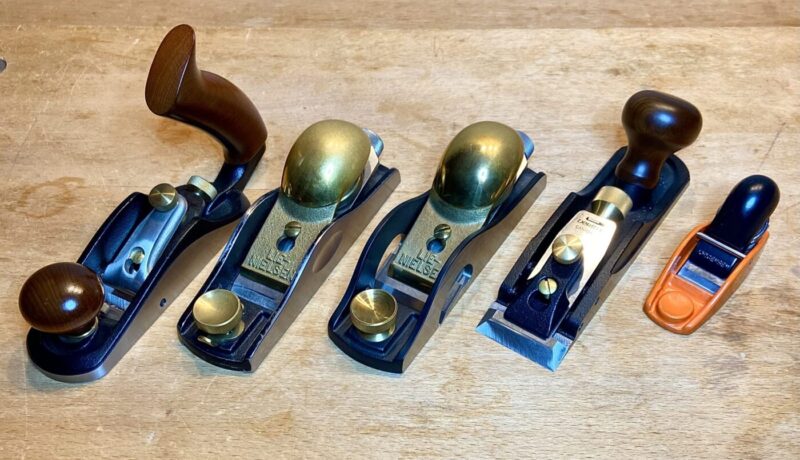
We turn to little planes when the regular big ones, such as the #4 smoothing, #5 jack, and #7 jointer will not do the job or are awkward. These five little planes are worth having in my shop.
Left to right in the photo above:
1. Veritas Bevel-up #1. The blade bed is at 15°. The mouth is adjustable. I sharpen the PM-V11 steel blade at 27.5°/32.5°. The plane is 5 13/16” long, 1 25/32” wide. The blade is 1 7/32” wide, 1/10” thick.
2. Lie-Nielsen #60 1/2 block plane, 12° blade bed, adjustable mouth. I sharpen the W1 blade (an early model) at 27.5°/32.5°. Plane 6 1/4” long, 1 3/4” wide. Blade 1 3/8” wide, 1/8” thick.
3. Lie-Nielsen #60 1/2 rabbet block plane, 12° blade bed. I sharpen the A2 blade at 27.5°/32.5°. Plane 6 1/2” long, 1 3/4” wide. Blade 1 3/4” wide, 1/8” thick.
4. Veritas Cabinetmaker’s Trimming plane, 15° blade bed. I sharpen the O1 blade at 25°/30°. Plane 6 1/2” long, 1 3/4” wide. Blade 1 3/4”+ wide, 1/8” thick.
5. Jorgensen mini block plane #70700, 20° blade bed. I sharpen O1 blade at 25°/30°. Plane 3 1/2” long, 1 1/4” wide. Blade 7/8” wide, 1/8” thick.
The #1 plane functions just like the larger planes but it is handily smaller. For example, it handles very well for smoothing a narrow part of a cabinet frame, even a long one. The handles allow you to hold it and move it just as well as a #4 smoother. I think it is nearly a must. I keep it just as well sharpened as the #4.
The regular block plane works well with one hand pushing in any direction and angle. I use it for practical fitting, trimming, and sizing parts. I think just about everyone has a regular block plane.
The rabbet block plane is the same idea but you can cut to the side edges. So it can fit in length or side joints where it can often out do a chisel. Not essential, but very handy.
The trimming plane can save the day where it is too hard to consistently and accurately use a chisel. For example, where you need to clean up the width and length of a joined corner section. I do not pick it up too often but it saves the day when I need it!
Sure, for #3 and #4, you can often substitute a shoulder plane, edge plane, or others, but these block plane variants have advantages in holding and pushing. There are alternatives, but these have important roles.
The mini block plane: yes, have it and you will quickly use it for all sorts of little tasks. It is incredibly well made – flat, excellent steel blade, easy to adjust well – for $18! You might even keep it in a pocket.
Ok, if you want only two: bevel-up #1 and mini plane. Three? Ok, add the regular block plane. All five?! Ok, skip an expensive restaurant group outing or two. Hey, you’re a woodworker! These are like fingers in the hands and connections in the brain.