Author Archive

Author:
• Saturday, March 12th, 2016

edge-to-edge joints

Board orientation

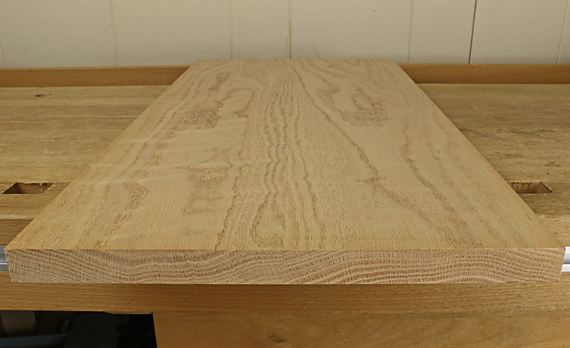
When gluing up flatsawn boards to make a panel, is it important to alternate the growth ring orientation of the boards? The short answer is no.

In general, I suggest go for the best appearance. The reasoning usually given for alternating heart and bark faces is that the full depth of the cupping in any season is confined within each board, and thus is particularly helpful in unrestrained panels. The case usually given for orienting all the boards alike is that cupping will want to produce one large curve, which is more easily kept flat in, for example, a leg-and-apron table.

There is truth to both assertions, though unless appearance strongly dictates one or the other, I tend to favor alternating the boards. Just thinking geometrically (see the endgrain photos below), I wonder if the restraint of a presumptive large arc of like-facing boards is inordinately stressing the joints in tension on the heart face of the panel in the dry season, and vice versa in the humid season.

You can avoid the issue by using quartersawn or near-vertical riftsawn boards. With flatsawn boards, you can minimize problems by assembling the panel from equilibrated boards in a workshop in the midrange of humidity, using narrow boards, choosing species with a low T/R ratio and volumetric movement, and avoiding aberrant boards such as those with crook or substantial twist.

If you alternate the heart and bark faces of flatsawn boards, pay attention to the grain orientation if you plan on planing the glued up panel by hand or machine. Look at the glue up in the top photo. The board on the left will be planed away from the viewer – “pith side, plane with the points” – and so will the board on the right – “bark side backwards.” (Thanks to R. Bruce Hoadley for the mnemonics.) In the photo below, the endgrain growth rings are also alternated but the proper planing directions of the faces are opposing. Thus, if you alternate rings, you’ll probably also want to alternate the cathedral points.
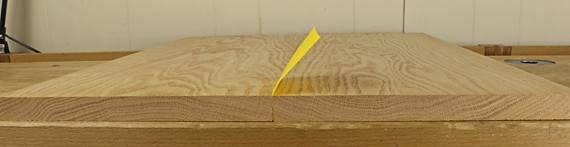
growth rings

You also have to pay attention to grain direction if heart and bark are not alternated but the choice is more apparent. The boards in the photo below are correctly oriented in this regard (plane toward the viewer).
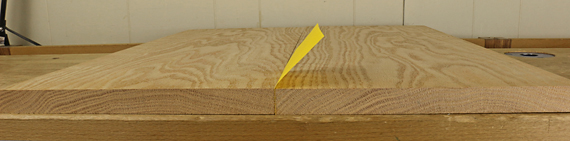
growth rings

The camber question and how to check the joint

This is one of those perpetual arguments among woodworkers. Here’s my view.

I aim for just a trace of camber (hollow), simply as a one-sided tolerance. I do not want any kissing in the central length of the joint, which might create separation tension across the joint line at the outer ends where it is most likely to open. I would be satisfied with two perfectly flat edges but that is nearly impossible to reliably observe.

With any method of planing the edges (options discussed in the next post), I want to finish with a continuous shaving to ensure there are no localized bumps or troughs in the edge. Then the best test of the joint is to set the edges against each other as in the photos below.

Move the upper board by its end. It should barely pivot at the opposite end as in the first photo below. The gap in the middle of the closed joint should be nearly invisible but you know it is there by the pivot.

In the second photo below, the pivoting shows that the boards are kissing within the length of the joint. No good.
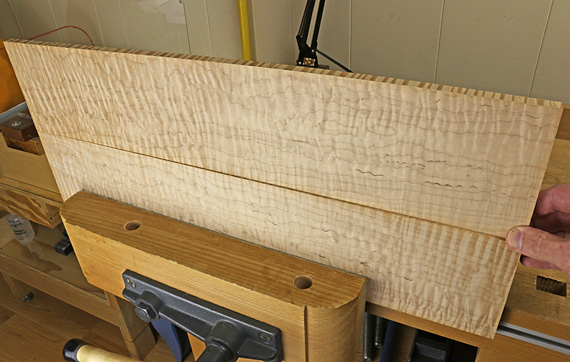
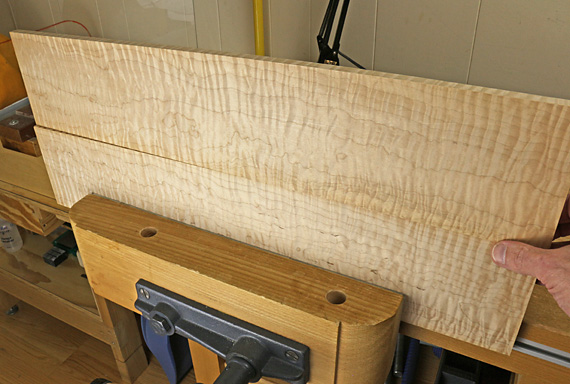
edge joint test

poor edge joint

Also, check for twist within the joint by gently trying to rock the top board across opposite-end corners of the joint. Significant twist of the joint faces against each other will produce a subtle but surprisingly detectable rocking.

Check for flatness in a few places as below, again being aware of any rocking.  Ultimately, this is far more sensitive than directly checking if the joint surface itself is square to the face of the board.

If all is well, you know you have a joint that wants to be together and is not being forced into submission by clamp pressure.
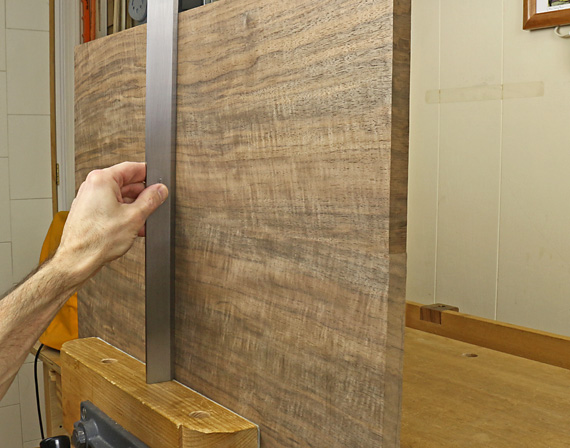
edge joint test

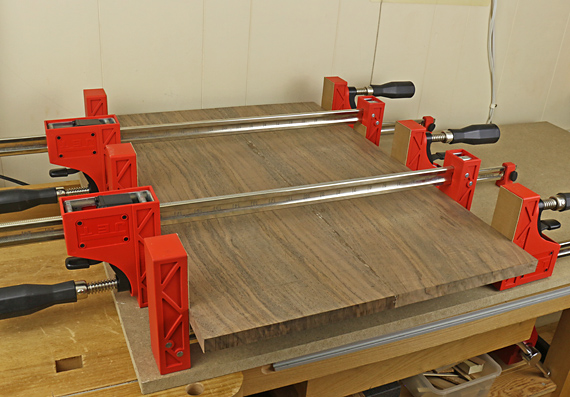
Some woodworkers like to produce a more pronounced camber to be able to clamp the joint with a single clamp across the midpoint of the length of the joint. I acknowledge that this can work but unless one has a shortage of clamps, I consider this to be an unnecessary and awkward method with several disadvantages for most work.

Also, making a substantial camber in the joint on the assumption that insufficiently equilibrated wood will dry faster at the ends is basically starting off on the wrong foot.

Upcoming: options for hand planing, and more.
Category: Techniques  | Tags:  | 3 Comments
Author:
• Friday, March 11th, 2016

edge joint

From tabletops to drawer bottoms, edge-to-edge joinery is found throughout furniture making, so it is worthwhile to explore the issues involved in preparing, cutting, and gluing up these joints.

For most of the steps there are a variety of good approaches, particularly based on the size of the joint and the available tools. The outright errors usually come from injudicious wood selection or inattention to the key tolerances in the joint.

As we woodworkers can’t help but notice, edge joints that have opened up can be found everywhere. But why? After all, if the bonded glue line is really as strong as the wood itself, it should not have any more propensity to split than the adjacent wood.

One of the large drawer fronts at the factory-made red oak desk where I am typing has a small edge joint failure. A cross grain conflict with the particleboard sides is stressing the solid wood front but why is the split at the glue line?

split edge joint

Whether due to luck or skill, pieces that I made 25 years ago have fully intact edge joints but, again, why?

So let’s think about this fundamental joint in a short series of posts.

Keep in mind that a little split here and there usually does not affect the function of the piece. My workbench, which I’ve used for more than 30 years, has several splits in its top that don’t bother me one bit. In fact, they seem to function as built-in stress relievers that probably help maintain the remarkably consistent flatness of the top throughout the seasons.

Wood selection

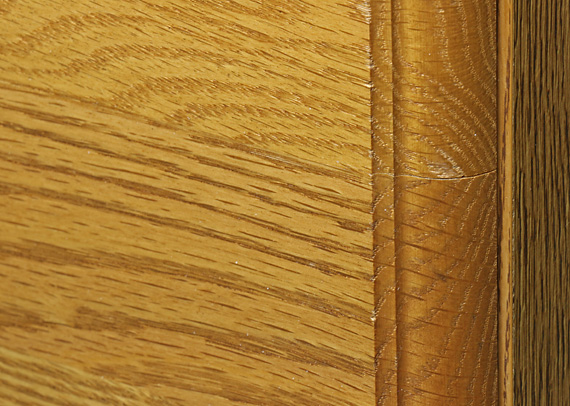
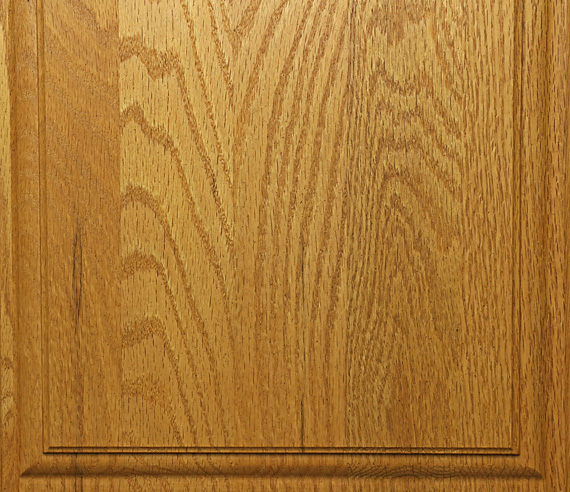
It is surprising how often we see mismatched glueups in otherwise fine work. A door panel with flatsawn cathedral figure running out at a glued edge adjacent to straight rift figure looks like it came from a factory, not the shop of a craftsman. Below is a factory-made door panel that is devoid of human finesse.

poor wood selection

It is best to match the figure at adjacent edges and generally avoid edge runout of flatsawn figure. Join rift to rift and quartered to quartered. Cathedral figure boards are best joined where there is rift figure beyond the width of the arches – ideally where the figure lines are nearly straight. Where this is not possible, try to have the figure lines flow into each other across the glue line. In this way, attention is not called to the joint line and the completed panel looks harmonious.

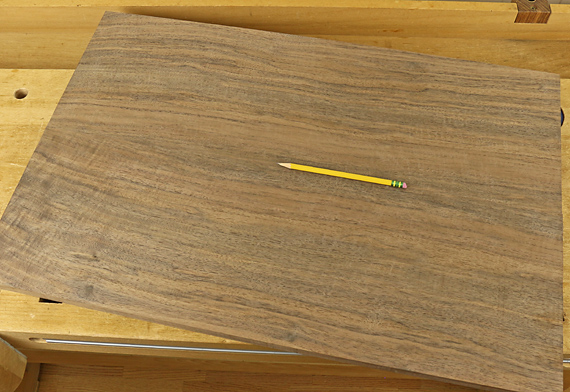
Below, even in this book-matched panel where the halves are necessarily mirror images of each other, the boards blend together and the joint line (indicated by the pencil) is barely detectable.

book match edge joint

Joining a quartered-grain edge with a flatsawn-grain edge, for example, not only looks poor but the thickness of each board at the glue line will undergo different seasonal change because of the different orientation of the growth rings. This can produce a tiny but disconcerting step on the surface at the joint line. The joint is stressing itself from this conflicting movement.

In summary, join similar edges to produce visual and structural harmony.

Next: Should you alternate the growth ring orientation of flatsawn boards in a glued up panel? Also, we’ll consider the camber question.

Category: Techniques  | Tags:  | 3 Comments
Author:
• Thursday, March 10th, 2016

blog

Every once in a long while on this blog, your devoted scribe sweeps off the sawdust to see how this little blog is doing. According to the stats counter program, Heartwood has, since its inception, received about 2.5 million legitimate visits (i.e. humans, not crawlers, robots, and so forth) and more than 7 million page views.

The main message here is: thank you, dear readers. Special thanks to those who have posted comments. I will not be shy about encouraging comments – they add interest for all readers, and give me a sense of connection with woodworkers out there. I also enjoy the many woodworking questions emailed by readers, though when appropriate, I suggest present the inquiry as a comment on the blog so the information can be shared among readers.

Content on Heartwood now includes almost 160,000 words, which is the length of two to three non-fiction books, and more than 800 original photographs. Remember to check the Series Topics tab (under the header photo) for groups of posts on single topics. In the past year, I’ve posted about one-third less than usual, due to less available time, but not due to running out of things to say. I’m going to try to pick it up soon. As always, I’ll offer real-deal content “from the sawdust and shavings of my shop,” not armchair woodworking.

Blogging (by the way, I’ve never liked that word; it sounds like something you do uncontrollably when you’re ill), including woodworking blogging, is certainly not as vibrant as several years ago. Other media, particularly social media and video posting have taken their shares of the communications universe. Still, I think a good blog is a useful and enjoyable medium to share woodworking information and ideas, and interest on this one does not seem to have waned.

Thus, again, thank you, readers.

Coming up is a series on edge-to-edge joints. Happy woodworking.

A.M.D.G.

Category: Ideas  | 8 Comments
Author:
• Sunday, February 28th, 2016

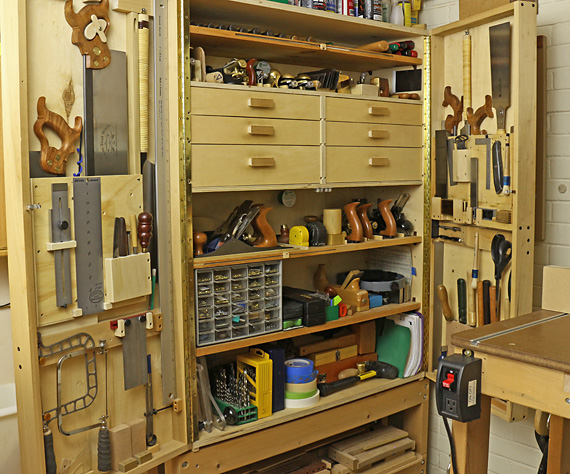
tool cabinet

Just about all of us involved in woodworking have somewhere along the way received a pivotal benefit from encouragement, support, or an introduction to the craft from someone. If you have the opportunities, thank that person, then do the same for someone else.

Bob Flexner’s reasoned clarifications of all matters of wood finishing are among the most lucid explanations I have read, not only in the field of woodworking but anywhere. His books Understanding Wood Finishing and Flexner on Finishing are essentials for all woodworkers.

Just wondering: if you could program a laser to perfectly cut all the joinery in a work of your design, how would you feel about the finished piece? Further, how would you feel about woodworking in general and the aspects of it that are most important to you?

With all due respect to period reproduction furniture makers, it must be acknowledged that some of the most difficult steps of creating a piece of furniture have been already been done for them, not least of which is developing a coherent style within and among pieces.

Doing excellent work is never automatic. Of course, experience, good habits, muscle memory, and so forth are important, but to achieve excellent results you must bear down and concentrate each and every time. It doesn’t just happen.

Sharpness is a magic that solves so many troubles with tools and everything else in the shop. Yet I still hate to stop the workflow to sharpen.

Theodore Roosevelt said, “Do what you can, with what you have, where you are.” This speaks so much to us woodworkers, with our tools and wood, in our shops, perhaps bogged down by doubt. It’s worth posting in the shop.

Face it, we’re so lucky to be able to make fine things in wood.

Category: Ideas  | 4 Comments
Author:
• Sunday, January 31st, 2016

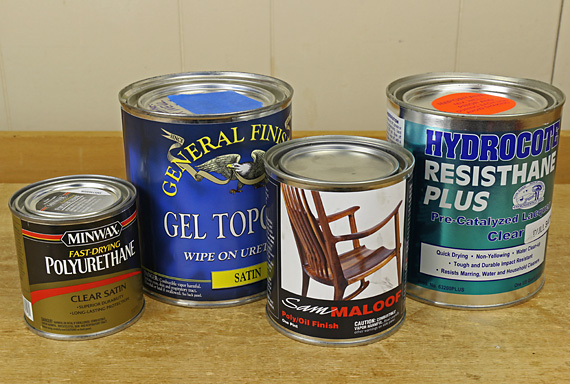
wood finishes

Good job! You developed a compelling design, skillfully employed sound construction techniques, and lavished care on your baby – I mean woodworking project. And of course, you applied a finish that made her look fabulous when she – uh, it – left the shop.

Well, it’s not over because it’s a jungle out there. Consider especially that pretty finish in which you sent your furniture/accessory oeuvre out into the world.

Think about the likely use and possible abuse of the piece. Sure, a wall cabinet for art objects will not suffer as will a dining table, but will that hall table display family photos or have keys and wet umbrellas tossed onto it? Will later owners of the piece value it as much as the original owner?

A key issue is that the durability and reparability of a wood finish are generally inversely related. For example, oil-varnish mix is not very durable but is easy to repair, while a tough polyurethane film finish is more difficult to repair.

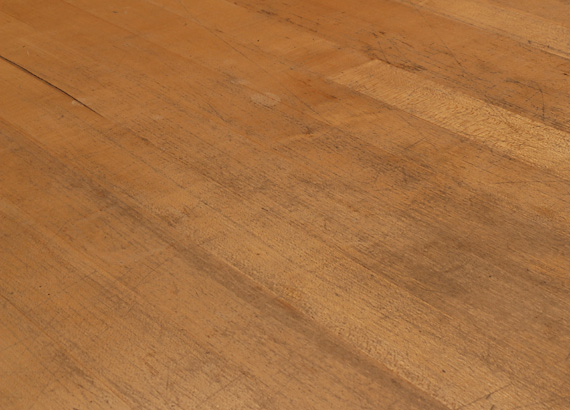
I think in many cases it comes down to which is more tolerable: dented, scarred wood or a dented, scarred thick film finish. Ultimately, water, abrasion, and ultraviolet light can break down any finish, resulting in something like the table top below. When dirt and grime get into the grain of the wood, restoration gets even more difficult.

deteriorated finish

One approach, which is gaining appeal with me in some cases, is to take it easy and apply a few coats of oil-varnish mix. I like Rockler’s Sam Maloof poly-oil because of its high solids content and amber color that is not too dark like some oil or varnish products such as Waterlox. It leaves a low-key sheen that allows one to “take pleasure in the wood surface,” as the late, great Sam said.

The car key abrasions probably will look better – and maybe even add character – in a wood surface finished with oil-varnish mix that can be easily touched up by anyone, than in the layers of a heavy film finish that will probably never be repaired by anyone.

There are always trade-offs. The point is to think it through the long term when choosing a finish.

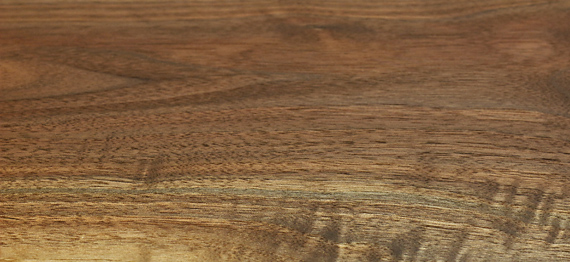
walnut finish

Category: Techniques  | 5 Comments
Author:
• Saturday, January 30th, 2016

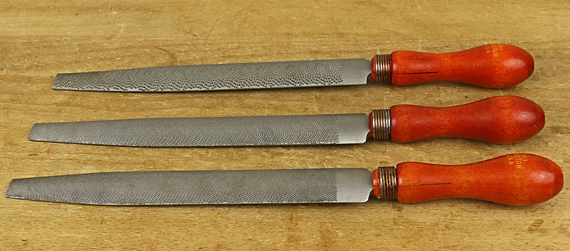
Corradi rasps

These Corradi rasps are the ones I reach for most often. Several years ago, I wrote on choosing and using rasps, highlighting the excellence of hand-cut rasps, specifically the Auriou brand, based on the feel and feedback they provide.

In this regard, for a 10″ cabinet rasp in the finest grain, I still prefer the Auriou #13. However, I’ve come to prefer the Corradi rasps in the coarse and medium ranges. Furthermore, I don’t think there is a big difference between the finest Corradi #10 and its close equivalent, the Auriou #13. Practically, I tend to save the Auriou for the most sensitive work, much like a carefully tuned smoothing plane.

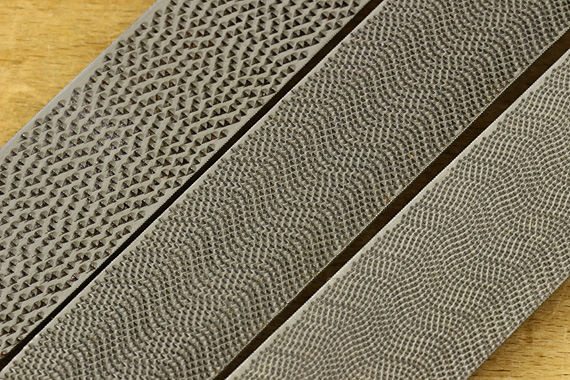
The Corradi rasps have uniform, densely packed, machine-cut teeth with a surface hardness of Rc 65-66, which the manufacturer claims is harder than the best hand-cut rasps at Rc 59-60. In my experience, which is not controlled testing, the Corradi rasps have indeed maintained their sharpness better than the Aurious.

The swirl pattern of the teeth produces a very smooth cutting action, though again, just slightly lacking the superb feedback of the Auriou in the finest grain models. In the medium and coarse grains, I prefer the consistent smoothness of the Corradis. I do, however, wish the Corradi cabinet rasps were shaped to a point like the Aurious.

Heresy, some may say, but I’m only telling you what the wood and my hands have told me. These comments, unsolicited and uncompensated, are only meant to help readers make their own choices.

Corradi 5, 8, 10 grain

My set of Corradi 10″ half-round cabinet rasps consists of the “Gold” #10 and #8, and the Cabinet #5, from right to left in the photo above. This set is an excellent value at a current total price of $134. By comparison, a single 10″ half-round Auriou #9 costs from $110 – $135, and the finer grains cost still more.

For reference, in 10″ rasps, I estimate the Corradi #10 about the equivalent of the Auriou #13, though the latter is probably a trace finer. Either allows a very easy transition to scraping or sanding.

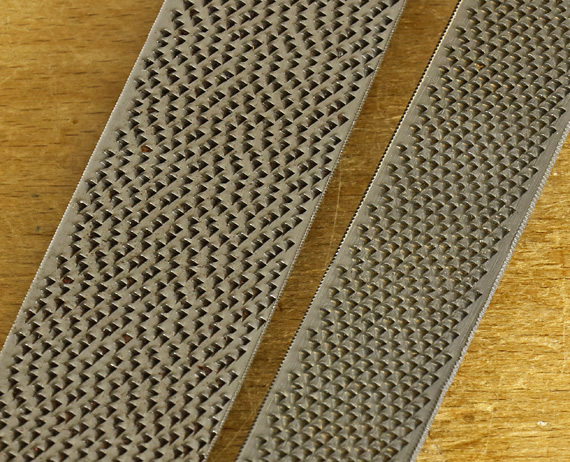
At the coarse end, the Corradi #5 is about equivalent to an old Nicholson #49 (below, at left and right, respectively), but broader and better. (The Auriou #9 approximates a Nicholson #50.) Looking at the photo above, it seems like a fairly large jump from the Corradi #5 to the #8 but in practice the transition works well.

Corradi 5 grain vs Nicholson #49

The three 10″ half-round Corradis – #5, 8, and 10 – plus an inexpensive Shinto double-sided “saw” rasp and a cheap Surform Shaver, with the modification described in an earlier post, form a versatile basic set. I wish Corradi made “ironing” rasps in the form I described in a recent post.

Aside from cabinet rasps, I like the Corradi Gold 6″ #10 flat (“hand”) rasp with one safe edge for smaller scale work such as rounding over tenons. The 4″ Auriou half-round #14 remains the finest rasp in my drawer.

Rasps are often underestimated but high quality versions, skillfully employed, are capable of sensitive, refined work.

Author:
• Monday, January 25th, 2016

reference constructions

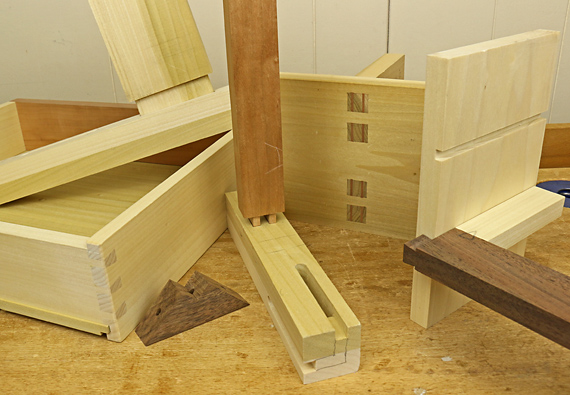
When designing and making a particular joint or subassembly, an actual sample of it is a great aid to spatial thinking. I keep a bunch of these brain helpers in the shop, including various mortise and tenon configurations, sliding dovetails, a section of a web frame, some curved legs, and, of course, a drawer or two. Most are unglued to permit study.

In the design phase of a project, when considering proportions, thicknesses, and surface relationships, the models help in a way that drawings cannot. Later, they are useful when strategizing construction methods. They are particularly helpful if it’s been a while since I last incorporated such an assembly into a piece.

A reference model does not have to be very neat or even complete. Most likely it will be one section of an assembly or the critical parts that are just enough to direct your thinking. I often write notes and dimensions on the reference models, especially if there’s something that I’m not likely to notice later. Basically, give yourself all the help you can; woodworking is hard enough already.

Accumulate the models from practice joints, experiments, or extras from a past project. It’s amazing how some in my shop of have aged and then jog my memory when needed. “Oh, that’s how that frame went together,” or whatever, in some project from the past. A piece that you completed long ago may be unavailable to you now but even if it is, you can’t disassemble it.

Since virtually all of my woodwork is one-of-a-kind, the reference models serve as brain assistants, not formulas. I benefit from my former efforts but I’m still thinking things through as they pertain to the project at hand. I really enjoy that combination!

If accumulating reference constructions is not a woodworking habit of yours, consider giving it a try. I think you’ll find it pays off.

Category: Jigs and Fixtures  | Comments off
Author:
• Thursday, December 31st, 2015

square to check dovetails

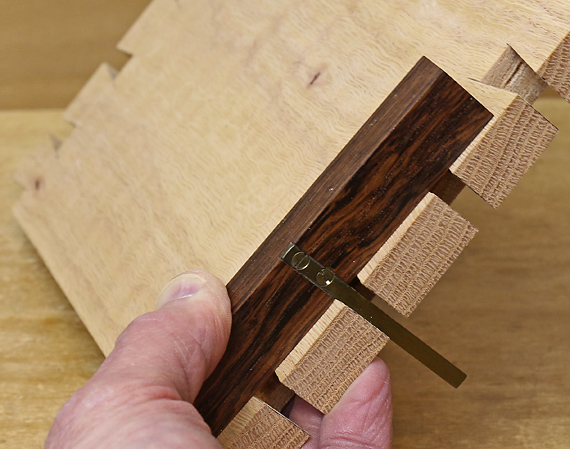
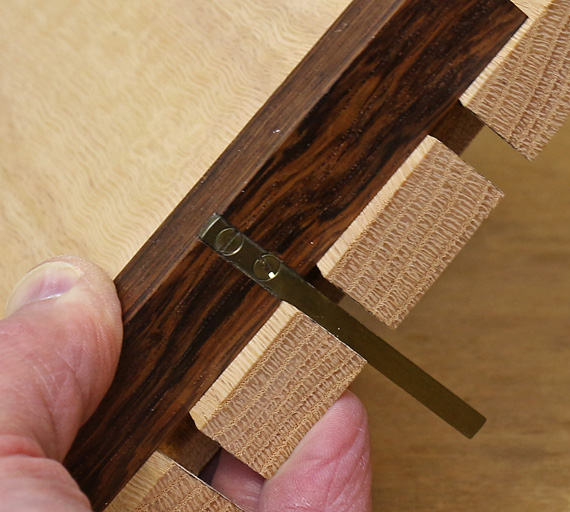
When making dovetail joints, it is important that the tails, which you’ve cut first (of course, right?), have their sides square to the reference (inside) face of the board.

In practice, depending on the compressibility of the wood species being worked, it may be acceptable or even helpful for the inside width of the tail to be a hair narrower than the outside face. This creates a slight wedge effect that helps ensure tightly meeting surfaces at the outside face of the completed joint.

There should never be the opposite arrangement where the entering width of the tail is wider than the outside face of the tail. That would directly, by the geometry of it, leave gaps on the show face of the joint, making it weaker and less attractive. It would also indirectly create these gaps by corrupting the marking out of the pins from the inside-face edges of the tails.

Thus, as with many aspects of woodworking, this is a one-sided tolerance issue, and we want to avoid compounding small errors.

So, is it really necessary to check the sawn surfaces of the tails before proceeding to mark and saw the pins?

With good sawing skills, frequent repetition, and an easy-going wood, you may need little or no checking. Realistically however, it is not easy to make all the saw cuts right on, and checking takes very little time and effort. And while you or a demonstrator may be heroic in pine, what about oak, shedua, or hard maple? Also, it’s a lot easier to dovetail a 3/8″-thick, 3″-wide drawer side than a 3/4″-thick 12″ carcase side.

I suggest be realistic and reasonably careful in your work without being timid or plodding.

dovetail square

Here is the little square I use to check the sawn sides of the tails as well as the adjustments I make by paring them. I made this tool about 30 years ago.

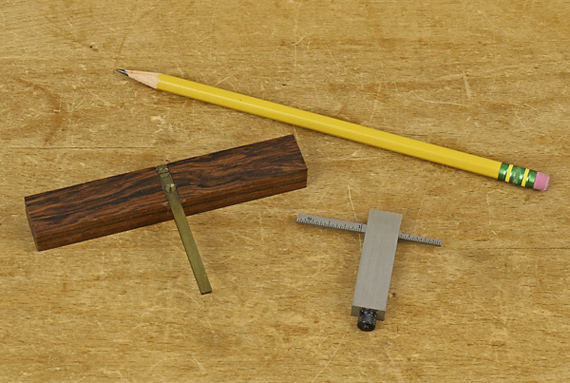
The beam, made of pre-ban Brazilian rosewood (Dalbergia nigra), is about 4 1/4″ long x 3/4″ x 1/2″. The 1/16″-thick brass blade is 11/64″ wide, which can fit between almost any pair of tails that I make. At almost 1 3/4″, it is unnecessarily long – maybe I envisioned sometime making giant dovetails. The square is accurate to less than 0.001″ on both sides, a tolerance not too difficult to achieve in this size tool with patient filing and scraping.

The T shape allows the beam to register on the face of the wood on both sides of the measurement point. This makes it fast and convenient to use. It also averages out any trace of cupping that might have creeped into the board since it was four-squared.

There are two excellent manufactured tools for this task. One is the little (in size but not in price) Starrett 14D square, shown below, which has a blade 5/32″-wide over most of its length that is cut down to a mere 3/32″ wide over the remainder.

small squares

A lot less expensive is Sterling Toolworks’ Dovetailing Rule. This blade fits in a 6″ combination square stock (Starrett and others) and has a section just under 3/32″ wide to fit between virtually any pair of tails. Chris Kuehn, founder of Sterling, has produced a practical, commercially available solution.

Category: Tools and Shop  | Comments off