This is a short post to summarize the glue joint distribution of dowel joinery that was discussed in detail in the last post and with excellent commentary from readers.
Dowel joinery, properly done with good dowel layout and distribution is certainly strong enough. This has been well shown online, notably by DowelMax testing. Some, certainly not all, of the other testing shown online is invalid in my opinion.
Realistically, it is the portion of the joint where the attachment pieces (dowels or tenons) go across the grain of one of the two main components of the build where there is the potential for breaking apart. Yet this does not lead to broken joints if the sizing is properly done.
Dowel joinery creates different cross-grain conflict than mortise-and-tenon joinery. Some of the dowel meets the cross-grain of the built wood, but some of the dowel meets the end grain of the built wood. This makes it seem weaker, especially over time. However, the overall result still fares very well.
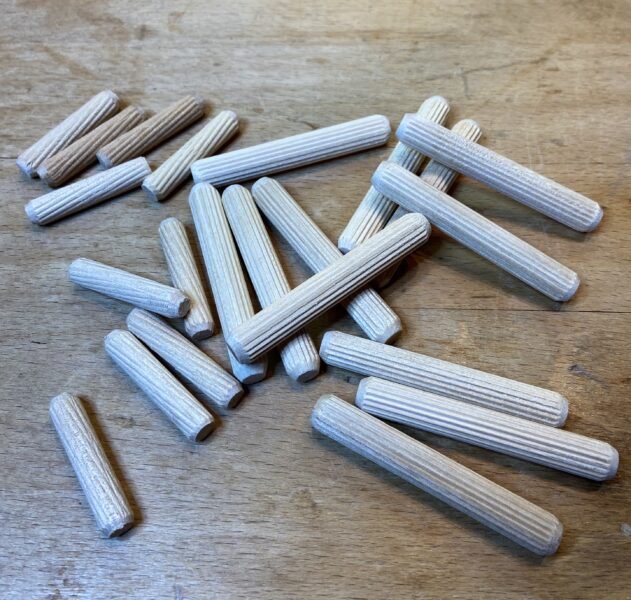
Dowel style – parallel or curled groves – probably matters little if at all.
The main credits for dowel joinery, in my view, are: 1) Decades of dowel joints that I built have never failed. There is plenty of building where I have not used them. Probably because I do not fully trust them in some situations. 2) Valid mechanical testing shows that dowel joinery meets or exceeds mortise and tenon joinery.
So, after thinking through dowel joinery over and over, in numerous ways, it just cannot impress me. However, it works! Shown and proved. So I use it. Not always, but often.
Next: Other ways to join wood. We are building to a summary of practical, convenient joinery to build things with. We’re getting there.
