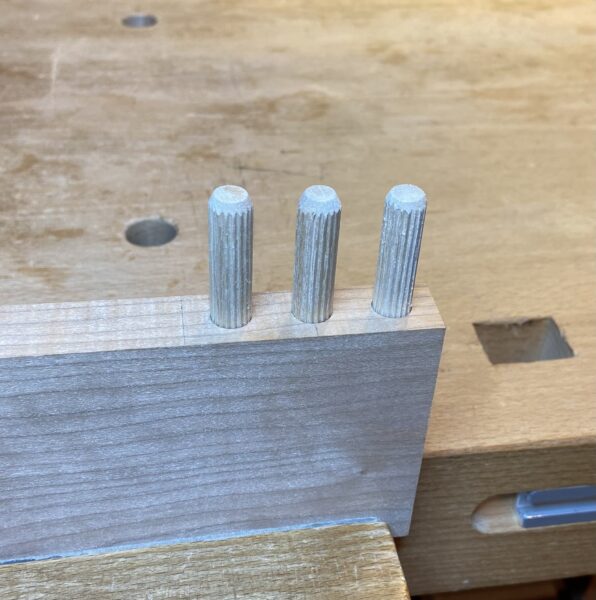
Consider the strength of the end to side-edge joinery which we have put into three categories: mortise pair and free tenon, Domino, and dowel.
When did you see a properly made joint fall? I never have in my work. The dowel joint gets the most criticism regarding strength. Let’s discuss that.
As an example, consider a 2 3/8” dowel joint with three 3/8” dowels that are set 3/8” apart and 1/4” from the edges. (As above photo.) We only need to examine the cross grain part of the joint. The other half – dowel grain entirely inline with the wood grain – will really not break for practical reason.
Based on the number of dowels and their diameters, the total glue width is 3.5”. As a mortise joint, we are gluing 3.9” width. This assumes not applying glue to flat or curved outer tenon edges to allow space for a bit of seasonal movement. Nor would the bond grip well there. We also assume the depth of the joint is the same for dowel and mortise.
Also, note that some of the dowel side area, though entirely glued, does not grip as well since it is attached to opposite grain direction. It is hard to say at what stage of the circle this changes for better.
So, the dowels use a little less glue joint area than mortise joints, but not much. Working out a similar example using 1/2” dowels in a 2 1/2” wide joint, gives 4.7” of glue width. The mortise joint has less at 4” of width.
By the way, wedged tenons – either at the central end or on the sawn and angled wide sides – have a distinct strength advantage. For that we have to award the strength contest to mortise and tenon.
Basically, to compare mortise and tenon joints with properly made dowel joints is a close call for strength in my opinion.
The best joint strength contests that I have seen online are done by the DowelMax. They look careful and legitimate. Dowel joints win. Dominos come in third place.
All of this is not a science project. I simply am saying that joint strength is not a good reason to oppose dowel joinery. Again, it must be properly done, like all joinery.
Let’s give the appropriate, but commonly opposed credit to dowel joinery: strength. It also is convenient, fast, and cost efficient for good tools. Pieces that I have made months ago as well as decades ago with plenty of dowel joinery have never failed!
Once again, I list the three main joints I use and recommend for woodworking: Pair of mortises with free tenon, Domino, Dowels.
But which of the three have I now come to choose most of the time? The answer is coming but anyway, my choice may not be your best choice.
Having a realistic practical choice is what matters for each woodworker. Hopefully this series helps you choose.
More to come.

Will you be using a gap filling adhesive for the dowels pictured in the image above? If not you can’t really say that the full surface area of the dowel contributes to the surface area of the joint. Only the crests and not the valleys count.
I’ve always found that plate joinery (a.k.a. biscuits) are at least as good as dowels and a lot less fiddly.
Many dowel proponents who learned the technique from James Krenov’s “A Cabinet Maker’s Notebook” should remember that the method predates widespread usage of plate joinery.
I have used wedged dowels a few times with good results. Sizing the wedge so that it isn t much bigger than the kerf, and correct kerf orientation are important. I used wedged dowels in cases where I had to drill out a failed dowel using my Stanley 59 jig. The replacements are still working fine in a chair with doweled joints. The original dowels failed because they were made of weak wood.
Steve and Al, thanks for your very thoughtful comments!
I too have wondered about the gaps surrounding the dowels. I wonder if they are too deep and thus reduce joint strength.
I use Titebond 3.
As we know, a tiny fraction of a millimeter gap is still ok for the glue to hold. And when you consider the gap, most of it is not at the deepest depth. And the space can close a bit with the glue moisture.
So, while I do wish the gaps were smaller in dowels, it probably matters minimally – some of the gap closes, some is functionally filled with the glue, and most of the gap is not full depth. And of course, glue can fill and bind a slight gap, within limits. (The dowels set up in the photo of this entry are dry. Just a demo.)
Note that on page 137 of Krenov’s The Fine Art of Cabinetmaking, one can see that he certainly is using dowels with the gaping.
Also, the dowels would have to be made too narrow for joint alignment to prevent the glue from being too squeezed out of the joint upon assembly.
Steven, what you say makes sense to me, however the thing we do know is that dowel strength really works when the joint is well made.
And that is the bottom line for me. Woodwork that I built decades ago, with dowel joinery in significant parts, has never cracked, broken, or gaped.
Almost all of the dowels I have used were a tight friction-fit, tighter than the loose tenons I.have seen. Whether ridged or spiral-grooved, all have worked well, if the wood type and quality of the dowel were ok.
The reasons I don t used biscuits often are:
1. Limited depth. I often used 3 in long dowels, e.g. when edge-gluing.
2. I m very accustomed to my Stanley 59 dowel jig,
3. Sometimes I have to keep the noise level down, and my cordless drill is much quieter than a biscuit joiner.
Biscuits are a good option/alternative in most joining situations. It s good to have choices.
Thanks again, Al. Agree, dowel joints hold.
I am going to cover biscuits in this series soon. I agree, not a reliable strength joint but still quite useful. I get the most use for edge joining boards and some good line up in gluing up sections.
I understand your use of the old Stanley 59 but I suggest consider getting a JessEm, Woodpecker set, or a Dowelmax. Life gets much easier and it is more precise fitting work.
I think dowels require a bit deeper analysis
Assuming we have smooth dowels the glue area shouldn’t be taken as the area of the cylinder, because there’s long grain to end grain gluing. While not entirely useless it’s weaker than long grain to long grain gluing. I put the effective gluing area into 0.6-0.7 total area ballpark.
Next, as shown by Hoadley dowels actually dry and become oval. The drying shrinkage actually delaminates quite a bit of glue surface. Hoadley showed cross section photos where it looked pretty terrible, but let’s be generous and subtract yet 0.1-0.2 from what we have. So worst case we’re at around 0.5 glue area compared to mortise and tenon.
But there’s a few other considerations. Let’s forget for the moment about the part itself drying more than a dowel and cracking
Glue surface matters for shearing loads, that is, something is pulling dowelled joint apart in a direction it was assembled. I personally never design pieces to have loads like that — e.g. I usually don’t dowel cabinets bottoms Krenow style in large cabinets. For all other types of load several dowels should be on par with a Domino
The drying dowels concern can be addressed by using compressed dowels. Spiral ones are better than ribbed ones, because as mentioned above ribbed dowels require a tight hole and that opens another can of worms. Spiral dowels are hard to come by and I don’t know a good way making compressed dowels in a shop (a steel plate is not enough unfortunately).
And finally our joinery is usually overbuilt at least several times more. So even if a dowel joint is weaker than M&T it’s still plenty strong for cabinetry assuming all other concerns were correctly addressed.
I’m typing this on a screen slightly larger than a post stamp, so pardon typos and errors, I can’t barely read what I typed
If I m not mistaken, most MCM carcases of dressers are made of veneered plywood held together by rows of dowels. I have looked at dozens and never seen any failures in carcase joints. Maybe the often tightly spaced dowels were more than what was needed. Modern glues are likely a.factor, too.
Hi JD. And thanks again, Al. Yea, some good points you both brought up.
The late R. Bruce Hoadley did considerable discussion of dowel joint strength in his book Understanding Wood. I bought the 1980 edition shortly after it came out, and re-bought it with the 2000 edition. One of the many interesting points written and shown: cutting the dowel across the diameter at the radial width to permit thickness change across the cut without break in the circumference of the glue bond.
Also:
Compressed dowels seem interesting but I have never seen or used them.
Spiral dowels might be a good idea but I can never find them lately, though I have used them in the past. Better? I don’t know.
All of this comes down to: does the joint break compared to mortise and tenon. Based on the tests online that I cited, the answer is no. I add to that: my experience with seeing my own work survive unbroken for decades.
I think I MAY add another post to make a simpler, more direct comparison of wood grain direction, without using complicated numbers, about dowel joints versus mortise and tenon joints. I think it will be clear that it just doesn’t matter for practical purposes.
Bottom line: I am trying to put aside the strength issue of properly made dowel joints. They work.
Rob,
the store bought fluted (apparently the correct term) dowels are compressed dowels. Factories produce dowels by rolling steamed wood between fluted dies. This process does a number of things to wood, so I think these dowels are materially different from just round pieces of wood. It seems that Hoadley used pieces of a regular rod as dowels — I don’t think that compressed dowels would shrink that much. In fact factory made dowels have an opposite issue, they can swell too much.
Note there are different types of spiral dowels. I’m talking about those that have a single spiral grove cut into them. They’re about x1.5-2 the price of the fluted dowels and mostly sold online. But they’re usually way better quality, definitely worth the extra money.
More good points, JD. Thanks!
I do not find spiral dowels available now. Consistent with your points, I suspect it does not matter, or insignificantly so. I think the glue fills the grooves, and they functionally expand, in either kind of dowel.
Still comes down to: is the joint strong? Yes, when properly made. I still bank on the decades of positive experience with dowel joinery.
Great to have highly knowledgeable readers such as you, JD! Appreciated!