We all have squares in the shop. No, no, not nerds, but the 90° measuring tools needed for nearly every project. I will go through what I use in my shop. Not covered here are straightedges. Just squares.
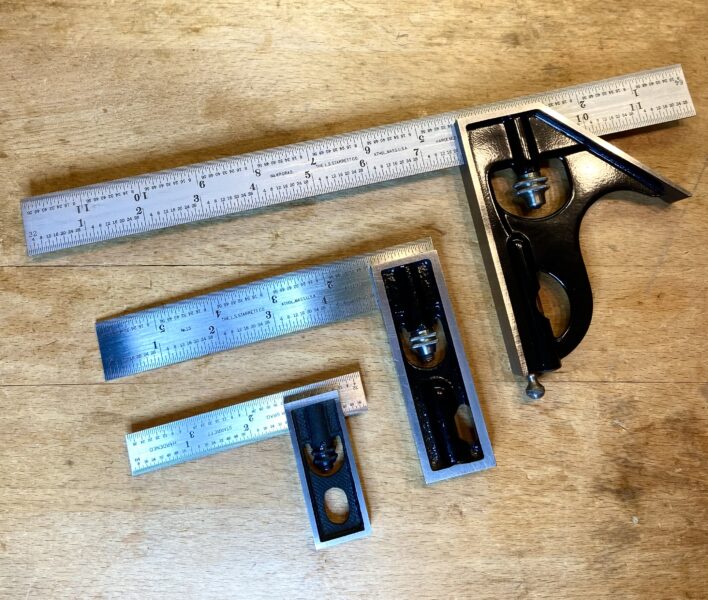
Let’s start with “combination” squares – the blade can be slid along most of its length. I have had Starrett squares for many years. There are other good brands (Woodpeckers has some useful choices) but in this type of tool, Starrett meets, by all I have seen or read, the top standard in documentable square accuracy: .0001” (1/10,000) per 6”. (Woodcraft has, for many years, incorrectly listed +/- .00001”, i.e. 1/100,000”.)
I have Starrett 12”, 6”, 4”, and 2 1/4”. I use them all. (The little one has regular, narrow, and angled blades.) To have only one, I would chose the 12”. The 4” or 6” would be the second choice. The 12” has a 45° angle in the frame, sure to come in handy. The angle slope bubble measure and the pointed scriber get almost no use from me but they do not get in the way. I use other, better tools for that.
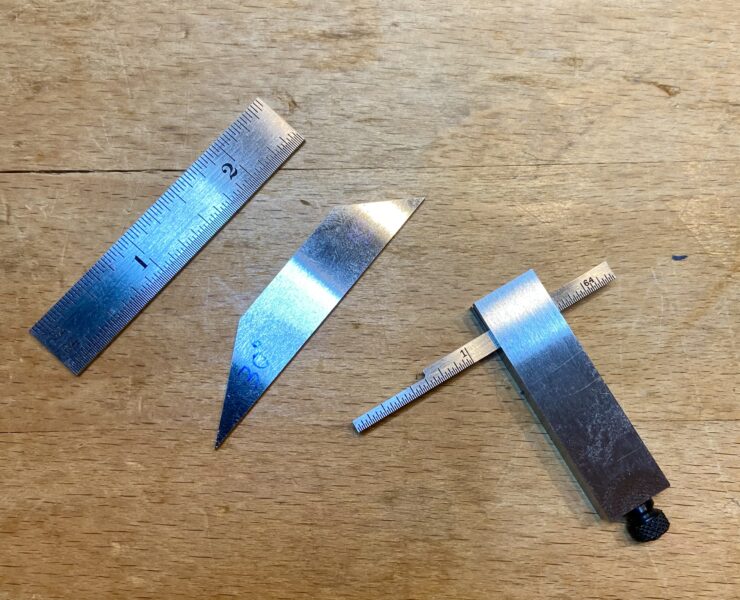
Starrett has a huge range of variety including flat or satin-chrome blades, smooth and mildly rough heads, plain straight or straight + angled handle heads, separate 45° head, and variable protractor head, inch and millimeter markings, etc. I suggest to shop around for price and choose what you need. This tool is worth it!
Do we need the 1/10,000 accuracy for everything? Of course not, but it always works in your favor. The best accuracy is valuable for some important things – like tuning machines. The excellent tool can do it all and lasts indefinitely.
The other set of squares that I have are the solid machinist type. The very useful set of three is the 9”, 6”, and 4”. These are more convenient and faster to handle than the combination squares for stock preparation and some joinery. For this type of square, the highly accurate Starrett machinist squares are unnecessarily accurate and expensive.
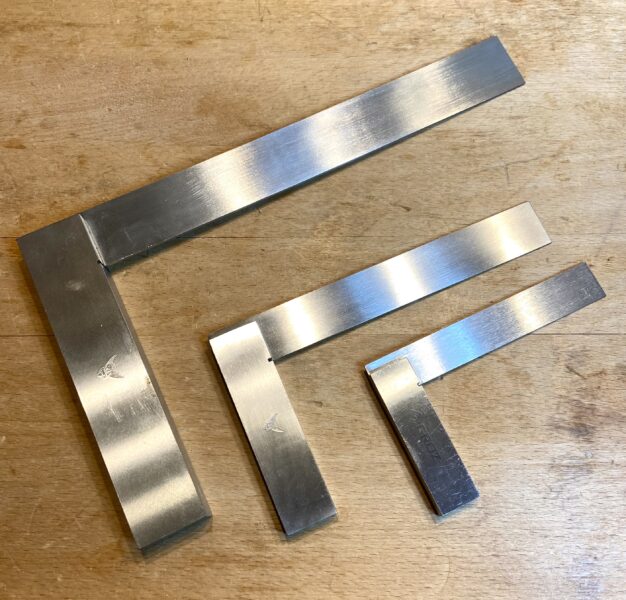
For the 6” and 9”, I have PEC brand. Their standard is 6/10,000” (about half a thou) for 6”, which well meets the needs. They are well made and reasonably priced. Unlike some less expensive machinist squares, the edges are cut appropriately square-sharp enough without being rounded over.
For the 4” machinist square, I have a Groz. The inexpensive brand meets 28/10,000” for 6” (about 3 thou) which is not good enough. However, I lucked out with this one – it is well under 1 thou based on assessment with a Starrett. It gets lots of convenient use.
There is one more square in the shop. I made it long ago for checking the square of dovetail parts. The very narrow square blade fits into small areas. I use this one or the little Starrett. Refer to this post:
https://www.rpwoodwork.com/blog/2015/12/31/narrow-square-for-checking-dovetails/
I keep all the squares clean, free of rust, and handled efficiently. Squares really move along the work. Get good ones. I hope this outline helps!

> Do we need the 1/10,000 accuracy for everything?
Yes, we do. Because the actual accuracy we’re getting is exactly an order of magnitude worse than what a tool is certified for. And thus we’re getting into half a pencil line range which is the range we should care about. Remember that squares (and calipers for the most part) are considered rough marking tools for machinists — they attain their precision with micrometers.
Speaking of machinists: a really great dovetail square is an inexpensive depth gauge, somewhere around 6-9$ at the time of writing. Because it’s inexpensive it’s not exactly square, but this is an advantage: it allows gauging a minute taper and the blade can be set to exactly the right angle with a square. And it’s not for just dovetails, it’s 6” long so it can gauge mortises too (although one might argue there are better ways).
Another tip: a sliding square body is milled precisely square, so the bottom can be used for checking squareness of, say, a rabbet, or used as a small setup block. On a good one (PEC tools, Starret, perhaps iGaging) both ends of the blade are also square and they can be used where a regular square doesn’t fit. For example when making blind dovetails or marking a haunch on a tenon.
Thanks for some ideas. I think the 1/10,000 is not always necessary but we agree that it sure is worth having in the shop.
I have a 24”, 12”, and 6” Starrett and they all get a lot of use. My only pet peeve is I wish I could get a blade from Starrett that only showed 1/8” markings on one side and 1/16” on the other. I have some older squares from others that do this and I like it for woodworking. After the first few defining measurements, most things are measured by marking to fit with a knife. It is rare that I would ever need a 32nd mark on a square.
I find the 64th grades are too tiny to mark from but they can evaluate an already existing cut or line, using a good light.
To mark a 32nd grade, I like the Incra ruler that has tiny holes and slots in exact locations. They take a .5mm pencil exactly.
If I really have to judge a space though, I go to the shim stock (discussed a few posts back), or sometimes the metal collection of strips.